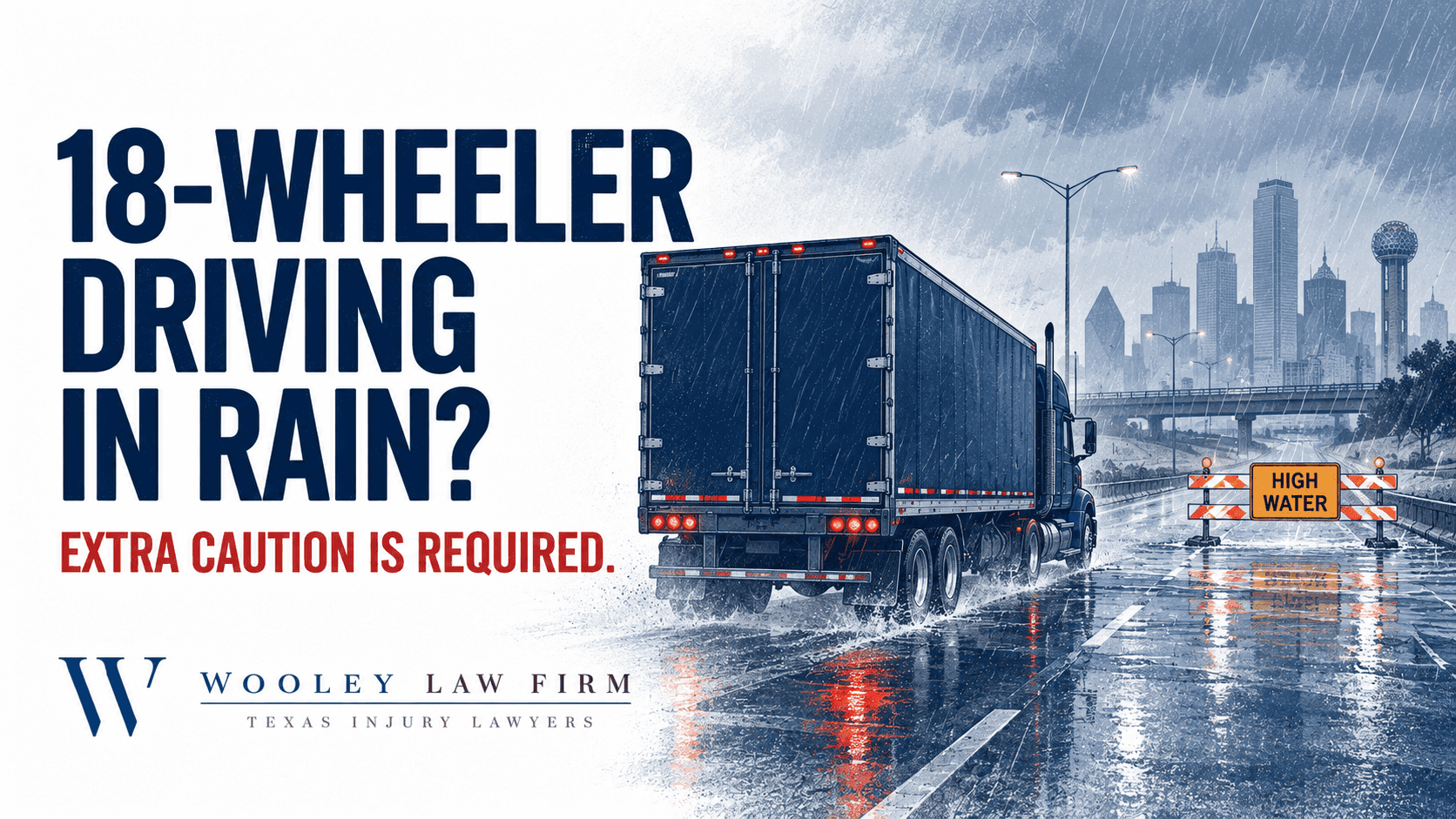
Rain does not affect an 18-wheeler the same way it affects a passenger car.
A fully loaded tractor-trailer is longer, heavier, harder to maneuver, and requires substantially more planning to stop safely. When Dallas roads become wet, visibility drops, water begins accumulating in travel lanes, or flash flooding develops, a commercial truck driver may need to do much more than simply turn on the windshield wipers.
Federal trucking regulations specifically require commercial drivers to exercise extreme caution when rain or other hazardous conditions reduce visibility or traction. Drivers must reduce their speed, and when conditions become sufficiently dangerous, the truck may need to stop operating altogether. CSA Compliance
If an 18-wheeler causes a crash during heavy rain in Dallas, the trucking company may argue that the weather caused the collision. But the investigation should also ask whether the driver properly adjusted for the conditions.
That distinction can be critical after a serious Dallas truck wreck.
Federal Law Requires Extra Caution From Truck Drivers in Rain
Commercial truck drivers are subject to federal safety rules that go beyond simply obeying the posted speed limit.
Under 49 C.F.R. § 392.14, commercial drivers must exercise extreme caution when hazardous conditions such as rain, mist, fog, snow, or ice affect visibility or traction. The rule requires the driver to reduce speed when those conditions exist. If conditions become sufficiently dangerous, operation of the commercial vehicle must be discontinued until it can again be safely operated. CSA Compliance
FMCSA guidance also makes clear that the truck driver is responsible for deciding when conditions are dangerous enough to stop operating the vehicle. FMCSA
That means a truck driver generally cannot defend unsafe driving simply by saying:
“It was raining.”
“The road was slick.”
“Traffic stopped suddenly.”
“I hydroplaned.”
“I couldn’t see.”
“There was standing water.”
Those explanations may instead raise additional questions about whether the driver should have slowed earlier, increased following distance, avoided the roadway, or stopped driving.
For people injured by a commercial vehicle, our Dallas 18-wheeler accident lawyer page explains how truck-driver conduct, company records, electronic data, and vehicle evidence can be investigated after a serious collision. The Wooley Law Firm, PLLC
Texas Law Also Requires Drivers to Slow for Weather Conditions
Texas law separately requires motorists to drive at a speed that is reasonable and prudent under existing circumstances.
Texas Transportation Code § 545.351 specifically requires an appropriate reduction in speed when a special hazard exists because of weather or highway conditions. Texas Legislative Website
A posted speed limit is therefore not a guarantee that the same speed is safe during a Dallas thunderstorm.
A tractor-trailer traveling 65 mph may technically be below the posted limit but still be moving too fast for:
Heavy rain;
Standing water;
Reduced visibility;
Congested traffic;
A flooded lane;
Water collecting near a median;
Sudden traffic backups; or
Vehicles braking ahead.
In a serious truck case, the question is not merely, “Was the driver under the speed limit?”
The better question may be:
Was that speed safe for an 18-wheeler under the conditions that actually existed?
1. An 18-Wheeler Driver Should Reduce Speed Before Reaching Standing Water
A truck driver should not wait until the tractor-trailer begins sliding before slowing down.
Rain changes the amount of traction available between the tires and roadway. Standing water can make control even more difficult.
A professional truck driver should be watching far enough ahead to recognize:
Water collecting in the lane;
Spray from vehicles ahead;
Brake lights;
Traffic slowing around a flooded area;
Vehicles changing lanes to avoid water;
Water flowing across the roadway; and
Flood-warning signs or barricades.
Reducing speed before entering the hazard gives the driver more time to react and decreases the need for abrupt braking or steering.
2. Truck Drivers Should Increase Following Distance in Rain
Following distance becomes especially important when an 18-wheeler is traveling on wet pavement.
A commercial driver who normally leaves adequate space may need substantially more room during rain because the truck may take longer to slow and the driver may have less traction available.
This matters on heavily traveled Dallas highways such as:
I-35E;
I-30;
I-20;
I-635;
U.S. 75;
I-45;
SH 114; and
SH 121.
Traffic on these roads can change from highway speed to stopped traffic quickly.
If an 18-wheeler rear-ends vehicles stopped or slowing in heavy rain, investigators should examine whether the truck driver was following too closely for the conditions.
Our article about being rear-ended by an 18-wheeler in Dallas explains the electronic and physical evidence that may show why the truck failed to stop.
3. A Truck Driver Must Account for Limited Visibility
Rain creates more than a traction problem.
It can also dramatically reduce how far ahead a driver can see.
Heavy rain may obscure:
Brake lights;
Lane markings;
Disabled vehicles;
Traffic backups;
Construction barrels;
Roadside workers;
Smaller passenger vehicles; and
Flooded portions of the roadway.
Large trucks can also create substantial road spray that further reduces visibility for both the commercial driver and nearby motorists.
A truck driver who cannot see far enough ahead to safely react should reduce speed accordingly.
If visibility becomes so poor that safe operation is no longer possible, federal regulations may require the driver to discontinue operation until conditions improve. CSA Compliance
4. Sudden Braking Can Be Especially Dangerous on Wet Roads
Abrupt braking with a tractor-trailer can create additional risks on slick pavement.
Depending on speed, roadway conditions, cargo, vehicle configuration, braking input, and other factors, a truck may:
Lose traction;
Slide;
Jackknife;
Drift into another lane;
Strike stopped traffic; or
Lose control of the trailer.
That does not mean a driver should avoid braking when necessary.
Instead, it underscores why commercial drivers need to recognize hazards earlier and maintain enough distance to make controlled speed reductions.
Our guide to jackknife 18-wheeler accidents in Dallas discusses how rain, slippery pavement, speed, braking, and other factors can contribute to these crashes.
Injured in an Accident?
Free consultation. Tell us what happened and learn what options may be available.
5. Truck Drivers Should Avoid Abrupt Lane Changes During Heavy Rain
Changing lanes can become more dangerous when the pavement is slick and visibility is reduced.
A truck driver should make sure the entire tractor and trailer can safely move into the next lane.
That may require:
Checking mirrors carefully;
Rechecking blind spots;
Signaling early;
Avoiding sudden steering input;
Allowing enough room for the trailer;
Accounting for vehicles hidden by road spray; and
Delaying the lane change if visibility is poor.
A passenger vehicle beside a trailer may be especially difficult to see through rain and tire spray.
Our article about 18-wheelers changing lanes and causing multi-vehicle wrecks in Dallas explains how a lane-change maneuver can trigger several collisions even when the truck does not strike every vehicle involved.
6. Truck Drivers Should Watch for Hydroplaning and Loss of Traction
Passenger vehicles are not the only vehicles that can lose traction on wet roads.
A tractor or trailer can also become unstable when water interferes with tire contact.
Factors that may increase the danger include:
Excessive speed;
Standing water;
Worn tires;
Improper tire inflation;
Lightly loaded trailers;
Sudden steering;
Hard braking; and
Poor roadway drainage.
If a truck driver sees significant water accumulating ahead, slowing before reaching it may be critical.
After a serious collision, tire condition and maintenance records may become important evidence.
7. Floodwater Is Different From an Ordinary Wet Road
A professional truck driver should not assume that the size or weight of an 18-wheeler makes it safe to drive through floodwater.
Floodwater may conceal:
Washed-out pavement;
Debris;
Deep holes;
Damaged bridges or culverts;
Moving water;
Mud;
Road-edge drop-offs; or
Other hazards that cannot be seen from the cab.
A commercial truck can also become disabled in floodwater and create an additional hazard for everyone else on the roadway.
When flood conditions are severe enough that the vehicle cannot safely proceed, federal regulations may require operations to stop. CSA Compliance
A delivery deadline does not change that requirement.
8. A Truck Driver Should Not Drive Around Flood Barricades
Flood barricades and road-closure signs are there for a reason.
A driver should not assume that a heavy commercial vehicle can safely pass simply because the water does not look deep from the cab.
Truck drivers should obey:
Road-closed signs;
High-water warnings;
Police instructions;
TxDOT closures;
Barricades; and
Emergency detours.
Ignoring an official road closure can turn an already dangerous situation into a collision, disabled-truck event, or rescue operation.
9. The Trucking Company Should Not Pressure a Driver to Continue
Weather-related truck crashes should not always be investigated solely as driver-error cases.
The trucking company's conduct may also matter.
FMCSA guidance states that the driver is responsible for deciding whether conditions are sufficiently dangerous to stop operating. FMCSA
That raises important questions when dispatch records show pressure to continue despite deteriorating conditions.
An investigation may examine whether the company:
Pressured the driver to meet a delivery appointment;
Criticized drivers for weather-related delays;
Encouraged the driver to continue through severe storms;
Failed to communicate road closures;
Failed to monitor weather conditions;
Had inadequate adverse-weather policies;
Failed to train drivers on hazardous-weather procedures; or
Rewarded unsafe delivery schedules.
Depending on the evidence, the trucking company's own decisions may become part of the liability investigation.
10. Tires, Brakes, and Wipers Become Even More Important During Rain
A truck that is marginally safe on dry pavement may become dangerous when the road is wet.
Maintenance should therefore be closely investigated after a weather-related crash.
Potential issues include:
Tires
Investigators may examine:
Tread depth;
Tire pressure;
Uneven wear;
Damage;
Mismatched tires;
Prior inspection reports; and
Whether replacement was overdue.
Brakes
Wet-road conditions make it even more important that the tractor and trailer braking systems are properly maintained.
Our article on brake failure after a rear-end 18-wheeler wreck in Dallas explains the maintenance and inspection records that may be important when a truck fails to stop.
Windshield Wipers and Visibility Equipment
The driver must be able to see the roadway.
Defective wipers, lighting problems, or other visibility-related equipment issues can become significant when heavy rain is involved.
The Truck's Electronic Data May Show Whether the Driver Slowed Down
One major advantage of investigating a commercial-truck wreck is that the tractor may contain electronic evidence showing what happened before impact.
Potential sources include:
Engine control module data;
Event data recorder information;
GPS;
Telematics;
Electronic logging devices;
Forward-facing cameras;
Driver-facing cameras;
Automatic emergency braking;
Forward-collision warnings;
Lane-departure systems;
Hard-braking events; and
Speed histories.
This evidence may answer an important question:
Did the truck driver actually reduce speed when the weather became dangerous?
Our guide to 18-wheeler black-box data after a Dallas-Fort Worth truck wreck explains the different electronic systems that may contain useful crash evidence.
Automatic emergency braking data may also show whether the truck detected slowing traffic and whether the driver responded before impact.
Dash Cameras Can Show How Bad the Weather Really Was
Weather conditions can change rapidly after a collision.
By the time investigators arrive:
The rain may have slowed;
Water may have drained;
Traffic may be moving again; or
A flooded lane may have reopened.
Video can preserve the conditions that actually existed immediately before the wreck.
A forward-facing truck camera may show:
Rainfall intensity;
Visibility;
Standing water;
Traffic conditions;
Brake lights ahead;
Road spray;
Flood-warning signs;
Barricades; and
How long the danger was visible.
Driver-facing video may also show whether the driver was watching the roadway.
The Trucking Company's Dispatch Records May Be Critical
Dispatch and electronic communications can become especially important in a weather-related truck wreck.
Those records may show:
When the driver first encountered severe weather;
Whether the driver reported unsafe conditions;
Whether dispatch told the driver to continue;
Whether the company knew about road closures;
Whether the driver was behind schedule;
Whether a delivery deadline affected decision-making; and
Whether the company had an opportunity to reroute the truck.
That evidence can help determine whether the crash resulted from a split-second mistake or from decisions made much earlier.
“The Rain Caused the Wreck” Should Not End the Investigation
Rain may contribute to a truck collision.
But weather does not automatically mean the collision was unavoidable.
The investigation should determine whether the truck driver:
Reduced speed;
Increased following distance;
Maintained control;
Watched traffic ahead;
Avoided abrupt lane changes;
Properly responded to standing water;
Obeyed flood warnings;
Maintained adequate visibility; and
Stopped operating if conditions became too dangerous.
It should also examine whether the trucking company properly trained and supervised the driver and whether the tractor and trailer were maintained for safe operation.
What Evidence Should Be Preserved After a Rain-Related 18-Wheeler Wreck?
After a serious Dallas truck wreck during heavy rain, potentially important evidence may include:
Tractor and trailer;
Tires;
Brake components;
ECM and EDR data;
GPS and telematics;
ELD information;
Dash-camera footage;
Driver-facing camera footage;
Automatic emergency braking data;
Forward-collision warnings;
Lane-departure alerts;
Dispatch communications;
Weather alerts;
Route information;
Driver training records;
Driver qualification file;
Maintenance records;
Inspection reports;
Tire records;
Police video;
TxDOT camera footage;
Witness videos; and
Photographs of standing water or flooding.
This information should be considered early because some electronic and video evidence may be overwritten or lost.
Frequently Asked Questions About 18-Wheelers Driving in Rain
Are truck drivers legally required to slow down in rain?
Yes. Federal regulations require commercial drivers to reduce speed when hazardous conditions such as rain adversely affect visibility or traction. Texas law also requires an appropriate reduction in speed when weather or highway conditions create a special hazard. CSA Compliance
Does an 18-wheeler have to stop driving during severe weather?
Potentially. Under 49 C.F.R. § 392.14, if conditions become sufficiently dangerous, operation of the commercial motor vehicle must be discontinued until it can again be safely operated. CSA Compliance
Who decides whether the truck should stop because of bad weather?
FMCSA guidance states that the driver is responsible for the safe operation of the commercial vehicle and the decision to cease operation because of hazardous conditions. FMCSA
Can a trucking company blame rain for a crash?
The weather may be relevant, but it does not automatically eliminate potential responsibility. Investigators should examine whether the driver reduced speed, increased following distance, maintained control, and complied with the federal hazardous-weather rule.
What if the truck driver says traffic stopped suddenly because of flooding?
That claim should be compared with camera footage, speed data, braking information, following distance, weather conditions, and collision-warning data. The issue may be whether the driver should have recognized the developing hazard sooner.
Injured in an 18-Wheeler Wreck During Heavy Rain in Dallas?
A serious truck crash during rain or flooding should not automatically be dismissed as a weather accident.
Federal regulations specifically require commercial truck drivers to use extreme caution, reduce speed, and stop operating when conditions become too dangerous. CSA Compliance
If an 18-wheeler hit you during heavy rain, on a wet roadway, or near flooding, The Wooley Law Firm can investigate the driver, trucking company, electronic data, cameras, maintenance history, dispatch records, and weather conditions surrounding the collision.
Call The Wooley Law Firm at (214) 699-6524 for a free consultation. You don't pay unless we win.
This article is for general informational purposes only and is not legal advice. Reading it does not create an attorney-client relationship. The application of federal trucking regulations and Texas law depends on the facts of each collision.
Topics
Share This Article

Andrew J. Wooley
Personal Injury Attorney
Andrew J. Wooley is a dedicated personal injury attorney based in Dallas, Texas. He focuses on helping accident victims recover fair compensation for their injuries. With a commitment to personalized service, Andrew works directly with each client to understand their unique situation and fight for their rights.