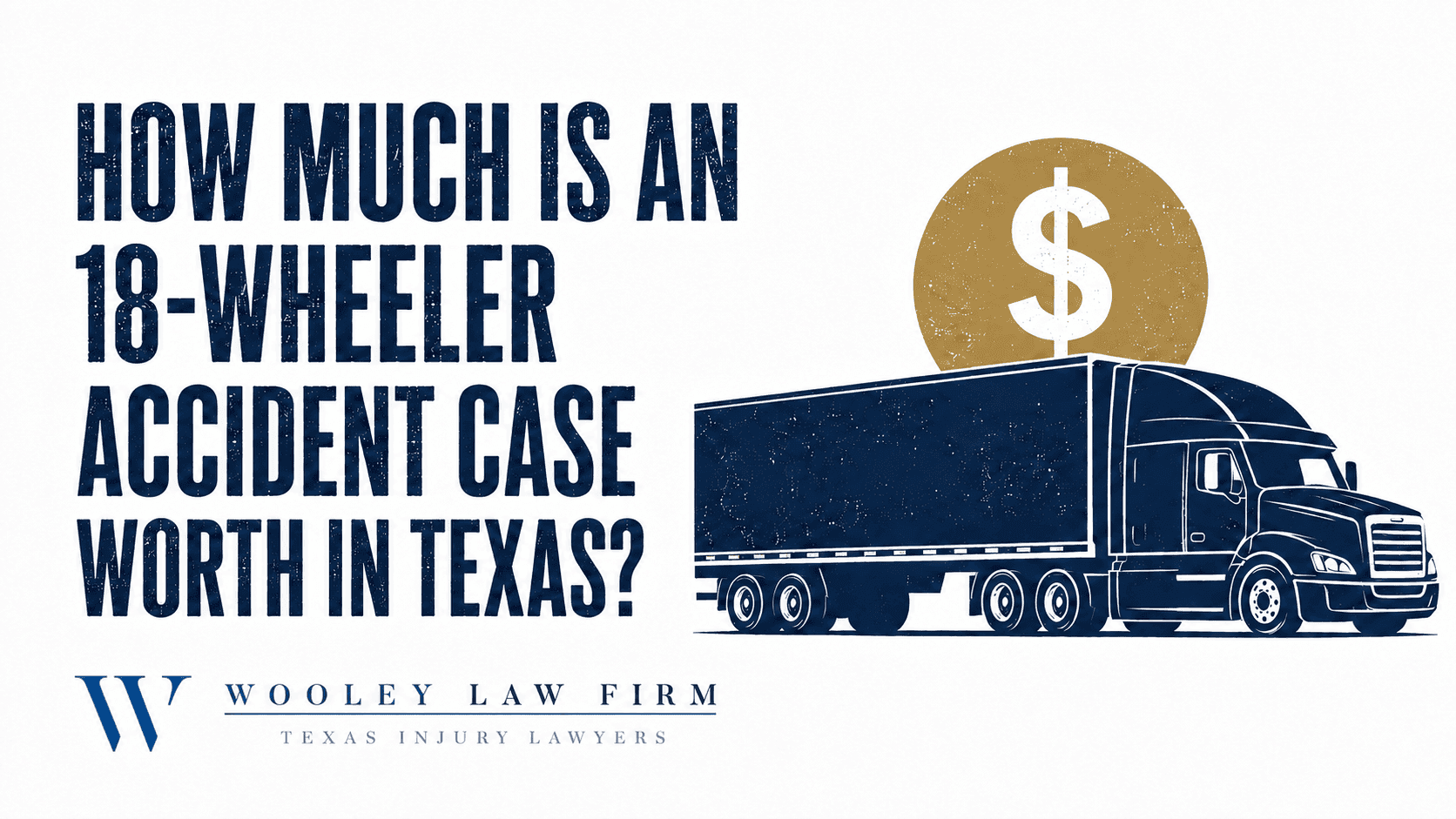
After a serious collision with an 18-wheeler, one of the first questions injured people ask is:
How much is my truck accident case worth?
It is an understandable question. You may be facing hospital bills, surgery, missed work, vehicle damage, physical pain, and uncertainty about your future. You want to know whether the trucking company will be held responsible and whether your claim will provide enough compensation to protect you and your family.
The honest answer is that there is no reliable “average” 18-wheeler accident settlement.
Some truck accident claims involve injuries that resolve after several weeks of treatment. Others involve spinal cord injuries, brain injuries, amputations, permanent disability, or wrongful death. The value of a case depends on the injuries, available evidence, responsible parties, insurance coverage, and many other facts.
A serious truck accident case should be evaluated individually, not by using an online settlement calculator or comparing it to an unrelated verdict or settlement.
At The Wooley Law Firm, we represent people injured in 18-wheeler, semi-truck, tractor-trailer, and commercial vehicle accidents throughout Dallas-Fort Worth and across Texas. We investigate the collision, preserve trucking evidence, identify every potentially responsible party, and determine the full impact of the injuries before demanding compensation.
There Is No Standard Settlement for an 18-Wheeler Accident
Two truck wrecks that appear similar can have dramatically different values.
For example, two vehicles may both be rear-ended by an 18-wheeler. One driver may experience temporary neck and back pain that improves with conservative treatment. The other may suffer a herniated disc requiring surgery and lose the ability to return to a physically demanding job.
The accidents may look similar in photographs, but the damages are not the same.
The value of an 18-wheeler accident claim usually depends on several major factors:
The seriousness of the injuries
Whether the injuries are permanent
The amount of past and future medical treatment
Lost wages and diminished earning capacity
Pain, mental anguish, impairment, and disfigurement
The strength of the liability evidence
Whether the injured person is accused of contributing to the wreck
The number of responsible companies
Available insurance and business assets
Whether the trucking company acted with gross negligence
Where the lawsuit is filed
Whether the case can be settled or must be tried
No lawyer should guarantee a particular recovery before investigating these issues.
The Severity of Your Injuries Is One of the Most Important Factors
The seriousness and long-term effect of the injuries often have the greatest impact on the value of a truck accident case.
An 18-wheeler can weigh many times more than a passenger vehicle. The force created by a collision can cause catastrophic injuries even when the occupants of the smaller vehicle survive.
Serious truck accident injuries may include:
Traumatic brain injuries
Spinal cord injuries and paralysis
Herniated or damaged spinal discs
Severe back and neck injuries
Multiple fractures
Crush injuries
Amputations
Internal organ damage
Burns
Facial injuries and scarring
Vision or hearing loss
Nerve damage
Permanent physical impairment
Post-traumatic stress and emotional trauma
An injury that requires surgery, causes permanent limitations, or prevents someone from returning to work will generally support a larger claim than an injury that fully resolves within a short period.
However, the name of the diagnosis alone does not determine value. The evidence must show how the injury affects the particular person.
A fractured leg may have a much greater effect on a construction worker than on someone whose job can be performed remotely. A hand injury may be especially damaging to a surgeon, mechanic, musician, or tradesperson. A brain injury may affect memory, concentration, relationships, personality, and the ability to remain employed.
The claim should account for the injured person’s actual life, not just the language found in a medical record.
Past Medical Expenses
Past medical expenses are an important part of an 18-wheeler accident claim.
Depending on the injuries, treatment may include:
Ambulance transportation
Emergency-room care
Hospital admission
Diagnostic imaging
Surgery
Physical therapy
Pain-management treatment
Orthopedic care
Neurological care
Rehabilitation
Prescription medication
Medical equipment
Home-health services
Psychological treatment
In Texas, recovery for medical expenses is generally limited to expenses that were actually paid or remain legally owed, rather than an automatically recoverable amount based solely on the provider’s original sticker price.
That means a proper case evaluation requires more than adding the original amounts printed on medical bills. An attorney may need to review health-insurance payments, contractual adjustments, medical liens, letters of protection, Medicare or Medicaid interests, and the balances the patient remains responsible for paying.
Future Medical Care Can Substantially Increase Case Value
The value of a serious truck wreck case should not be calculated before the future medical needs are understood.
An injured person may need:
Additional surgery
Revision surgery
Pain-management procedures
Long-term physical therapy
Prescription medications
Prosthetic devices
Mobility equipment
Home or vehicle modifications
In-home assistance
Counseling
Neurological monitoring
Lifelong attendant care
Doctors may need to provide opinions about the type, frequency, and likely cost of future care. In catastrophic injury cases, a life-care planner and economist may be needed to calculate expenses expected over the injured person’s lifetime.
Accepting a settlement before future treatment is evaluated can leave the injured person responsible for costs that arise after the claim has been closed.
Once a release is signed, the injured person ordinarily cannot return to the trucking company and request more money because the injury became worse or another surgery was recommended.
Lost Income and Reduced Earning Capacity
A truck accident claim may include income already lost because the injured person could not work.
Proof may include:
Pay stubs
Tax returns
Employer wage statements
Attendance records
Disability records
Work restrictions
Evidence of missed overtime or bonuses
Business records for self-employed individuals
But past lost wages may be only part of the claim.
A serious injury can also reduce a person’s future earning capacity. The injured person may be able to return to work but no longer perform the same job, work the same hours, accept overtime, travel, lift heavy objects, or pursue promotions.
For example, a commercial driver with a permanent leg injury may no longer be able to operate a truck. A warehouse employee with a spinal injury may need to transition into lower-paying work. A business owner may lose contracts or become unable to perform essential parts of the business.
Vocational experts and economists may be used to evaluate the difference between what the person probably would have earned without the collision and what the person can reasonably earn after the injury.
Physical Pain and Mental Anguish
An 18-wheeler accident claim is not limited to medical bills and lost wages.
Texas law may permit recovery for the physical pain caused by the injuries and treatment. Relevant evidence may include:
The intensity and duration of pain
Painful surgeries and rehabilitation
Sleep disruption
Medication side effects
Chronic headaches
Nerve pain
Reduced mobility
Flare-ups
The likelihood that pain will continue
Mental anguish is related but distinct. A catastrophic truck wreck may cause anxiety, depression, fear of driving, nightmares, panic attacks, grief, embarrassment, or post-traumatic stress.
These damages cannot be measured by a receipt. They must be demonstrated through medical records, testimony, changes in behavior, and evidence showing how the collision affected the person’s daily life.
Physical Impairment
Physical impairment addresses the loss of the ability to participate in normal activities independently of pain or lost income.
Examples may include the inability to:
Walk or run normally
Exercise
Drive
Lift or carry children
Perform household work
Participate in hobbies
Travel
Play sports
Maintain a home
Care for family members
Live independently
A person may return to work and still suffer substantial physical impairment.
Photographs, videos, testimony from family members, work records, activity records, and medical restrictions can help show what the injured person could do before the wreck and what has been lost afterward.
Scarring and Disfigurement
Truck wrecks can cause visible and permanent changes to the body.
Disfigurement may result from:
Surgical scars
Burn scars
Facial injuries
Amputation
Orthopedic deformity
Skin grafts
Dental damage
Loss of an eye
Permanent use of a brace or medical device
The location, size, visibility, and permanence of the disfigurement may affect the value of this portion of the claim.
How Clear Is the Evidence That the Truck Driver Was at Fault?
A severe injury does not automatically establish liability.
The injured person must still prove that the truck driver, trucking company, or another party caused the collision.
Strong evidence may include:
Police reports
Witness statements
Dash-camera footage
Surveillance video
Photographs of the scene
Vehicle damage
Skid marks and debris
Electronic control module or “black box” data
Trucking telematics
Electronic logging-device records
Driver cellphone records
Dispatch communications
Driver qualification records
Inspection reports
Maintenance records
Drug and alcohol testing records
Cargo-loading documents
Accident-reconstruction analysis
The stronger the liability evidence, the more difficult it becomes for the trucking company’s insurer to deny or undervalue the claim.
But trucking evidence can disappear quickly. Video may be overwritten, vehicles may be repaired, electronic data may be lost, and records may be destroyed under document-retention practices.
Learn more about the records that may need to be preserved in our guide to evidence after an 18-wheeler wreck.
Injured in an Accident?
Free consultation. Tell us what happened and learn what options may be available.
What If the Trucking Company Blames You?
Trucking companies and their insurers frequently try to shift responsibility to the injured driver.
They may claim that the injured person:
Changed lanes unexpectedly
Drove in the truck’s blind spot
Stopped suddenly
Was speeding
Failed to pay attention
Entered the truck’s lane
Failed to wear a seat belt
Made the injuries worse by delaying treatment
Texas follows a modified comparative-responsibility system. A claimant generally cannot recover if found more than 50% responsible. When the claimant is 50% or less responsible, the recovery is generally reduced by the assigned percentage of responsibility.
For example, if a jury determines that a person suffered $1 million in damages but was 20% responsible, the recoverable amount may be reduced to $800,000.
This is why independent evidence matters. The truck driver’s version of events should not be accepted without comparing it to video, electronic data, physical evidence, and witness accounts.
The Number of Responsible Parties Can Affect the Available Recovery
An 18-wheeler accident case may involve more than the truck driver.
Potentially responsible parties may include:
The motor carrier
The truck driver’s employer
The tractor owner
The trailer owner
A freight broker
A shipper
A cargo-loading company
A maintenance or repair company
A leasing company
A staffing company
A truck or component manufacturer
Another driver who contributed to the crash
Determining who is responsible requires examining ownership records, employment relationships, contracts, dispatch records, bills of lading, loading documents, maintenance agreements, and insurance filings.
Identifying every responsible party can be especially important when the injuries are catastrophic or several people were injured in the same collision.
How Much Insurance Does an 18-Wheeler Carry?
Commercial trucks often have more liability coverage than passenger vehicles, but the amount varies.
Under federal rules, certain for-hire interstate property carriers operating vehicles weighing 10,001 pounds or more must maintain at least $750,000 in financial responsibility for nonhazardous property transportation. Higher minimums may apply when particular hazardous materials are transported, including requirements reaching $5 million in some circumstances.
A company may also carry coverage exceeding the legal minimum, including:
Primary commercial liability insurance
Excess insurance
Umbrella policies
Trailer coverage
Separate policies held by other responsible companies
Self-insured retention
Corporate assets available to satisfy a judgment
The minimum required policy is not necessarily the total amount available.
An attorney may investigate FMCSA filings, insurance disclosures, ownership relationships, contracts, and other policies that could apply.
Insurance coverage can become particularly important when a wreck causes multiple serious injuries or deaths. Several people may be making claims against the same policy, and the total damages may exceed the available primary coverage.
Does the Trucking Company’s Conduct Support Gross-Negligence Damages?
Most truck accident claims are based on negligence. In some cases, the evidence may show conduct that goes beyond an ordinary mistake.
Examples may include allegations that a trucking company:
Knowingly allowed an unqualified driver to operate
Ignored repeated safety violations
Pressured a driver to exceed lawful driving limits
Continued using a truck with known brake problems
Falsified inspection or maintenance records
Allowed an impaired driver to remain on the road
Ignored a driver’s history of dangerous crashes
Destroyed evidence after receiving notice of the claim
Texas law generally requires clear and convincing evidence of fraud, malice, or gross negligence before exemplary damages may be awarded. Gross negligence involves an extreme degree of risk and actual awareness of that risk accompanied by conscious indifference. Texas law also places limits on many exemplary-damage awards.
Punitive or exemplary damages are not available in every truck accident case. They require evidence of conduct substantially more serious than ordinary carelessness.
Gaps in Medical Treatment Can Reduce the Value of a Claim
Insurance companies examine the timeline of medical treatment closely.
They may argue that:
The person was not seriously injured because no ambulance was requested
The injury was unrelated because treatment began several days later
The condition resolved because there was a lengthy treatment gap
The person failed to follow medical advice
A later incident caused the symptoms
The person received more treatment than was reasonably necessary
There may be legitimate explanations for a delay or gap. A person may lack health insurance, have difficulty finding a specialist, be unable to miss work, or initially believe the pain would improve.
Those explanations should be documented. Silence allows the insurer to create its own explanation.
Injured people should seek appropriate medical care, accurately report their symptoms, follow reasonable treatment recommendations, and discuss any inability to continue treatment with their healthcare provider and attorney.
Pre-Existing Injuries Do Not Automatically Defeat a Claim
Many people have prior back pain, arthritis, previous surgery, degenerative changes, or earlier injuries.
The trucking company may argue that all symptoms existed before the wreck. But a pre-existing condition does not necessarily eliminate the claim.
A collision may:
Aggravate a prior condition
Turn occasional discomfort into constant pain
Cause a previously manageable condition to require surgery
Create new symptoms in a previously injured body part
Accelerate the need for treatment
Reduce function beyond the person’s pre-collision limitations
Medical records from before and after the collision may be critical. They can show the person’s baseline condition, prior level of function, changes in symptoms, and new treatment made necessary by the wreck.
Trying to hide prior medical treatment can seriously damage credibility. It is generally better to disclose the history and clearly demonstrate what changed after the collision.
The Injured Person’s Credibility Matters
Insurance companies and juries evaluate whether the claimant is honest and consistent.
Credibility can be damaged by:
Exaggerating symptoms
Denying obvious prior injuries
Giving conflicting descriptions of the wreck
Claiming complete disability while posting contrary activities online
Missing medical appointments without explanation
Making inaccurate wage-loss claims
Failing to disclose a later accident
Credibility can be strengthened through consistent medical histories, accurate testimony, reliable work records, and reasonable descriptions of limitations.
A persuasive case does not require exaggeration. The goal is to show the full truth of how the collision changed the person’s life.
Social Media Can Affect an 18-Wheeler Accident Claim
Trucking insurers and defense lawyers may review public social-media accounts.
A photograph or short video can be taken out of context and used to argue that the injured person is more active than claimed.
For example, smiling in a family photograph does not prove that someone is pain-free. Attending an important event does not mean the person recovered. But the defense may still use the post to create doubt.
After a wreck, avoid discussing:
The collision
Your injuries
Medical treatment
Settlement negotiations
Physical activities
Travel
Legal advice
The trucking company or driver
Do not delete existing content after a claim is anticipated without first speaking with an attorney. Deleting material can create separate evidence-preservation issues.
Early Settlement Offers Are Often Made Before the Full Damages Are Known
A trucking insurer may contact an injured person quickly and offer money before medical treatment is complete.
An early offer may sound substantial when bills are arriving and the person cannot work. But the offer may not account for:
Future surgery
Permanent impairment
Reduced earning capacity
Long-term pain
Future medical expenses
Additional responsible parties
Additional insurance coverage
Medical liens
The full effect on the person’s family and daily life
The insurer may be attempting to buy final peace before the claim’s true value becomes clear.
Before accepting an offer, the injured person should understand the diagnosis, prognosis, future treatment, work limitations, available insurance, and evidence of fault.
How Long Does It Take to Determine What a Truck Accident Case Is Worth?
A preliminary evaluation may be possible early, but a reliable valuation often takes time.
The investigation may require:
Preserving electronic and physical evidence
Obtaining the police report and scene materials
Identifying the motor carrier and other companies
Reviewing insurance coverage
Collecting medical records and bills
Understanding whether additional treatment is needed
Calculating lost income
Consulting medical or vocational experts
Taking depositions
Evaluating the strength of the defenses
Settling too soon can result in undervaluing permanent injuries. Waiting without taking legal action can also be dangerous because evidence and filing deadlines may be lost.
Texas generally imposes a two-year limitations period on personal-injury and wrongful-death claims, although exceptions and shorter notice requirements may apply in particular cases.
The deadline should be evaluated immediately rather than assumed.
Does Filing a Lawsuit Increase the Value of an 18-Wheeler Accident Case?
Not automatically.
A lawsuit does not create damages that do not exist. But litigation may provide tools needed to uncover evidence the trucking company will not voluntarily provide.
Through formal discovery, an attorney may seek:
Driver qualification files
Safety and training policies
Electronic logs
Dispatch messages
Drug and alcohol testing records
Maintenance records
Inspection reports
Insurance information
Contracts between trucking entities
Prior collision and safety records
Corporate testimony
Depositions may also reveal inconsistencies between the driver’s account, the company’s records, and the electronic evidence.
A strong case may resolve through negotiation or mediation. Other cases must be prepared for trial before the insurer makes a reasonable offer.
The value comes from the evidence, damages, legal responsibility, and ability to prove the case—not merely from the act of filing suit.
Examples of Factors That May Increase the Value of a Truck Accident Case
Factors that may support a higher value include:
Clear evidence that the truck driver caused the collision
Surgery or permanent injury
Significant future medical care
Long-term disability
Substantial lost earning capacity
Visible scarring or disfigurement
Strong witnesses or video evidence
Electronic data contradicting the truck driver
Multiple responsible companies
Significant commercial insurance coverage
Evidence of repeated safety violations
Evidence supporting gross negligence
A credible claimant with consistent medical treatment
No single factor guarantees a particular result. The entire case must be considered together.
Factors That May Reduce the Value of a Truck Accident Case
Factors that can make recovery more difficult include:
Disputed fault
Evidence that the claimant contributed to the wreck
Minor or temporary injuries
Long and unexplained treatment gaps
Inconsistent medical histories
Failure to follow reasonable medical recommendations
Prior similar symptoms with no evidence of aggravation
Social-media content contradicting claimed limitations
Limited insurance or assets
Multiple injured claimants competing for limited coverage
Missed legal deadlines
Lost or destroyed evidence
Credibility problems
Some of these issues can be addressed when identified early. Others may place unavoidable limits on the claim.
Why Online Settlement Calculators Are Unreliable
An online calculator cannot meaningfully evaluate:
Whether the truck driver violated a safety rule
Whether black-box data supports your version
Whether surgery will be needed
Whether you can return to your occupation
Whether additional companies are responsible
Whether excess insurance exists
Whether the jury is likely to believe the witnesses
Whether the trucking company ignored known dangers
How the injuries have affected your family and independence
Multiplying medical bills by an arbitrary number is not a proper way to value a serious injury claim.
A case should be evaluated using its actual evidence and damages.
What Should You Bring to a Truck Accident Case Evaluation?
Helpful information may include:
The crash report
Photographs and videos
The truck’s company name and DOT number
Insurance correspondence
Witness contact information
Medical records and bills
Health-insurance information
Work restrictions
Wage records
Tax returns if self-employed
Photographs of injuries or scarring
A list of prior injuries
Information about any earlier or later accidents
Copies of text messages, emails, or recorded communications with insurers
Do not delay contacting a lawyer simply because you do not have every document. An attorney can help identify and obtain missing records.
How a Dallas 18-Wheeler Accident Lawyer Can Help Determine Case Value
A truck accident lawyer can evaluate far more than the amount of the existing medical bills.
The investigation may include:
Sending evidence-preservation notices
Inspecting the truck and involved vehicles
Obtaining electronic truck data
Locating witnesses and video
Reviewing driver logs and dispatch records
Examining hiring, training, and safety practices
Identifying every responsible company
Finding all available insurance
Working with medical and economic experts
Calculating future losses
Addressing medical liens
Negotiating with commercial insurers
Filing suit and preparing the case for trial
At The Wooley Law Firm, attorney Andrew J. Wooley works directly with clients and investigates serious truck wreck claims throughout Dallas, Fort Worth, Irving, Garland, Mesquite, Grand Prairie, Richardson, Arlington, Plano, Frisco, McKinney, Denton, and communities across Texas.
Talk to a Dallas 18-Wheeler Accident Lawyer
The value of your truck accident case depends on much more than the damage to your vehicle or the total of your current medical bills.
A proper evaluation should consider your future medical needs, ability to work, permanent limitations, pain, mental anguish, physical impairment, evidence of fault, responsible companies, and all available insurance coverage.
Just as importantly, the trucking company may already be investigating the wreck and protecting its interests.
If you were injured in an 18-wheeler, semi-truck, tractor-trailer, or commercial vehicle accident, contact The Wooley Law Firm’s Dallas truck accident lawyer.
Call 214-699-6524 for a free and confidential consultation. You do not pay attorney’s fees unless we recover compensation for you.
Frequently Asked Questions About 18-Wheeler Accident Case Value
What is the average settlement for an 18-wheeler accident?
There is no reliable average that can predict the value of an individual claim. Truck accident cases vary based on the injuries, future treatment, lost earning capacity, liability evidence, insurance coverage, and number of responsible parties.
Are truck accident settlements usually larger than car accident settlements?
They can be, particularly when the collision causes catastrophic injuries and substantial commercial insurance coverage is available. However, involvement of an 18-wheeler does not automatically guarantee a large recovery. Fault and damages must still be proven.
How much is a truck accident case worth if I need surgery?
Surgery can substantially affect the value of a claim, but there is no fixed amount. The type of procedure, recovery time, medical cost, prognosis, permanent restrictions, future treatment, lost income, and strength of the liability evidence must all be considered.
Can I recover compensation if I was partly at fault?
Possibly. Under Texas proportionate-responsibility law, a claimant generally cannot recover when more than 50% responsible. A claimant who is 50% or less responsible may recover damages reduced by the assigned percentage of fault.
How much insurance does a trucking company have?
Coverage varies. Certain interstate motor carriers are subject to federal minimum financial-responsibility requirements, but the company may carry primary, excess, or umbrella coverage above the minimum. Other responsible companies may also have separate policies.
Should I accept the trucking company’s first offer?
You should be cautious about accepting an offer before you understand the full extent of your injuries, future medical care, work limitations, evidence, medical liens, and available insurance. Signing a release generally ends the claim permanently.
Does hiring a truck accident lawyer increase the value of a case?
No attorney can guarantee a result. A lawyer can help preserve evidence, investigate the trucking company, identify additional defendants and insurance, document damages, work with experts, and prepare the case for litigation or trial.
How long do I have to file an 18-wheeler accident lawsuit in Texas?
Texas generally has a two-year limitations period for personal-injury claims, but exceptions and shorter notice deadlines can apply. The specific deadline should be reviewed promptly by an attorney.
How much does it cost to hire The Wooley Law Firm?
The Wooley Law Firm handles truck accident cases on a contingency-fee basis. You do not pay attorney’s fees unless the firm obtains compensation for you. Fee terms and case expenses are explained before representation begins.
Disclaimer: This article provides general information and is not legal advice. Reading this article does not create an attorney-client relationship. Every case is different, and past results do not guarantee a similar outcome.
Topics
Share This Article

Andrew J. Wooley
Personal Injury Attorney
Andrew J. Wooley is a dedicated personal injury attorney based in Dallas, Texas. He focuses on helping accident victims recover fair compensation for their injuries. With a commitment to personalized service, Andrew works directly with each client to understand their unique situation and fight for their rights.