If you were seriously injured in an 18-wheeler wreck in Dallas, you may think the trucking company and its insurance carrier are focused only on investigating the truck driver and determining what caused the crash.
They may also be investigating you.
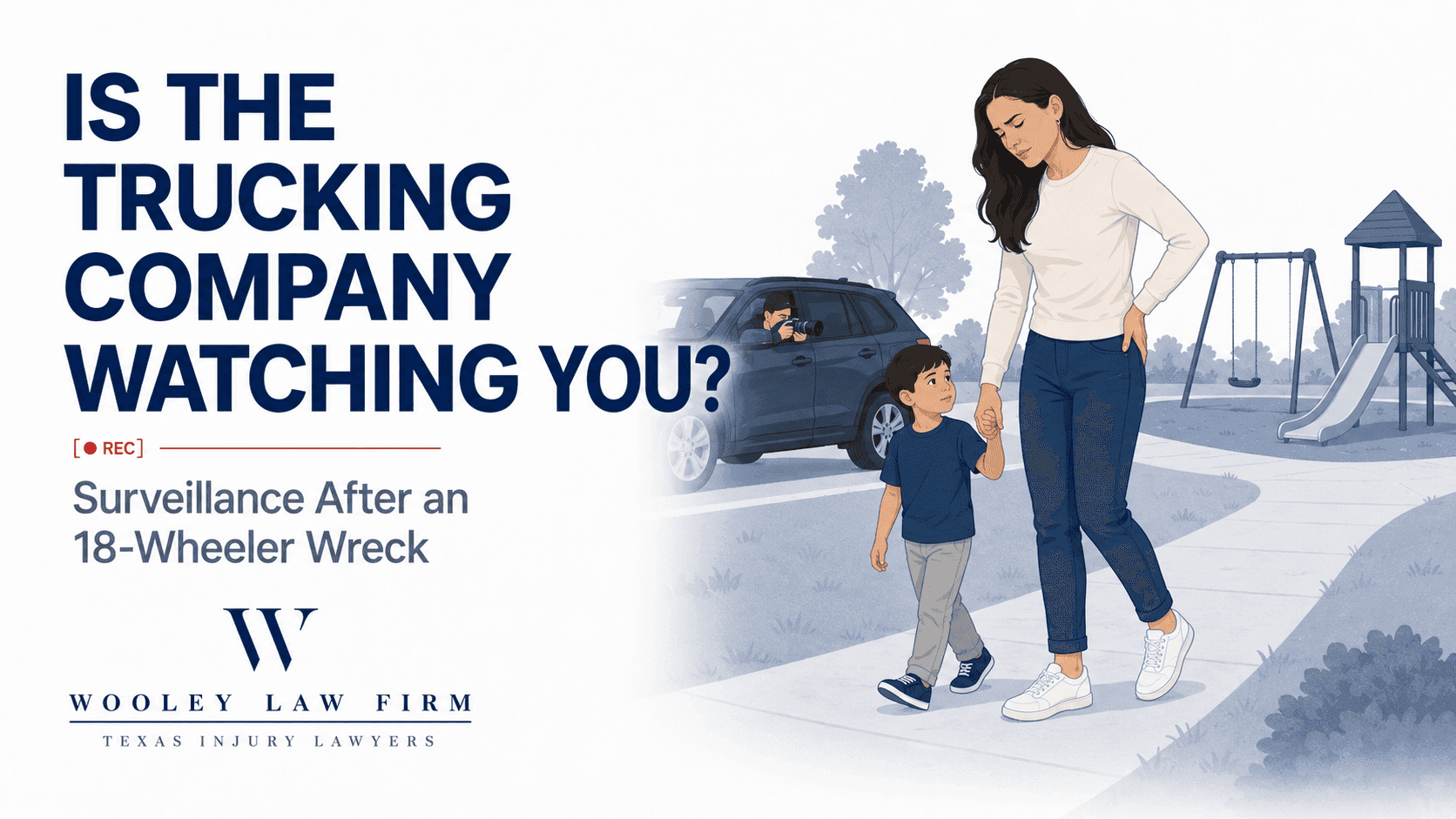
In serious truck accident cases, trucking companies, insurance carriers, and defense attorneys may hire private investigators to conduct surveillance of the injured person. An investigator may park near your home, follow you to work or medical appointments, photograph you in public, or record videos of you performing everyday activities.
The goal may be to find something the defense can use to argue that your injuries are not as serious as you claim.
At The Wooley Law Firm, we have seen this happen to our own clients. We have had clients followed and recorded while taking their children to a playground, mowing their lawn, and simply walking into work.
That does not mean an injured person should stop living his or her life.
But it does mean that after a serious 18-wheeler wreck, you should understand that the trucking company's investigation may include an investigation of your activities, injuries, and daily life.
If you were seriously hurt in a commercial truck collision, our Dallas 18-wheeler accident lawyer page explains more about these claims and the evidence that may be involved.
Why Would a Trucking Company's Insurance Company Put You Under Surveillance?
A serious 18-wheeler collision can cause substantial damages.
Depending on the circumstances, an injured person may seek compensation for:
Medical expenses;
Future medical treatment;
Lost wages;
Loss of earning capacity;
Physical pain;
Mental anguish;
Physical impairment;
Disfigurement; and
Other damages caused by the wreck.
When the injuries are serious and the financial exposure is significant, the trucking company and its insurance carrier may aggressively investigate the claim.
One way they may do that is by hiring a private investigator.
The investigator may attempt to find evidence that appears inconsistent with what you have told your doctors, stated in discovery, testified to during a deposition, or alleged in your lawsuit.
This is one of the reasons an 18-wheeler accident claim can be very different from an ordinary car accident claim. Trucking companies and their insurers may begin building a defense almost immediately after a serious collision.
For more information about the broader issues involved in these cases, visit our page on 18-wheeler and truck accident claims in Dallas.
We Have Had Clients Followed by Private Investigators
Surveillance after an injury claim is not just something we warn clients about in theory.
We have had clients followed and recorded by private investigators.
We have seen investigators record clients:
Taking their children to a playground;
Mowing their lawn;
Walking into work; and
Going about ordinary activities outside their homes.
Why would an insurance company care whether an injured parent takes their children to a playground?
Because the defense may attempt to take a short piece of video and use it to tell a much larger story.
For example, an investigator might record someone walking around a playground with their children and argue that the person cannot be as injured as claimed.
But the camera may not show that the person could not play with the children, could not lift them, needed to sit down repeatedly, or experienced substantially increased pain after returning home.
The same problem can occur with footage of someone mowing the lawn.
A short clip may show the person pushing a lawn mower.
It may not show that the person only mowed part of the yard, stopped repeatedly, experienced significant pain, took medication afterward, or spent the rest of the afternoon lying down.
Likewise, walking into work does not necessarily mean someone can perform all of their job duties for eight hours a day, five days a week.
That is why context matters.
What Are Private Investigators Looking For After a Truck Wreck?
A surveillance investigator is generally interested in observable physical activity.
For someone claiming neck, back, knee, shoulder, spinal, or other serious injuries, an investigator might record the person:
Carrying groceries;
Lifting a child;
Taking out the trash;
Mowing the lawn;
Washing a vehicle;
Working in the yard;
Walking a dog;
Shopping;
Driving;
Entering or leaving work;
Attending a sporting event;
Going to a gym;
Bending over;
Reaching overhead;
Carrying packages; or
Traveling.
The defense may then compare those activities with statements in the person's medical records or testimony.
But physical injuries are rarely as simple as whether a person can or cannot perform one isolated movement.
Someone may be capable of lifting a grocery bag but unable to repeatedly lift 30 pounds throughout a workday.
Someone with a serious back injury may be able to walk through a parking lot but suffer increased pain after prolonged standing or walking.
Someone with a knee injury may be able to attend a child's sporting event but need to sit for most of it.
A few minutes of video may not show any of that.
Serious neck and back injuries are especially easy to misunderstand from a short video because pain and reduced endurance may not be visible. We discuss those injuries in more detail in our article on serious back and neck injuries after a Dallas-Fort Worth truck wreck.
Surveillance Video Can Be Powerful Evidence in a Texas Injury Case
The Texas Supreme Court has recognized how powerful surveillance video can be in a personal injury case.
In Diamond Offshore Services Ltd. v. Williams, a defendant had an injured worker surveilled and recorded performing physical activities. The defendant sought to use the footage to challenge evidence concerning the plaintiff's pain, physical abilities, and ability to work.
The Texas Supreme Court concluded that the surveillance footage was relevant and that its exclusion was harmful under the circumstances of that case.
That case illustrates an important point for anyone pursuing a serious injury claim:
Do not assume surveillance footage is harmless simply because your injuries are legitimate.
Video is persuasive.
An insurance company's attorney may attempt to take a few moments of footage and argue that they represent your entire physical condition.
That makes the context surrounding the video extremely important.
Injured in an Accident?
Free consultation. Tell us what happened and learn what options may be available.
Is It Legal for a Private Investigator to Follow You in Texas?
Texas regulates private investigation under Chapter 1702 of the Texas Occupations Code.
The statute specifically describes investigations involving information about a person's habits, occupation, movements, location, associations, transactions, and acts, as well as investigations into the cause or responsibility for an accident or injury.
That does not mean a private investigator can do anything they want.
Whether particular surveillance is lawful can depend on how it is conducted, where the investigator is located, whether the investigator enters private property, and other circumstances.
But as a practical matter, an injured person should understand that activities visible from public locations may potentially be observed or recorded.
If you believe an investigator is trespassing, threatening you, harassing you, or creating a safety problem, do not confront the investigator. Document what is happening and discuss it with your lawyer.
When Might an Insurance Company Conduct Surveillance?
There is no specific time when surveillance must occur.
An insurance company may authorize an investigator to conduct surveillance at different points during a claim or lawsuit.
The defense may be especially interested in periods surrounding:
Your deposition;
An independent medical examination;
Mediation;
Trial;
Medical appointments;
Weekends;
Holidays; or
Other times when they believe you may be active.
For example, if you testify in a deposition on Thursday about difficulties walking or lifting, an investigator might attempt to observe you during the following weekend.
That does not mean this happens in every case.
But victims of serious truck wrecks should know that it can happen.
Social Media Can Give Investigators Information About You
Physical surveillance is only one method of investigation.
Insurance companies and defense attorneys may also review publicly available social media.
Posts, photographs, videos, location tags, and comments could potentially reveal:
Where you are;
Where you plan to go;
Whether you are traveling;
What activities you are participating in;
Whether you are attending an event; or
When an investigator might be able to observe you.
A photograph can also be misleading.
A picture of someone smiling at a birthday party does not establish that the person does not suffer from chronic pain.
But the defense may still attempt to use that photograph as part of its argument.
This can be particularly important when someone has suffered a serious or permanent injury. Our article on life-changing injuries after a Dallas-Fort Worth truck wreck discusses the long-term effects these crashes can have on work, mobility, independence, and daily life.
Should You Stay Home Because You Might Be Under Surveillance?
No.
You should not stop living your life simply because an insurance company might be watching.
The better rule is:
Be truthful about what you can and cannot do.
If you can walk but prolonged walking causes severe pain, explain that accurately.
If you can lift something occasionally but cannot repeatedly lift throughout a workday, explain that.
If you have good days and bad days, say so.
Do not exaggerate your limitations.
But do not minimize them either.
A legitimate injury claim does not require someone to remain inside the house every day.
Follow Your Doctors' Recommendations
Continue following the restrictions and recommendations provided by your medical providers.
You should also accurately explain your limitations to your doctors.
Depending on your injuries, that may include difficulty with:
Sitting;
Standing;
Walking;
Bending;
Lifting;
Driving;
Sleeping;
Working;
Exercising;
Performing household chores; or
Caring for your children.
Medical records can provide important context when surveillance footage shows only a small portion of someone's day.
For example, a video may show a client walking from a parking lot into work.
Medical records may show that the same person cannot sit at a desk for long periods without changing position because of back pain.
Those facts are not necessarily inconsistent.
The Camera Usually Does Not Show What Happens Later
This may be one of the biggest limitations of surveillance footage.
The investigator may record what happens during an activity.
The investigator usually does not know what happens afterward.
The video may show someone mowing part of the yard.
It may not show that the person spent several hours afterward lying down with an ice pack.
The video may show someone walking around a playground with their children.
It may not show the pain medication they took later that evening.
The video may show someone carrying groceries into the house.
It may not show that they needed someone else to unload the heavier items.
That context can become extremely important when surveillance footage is used in a personal injury case.
While They Are Investigating You, Your Lawyer Should Be Investigating the Trucking Company
There is an important contrast in serious truck accident cases.
While the trucking company and insurance carrier may be paying someone to record you, your attorney should be investigating what happened with the truck, driver, and trucking company.
Depending on the collision, important evidence may include:
The truck's electronic control module or engine data;
Electronic logging device records;
GPS and telematics data;
Dash-camera footage;
Driver-facing camera footage;
Dispatch communications;
Cellphone evidence;
Hours-of-service records;
Driver qualification files;
Training records;
Maintenance records;
Inspection reports;
Cargo and loading documents;
Drug and alcohol testing records when applicable;
Trucking company policies;
Witness statements;
Police body-camera footage;
Photographs;
Physical evidence from the tractor and trailer; and
Other electronic or documentary evidence.
Some electronic trucking information can be overwritten or lost if it is not preserved promptly.
Our article on evidence that can help prove an 18-wheeler wreck case explains why driver logs, electronic records, company policies, and other evidence can become important after a commercial truck collision.
The truck's electronic systems may also contain information about speed, braking, throttle use, cruise control, engine activity, GPS history, or other vehicle information depending on the equipment involved. Learn more in our article on 18-wheeler black box data after a Dallas-Fort Worth truck wreck.
The trucking company may have started its investigation shortly after the crash.
The injured person's investigation should begin as well.
What Should You Do If You Think a Private Investigator Is Following You?
If you believe you are being watched after a truck accident claim:
Do not panic.
Do not confront the investigator.
Continue living your life normally.
Follow your doctors' instructions and restrictions.
Be accurate when describing your injuries and limitations.
Do not exaggerate what you cannot do.
Be cautious about public social-media posts concerning your injuries or activities.
Tell your attorney if you believe surveillance is occurring.
Document concerning conduct if someone appears to be trespassing or creating a safety issue.
Most importantly, do not perform for the camera.
Do not pretend to be more injured than you are.
And do not force yourself to perform painful activities merely because you are worried someone may be recording you.
Live according to your actual condition and your doctors' recommendations.
Can Your Truck Accident Lawyer Obtain the Surveillance Video?
Potentially.
Once a lawsuit has been filed, the existence, discoverability, production, and admissibility of surveillance materials can involve legal and procedural issues that depend on the particular case.
An attorney can evaluate whether surveillance materials exist, what discovery should be served, whether the investigator may be a witness, and how the defense intends to use the footage.
If surveillance video is produced, your attorney can also examine the complete footage rather than simply accepting the clips the insurance company considers most favorable to its position.
Frequently Asked Questions About Truck Accident Surveillance
Do trucking companies really hire private investigators after 18-wheeler wrecks?
They can. In serious personal injury cases, trucking companies, insurance carriers, or defense attorneys may use investigators to observe and record an injured person's activities.
Can a private investigator record me outside my house?
The legality of specific surveillance depends on the circumstances. Activities visible from lawful public locations generally raise different issues than surveillance involving private areas or trespassing.
Can surveillance footage hurt my 18-wheeler accident case?
It can potentially be used by the defense, particularly if the footage appears inconsistent with statements about your physical abilities. But a short video may not accurately demonstrate your pain, endurance, limitations, or what happens after an activity.
Can I still go to work if I have an injury claim?
Yes. An injury claim does not require you to stop working if you are physically able to work. Be truthful about what duties you can perform, what accommodations you need, and what limitations you experience.
Should I stop mowing my lawn or playing with my children?
Not merely because surveillance may occur. Follow your medical restrictions and live within your genuine physical abilities. The important thing is to be truthful about what you can and cannot do.
Should I delete my social media after a truck accident?
Speak with your attorney before deleting existing posts or accounts, particularly after a claim or lawsuit has begun. Evidence-preservation obligations can apply. You can, however, be thoughtful about what you choose to post publicly going forward.
Talk to a Dallas 18-Wheeler Accident Lawyer
After a serious 18-wheeler collision, the trucking company may already have insurance adjusters, investigators, defense attorneys, accident reconstruction experts, and other professionals protecting its interests.
The injured person deserves someone protecting theirs.
The Wooley Law Firm represents people seriously injured in 18-wheeler, tractor-trailer, semi-truck, and commercial vehicle wrecks in Dallas-Fort Worth and throughout Texas.
We investigate how the collision happened, work to identify and preserve trucking evidence, communicate with the insurance companies, and help document how our clients' injuries have affected their lives.
If you were injured in a truck accident and believe the trucking company's insurance carrier may be investigating or surveilling you, contact The Wooley Law Firm to discuss your situation.
Call (214) 699-6524 for a free consultation. You don't pay unless we win.
Disclaimer
This article is for general informational purposes only and is not legal advice. Reading it does not create an attorney-client relationship. Every case is different, and past results do not guarantee a similar outcome.
Topics
Share This Article

Andrew J. Wooley
Personal Injury Attorney
Andrew J. Wooley is a dedicated personal injury attorney based in Dallas, Texas. He focuses on helping accident victims recover fair compensation for their injuries. With a commitment to personalized service, Andrew works directly with each client to understand their unique situation and fight for their rights.