An 18-wheeler driver's responsibilities do not end when a collision occurs. Texas law and federal trucking regulations can require a commercial driver to stop, remain at the scene, assist injured people, report the wreck, warn approaching traffic, and comply with post-accident procedures.
If an 18-wheeler causes a wreck in Dallas, the truck driver cannot simply continue down the highway or leave the scene because the truck is still drivable.
Truck drivers have important responsibilities after a collision. Some come from the same Texas laws that apply to every driver. Others arise from federal safety regulations governing commercial motor vehicles.
What the driver does, or fails to do, in the minutes and hours after a serious truck wreck can become important evidence in a personal injury case.
If you were injured in a collision with a tractor-trailer, a Dallas truck wreck lawyer should investigate not only what caused the crash, but also what the truck driver and trucking company did immediately afterward.
1. The Truck Driver Must Stop After an Injury Wreck
The first rule is straightforward: the truck driver must stop.
Under Texas Transportation Code § 550.021, a driver involved in a collision that results, or is reasonably likely to result, in injury or death must:
Immediately stop at the scene or as close to it as possible;
Return immediately if the vehicle was not initially stopped at the scene;
Determine whether another person was involved and needs assistance; and
Remain at the scene until the driver has fulfilled the duties imposed by Texas law.
Texas law also provides that the driver should stop without obstructing traffic more than necessary.
These rules apply to an 18-wheeler driver just as they apply to someone driving a passenger vehicle.
A truck driver's CDL, delivery deadline, dispatch instructions, or desire to get the truck back on the road does not excuse leaving an injury collision.
What if the 18-wheeler leaves the scene?
A collision involving an 18-wheeler that leaves can create additional investigative issues.
Evidence that may help identify a truck includes:
Tractor license plate;
Trailer license plate;
USDOT number;
Company name or markings;
Tractor or unit number;
Trailer number;
Dash-camera video;
Traffic-camera footage;
Business surveillance video; and
Witness photographs or video.
We have seen firsthand how important this evidence can be. In a recent case, our client's dash camera captured the license plate of an 18-wheeler involved in a collision even though the truck left the scene.
That small piece of video evidence can completely change the investigation.
For more on this issue, read our article about how dash-camera evidence can help after a car or truck wreck.
2. The Driver Must Check Whether Someone Needs Help
Stopping is not enough.
Texas law requires a driver involved in an injury collision to determine whether someone needs aid.
Texas Transportation Code § 550.023 further requires the driver to provide reasonable assistance to an injured person. Depending on the circumstances, that can include arranging transportation to a hospital or physician when treatment is obviously necessary or when the injured person requests transportation.
After a serious Dallas 18-wheeler wreck, reasonable steps may include calling 911 and making sure emergency responders know that someone may be injured.
Truck crashes can cause serious and sometimes life-changing injuries after an 18-wheeler wreck, including spinal injuries, traumatic brain injuries, fractures, internal injuries, amputations, burns, and other major trauma.
A professional truck driver should not assume everyone is fine simply because someone is able to get out of a vehicle or speak after the collision.
3. The Truck Driver Must Exchange Required Information
Texas law also requires a driver involved in a collision involving injury, death, or damage to an attended vehicle to provide certain information.
This includes:
The driver's name and address;
The registration number of the vehicle being driven;
The name of the motor vehicle liability insurer; and
The driver's license, if requested and available.
The driver must also provide reasonable assistance to injured people.
With an 18-wheeler, however, identifying the driver is only the beginning.
A commercial truck case may involve multiple companies or entities, including:
The driver's employer;
The motor carrier;
The tractor owner;
The trailer owner;
A leasing company;
A cargo owner or shipper;
A company responsible for loading the trailer;
A maintenance contractor; or
Other companies involved in the truck's operation.
This is one reason an 18-wheeler accident claim is different from an ordinary car accident claim.
The name written on the side of the truck does not always tell you every company that may have been involved.
4. Serious Truck Wrecks Must Be Reported to Law Enforcement
Texas law requires immediate notice to law enforcement when a collision results in:
Injury;
Death; or
Damage that prevents a vehicle from being normally and safely driven.
The driver must give notice by the quickest means of communication to the appropriate police department, sheriff's office, or other designated agency depending on where the collision occurred.
For a serious truck wreck inside Dallas, that will commonly mean notifying local law enforcement and requesting emergency assistance.
Calling the police is particularly important in a commercial truck accident because investigators may document:
Vehicle positions;
Skid or tire marks;
Road debris;
Witness information;
Driver statements;
Visible injuries;
Traffic conditions;
Damage to the tractor and trailer;
Citations;
Possible impairment; and
Whether vehicles required towing.
These early observations may later become important evidence in a Dallas 18-wheeler accident claim.
5. A Truck Driver Should Not Create Another Road Hazard After the Wreck
Where an 18-wheeler stops after a collision matters.
A tractor-trailer stopped partly in a Dallas highway travel lane can create the risk of a second, potentially catastrophic crash.
Texas law addresses this issue differently depending on the circumstances.
For an injury or death collision, the driver must stop but should avoid obstructing traffic more than necessary.
For certain property-damage-only crashes on a metropolitan freeway, when the vehicles can be normally and safely driven, Texas law requires drivers to move them as soon as possible to an appropriate location, such as a collision investigation site, frontage road, suitable cross street, or other safe location.
A driver should not blindly move a damaged 18-wheeler when doing so would create another danger.
The circumstances of the crash, vehicle damage, injuries, leaking fuel, cargo, traffic conditions, law-enforcement instructions, and roadway location can all affect what is safe.
Injured in an Accident?
Free consultation. Tell us what happened and learn what options may be available.
6. Stopped 18-Wheelers Have Special Federal Warning Requirements
Commercial trucks have additional safety obligations when stopped on a highway or shoulder.
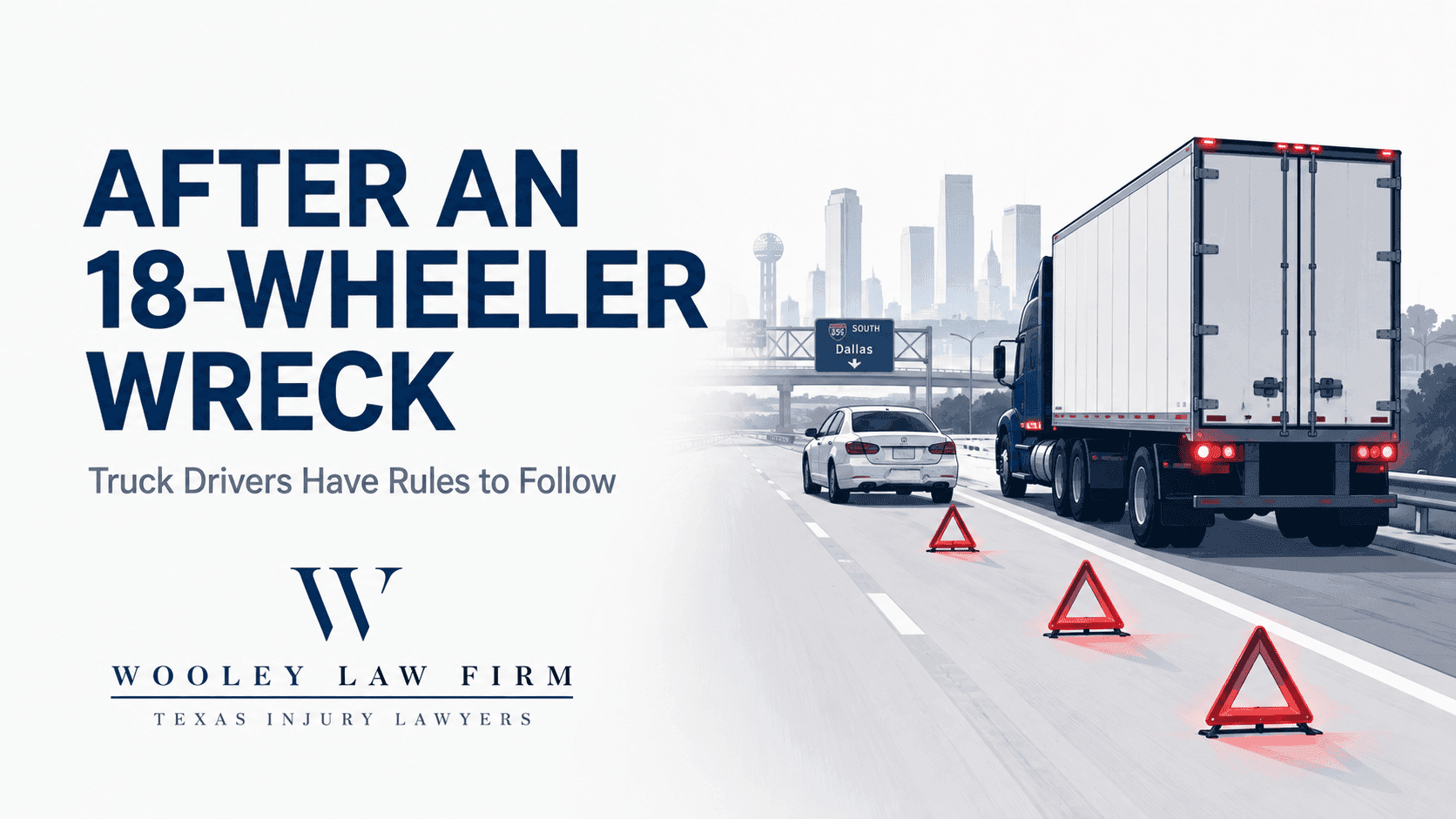
Under 49 C.F.R. § 392.22, when a commercial motor vehicle is stopped on the traveled portion or shoulder of a highway for a reason other than a necessary traffic stop, the driver generally must immediately activate the truck's hazard warning flashers.
The federal regulations also generally require warning devices to be placed as soon as possible and within 10 minutes, subject to specified exceptions and special placement rules.
Those warning devices commonly include reflective triangles carried by commercial trucks.
The required placement depends on the roadway.
For example, the federal rule contains special requirements for:
Divided highways;
One-way highways;
Hills;
Curves;
Locations where visibility is obstructed; and
Situations involving leaking flammable material.
This can become extremely important when a crash leaves an 18-wheeler sitting on I-35E, I-30, I-20, I-45, I-635, U.S. 75, or another high-speed North Texas roadway.
A poorly marked tractor-trailer can become a massive obstacle that approaching motorists may not see until it is too late.
We discuss these requirements in much more detail in our article on 18-wheelers stopped on the shoulder and federal warning-device rules.
7. Some Truck Wrecks Trigger Federal Drug and Alcohol Testing Requirements
A commercial driver's obligations may continue after the vehicles have been removed from the roadway.
Under 49 C.F.R. § 382.303, federal regulations require an employer to perform post-accident alcohol and controlled-substance testing in certain qualifying crashes.
For example, testing requirements can apply when a commercial vehicle crash results in a fatality.
They can also apply under certain circumstances when the commercial driver receives a citation and the crash results in either:
An injury requiring immediate medical treatment away from the scene; or
Disabling vehicle damage requiring a vehicle to be towed away.
The exact requirements depend on the circumstances.
When testing is required, the commercial driver generally must remain readily available for testing. Necessary emergency medical treatment and obtaining emergency assistance should not be delayed.
Why post-accident testing matters in a truck accident case
A Dallas truck accident lawyer may investigate:
Whether testing was required;
Whether it actually occurred;
When the samples were obtained;
The results;
Whether the trucking company followed its procedures;
Why any required test was delayed or not completed; and
Whether the driver remained available for testing.
These records can become an important part of the investigation.
8. The Trucking Company May Have Its Own Post-Accident Responsibilities
The driver's conduct is only one part of a commercial truck wreck investigation.
Under federal trucking regulations, motor carriers must maintain an accident register for qualifying crashes. The Federal Motor Carrier Safety Administration explains the accident-register requirements, including the information carriers are expected to preserve.
The register can include information such as:
Date of the wreck;
Location;
Driver's name;
Number of injuries;
Number of fatalities; and
Whether certain hazardous materials were released.
This information can help a Dallas truck accident attorney investigate the driver, motor carrier, and potentially relevant prior accidents.
What Evidence Should Be Preserved After an 18-Wheeler Wreck?
The moments immediately after the collision can generate important evidence.
Depending on the case, a Dallas truck wreck lawyer may seek preservation of:
Dash-camera footage;
Driver-facing camera footage;
Electronic logging device data;
Engine control module or event data;
GPS and telematics data;
Dispatch messages;
Driver logs;
Driver qualification records;
Drug and alcohol testing records;
Tractor and trailer inspection records;
Maintenance records;
Photographs taken by the truck driver;
Driver accident reports;
Insurance reports;
Tow records;
Cargo records;
Bills of lading;
Cellphone records when appropriate;
Tractor and trailer electronic data; and
The vehicles themselves.
Truck cameras and electronic systems may overwrite data. Vehicles may also be repaired or returned to service.
That is why preservation can be especially important after a serious commercial vehicle crash.
Learn more about why these cases require a different investigation on our Dallas truck accident lawyer page.
What If the Truck Driver Did Not Follow the Rules After the Crash?
Failure to follow a post-crash rule does not automatically answer every question about who caused the original collision.
But it can still matter.
For example, an investigation may reveal that a truck driver:
Left the scene;
Failed to check on injured motorists;
Failed to provide required information;
Failed to report a serious crash;
Left the truck dangerously positioned;
Failed to activate hazard lights;
Failed to place required warning triangles;
Failed to remain available for required post-accident testing; or
Gave inconsistent accounts of what happened.
Those facts may provide evidence regarding the driver's conduct, credibility, training, supervision, or the trucking company's safety practices.
A complete truck wreck investigation should examine what happened before, during, and after the collision.
Trucking Companies Can Begin Investigating Immediately
After a major 18-wheeler collision, the trucking company may quickly contact:
Its insurance carrier;
Defense attorneys;
Safety personnel;
Accident investigators;
Tow companies;
Maintenance personnel; and
Other consultants.
That means injured motorists should not assume important evidence will remain available indefinitely.
A truck accident attorney can send preservation notices and investigate the tractor, trailer, trucking company, driver, electronic records, video, witnesses, and other evidence before critical information is lost.
Our Dallas 18-wheeler accident lawyer page explains why these claims can involve significantly more evidence and more potentially responsible parties than a typical passenger-vehicle collision.
What Should You Do After Being Hit by an 18-Wheeler in Dallas?
If you are able to do so safely after a truck accident:
Call 911.
Get medical treatment for your injuries.
Photograph or video the tractor, trailer, vehicles, roadway, debris, and damage.
Record the truck's license plate, USDOT number, company name, tractor number, and trailer number.
Get contact information from witnesses.
Save your dash-camera footage immediately.
Do not sign a release from the trucking company's insurer without understanding exactly what rights you are giving up.
Preserve your damaged vehicle when possible.
Speak with a Dallas truck wreck lawyer about preserving trucking evidence.
Frequently Asked Questions About What Truck Drivers Must Do After a Wreck
Does an 18-wheeler driver have to stop after hitting a car in Texas?
Yes. When a collision results or is reasonably likely to result in injury or death, Texas law generally requires the driver to immediately stop, determine whether someone needs assistance, and remain at the scene while fulfilling the driver's statutory duties.
Can an 18-wheeler driver move the truck after a collision?
Sometimes. The answer depends on the circumstances. Texas law requires drivers to avoid obstructing traffic more than necessary, and certain property-damage-only freeway crashes involving safely drivable vehicles require vehicles to be moved to an appropriate location.
Serious injuries, unsafe vehicle damage, leaking cargo, or law-enforcement directions may change what should be done.
Does an 18-wheeler have to put out warning triangles after a crash?
Federal regulations generally require commercial drivers stopped on the traveled portion or shoulder of a highway to use hazard flashers and deploy required warning devices within specified time and placement requirements, subject to regulatory exceptions.
Read more about warning triangles, hazard lights, and stopped 18-wheelers.
Does a truck driver have to take a drug test after every accident?
No. Federal post-accident testing rules apply only to specified qualifying crashes.
Fatal crashes can trigger testing requirements, while certain injury or tow-away crashes generally require additional conditions to be met. The applicable federal rule is 49 C.F.R. § 382.303.
What if an 18-wheeler hits me and drives away?
Call police, preserve any dash-camera footage, photograph your vehicle, and write down everything you remember about the truck.
A license plate, USDOT number, company marking, tractor number, trailer number, witness video, or nearby surveillance footage may help identify the truck and companies involved.
A Dallas truck wreck attorney can also investigate ownership, motor-carrier records, insurance information, electronic evidence, and video that may identify the truck.
Talk With a Dallas Truck Wreck Lawyer
An 18-wheeler driver's responsibility does not end at the moment of impact.
Texas law may require the driver to stop, remain at the scene, provide information, assist injured people, and report a serious collision. Federal commercial vehicle regulations can add requirements involving hazard flashers, warning devices, accident records, and post-accident drug and alcohol testing.
If you were injured in a Dallas 18-wheeler wreck, The Wooley Law Firm's Dallas truck accident lawyer can investigate what the truck driver and trucking company did before, during, and after the collision.
Call The Wooley Law Firm at (214) 699-6524 for a free consultation. You don't pay unless we win.
Disclaimer
This article is for general informational purposes only and is not legal advice. Reading it does not create an attorney-client relationship. Trucking regulations and Texas collision laws may apply differently depending on the particular vehicle, driver, motor carrier, roadway, and facts of the collision. Every case is different, and past results do not guarantee a similar outcome.
Topics
Share This Article

Andrew J. Wooley
Personal Injury Attorney
Andrew J. Wooley is a dedicated personal injury attorney based in Dallas, Texas. He focuses on helping accident victims recover fair compensation for their injuries. With a commitment to personalized service, Andrew works directly with each client to understand their unique situation and fight for their rights.