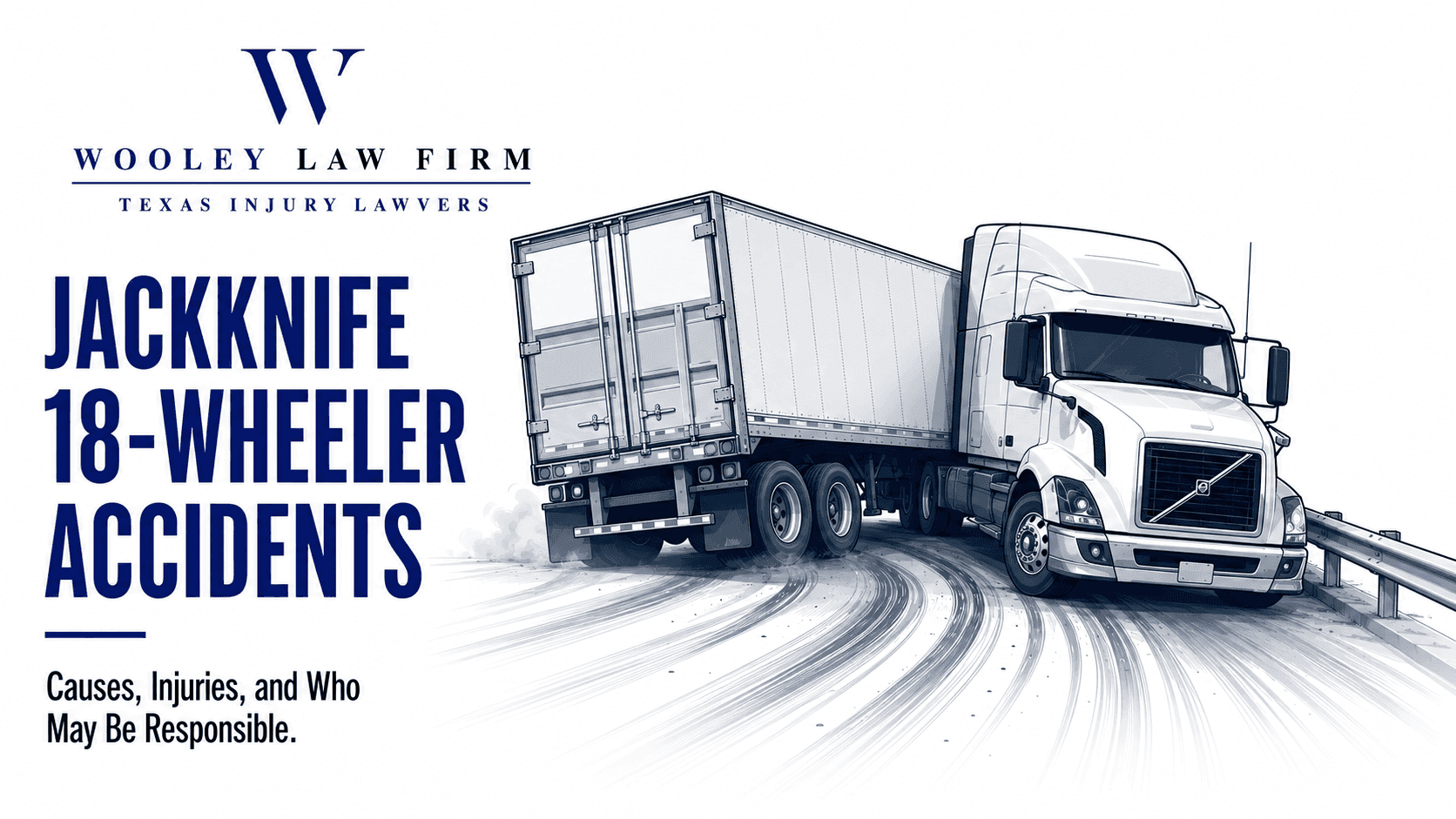
A fully loaded 18-wheeler can become nearly impossible to control when its trailer begins swinging sideways. Within seconds, the tractor and trailer may fold toward each other like a closing pocketknife. This is known as a jackknife accident.
A jackknifed 18-wheeler may block several lanes of traffic, strike vehicles traveling beside it, push cars into concrete barriers, or trigger a chain-reaction collision involving multiple motorists. These wrecks are especially dangerous on busy Dallas highways such as Interstate 35E, Interstate 30, Interstate 20, Interstate 635, U.S. 75, and U.S. 67.
If you were injured in a jackknife truck accident, the crash may not have been an unavoidable accident. Jackknifing is frequently connected to excessive speed, improper braking, driver inattention, inadequate training, poor maintenance, unsafe cargo loading, or a trucking company’s failure to follow federal safety requirements.
The Wooley Law Firm represents people injured in serious commercial vehicle crashes throughout Dallas and North Texas. A prompt investigation can help determine why the truck jackknifed, identify every responsible party, and preserve evidence before it is lost or destroyed.
What Is a Jackknife 18-Wheeler Accident?
A jackknife accident happens when an 18-wheeler’s trailer swings out of alignment with the tractor. Instead of following directly behind the cab, the trailer moves sideways until the tractor and trailer form an angle resembling a folding knife.
Two common types of jackknifing are:
Tractor jackknifing
The tractor’s wheels lose traction while the trailer continues moving forward. The trailer pushes the tractor sideways, causing the cab to rotate toward the trailer.
Trailer jackknifing
The trailer’s wheels lock or lose traction, causing the rear of the trailer to swing outward. The trailer may sweep across nearby traffic lanes and collide with multiple vehicles.
Once a trailer begins moving sideways, a truck driver may have very little time or roadway space to regain control. Passenger vehicles may become trapped between the trailer and a barrier, struck broadside, pushed beneath the trailer, or hit by other vehicles attempting to avoid the truck.
Federal truck-crash data specifically tracks whether large trucks jackknifed during fatal, injury, and property-damage crashes, demonstrating that jackknifing is a recognized crash characteristic in serious commercial vehicle collisions.
Why Are Jackknifed 18-Wheelers So Dangerous?
An 18-wheeler’s size and configuration make jackknife crashes fundamentally different from ordinary car accidents.
A swinging trailer can:
Sweep across several traffic lanes;
Strike vehicles traveling beside the truck;
Crush vehicles against guardrails or concrete barriers;
Cause underride collisions;
Spill or shift heavy cargo;
Overturn and land on nearby vehicles;
Create a highway-wide obstruction; and
Trigger secondary and chain-reaction crashes.
A motorist may have no safe escape route when a trailer suddenly swings across the roadway. Even drivers who avoid the initial impact may be struck by cargo, debris, another vehicle, or the tractor-trailer as it overturns.
What Causes an 18-Wheeler to Jackknife?
A careful investigation is necessary to determine why a tractor-trailer lost stability. In many cases, more than one safety failure contributes to the wreck.
Excessive speed
Speed is particularly dangerous when an 18-wheeler is approaching traffic congestion, a curve, a construction zone, an intersection, or wet pavement.
A truck driver traveling too fast may be unable to stop gradually when traffic slows. Sudden or forceful braking can cause the tractor’s wheels or the trailer’s wheels to lock, increasing the risk of a jackknife.
A driver does not have to exceed the posted speed limit to be traveling too fast. Truck drivers must reduce their speed when required by traffic, weather, visibility, road conditions, and the truck’s load.
Improper braking
Safe braking in a tractor-trailer requires training, judgment, and an understanding of how the truck’s braking system responds under different conditions.
A jackknife may occur when a driver:
Slams on the brakes;
Brakes too aggressively during a turn;
Fails to begin slowing early enough;
Improperly uses the trailer brakes;
Brakes while the tractor and trailer are misaligned;
Fails to account for wet or slippery pavement; or
Does not maintain a safe following distance.
Electronic data may help determine when the driver applied the brakes, how hard the brakes were applied, the truck’s speed, and whether the wheels lost traction.
Following too closely
An 18-wheeler requires substantially more room to stop than a passenger vehicle. A truck driver who follows traffic too closely may be forced to make an emergency braking maneuver when vehicles slow or stop.
The trucking company may bear responsibility when it pressures drivers to maintain unrealistic schedules or rewards unsafe driving practices that encourage speeding and tailgating.
Driver fatigue
Commercial drivers may spend long hours behind the wheel while working under demanding delivery schedules. A fatigued driver may react too slowly to stopped traffic, drifting vehicles, roadway hazards, or changing weather.
Fatigue can also impair judgment and cause a driver to brake or steer improperly. Electronic logging device data, dispatch communications, fuel receipts, delivery records, and driver logs may reveal whether the driver exceeded applicable driving limits or failed to obtain required rest.
Distracted driving
A truck driver looking at a cellphone, dispatching device, GPS unit, paperwork, food, or controls inside the cab may not notice traffic slowing ahead.
A few seconds of distraction can leave the driver with insufficient distance to stop safely. The driver may then slam on the brakes or make an abrupt steering maneuver that causes the trailer to swing.
Potential evidence of distraction may include cellphone records, text messages, application data, in-cab video, dispatch messages, and electronic logging records.
Inadequate driver training or experience
Operating an 18-wheeler requires specialized knowledge. Drivers must understand braking techniques, trailer stability, weight distribution, turning, downhill operation, emergency maneuvers, and the handling characteristics of different tractor-trailer combinations.
A trucking company may be negligent if it allows an inexperienced or unqualified driver to operate a commercial vehicle without adequate supervision and training.
Relevant evidence may include:
The driver’s application;
Commercial driver’s license records;
Training materials;
Road-test results;
Employment history;
Safety violations;
Prior crashes;
Disciplinary records; and
The trucking company’s hiring requirements.
Defective or poorly maintained brakes
A driver may be unable to control a tractor-trailer when the brakes are defective, improperly adjusted, contaminated, or unevenly maintained.
Uneven braking can cause some wheels to lock before others, potentially pulling the tractor or trailer sideways. Brake problems may result from inadequate inspections, delayed repairs, worn components, improper adjustments, or negligent maintenance performed by a third-party repair company.
Inspection reports, maintenance files, repair invoices, brake measurements, post-crash photographs, and the physical components of the truck may be critical evidence.
Injured in an Accident?
Free consultation. Tell us what happened and learn what options may be available.
Tire failure or inadequate tire maintenance
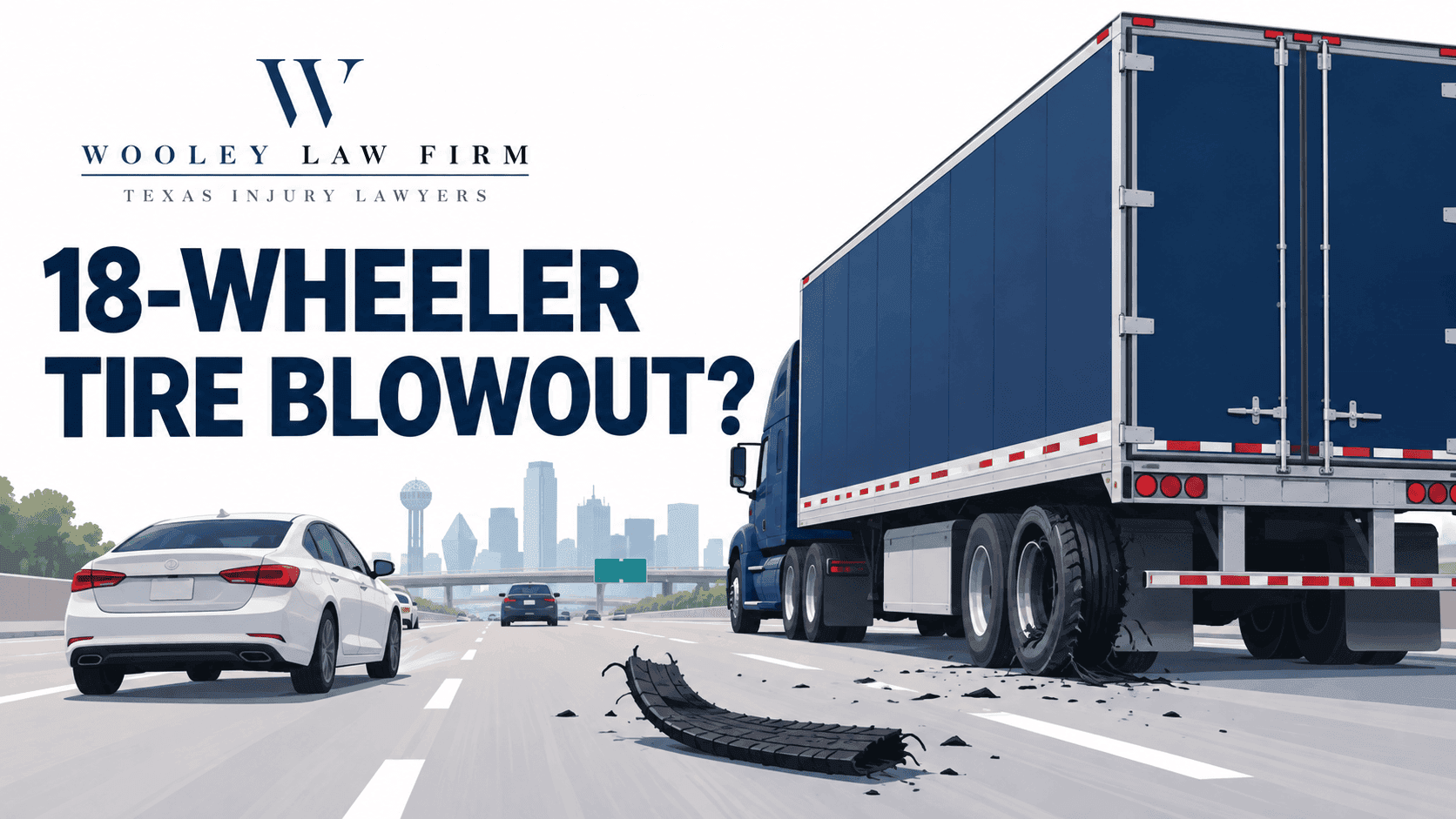
A blown tire or sudden loss of traction can cause a driver to lose control. Worn tread, improper inflation, mismatched tires, overloaded axles, and delayed tire replacement may increase the risk of a serious crash.
The truck and its tires should be preserved for inspection whenever a mechanical problem may have contributed to the jackknife.
Improperly loaded or unsecured cargo
Cargo affects the weight, balance, braking, and stability of an 18-wheeler. Improperly distributed cargo can make a trailer difficult to control, particularly during braking or turning.
Liquid cargo may surge inside a tanker. Unsecured freight may shift toward one side of a trailer. Excessive weight may increase stopping distance or overload the braking system.
Potentially responsible parties may include the motor carrier, shipper, freight broker, warehouse operator, cargo-loading company, or another contractor involved in loading and securing the shipment.
Rain, ice, and slippery roads
Wet or icy pavement reduces traction, but poor weather does not automatically excuse a truck driver or trucking company.
Commercial drivers are expected to account for road conditions by reducing speed, increasing following distance, avoiding abrupt maneuvers, and stopping operations when conditions become too dangerous. A driver who continues traveling at highway speed during heavy rain may be responsible for losing control even though weather contributed to the wreck.
Sudden steering or overcorrection
A truck driver may jerk the steering wheel to avoid stopped traffic, road debris, or another vehicle. An abrupt lane change can destabilize the trailer, particularly when combined with excessive speed, improper loading, worn tires, or hard braking.
Video footage and electronic control data may help reconstruct the driver’s actions before the collision.
Common Injuries Caused by Jackknife Truck Accidents
Because these wrecks often involve side impacts, crushing forces, rollovers, and multiple collisions, victims may suffer catastrophic or permanent injuries.
Common injuries include:
Traumatic brain injuries;
Concussions;
Skull and facial fractures;
Neck and cervical spine injuries;
Herniated or bulging discs;
Spinal cord injuries;
Paralysis;
Back injuries;
Broken ribs;
Collarbone fractures;
Shoulder injuries;
Arm, wrist, and hand fractures;
Pelvic and hip injuries;
Leg, knee, and ankle injuries;
Internal bleeding;
Organ damage;
Burns;
Crush injuries;
Amputations;
Psychological trauma; and
Wrongful death.
Some injuries are immediately apparent. Others—including concussions, disc injuries, internal injuries, and nerve damage—may become more noticeable in the hours or days following the collision.
Victims should seek appropriate medical attention and explain every symptom to their healthcare providers. Delaying treatment can endanger a victim’s health and may give the trucking company’s insurer an opportunity to argue that the injuries were unrelated or less serious than claimed.
Who Can Be Held Liable for a Dallas Jackknife Truck Wreck?
Truck accident cases may involve several companies and insurance policies. Identifying every responsible party is essential, particularly when a victim has suffered severe injuries requiring surgery, long-term treatment, or future care.
Potential defendants may include:
The truck driver
The driver may be liable for speeding, distracted driving, fatigue, following too closely, unsafe braking, failing to inspect the truck, or operating the vehicle in an unsafe condition.
The trucking company or motor carrier
A motor carrier may be responsible for its driver’s conduct and for its own negligent business practices, including:
Negligent hiring;
Inadequate training;
Negligent supervision;
Retaining an unsafe driver;
Pressuring drivers to violate safety rules;
Failing to monitor driver logs;
Inadequate inspections;
Deferred maintenance; and
Violations of federal motor carrier safety requirements.
The trailer owner
The tractor and trailer may be owned by different entities. A trailer owner may be responsible for defective equipment, improper maintenance, or dangerous conditions affecting the trailer.
A maintenance or repair company
A third-party maintenance provider may be liable if improper brake work, negligent inspections, defective repairs, or failure to identify a safety problem contributed to the crash.
A cargo-loading company or shipper
A company that improperly loaded, distributed, or secured cargo may share responsibility when cargo movement caused or worsened the jackknife.
A freight broker or logistics company
Depending on its conduct and level of control, a broker or logistics company may become relevant when it negligently selected an unsafe carrier or exercised control over transportation operations.
A truck or component manufacturer
A manufacturer may be liable when defective brakes, tires, steering components, coupling devices, stability systems, or other equipment caused the driver to lose control.
What Evidence Is Important After a Jackknife 18-Wheeler Crash?
Trucking companies and their insurers may begin investigating immediately. Victims need an investigation focused on protecting their interests—not simply protecting the trucking company from liability.
Important evidence may include:
Electronic control module or “black box” data;
Engine control data;
Event data recorder information;
Electronic logging device records;
Forward-facing and driver-facing camera footage;
Cellphone records;
GPS and telematics information;
Dispatch communications;
Driver qualification files;
Hours-of-service records;
Pre-trip and post-trip inspection reports;
Maintenance and repair files;
Brake inspection and adjustment records;
Tire records;
Cargo manifests;
Bills of lading;
Weight tickets;
Loading and securement documents;
Drug and alcohol testing records;
Photographs and measurements from the crash scene;
Police reports;
911 recordings;
Dashcam and surveillance footage;
Witness statements; and
The tractor, trailer, tires, brakes, and damaged components.
Some electronic information may be overwritten during normal operations. Vehicles may be repaired, sold, salvaged, or returned to service. Video recordings may also be automatically deleted.
An attorney can send preservation notices demanding that the trucking company, motor carrier, driver, maintenance contractors, cargo companies, and other parties retain relevant evidence.
What Should You Do After a Jackknifed Truck Accident?
Your safety and medical needs should come first. When possible, take the following steps:
Call 911 and report the collision.
Request medical assistance.
Photograph the vehicles, roadway, skid marks, cargo, debris, weather, and traffic conditions.
Obtain the truck number, license plate, trailer number, USDOT number, and company information.
Identify witnesses and obtain their contact information.
Preserve dashcam footage and photographs.
Avoid giving a recorded statement to the trucking company’s insurer before obtaining legal advice.
Follow your doctors’ treatment recommendations.
Keep records of medical expenses, missed work, mileage, and other losses.
Contact a Dallas truck wreck lawyer before important evidence disappears.
Do not assume that the name printed on the truck identifies every responsible company. Commercial vehicles may be owned, leased, operated, maintained, loaded, and dispatched by different businesses.
What Compensation May Be Available After a Jackknife Crash?
A person injured because of another party’s negligence may be entitled to recover compensation for losses caused by the collision.
Depending on the facts, recoverable damages may include:
Emergency medical treatment;
Hospital bills;
Surgery;
Rehabilitation;
Physical therapy;
Prescription medications;
Past and future medical expenses;
Lost wages;
Reduced earning capacity;
Physical pain;
Mental anguish;
Physical impairment;
Disfigurement;
Property damage; and
Other accident-related losses.
When a jackknife crash results in death, surviving family members may have claims for wrongful-death damages. The decedent’s estate may also possess a survival claim for losses suffered before death.
No attorney can determine the value of a truck accident case based only on the type of collision. The value depends on the injuries, medical treatment, long-term limitations, available insurance, responsible parties, evidence of negligence, and the crash’s effect on the victim and family.
How a Dallas Jackknife Truck Accident Lawyer Can Help
A serious truck wreck case requires more than obtaining a police report and submitting medical bills to an insurance adjuster.
A Dallas jackknife truck accident lawyer can:
Investigate the crash scene;
Identify the motor carrier and related companies;
Send evidence-preservation notices;
Obtain electronic truck data;
Review driver logs and qualification records;
Investigate the driver’s training and safety history;
Analyze maintenance and inspection records;
Examine cargo-loading documents;
Locate witnesses and video footage;
Work with qualified accident-reconstruction professionals;
Identify all available insurance coverage;
Calculate past and future damages;
File suit when necessary; and
Prepare the case for trial.
The Federal Motor Carrier Safety Administration continues to study the factors contributing to serious large-truck and bus crashes, emphasizing the importance of collecting and analyzing detailed evidence rather than treating these collisions like routine automobile accidents.
Contact a Dallas Jackknife 18-Wheeler Accident Lawyer
A jackknifed tractor-trailer can cause life-changing injuries in seconds. The trucking company may have investigators, insurance representatives, and defense attorneys working to limit its responsibility almost immediately after the crash.
Injured victims deserve their own investigation.
The Wooley Law Firm represents people injured in jackknife 18-wheeler accidents in Dallas and throughout North Texas. We investigate the truck driver, motor carrier, maintenance history, electronic data, cargo records, video footage, and other evidence that may explain why the truck lost control.
Call The Wooley Law Firm at 214-699-6524 or contact us through our website for a free consultation with a Dallas truck wreck lawyer.
You do not pay attorney’s fees unless we recover compensation for you.
Frequently Asked Questions About Jackknife Truck Accidents
Why does an 18-wheeler jackknife?
Common causes include excessive speed, hard braking, following too closely, driver fatigue, distraction, slippery roads, defective brakes, worn tires, inadequate training, and improperly loaded cargo.
Is the truck driver always responsible?
Not necessarily. The driver, trucking company, trailer owner, maintenance contractor, cargo-loading company, manufacturer, or another business may bear responsibility. Some crashes involve negligence by several parties.
Can a trucking company blame rain for a jackknife crash?
Rain may contribute to a crash, but commercial drivers must adjust their speed and driving to existing conditions. A driver may still be negligent for traveling too fast, following too closely, or braking improperly on a wet roadway.
What is a truck’s black box?
The term “black box” generally refers to electronic systems that may store information about speed, braking, engine operation, and other vehicle activity. The available data depends on the truck and its equipment.
How quickly should I contact a lawyer?
As soon as reasonably possible. Electronic data may be overwritten, video may be deleted, witnesses may become difficult to locate, and the truck may be repaired or returned to service.
Should I speak with the trucking company’s insurance adjuster?
You should be cautious. The adjuster represents the insurance company—not you. A recorded statement may later be used to dispute how the wreck happened or minimize your injuries.
What if several vehicles were involved?
Multi-vehicle jackknife crashes require a detailed reconstruction of the sequence of impacts. Liability may depend on the truck’s movement, the conduct of other drivers, roadway evidence, video, witness accounts, and electronic data.
How long do I have to file a Texas truck accident lawsuit?
Texas generally imposes a two-year limitations period on personal-injury and wrongful-death claims, but exceptions and shorter notice requirements may apply in some cases. Evidence can disappear long before the filing deadline, so victims should not wait to investigate their claims.
This article provides general information and is not legal advice. Reading this article does not create an attorney-client relationship.
Topics
Share This Article

Andrew J. Wooley
Personal Injury Attorney
Andrew J. Wooley is a dedicated personal injury attorney based in Dallas, Texas. He focuses on helping accident victims recover fair compensation for their injuries. With a commitment to personalized service, Andrew works directly with each client to understand their unique situation and fight for their rights.