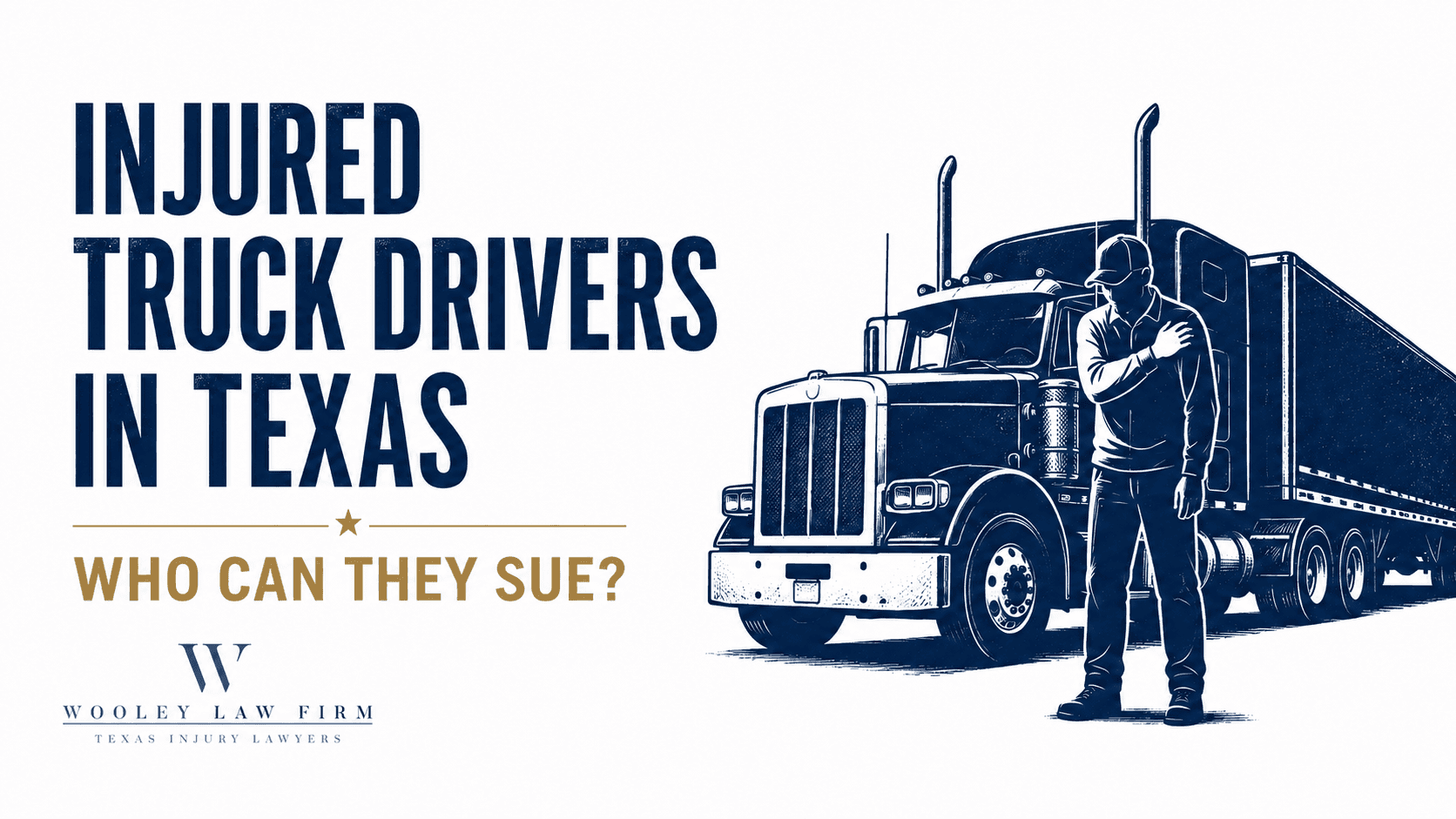
Truck drivers face some of the most dangerous working conditions in Texas. They spend long hours on highways, operate heavy commercial vehicles, work under strict delivery deadlines, and frequently depend on trucking companies to provide safe equipment, reasonable schedules, proper training, and lawful working conditions.
When a commercial driver is seriously injured or killed in a truck accident, the trucking company may quickly characterize the matter as a workers’ compensation claim. But the driver or surviving family members may have additional legal options.
Depending on the circumstances, an injured truck driver may be able to pursue claims against:
A trucking company that does not carry Texas workers’ compensation insurance;
A separate motor carrier;
A freight broker or logistics company;
The owner of the tractor or trailer;
A maintenance or repair company;
A tire, truck, or component manufacturer;
A shipper, warehouse, or cargo-loading company;
Another negligent driver; or
A roadway contractor or governmental entity.
The first question is not how to “avoid” workers’ compensation. The proper question is whether Texas workers’ compensation exclusivity applies and whether other responsible companies can be held accountable.
Can a Texas Truck Driver Sue the Trucking Company?
Sometimes.
Texas Labor Code section 408.001 generally provides that workers’ compensation benefits are the exclusive remedy of an employee covered by workers’ compensation insurance against the employer and certain people acting on the employer’s behalf.
That means a truck driver whose employer carries valid Texas workers’ compensation coverage may be prohibited from bringing an ordinary negligence lawsuit directly against that employer for a work-related injury.
However, that rule does not automatically apply merely because the trucking company says it does.
An attorney should investigate:
Whether the trucking company actually carried Texas workers’ compensation insurance;
Whether the policy covered the correct employing entity;
Whether the injured driver was covered under the policy;
Whether the driver was an employee, independent contractor, or owner-operator;
Whether multiple companies jointly employed or controlled the driver;
Whether a staffing or employee-leasing company was involved;
Whether another business contributed to the accident;
Whether an intentional-injury exception applies; and
In a fatal case, whether gross negligence supports an exemplary-damages claim.
A trucking company’s claim that an accident is “only a workers’ comp case” should not be accepted without reviewing the employment documents, insurance policies, contracts, and facts surrounding the crash.
Texas Nonsubscriber Claims Against Trucking Companies
Unlike most states, Texas generally allows private employers to operate without subscribing to the traditional workers’ compensation system.
An employer that does not carry qualifying Texas workers’ compensation coverage is commonly called a nonsubscriber.
When a trucking company is a nonsubscriber, an injured truck driver may be able to bring a negligence lawsuit directly against the company.
The lawsuit may allege that the trucking company:
Required the driver to work an unsafe schedule;
Pressured the driver to continue driving while fatigued;
Encouraged or required violations of hours-of-service rules;
Failed to provide reasonable rest opportunities;
Assigned the driver an unsafe commercial vehicle;
Failed to inspect, maintain, or repair the truck;
Ignored reports of mechanical problems;
Failed to train the driver;
Assigned unsafe routes or delivery deadlines;
Overloaded the truck or trailer;
Failed to establish reasonable safety policies; or
Failed to enforce its existing safety procedures.
A nonsubscriber claim can be significantly different from a workers’ compensation claim.
In a civil lawsuit, an injured driver may seek damages for physical pain, mental anguish, impairment, disfigurement, lost earning capacity, medical expenses, and other losses supported by the evidence.
Texas law may also limit certain defenses available to a nonsubscribing employer.
Whether a company is a subscriber cannot be determined simply by asking whether it has “insurance.” Occupational accident insurance, disability coverage, health insurance, and private employee benefit plans are not necessarily Texas workers’ compensation policies.
The policy and coverage documents must be reviewed carefully.
Claims Against Companies Other Than the Direct Employer
Even when the driver’s direct employer carries workers’ compensation insurance, the driver may still have a lawsuit against another company that contributed to the accident.
Workers’ compensation exclusivity does not automatically protect every business involved in a trucking operation.
A Separate Motor Carrier
The company listed on the driver’s paycheck may not be the same company that controlled the load, dispatch, schedule, route, truck, or safety program.
A separate motor carrier may be investigated when it:
Assigned the driver’s loads;
Controlled delivery schedules;
Monitored the driver through GPS or telematics;
Required the driver to follow specific routes;
Controlled safety procedures;
Had authority to remove the driver from service;
Owned or leased the commercial vehicle; or
Controlled how the transportation work was performed.
The motor carrier may argue that it was also the driver’s employer and is protected by workers’ compensation exclusivity. These defenses often involve complicated questions about borrowed employees, dual employment, statutory employment, and the right to control the driver’s work.
Contracts alone may not answer the question. Dispatch records, testimony, payroll documents, safety manuals, insurance policies, and evidence of actual control may all be important.
A Freight Broker or Logistics Company
Freight brokers and logistics companies frequently help arrange shipments, select carriers, communicate delivery expectations, and coordinate transportation services.
A broker is not automatically responsible whenever a truck driver is injured. Liability depends on the facts.
A claim may require investigation when the broker or logistics company:
Selected a carrier with a known history of safety violations;
Retained substantial control over the driver’s work;
Imposed dangerous delivery requirements;
Directed the manner in which the load was transported;
Ignored clear evidence that the carrier or equipment was unsafe; or
Participated in dispatch decisions that contributed to the crash.
The legal responsibilities of brokers and logistics providers are heavily disputed, making it important to examine what the company actually did rather than relying only on the title used in its contract.
The Owner of the Tractor or Trailer
Many commercial trucks and trailers are leased from separate companies.
The driver’s employer may operate the equipment without owning it. When defective or poorly maintained equipment contributes to an accident, the owner or leasing company may bear responsibility.
Potential claims may involve:
Failing to maintain the tractor or trailer;
Leasing unsafe equipment;
Ignoring known defects;
Failing to complete required repairs;
Concealing prior mechanical problems;
Failing to inspect safety-critical components; or
Allowing an unsafe vehicle to remain in service.
Ownership records, lease agreements, inspection documents, and maintenance responsibilities should be obtained early.
A Truck Maintenance or Repair Company
A third-party maintenance provider may be liable when negligent inspection or repair work contributes to a truck accident.
Potential maintenance failures include:
Improperly repaired brakes;
Failure to identify worn brake components;
Negligent steering repairs;
Incorrect tire installation;
Failure to tighten wheel components;
Improper suspension work;
Incomplete inspections;
Failure to diagnose reported mechanical problems; or
Representing that a commercial vehicle was safe when repairs remained necessary.
Federal motor-carrier safety regulations require commercial vehicles to be systematically inspected, repaired, and maintained. Maintenance records can help establish what the company knew, what work was performed, and whether the truck should have been placed out of service.
Injured in an Accident?
Free consultation. Tell us what happened and learn what options may be available.
A Tire, Truck, or Component Manufacturer
A defective commercial vehicle or component may support a product-liability claim.
Potentially defective products include:
Commercial truck tires;
Steering components;
Brake parts;
Wheels and hubs;
Suspension systems;
Coupling devices;
Seats and seat belts;
Cab structures;
Fuel systems; and
Electronic safety systems.
A manufacturer, distributor, or seller may be investigated for:
A manufacturing defect;
A dangerous product design;
Inadequate warnings;
Failure to issue or communicate a recall; or
Failure to provide reasonable crash protection.
The tractor, trailer, tires, and failed components should be preserved before they are repaired, discarded, sold, or destroyed.
A Shipper, Warehouse, or Cargo-Loading Company
Improperly loaded or secured cargo can make a tractor-trailer difficult or impossible to control.
Cargo may shift, roll, leak, fall, or suddenly change the vehicle’s center of gravity. This can contribute to rollovers, jackknifes, loss-of-control accidents, and trailer instability.
Depending on who controlled the loading process, potentially responsible parties may include:
The shipper;
A warehouse operator;
A loading contractor;
The motor carrier;
The trailer owner;
A cargo-securement company; or
Another business that prepared the load.
Important questions include:
Who loaded the cargo?
Who selected the securement devices?
Who determined the cargo’s placement?
Was the load weighed?
Was the weight distributed properly?
Were straps, chains, binders, or blocking adequate?
Did the shipper seal the trailer before the driver could inspect it?
Were the driver or carrier warned about unusual cargo characteristics?
Our article about unsecured cargo truck accidents in Texas explains how loading companies, carriers, shippers, and other businesses may share responsibility when cargo contributes to a commercial truck wreck.
Another Negligent Driver
Not every commercial truck accident is caused by the truck driver.
Another motorist may force a commercial driver to take sudden evasive action by:
Cutting in front of the truck;
Entering the truck’s lane;
Failing to yield;
Stopping suddenly;
Driving without lights;
Dropping debris onto the roadway;
Striking the tractor or trailer; or
Forcing the commercial vehicle onto the shoulder.
A claim may exist even when the other vehicle does not make physical contact with the truck.
Dash-camera footage, roadway cameras, business surveillance video, eyewitnesses, police recordings, physical evidence, cellphone data, and vehicle-location records may help identify the responsible driver.
A Road Contractor or Governmental Entity
Dangerous road conditions may also contribute to a commercial truck crash.
Potential hazards include:
Unsafe construction zones;
Missing warning signs;
Improperly marked lane shifts;
Pavement drop-offs;
Defective guardrails;
Standing water;
Poor drainage;
Debris;
Improperly placed equipment;
Dangerous work-zone barriers; or
Defective roadway design.
Claims against cities, counties, the State of Texas, and other governmental entities involve special immunity rules, notice requirements, and deadlines.
Private road contractors, engineering firms, and traffic-control companies may also be responsible depending on who created or controlled the dangerous condition.
These claims require immediate attention because construction layouts, warning signs, lane markings, and roadway conditions can change quickly.
Driver Fatigue and Unsafe Trucking Schedules
Fatigue is a major issue in commercial transportation cases, particularly when drivers are required to operate overnight, work irregular schedules, or meet aggressive delivery deadlines.
A fatigued-driving investigation should examine:
When the driver began working;
How many hours the driver had been on duty;
The driver’s schedule during the preceding days;
Whether the driver had a reasonable opportunity to sleep;
Whether dispatch contacted the driver during a rest period;
Whether the route or deadline changed;
Whether the electronic log was edited;
Whether on-duty time was improperly recorded as off-duty;
Whether the driver reported fatigue;
Whether the company pressured the driver to continue;
Whether the company used a claimed regulatory exception; and
Whether the driver’s compensation encouraged excessive hours.
Federal hours-of-service regulations limit driving and on-duty time for many commercial drivers and require qualifying rest periods. The specific rules and exceptions depend on the type of operation, vehicle, cargo, and route.
A trucking company should not be allowed to pressure a driver into operating while dangerously fatigued and later place all responsibility on that driver when an accident occurs.
Learn more in our discussion of truck-driver hours-of-service violations in Texas.
Claims After a Fatal Truck-Driver Accident
When a commercial driver is killed while working, surviving family members may have several potential sources of recovery.
The available claims depend on:
Whether the employer carried workers’ compensation insurance;
Whether the driver was covered under the policy;
Whether the employer was a nonsubscriber;
Whether a third party contributed to the accident;
Whether the employer acted with gross negligence; and
Which family members qualify to bring particular claims.
Eligible family members may be entitled to workers’ compensation death benefits when the employer carried valid coverage.
A subscribing employer is generally protected from an ordinary negligence lawsuit. Texas law, however, permits a surviving spouse or heirs to seek exemplary damages when an employee’s death was caused by the employer’s gross negligence or intentional conduct.
Gross negligence requires more than an ordinary mistake or safety violation. It generally requires evidence of an extreme degree of risk combined with actual awareness of that risk and conscious indifference to the safety of others.
Evidence that may support investigation of a gross-negligence claim includes allegations that a trucking company:
Knew a driver was dangerously fatigued;
Repeatedly required unlawful driving hours;
Ordered drivers to falsify electronic logs;
Threatened drivers for refusing unsafe assignments;
Knew that a truck had dangerous brake or steering defects;
Ignored repeated out-of-service violations;
Disabled safety equipment;
Continued using equipment after similar failures; or
Deliberately placed delivery demands above a known, extreme danger.
Family members may also bring wrongful-death and survival claims against responsible third parties that are not protected by the employer’s workers’ compensation coverage.
Possible third-party defendants include motor carriers, brokers, repair companies, manufacturers, loaders, shippers, road contractors, equipment owners, and negligent motorists.
The Intentional-Injury Exception
Texas recognizes a narrow exception to workers’ compensation exclusivity for intentional injuries.
This standard is difficult to satisfy.
An employer’s negligence, unsafe practices, regulatory violations, or even reckless conduct may not be enough. The evidence generally must show that the employer intended to cause the injury or knew that its conduct was substantially certain to injure the particular employee.
Most commercial driver cases involving unsafe schedules, defective equipment, or inadequate training are evaluated as negligence or gross-negligence cases rather than intentional-injury claims.
The exception may still require investigation when the facts involve deliberate conduct directed toward the driver or unusually strong evidence that the employer knew injury was substantially certain.
Is the Driver an Employee or an Independent Contractor?
Trucking companies frequently classify drivers as independent contractors or owner-operators.
The classification used in a contract is important, but it does not necessarily decide the issue.
Courts may examine the company’s right to control the details and methods of the driver’s work. Relevant evidence may include:
Who assigned the loads;
Who controlled the delivery deadlines;
Who selected the routes;
Whether the driver could reject assignments;
Who owned the tractor and trailer;
Who paid for fuel and repairs;
Who provided insurance and permits;
Whether the driver could work for other carriers;
Who controlled safety procedures;
Who could terminate the relationship;
How the driver was paid; and
Whether the company controlled the driver’s daily work.
A driver described as an independent contractor may legally be treated as an employee in some circumstances.
The opposite dispute can also arise. A trucking company seeking workers’ compensation immunity may need to establish that the driver was its covered employee.
The issue becomes more complicated when the driver was hired through a staffing agency, professional employer organization, leasing company, or related trucking business. Multiple companies may claim that the driver was a borrowed or dual employee.
Employment agreements, insurance policies, dispatch records, payroll documents, and evidence of actual control should all be reviewed.
Can a Truck Driver Have Both a Workers’ Compensation Claim and a Lawsuit?
Yes, in some cases.
An injured truck driver may receive workers’ compensation benefits from the employer while pursuing a third-party lawsuit against another company or driver that contributed to the accident.
For example, a driver may have:
A workers’ compensation claim through the direct employer;
A negligence claim against a maintenance company;
A product-liability claim against a component manufacturer;
A lawsuit against another motorist; or
A claim against a loading company responsible for unstable cargo.
The workers’ compensation carrier may assert a right of subrogation or reimbursement from the third-party recovery. That issue must be evaluated when negotiating or resolving the civil lawsuit.
The existence of a workers’ compensation claim does not necessarily mean that no other claim exists.
Evidence That Should Be Preserved After a Commercial Truck Accident
Trucking companies, insurers, and third-party administrators often begin investigating serious accidents immediately.
The injured driver or family should also act quickly to preserve evidence.
Important evidence may include:
Electronic logging device data;
Engine-control-module data;
Event-data-recorder information;
Forward-facing camera footage;
Driver-facing camera footage;
Dispatch messages;
GPS and telematics data;
Cellphone records;
Bills of lading;
Fuel receipts;
Toll records;
Scale tickets;
Payroll and time records;
Driver vehicle inspection reports;
Maintenance and repair records;
Tire records;
Prior mechanical complaints;
Company safety policies;
Training records;
Personnel records;
Drug and alcohol testing documents;
Weather records;
Police photographs;
911 recordings;
Roadway surveillance video;
Witness information; and
The tractor, trailer, tires, cargo, and failed components.
Video and electronic data may be automatically overwritten. The truck may also be repaired, returned to service, sold, salvaged, or destroyed.
A preservation letter should specifically identify the evidence that must be retained. In an appropriate case, court intervention may be necessary to prevent critical evidence from being altered or destroyed.
Read more about the evidence that matters in an 18-wheeler case and how commercial truck black-box data can help reconstruct a crash.
Compensation Available to an Injured Truck Driver
The compensation available depends on whether the case involves workers’ compensation, a nonsubscriber employer, a third-party defendant, or multiple claims.
A civil lawsuit may seek compensation for:
Past and future medical expenses;
Lost wages;
Loss of future earning capacity;
Physical pain;
Mental anguish;
Physical impairment;
Disfigurement;
Rehabilitation expenses;
Necessary medical equipment;
Home modifications;
Vehicle modifications;
Attendant-care expenses; and
Other damages supported by the evidence.
A fatal commercial truck case may involve:
Funeral and burial expenses;
Loss of financial support;
Loss of companionship and society;
Mental anguish;
Loss of inheritance;
Survival damages for harm suffered before death; and
Exemplary damages when permitted by Texas law.
The driver may also have occupational accident coverage, disability benefits, uninsured or underinsured motorist coverage, health insurance, or other contractual benefits.
Each potential source of compensation should be identified and evaluated.
Do Not Let the Trucking Company Blame the Driver Without an Investigation
Commercial drivers are often blamed immediately after serious truck accidents.
That conclusion may overlook evidence controlled by the trucking company or another business.
A complete investigation may reveal:
Excessive working hours;
Dispatch pressure;
Altered electronic logs;
Inadequate training;
Defective brakes or steering;
Tire failure;
Improper maintenance;
Shifting cargo;
Unsafe company policies;
Another negligent motorist; or
A dangerous roadway condition.
The driver may have no way of knowing that a component was about to fail, that a repair had been performed incorrectly, or that the company had ignored earlier complaints.
Liability should be based on preserved evidence—not assumptions about the person behind the wheel.
The Wooley Law Firm Represents Injured Truck Drivers and Their Families
Truck-driver injury cases involve issues that do not arise in ordinary motor-vehicle claims.
An attorney may need to analyze:
Texas workers’ compensation exclusivity;
Nonsubscriber liability;
Third-party negligence;
Gross negligence;
Wrongful-death and survival claims;
Employee and independent-contractor classifications;
Borrowed or dual employment;
Federal motor-carrier regulations;
Commercial insurance policies; and
Electronic evidence stored by the truck and carrier.
The Wooley Law Firm investigates serious commercial truck accidents throughout Dallas-Fort Worth and across Texas. We examine the employment and insurance relationships, identify every potentially responsible business, preserve electronic and physical evidence, and determine whether the driver or family has claims outside the workers’ compensation system.
Learn more about our representation in Dallas truck accident cases and our approach to Texas 18-wheeler and commercial truck claims.
If a commercial truck driver was seriously injured or killed in Texas, the case should not automatically be treated as driver error or limited to workers’ compensation. The driver or family may have the right to pursue claims against a nonsubscribing employer, motor carrier, maintenance provider, manufacturer, cargo-loading company, broker, equipment owner, roadway contractor, negligent motorist, or another responsible party.
Call (214) 699-6524 for a free consultation. You don’t pay unless we win.
Disclaimer
This article provides general information and is not legal advice. Workers’ compensation coverage, employment status, third-party liability, wrongful-death rights, and filing deadlines depend on the facts of each case. Reading this article does not create an attorney-client relationship. Anyone involved in a serious commercial truck accident should consult a qualified Texas attorney about the specific circumstances.
Topics
Share This Article

Andrew J. Wooley
Personal Injury Attorney
Andrew J. Wooley is a dedicated personal injury attorney based in Dallas, Texas. He focuses on helping accident victims recover fair compensation for their injuries. With a commitment to personalized service, Andrew works directly with each client to understand their unique situation and fight for their rights.