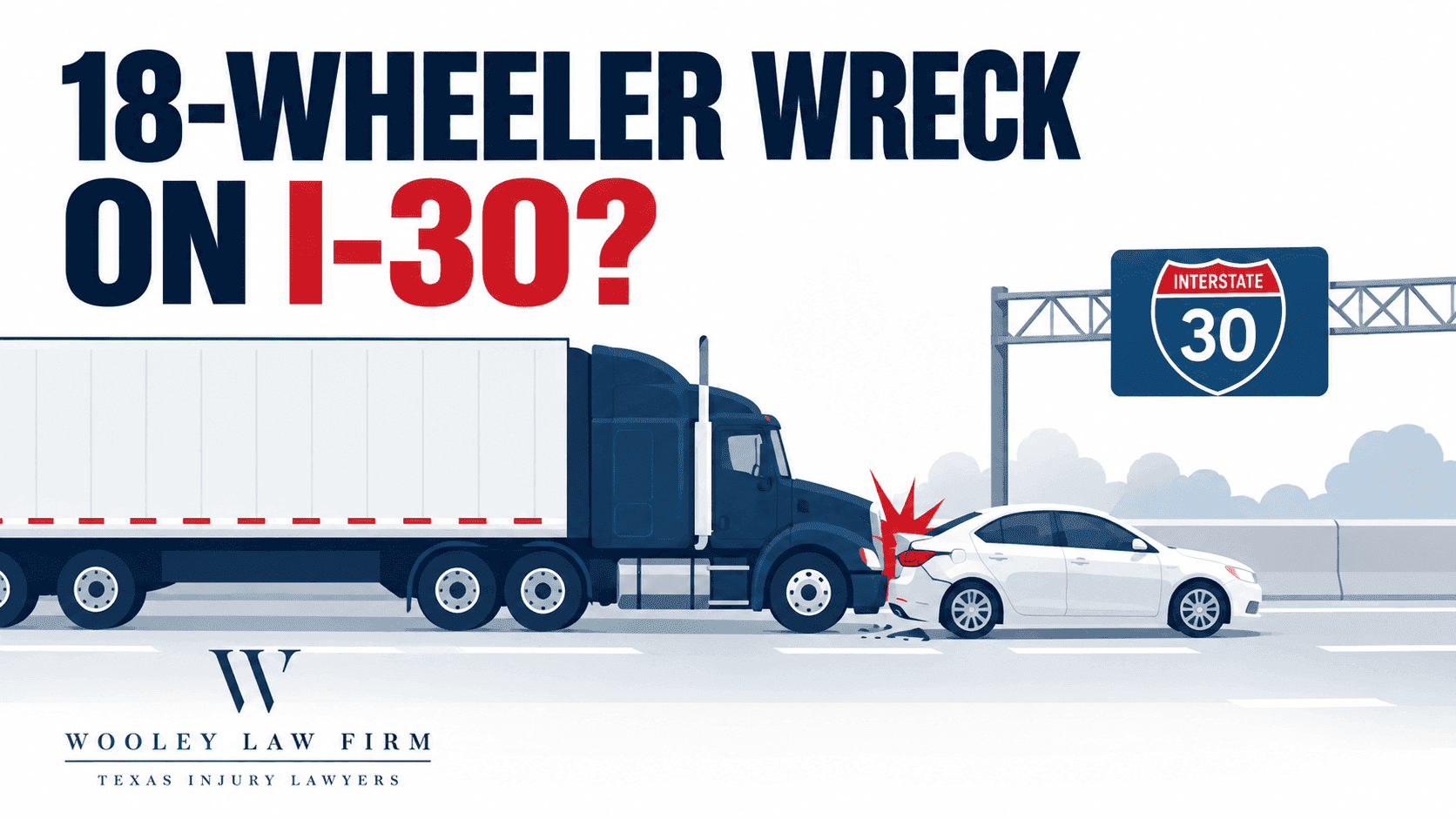
You may never have been hit directly by the 18-wheeler. Another car may have struck you. You may have been pushed into the vehicle ahead. Or several impacts may have occurred before anyone realized that a truck farther back started the sequence. That is what makes a multi-vehicle 18-wheeler wreck on I-30 different from many ordinary two-car accidents.
When a commercial truck fails to stop, loses control, or makes an unsafe lane change in dense traffic, several vehicles can become involved almost immediately. The vehicle that physically hits you may not be the vehicle that caused the wreck.
For broader information about these cases, visit our Dallas truck accident lawyer page.
How One 18-Wheeler Can Cause a Multi-Vehicle I-30 Wreck
A truck rear-ends stopped traffic
The 18-wheeler strikes Vehicle A. Vehicle A is pushed into Vehicle B. Vehicle B moves into Vehicle C. The force from the first impact can travel through a line of vehicles even though the truck physically contacts only one of them.
A truck makes an unsafe lane change
Vehicle A swerves away from the trailer. Vehicle B brakes to avoid Vehicle A. Vehicle C rear-ends Vehicle B. The truck may never make contact with every damaged vehicle.
A truck forces a vehicle into a barrier
The passenger vehicle loses control, rebounds into traffic, and is struck again. What appears to be a secondary collision may have begun with the truck’s lateral movement.
Our article on who is responsible when an 18-wheeler causes a chain-reaction crash in Dallas explains why the first unsafe act matters.
The Last Impact May Not Tell You Who Caused the Wreck
Imagine you are stopped in traffic. The car behind you is also stopped. An 18-wheeler hits that car and pushes it into you. Your vehicle shows impact from the passenger car, not from the tractor-trailer. Looking only at the final contact could lead to the wrong conclusion.
A reconstruction should determine which vehicles were moving, which were stopped, where each impact occurred, and whether later collisions were a foreseeable consequence of the first impact.
Why Several Insurance Companies May Point Fingers
Multi-vehicle crashes can involve several insurers with different financial interests. One may argue its insured was pushed. Another may contend there were two separate events. The trucking company may accept responsibility for one impact but dispute the remainder of the sequence. Those positions should be tested against the physical and electronic evidence.
Truck Camera Footage Can Show the Beginning of the Wreck
A forward-facing truck camera may capture traffic conditions before the first impact. It can show brake lights, stopped traffic, lane changes, distance, roadway conditions, and the driver’s approach. Driver-facing footage may show whether the driver was looking forward, handling a phone, reaching for something, or showing signs of fatigue.
Other Drivers’ Cameras Can Be Just as Important
Do not focus only on the truck’s camera system. Another motorist may have a dash camera. A rideshare vehicle may use multiple cameras. A commercial fleet vehicle may record continuously. A neutral driver who was never hit may have captured the entire sequence from a useful angle.
Electronic Truck Data Can Build the Collision Timeline
Electronic records may help establish speed, brake timing, hard-braking events, accelerator position, GPS movement, collision warnings, and automatic-braking activity. Those data points can be synchronized with video, witness statements, vehicle damage, and police photographs.
If the wreck involved stopped traffic, read our guide to automatic emergency braking data in truck-wreck claims.
What If the Truck Driver Says the Brakes Failed?
A claimed mechanical failure should trigger a maintenance investigation. The tractor and trailer should be treated as separate pieces of equipment because they may have different owners, components, service histories, and contractors.
Tractor brake inspections
Trailer brake inspections
Driver inspection reports
Prior defect notices
Repair recommendations and invoices
Brake adjustment and air-system issues
Who performed the work
Whether the driver attempted to brake according to electronic data
Our article about brake failure after a rear-end Dallas 18-wheeler wreck covers these issues in greater detail.
An Unsafe Lane Change Can Cause a Chain Reaction Without Contact
A truck can create a dangerous sequence even if it never touches the injured person’s vehicle. If an 18-wheeler moves into an occupied lane and a passenger driver reasonably swerves or brakes to avoid it, the resulting impacts may still need to be traced back to the truck’s movement.
See our related article about an 18-wheeler lane change causing a multi-vehicle wreck in Dallas.
Why Damage to Every Vehicle Matters
Damage patterns can help reconstruct impact order. Investigators may compare front, rear, and side damage; crush depth; paint transfer; trailer marks; wheel damage; barrier contact; airbag deployment; and final resting positions. No single mark tells the whole story, but the collection of physical evidence can support or contradict the accounts given by the drivers.
The Police Crash Report May Not Resolve Everything
A police report is useful for identifying drivers, vehicles, insurers, witnesses, citations, and preliminary contributing factors. But officers usually arrive after the collision and may not have access to internal trucking-company evidence. A civil investigation can therefore extend well beyond the initial report.
· Truck black-box or ECM information
· Camera downloads
· ELD records
· GPS and telematics
· Dispatch communications
· Driver qualification and safety records
· Maintenance and repair files
· Corporate ownership and lease agreements
More Than One Driver Can Potentially Share Responsibility
A chain-reaction wreck does not necessarily have only one contributing cause. An 18-wheeler may start the emergency while another driver follows too closely or reacts negligently. The sequence should be reconstructed carefully before responsibility is allocated.
The Trucking Company May Be Responsible Along With the Driver
The driver’s conduct may explain the final seconds before impact. The carrier’s records may explain why the driver was in that position in the first place. Depending on the evidence, hiring, training, supervision, retention, scheduling, hours-of-service monitoring, safety alerts, maintenance, or dispatch practices may become relevant.
Our article Can I Sue the Trucking Company After a Dallas 18-Wheeler Wreck? discusses corporate-liability issues in greater depth.
Tractor Ownership and Trailer Ownership May Be Different
One company may own the tractor while another owns the trailer. An owner-operator may drive under a motor carrier’s authority. A leasing company may own the trailer. A separate company may have arranged the freight. These distinctions matter because different entities may possess different records, maintenance duties, and insurance coverage.
Injured in an Accident?
Free consultation. Tell us what happened and learn what options may be available.
Driver Fatigue Can Play a Role in Highway Pileups
A fatigued commercial driver may react slowly, miss brake lights, drift lanes, misjudge stopping distance, or fail to process congestion until too late. ELD records are useful, but a meaningful fatigue investigation may also compare dispatch times, pickup and delivery records, fuel stops, GPS, tolls, camera footage, and the driver’s actual opportunities for rest.
Important Evidence After an I-30 Multi-Vehicle Truck Crash
· Forward-facing, driver-facing, side, and rear camera footage, if installed
· Engine-control-module and event data
· Electronic logging-device records and hours-of-service information
· GPS, telematics, hard-braking, speed, and safety-alert data
· Dispatch messages, trip assignments, bills of lading, and delivery records
· Driver qualification, training, safety, and disciplinary records
· Tractor and trailer inspection, maintenance, and repair records
· Post-crash photographs, measurements, tow records, and witness information
· The condition of the tractor, trailer, tires, brakes, lights, and other relevant components
· Damage and photographs from every involved vehicle
· 911 recordings and police photographs
· Traffic-camera or business-surveillance footage where available
· Tow and storage records showing where the vehicles were taken
Serious Injuries in I-30 Chain-Reaction Wrecks
Multiple impacts can expose occupants to different directions of force. A person may experience an initial rear impact, a forward impact, a side impact, airbag deployment, seat-belt loading, and rotation of the vehicle. Potential injuries include traumatic brain injuries, spinal injuries, fractures, shoulder and knee injuries, internal injuries, nerve injuries, and permanent impairment.
What If the Trucking Insurer Calls Quickly?
Commercial insurers often begin investigating immediately. An adjuster may request a recorded statement, medical authorization, prior medical information, or a release. An injured person should understand what is being requested before providing broad authorizations or detailed statements, particularly when the full collision sequence has not yet been reconstructed.
What Should You Do After a Multi-Vehicle I-30 Truck Wreck?
Call emergency services and seek appropriate medical care.
Photograph every vehicle you can safely document.
Take wide photographs showing vehicle positions, debris, roadway configuration, and barriers.
Identify the tractor, trailer, company markings, license plates, and USDOT information.
Obtain witness names and contact information.
Save dash-camera and phone video.
Keep tow and storage paperwork.
Preserve repair estimates and photographs before damaged vehicles are altered.
Keep medical, wage-loss, and expense documentation.
Consider legal advice before detailed recorded statements or broad releases.
Address preservation of trucking-company evidence promptly.
Talk to a Dallas-Fort Worth Truck Wreck Lawyer About an I-30 Collision
A multi-vehicle I-30 wreck should not be reduced to one question: “Which car hit me?” The more useful questions may be: What started the emergency? What was the 18-wheeler doing? When did it brake? Did the driver see traffic? Was the driver fatigued? Did the truck change lanes? What do the cameras show? Which companies were responsible for the tractor, trailer, driver, and transportation operation?
The Wooley Law Firm represents people seriously injured in truck crashes throughout Dallas-Fort Worth and North Texas.
Call (214) 699-6524 for a free consultation. You don’t pay unless we win.
How Investigators Separate the First Impact From Later Impacts
In a chain-reaction collision, the order of impacts can become one of the most disputed issues. Occupants may hear several crashes in rapid succession and have difficulty identifying which came first. The driver at the front may only know that the vehicle suddenly moved. The driver in the middle may believe there were two impacts but be unsure of the order.
Vehicle damage, event data, airbag information, dash-camera audio, witness statements, police photographs, and final resting positions can help separate the sequence. Sometimes the evidence shows one continuous push. In other cases, it shows distinct events. That distinction can affect which driver or company is responsible for particular injuries and property damage.
Why 911 Calls and Early Statements Can Matter
Calls made immediately after a multi-vehicle wreck can capture observations before people have had time to compare stories or speak with insurers. A caller may report that a truck “never slowed down,” that a tractor-trailer moved across several lanes, or that one vehicle was already stopped before being hit. Those early statements are not automatically conclusive, but they can help identify witnesses and preserve details that might otherwise be forgotten.
Body-camera recordings and officer conversations can also show what drivers and witnesses said at the scene. If later accounts change, those early statements may become important when reconstructing the collision.
Why Every Insurance Company May View the Wreck Differently
Each insurer approaches a chain reaction from the perspective of its own insured. The insurer for the last passenger car may argue that the truck started everything. The truck carrier may argue that passenger vehicles collided first. Another insurer may claim there were multiple independent accidents. Those competing positions can delay resolution while each company waits for more evidence.
A careful claim presentation should therefore explain the sequence rather than simply send bills and demand payment. Photographs, diagrams, witness accounts, electronic data, and medical timing can help connect the initial negligent act to the later impacts.
How Multiple Impacts Affect Injury Causation
An injured person in a pileup may experience several distinct forces: rear impact, forward rebound, side impact, rotation, airbag deployment, and seat-belt loading. An insurer may attempt to attribute the injury to a later impact involving a different vehicle. Medical history and reconstruction can become important when determining whether the injuries are reasonably related to the overall crash sequence or to a particular event.
This issue is especially important when different defendants point at each other. The injured person should not be forced to guess which millisecond caused a particular disc injury or concussion. The evidence should be developed so medical and reconstruction experts can address causation where necessary.
Commercial Coverage and Multiple Defendants
A serious I-30 collision may involve several liability policies. The truck carrier may have primary and excess coverage. Passenger vehicles may have their own liability limits. The injured person may also have underinsured motorist coverage. Determining how those coverages interact can matter when several people are injured and available limits are disputed or insufficient.
The existence of multiple defendants can also affect settlement strategy. One party may be ready to resolve its share while another disputes liability. Releases should be reviewed carefully so resolving a claim against one person or company does not unintentionally affect rights against another.
When a Reconstruction Expert May Be Useful
Not every chain-reaction case requires an accident-reconstruction expert. But expert analysis can be valuable when the impact order is disputed, the truck’s electronic data needs interpretation, the forces are complex, or the defense claims the passenger vehicles collided before the truck became involved. The expert may use photographs, measurements, vehicle specifications, event data, video, and physical evidence to test competing versions of the crash.
The purpose should be to answer a real disputed question, not to add unnecessary complexity. A straightforward rear-end sequence supported by video may require far less expert work than a six-vehicle collision with conflicting accounts.
Why Tow-Yard and Salvage Records Can Matter
After a major I-30 wreck, vehicles may be scattered among tow yards, repair facilities, salvage lots, and carrier terminals. Locating them quickly can matter if physical inspection is necessary. Tow records can also help establish where the tractor and trailer went, when they were moved, and whether repairs or disposal occurred before an inspection request was made.
Passenger vehicles can also contain important evidence. A total-loss carrier may send a car to salvage quickly. If the damage pattern is important to the collision sequence, photographs or inspection should be considered before the vehicle is destroyed or sold.
How a Multi-Vehicle Truck Case Can Be Organized Without Losing the Big Picture
A large I-30 collision can generate an overwhelming amount of information: several crash reports or supplements, multiple insurers, tow records, photographs, medical records, vehicle estimates, video clips, trucking documents, and conflicting statements. Organizing the evidence by timeline can make the case easier to understand. The timeline may begin before the collision with the truck’s route, speed, driver hours, and dispatch activity; continue through the first impact and later collisions; and end with the post-crash investigation, repairs, and medical treatment.
This structure helps separate questions that are sometimes mixed together. Liability asks what conduct caused the chain reaction. Causation asks how the collision sequence produced the claimed injuries. Damages address the medical, financial, and personal consequences. Insurance analysis identifies which policies may respond. Keeping those questions distinct while showing how they connect can make a complicated pileup understandable to an adjuster, judge, or jury.
It also helps identify gaps early. If the sequence depends on one missing dash-camera clip, that should be pursued. If the truck’s speed is disputed, electronic data may be more important than additional witness interviews. If several injured people are competing for limited coverage, policy information becomes urgent. A disciplined investigation prioritizes the evidence that can change the outcome rather than collecting documents without a plan.
Why Early Settlement Offers Can Be Complicated in a Pileup
An insurer may make an early offer before the full chain-reaction investigation is complete. That can be tempting when the vehicle is totaled, medical bills are arriving, and several insurance companies are pointing at one another. But a multi-vehicle case may still have unanswered questions about which impact caused which damage, whether additional commercial coverage exists, whether other injured people are making claims against the same policy, and whether future medical care will be necessary.
A release should therefore be reviewed carefully. Resolving a claim against one driver or carrier can have consequences for claims against others, depending on the wording and circumstances. The safest approach is to understand the collision sequence, available defendants, policy structure, injuries, and future needs before signing away rights. In a complicated I-30 truck wreck, the value of patience is not delay for its own sake; it is having enough evidence to make an informed decision.
Frequently Asked Questions
What if another car hit me instead of the truck?
The investigation should determine what caused that vehicle to hit you. The final impact may not identify the party that started the sequence.
Can an 18-wheeler be responsible without hitting my car?
Potentially. A truck’s unsafe movement may create an emergency that causes surrounding vehicles to collide.
Can several drivers share fault?
Depending on the facts, yes. Multi-vehicle wrecks may involve several contributing acts.
Why is truck video important?
It may show the beginning of the collision sequence and the traffic conditions before the first impact.
Should every vehicle be inspected?
Potentially. Damage patterns across multiple vehicles can help reconstruct impact order and force.
Disclaimer: This article is for general informational purposes only and is not legal advice. Reading it does not create an attorney-client relationship. Every case is different.
Topics
Share This Article

Andrew J. Wooley
Personal Injury Attorney
Andrew J. Wooley is a dedicated personal injury attorney based in Dallas, Texas. He focuses on helping accident victims recover fair compensation for their injuries. With a commitment to personalized service, Andrew works directly with each client to understand their unique situation and fight for their rights.