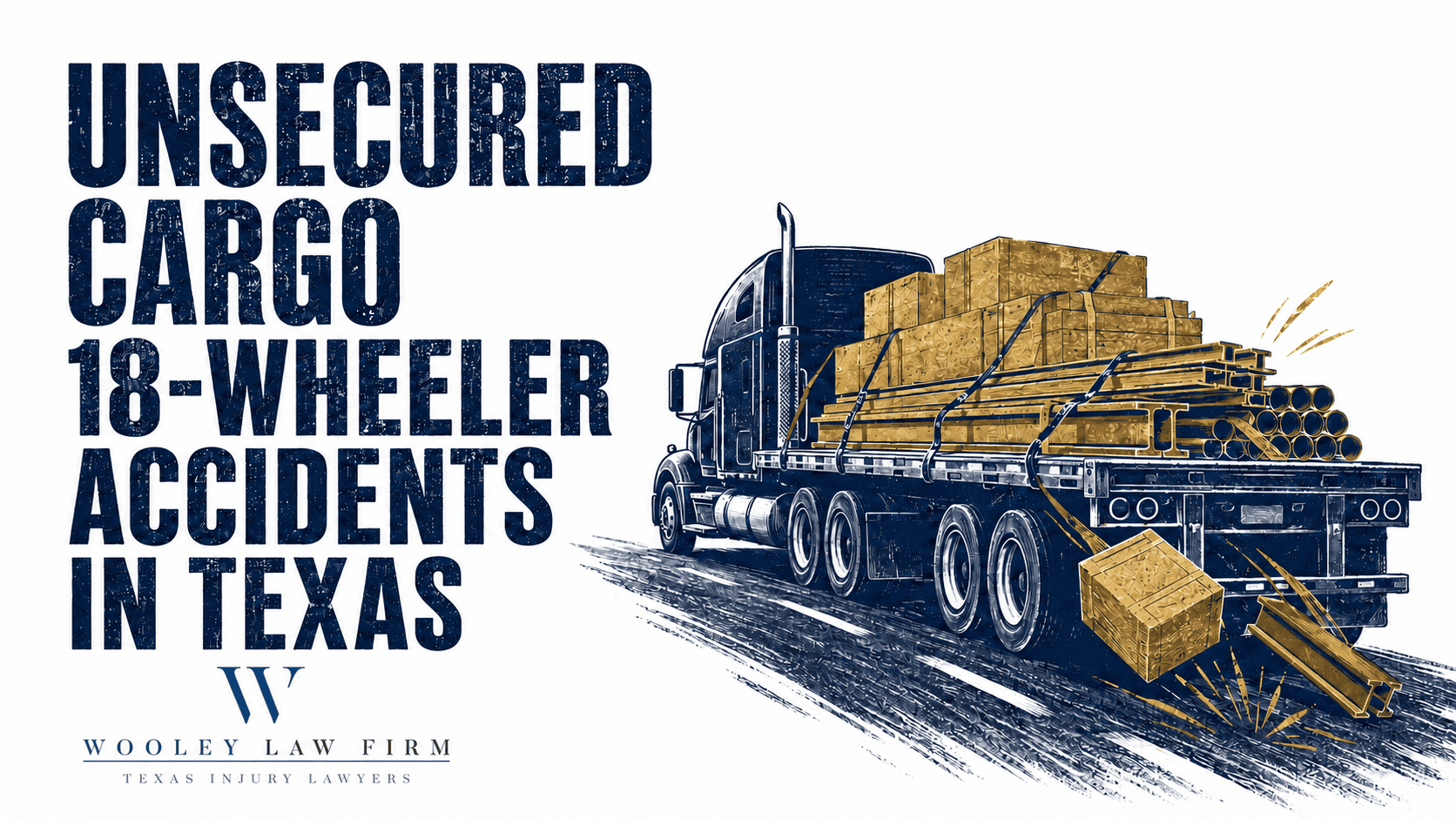
Cargo carried by an 18-wheeler can weigh tens of thousands of pounds. If that load is not properly distributed, blocked, braced, tied down, or contained, it can turn into a deadly highway hazard.
Cargo may fall from a flatbed directly into traffic. A tire, piece of equipment, steel pipe, lumber, or construction material may bounce across the road and strike another vehicle. Cargo can also shift inside a trailer, moving the truck’s center of gravity and causing the driver to lose control or the trailer to overturn.
These accidents are rarely as simple as blaming the truck driver. The trucking company, shipper, warehouse, cargo-loading contractor, trailer owner, maintenance provider, or manufacturer of a failed securement device may also be responsible.
The Wooley Law Firm represents people injured in serious Dallas 18-wheeler and commercial-truck accidents. When unsecured cargo causes a collision, we investigate how the load was prepared, who inspected it, what securement equipment was used, and which company controlled each stage of the shipment.
How an Improperly Secured Load Can Cause an 18-Wheeler Collision
Cargo does not have to strike another vehicle directly to cause a serious wreck. Improper loading or securement can affect the truck’s balance, steering, braking, and stability.
Cargo Can Fall From the Trailer
Flatbed trailers commonly transport exposed cargo such as:
Steel coils, beams, and pipes
Lumber and building materials
Heavy machinery
Concrete barriers
Tires and automotive parts
Construction equipment
Scrap metal
Large containers or crates
These loads may depend on chains, straps, binders, blocking, bracing, stakes, or other securement systems. If the equipment is damaged, improperly positioned, insufficient for the cargo’s weight, or not tightened correctly, the load can slide or fall from the trailer.
A motorist may be struck by the cargo itself or may crash while trying to avoid debris. Falling cargo can also create a chain-reaction collision involving multiple vehicles.
Shifting Cargo Can Cause a Rollover
A trailer’s load must be properly distributed and secured against movement. When heavy cargo shifts during a turn, lane change, or emergency maneuver, it can suddenly move the truck’s center of gravity.
That shift may pull the trailer sideways or cause it to tip. Once the trailer begins to roll, it may drag the tractor with it, crush a nearby vehicle, spill cargo across multiple lanes, or trigger a major highway pileup.
Shifting cargo is one of several issues that should be investigated after a Dallas truck rollover accident.
Poor Weight Distribution Can Affect Steering and Braking
A load does not have to break loose to be dangerous. Cargo placed too far forward, too far back, too high, or unevenly from side to side may make the truck harder to control.
Improper distribution can:
Overload one or more axles
Reduce traction on the steering axle
Increase stopping distance
Make the trailer more likely to sway
Place excessive stress on tires and suspension components
Increase the risk of a jackknife or rollover
A truck may therefore collide with another vehicle even though the cargo remains inside the trailer.
Securement Equipment Can Break or Release
Cargo straps, chains, hooks, anchor points, winches, and binders must be appropriate for the load and kept in usable condition. A worn strap, damaged chain, defective latch, corroded anchor point, or improperly closed trailer door may fail at highway speed.
An investigation should determine whether the equipment was defective, poorly maintained, used incorrectly, or simply inadequate for the cargo being transported.
Federal Cargo-Securement Rules for Commercial Trucks
Federal regulations establish requirements intended to prevent cargo from shifting or falling from commercial vehicles.
Under 49 C.F.R. § 393.100, a commercial motor vehicle transporting cargo on a public road must be loaded and equipped so that its cargo does not leak, spill, blow, or fall from the vehicle. Cargo must also be contained, immobilized, or secured so that shifting does not adversely affect the truck’s stability or maneuverability.
Additional regulations address the required strength and condition of securement systems and establish specific rules for commodities such as logs, metal coils, concrete pipe, automobiles, heavy equipment, and large boulders.
Federal law also places responsibilities on drivers and motor carriers. 49 C.F.R. § 392.9 generally prohibits a driver from operating—and a motor carrier from requiring or permitting operation of—a commercial vehicle unless its cargo is properly distributed and adequately secured.
Depending on the type of cargo and trailer, the driver may also be required to inspect the cargo and securement devices before driving and reexamine them during the trip. Exceptions can apply, including circumstances involving certain sealed trailers or loads the driver has been ordered not to inspect.
A violation does not automatically decide every injury claim. However, evidence that a company or driver failed to comply with an applicable safety rule may be important in determining negligence and responsibility.
Injured in an Accident?
Free consultation. Tell us what happened and learn what options may be available.
Who Can Be Liable for an Unsecured-Load Truck Accident?
The responsible parties depend on who loaded the cargo, who inspected it, who controlled the shipment, and why the securement system failed.
The Truck Driver
The driver may be responsible for failing to inspect an accessible load, ignoring a visibly loose strap, failing to perform required rechecks, or continuing to drive after noticing that the cargo had shifted.
Drivers must also respond appropriately when a truck begins pulling, leaning, swaying, or handling differently. Those symptoms may indicate that the cargo has moved.
The Trucking Company or Motor Carrier
A trucking company may be liable for its own unsafe conduct, including:
Failing to train drivers on cargo securement
Using damaged or inadequate securement equipment
Failing to enforce inspection procedures
Pressuring a driver to continue with an unsafe load
Assigning an unsuitable trailer for the cargo
Failing to maintain the truck or trailer
Permitting an overloaded or improperly loaded vehicle onto the road
The carrier may also be legally responsible for the negligence of a driver acting within the course and scope of employment.
The Shipper, Warehouse, or Loading Company
A separate business may have selected, arranged, loaded, or secured the cargo before the driver arrived. This is common when goods are loaded at a warehouse, distribution center, construction site, manufacturing plant, or shipping terminal.
A shipper or loading contractor may be responsible if its employees:
Used the wrong number or type of tiedowns
Failed to block cargo against movement
Stacked the load unsafely
Distributed the weight unevenly
Concealed a dangerous loading condition
Provided inaccurate information about the cargo’s weight
Loaded a sealed trailer that the driver could not reasonably inspect
The Federal Motor Carrier Safety Administration explains that a driver is not necessarily required to personally load, block, brace, and tie down every shipment. That is one reason an investigation must identify who actually handled the cargo instead of assuming the driver performed every loading task.
The Trailer Owner or Equipment-Leasing Company
The tractor and trailer may be owned by different companies. A trailer owner or leasing company could bear responsibility if defective doors, latches, anchor points, flooring, sidewalls, or other components allowed the cargo to escape.
A Maintenance Company or Securement-Equipment Manufacturer
A maintenance provider may be responsible if poor repairs contributed to a component failure. A manufacturer or seller may also be investigated when a defective strap, chain, binder, hook, anchor point, latch, or trailer component failed during normal use.
How The Wooley Law Firm Identified a Commercial Vehicle After Cargo Fell Into Traffic
The Wooley Law Firm represented a client who was injured when a tire fell from the back of a trailer on a highway. The tire bounced over the median, entered oncoming traffic, and struck our client’s vehicle.
The commercial vehicle did not remain at the scene, making identification of the responsible parties a major issue.
We located surveillance video and used it to track down the commercial vehicle involved. After identifying the vehicle and pursuing the case through discovery, we determined who was responsible for securing the load. We obtained full compensation for our client’s injuries.
That case illustrates why an immediate investigation matters. Without the surveillance footage, it could have been much more difficult to identify the vehicle, reconstruct the shipment, and determine who was responsible for the tire.
Every case is different, and past results do not guarantee a similar outcome.
Evidence That Can Prove Who Secured the Load
The police report may describe the debris or resulting collision, but it may not identify everyone involved in loading and transporting the cargo. Important evidence can include:
Traffic, surveillance, dash-camera, and nearby business video
Photographs of the cargo, debris, trailer, and securement devices
Bills of lading and shipping documents
Loading diagrams, weight tickets, and scale records
Driver vehicle inspection reports
Cargo-inspection and reinspection records
Warehouse logs and security footage
Dispatch, GPS, and route-tracking data
Driver and employee training materials
Contracts between the shipper, carrier, and loading company
Company cargo-securement policies
Maintenance and repair records
The broken straps, chains, binders, or trailer components
Electronic control module and telematics data
Witness statements
Video can be overwritten, physical evidence can be repaired or discarded, and electronic information may be retained only temporarily. Our article on why truck-accident evidence can disappear quickly explains why early preservation efforts can make a substantial difference.
What Compensation May Be Available?
Someone injured by falling or shifting truck cargo may be able to pursue compensation for losses such as:
Emergency and hospital bills
Surgery, rehabilitation, and future medical care
Lost wages and reduced earning capacity
Physical pain and impairment
Mental anguish
Disfigurement
Vehicle damage and other property loss
Losses resulting from a permanent disability
The available damages depend on the injuries, insurance coverage, responsible parties, and evidence connecting the unsafe load to the collision.
Talk to a Dallas Unsecured-Cargo Truck Accident Lawyer
Unsecured-load cases require more than showing that debris was present in the road. The investigation must identify where the cargo came from, who loaded it, who inspected it, which companies controlled the shipment, and why the securement system failed.
The Wooley Law Firm investigates 18-wheeler, flatbed, and falling-cargo accidents throughout Dallas–Fort Worth and across Texas. We work to preserve video, locate commercial vehicles, obtain loading and inspection records, and identify each potentially responsible company.
Call (214) 699-6524 for a free consultation. You do not pay unless we win.
Frequently Asked Questions
Is the truck driver always liable when cargo falls from a trailer?
No. The driver may be responsible, but liability can also extend to the trucking company, shipper, warehouse, loading contractor, trailer owner, maintenance provider, or equipment manufacturer. The evidence must show who controlled the loading and securement process.
What if the cargo fell from an unidentified truck?
The vehicle may sometimes be identified through surveillance footage, traffic cameras, dash-camera video, witness information, shipping records, or distinctive markings on the tractor, trailer, or cargo. The search should begin quickly because video may be overwritten.
Can a shifting load cause an accident without falling from the trailer?
Yes. Cargo that moves inside or across a trailer can destabilize the truck, interfere with steering, increase stopping distance, or cause a jackknife or rollover.
Do cargo-securement rules apply only to flatbed trucks?
No. Although exposed flatbed cargo creates obvious risks, securement rules can apply to trucks, truck tractors, semitrailers, full trailers, and other commercial vehicles. The precise requirements depend on the vehicle, cargo, and circumstances.
Disclaimer
This article is for general informational purposes only and is not legal advice. Reading it does not create an attorney-client relationship. Every case is different, and past results do not guarantee a similar outcome.
Topics
Share This Article

Andrew J. Wooley
Personal Injury Attorney
Andrew J. Wooley is a dedicated personal injury attorney based in Dallas, Texas. He focuses on helping accident victims recover fair compensation for their injuries. With a commitment to personalized service, Andrew works directly with each client to understand their unique situation and fight for their rights.