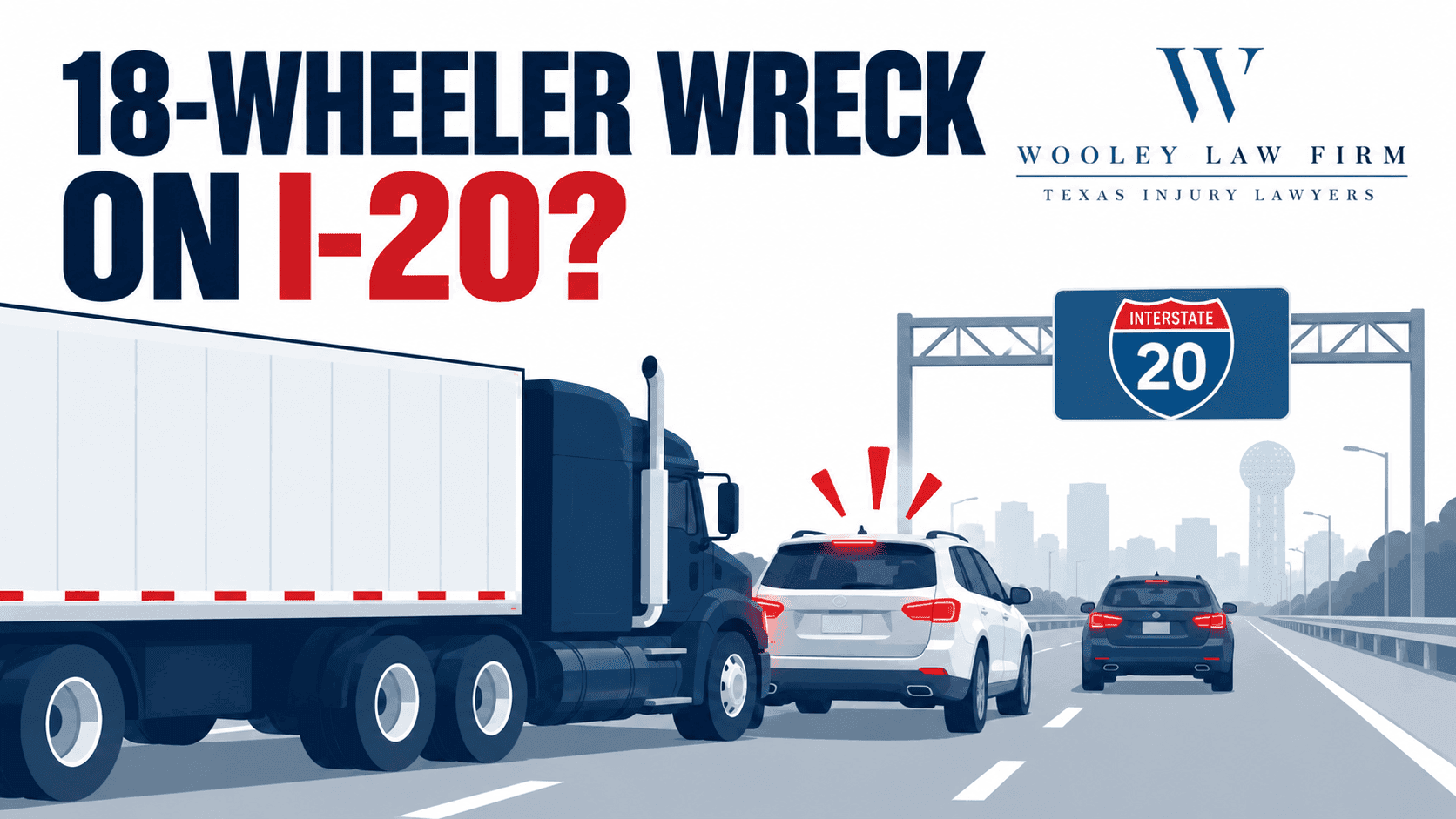
When an 18-wheeler crashes into the back of traffic on I-20, one question immediately stands out: Why didn’t the truck stop? The answer may involve distraction, excessive speed, fatigue, following distance, brake maintenance, tire condition, or several factors acting together.
Interstate 20 carries significant commercial traffic across southern Dallas-Fort Worth. Tractor-trailers, dump trucks, box trucks, delivery vehicles, commuters, and local traffic share the corridor. For a seriously injured person, determining why a commercial vehicle failed to avoid a collision often requires a detailed investigation of the driver, truck, and company behind it.
Our Dallas truck accident lawyer page explains the broader investigation process.
Why Rear-End 18-Wheeler Crashes Can Be Catastrophic
An 18-wheeler can create far greater forces than a passenger vehicle. A heavy tractor-trailer may crush the rear of a smaller car, push it into another vehicle, force it into a barrier, cause a rollover, or start a chain reaction. The severity of those consequences makes safe following distance, attention, and equipment maintenance especially important.
The Truck Driver Should Be Looking Far Ahead
Safe commercial driving requires scanning beyond the bumper immediately ahead. A driver should be watching for brake lights, construction, lane closures, disabled vehicles, emergency traffic, merge conflicts, and congestion. If traffic is visibly slowing, the driver should respond before reaching the last vehicle in line.
Our article about being rear-ended by an 18-wheeler in Dallas explains how following distance and reaction time can become central issues.
“Traffic Stopped Suddenly” Should Be Tested
A truck driver may claim that everything stopped at once. Video may show brake lights visible well ahead. Electronic records may show little or no braking until just before impact. A collision-warning system may have alerted the driver. The investigation should determine how much time and distance were actually available and whether a reasonably careful commercial driver should have reacted sooner.
Driver Fatigue May Explain a Delayed Reaction
Fatigue can impair attention, judgment, lane control, and reaction time. A tired driver may stare ahead without processing danger, drift within the lane, miss an exit, miss brake lights, react late, make poor decisions, or fall asleep. The driver’s statement that he or she felt “fine” should be compared with the actual work and rest schedule.
Hours-of-Service Records Are Important, but Not the Whole Story
For many interstate property-carrying drivers subject to federal hours-of-service rules, federal regulations limit driving and duty periods and require qualifying rest. Electronic logging devices can help show duty status. But a driver can still be fatigued even if the log appears technically compliant.
Electronic logging-device records
GPS history
Fuel purchases
Toll transactions
Bills of lading
Pickup and delivery times
Dispatch communications
Sleeper-berth and off-duty periods
Driver-facing camera footage
Cellphone activity where relevant
The driver’s work and sleep opportunities in the days before the wreck
Dispatch Records May Reveal Company Pressure
Suppose the driver was running late because loading took longer than expected. Traffic then created additional delay. The driver tells dispatch the schedule cannot be met safely. What happened next? Company communications may show whether dispatch told the driver to stop, adjusted the schedule, or continued to emphasize an unrealistic delivery expectation.
The Carrier May Have Known About Unsafe Driving Before the Crash
Modern fleets can generate safety alerts for speeding, hard braking, close following, lane departures, collision warnings, camera events, and other driving behavior. If a driver repeatedly generated alerts, an investigation may ask who received them, whether they were reviewed, whether coaching occurred, and whether the unsafe pattern continued.
Automatic Emergency Braking May Show When Danger Was Detected
Forward-collision systems can be particularly important in rear-end cases. Depending on the system, data may help establish when an obstacle was detected, whether a warning occurred, whether the driver responded, whether automatic braking activated, how speed changed, and whether the system was functioning normally.
Read our guide to automatic emergency braking evidence after a truck wreck.
What If the Brakes Really Did Fail?
A genuine mechanical problem does not end the analysis. It shifts the focus to inspection, repair, maintenance, and the people or companies responsible for those tasks. Investigators may review prior defect reports, driver inspections, maintenance schedules, service invoices, repair recommendations, and the condition of the tractor and trailer after the collision.
Our article on brake failure after a Dallas rear-end 18-wheeler accident addresses these maintenance issues in detail.
The Trailer’s Brakes Matter Too
A tractor-trailer is a combination vehicle. The trailer is not merely cargo space attached to the tractor; its braking and mechanical systems can affect stopping and control. The tractor and trailer may also have different owners and maintenance histories, which means both should be considered when brake performance is disputed.
Tire Problems Can Affect Control and Braking
Tire problems can contribute to loss of control, blowouts, reduced traction, lane departures, and difficulty braking safely. Relevant issues can include tread depth, inflation, uneven wear, prior damage, overloading, or a product defect. Tire evidence can disappear quickly if a damaged tire is discarded after the wreck.
Was the Truck Following Too Closely?
Even a perfectly functioning braking system cannot eliminate physics. A driver who follows too closely may leave too little time or distance to respond. Speed, traffic density, vehicle weight, road conditions, visibility, and driver attention should all be considered when evaluating whether the following distance was reasonable.
Truck Camera Video May Show Whether the Driver Was Watching
Forward-facing video can show what was happening on the road. Driver-facing video can potentially show head position, eye direction, phone handling, reaching, eating, looking down, or signs the driver was struggling to stay awake. That evidence can be valuable when the driver’s attention is disputed.
What If the Driver Was Using a Cellphone?
Distraction can involve more than texting. A driver may be dialing, reading messages, handling navigation, looking at social media, interacting with an app, or simply manipulating the device. Relevant evidence may come from the phone, carrier records where legally obtainable, camera footage, or company systems.
Injured in an Accident?
Free consultation. Tell us what happened and learn what options may be available.
Who Can Be Responsible After an I-20 Truck Wreck?
Truck driver
Motor carrier or employer
Tractor owner
Trailer owner
Leasing company
Maintenance or repair contractor
Cargo-loading company where cargo contributed
Manufacturer where a defective product is implicated
Other negligent drivers
Why the Name on the Cab Is Not Enough
Commercial trucking arrangements can be complicated. A motor carrier may lease the tractor. An owner-operator may own the tractor. A separate leasing company may own the trailer. An outside business may maintain the equipment. Another company may have arranged or loaded the freight. The investigation should identify what each company actually did.
Our article Can I Sue the Trucking Company After a Dallas 18-Wheeler Wreck? explains why the case may extend beyond the individual driver.
Evidence to Preserve After an I-20 Truck Wreck
Forward-facing, driver-facing, side, and rear camera footage, if installed
Engine-control-module and event data
Electronic logging-device records and hours-of-service information
GPS, telematics, hard-braking, speed, and safety-alert data
Dispatch messages, trip assignments, bills of lading, and delivery records
Driver qualification, training, safety, and disciplinary records
Tractor and trailer inspection, maintenance, and repair records
Post-crash photographs, measurements, tow records, and witness information
The condition of the tractor, trailer, tires, brakes, lights, and other relevant components
Driver safety-alert history
Relevant cellphone and communication evidence
Cargo weight and loading records where stopping distance or stability is disputed
Why the Truck Should Be Preserved Before Repair
Commercial trucks generate revenue when they are working, so damaged equipment may be repaired quickly. Repairs can alter evidence. Brake components can be replaced. Tires can be discarded. Damage can be painted over. Electronic equipment can be serviced. When vehicle condition matters, preservation should be addressed promptly.
Serious Injuries After an I-20 Truck Collision
Traumatic brain injuries
Cervical and lumbar spine injuries
Spinal cord injuries
Fractures
Crush injuries
Internal organ injuries
Amputations
Burns and scarring
Nerve damage
Permanent impairment
Wrongful death
What Damages May Be Considered?
Depending on the evidence and applicable Texas law, a personal-injury claim may involve medical expenses, future medical needs, lost income, loss of earning capacity, physical pain, mental anguish, physical impairment, disfigurement, and property damage. There is no automatic value assigned to an 18-wheeler case; the claimed damages must be supported by evidence.
What Should You Do After an I-20 18-Wheeler Wreck?
Call emergency services.
Seek appropriate medical evaluation.
Photograph the tractor, trailer, license plates, and company markings.
Obtain witness information.
Save dash-camera footage and original phone media.
Keep tow, storage, repair, rental, wage, and medical records.
Avoid guessing about unknown facts when communicating with insurers.
Do not assume a claimed brake failure or sudden stop resolves liability.
Consider legal advice before detailed recorded statements or releases.
Address preservation of trucking evidence promptly.
Talk to a Dallas-Fort Worth I-20 Truck Wreck Lawyer
A serious I-20 truck crash should not be reduced to the statement that the driver “didn’t stop.” The investigation should ask why. Was the driver tired? Distracted? Following too closely? Did a warning system activate? Were the brakes properly maintained? Did the carrier know about prior safety concerns? Who maintained the tractor and trailer?
The Wooley Law Firm investigates the truck, driver, carrier, electronic systems, corporate relationships, maintenance evidence, and available insurance coverage after serious commercial-vehicle crashes.
Call (214) 699-6524 for a free consultation. You don’t pay unless we win.
Why Fatigue Cases Require More Than Reading the ELD
Electronic logging devices are an important starting point because they can show duty status and driving time. But fatigue is a human condition, not simply a log entry. A driver may have been awake for many hours before going on duty, may have slept poorly, may have performed physically demanding work, or may have experienced repeated schedule disruptions that are not obvious from a single day’s log.
A meaningful fatigue investigation can compare several days of logs with dispatch records, pickup and delivery times, fuel stops, tolls, GPS, text messages, camera footage, and the driver’s own account. The question is whether the overall pattern is consistent with a rested driver who was capable of responding safely to traffic conditions on I-20.
The Difference Between a Driver Violation and Company Scheduling
Sometimes the unsafe decision is made by the driver alone. In other cases, the company’s dispatching or scheduling practices may contribute. A carrier that repeatedly assigns unrealistic delivery windows, ignores driver complaints, or fails to respond to fatigue-related safety alerts may present different issues from a case involving a single isolated driver choice.
Dispatch communications can be especially useful because they show the interaction between the driver and company in real time. Messages about delays, remaining hours, missed appointments, or pressure to continue can help explain why the truck was still moving when the collision occurred.
How Prior Safety Alerts Can Become Relevant
Fleet telematics can generate alerts for hard braking, speeding, close following, lane departures, and camera-triggered events. A single alert may not prove negligence. A pattern, however, may raise questions about what the carrier knew, whether it investigated, whether coaching occurred, and whether the driver continued the same conduct.
The usefulness of this evidence depends on the claim. If a driver rear-ended stopped I-20 traffic, repeated close-following or distraction alerts may be more relevant than an unrelated event from years earlier. Discovery should focus on information that can reasonably shed light on the safety issue involved in the wreck.
Brake Maintenance: Tractor, Trailer, and Repair Vendors
A brake-failure allegation can involve several layers of responsibility. The carrier may control preventive maintenance. The driver may have inspection duties. The tractor owner may use an outside repair facility. The trailer may be leased from a company with its own maintenance program. A recent repair may have been performed by a third-party shop.
The investigation should determine who inspected the system, what was found, what repairs were recommended, what was actually performed, and whether any problem recurred. Parts removed after the wreck may also be important if a mechanical defect is alleged.
Cargo Weight and Stopping Distance
Truck weight can affect braking and vehicle dynamics. If stopping distance is disputed, bills of lading, scale tickets, cargo records, and loading documents may help establish what the tractor-trailer was carrying. An overloaded or improperly loaded trailer may also create separate handling or braking issues depending on the facts.
Cargo evidence should be used carefully. A heavy load does not excuse a driver from leaving adequate stopping distance; it may instead make planning and speed selection more important. The analysis should focus on the actual vehicle configuration, weight, roadway, and conditions.
How a Rear-End Truck Claim Is Valued
The seriousness of a truck does not automatically determine the value of the injury claim. The evidence still matters. Medical diagnosis, objective findings, treatment, future care, work limitations, income loss, impairment, pain, and the effect on daily life all contribute to the damages analysis. Severe property damage can help explain the mechanics of a collision, but a crushed vehicle is not a substitute for medical proof.
Future damages require particular care. A recommendation for surgery, long-term treatment, or work restrictions should be supported by qualified medical evidence. Lost earning capacity may require employment, wage, or vocational evidence. The goal is to document the loss rather than rely on a generic multiplier.
Why Early Recorded Statements Can Create Problems
A person may speak with an insurer before the full extent of injuries is known. Statements such as “I’m okay” or “just sore” may later be used to argue that symptoms were minor, even though some injuries become clearer over the next several days. Likewise, a driver may be asked detailed questions about traffic and distance while still shaken from the crash.
That does not mean every insurer conversation should be avoided. It means the injured person should understand who is calling, which company the adjuster represents, whether the statement is recorded, and whether the person has enough information to answer accurately before discussing disputed details.
How the Driver’s Pre-Trip and Post-Trip Inspections Fit Into the Case
Commercial drivers may be required to inspect equipment and report certain defects. In a case involving brakes, tires, lights, steering, or other mechanical systems, driver inspection documents can help show whether a problem was noticed before the collision, whether it was reported, and what the carrier did in response. The absence of a reported defect does not necessarily prove the equipment was sound, just as a reported defect does not automatically prove it caused the wreck.
Post-crash inspection records can be equally important. A carrier, law-enforcement agency, repair facility, or insurer may document the condition of brakes, tires, lights, and other components after the collision. Those records should be compared with pre-crash maintenance history and any later repairs. If a component was replaced immediately after the wreck, the removed part, photographs, and repair invoice may become important evidence.
Mechanical evidence is strongest when tied to the actual theory of the crash. For example, a minor lighting issue may have little relevance to a daytime rear-end collision, while a documented brake defect could be central. The investigation should remain focused on whether the condition actually contributed to the driver’s inability to stop or control the truck on I-20.
Why Maintenance Records Should Be Read as a Timeline
Maintenance files are most useful when they are organized chronologically. A single repair invoice may not reveal much, but a timeline can show recurring brake complaints, repeated tire replacement, inspection findings, deferred repairs, or a pattern of the same component failing more than once. The driver’s inspection reports, shop work orders, parts invoices, and post-crash inspection should be compared rather than reviewed in isolation.
Timing matters. A repair performed days before the wreck may raise different questions from routine work completed a year earlier. A defect reported the morning of the collision can be highly significant if it was not corrected. Conversely, a maintenance issue that had no relationship to braking, steering, tires, or control may add little to the case. A focused timeline helps separate relevant safety evidence from background records that do not actually explain why the truck failed to stop on I-20.
A complete maintenance timeline can also help identify which company had control of the equipment at each point, which can matter when the tractor or trailer was leased or serviced by different entities.
Frequently Asked Questions
Can driver fatigue be proven?
It may be investigated through logs, dispatch records, GPS, schedules, camera footage, receipts, and other records.
Does hours-of-service compliance prove the driver was not tired?
Not necessarily. Fatigue depends on the driver’s actual sleep, work, schedule, and circumstances in addition to regulatory compliance.
What if the driver says the brakes failed?
That usually creates additional inspection and maintenance questions rather than ending the investigation.
Can a maintenance company be responsible?
Potentially, depending on the work performed and whether negligent inspection or repair contributed to the collision.
Should both the tractor and trailer be inspected?
Potentially yes, especially when braking, tires, physical damage, or equipment condition are relevant.
Disclaimer: This article is for general informational purposes only and is not legal advice. Reading it does not create an attorney-client relationship. Every case is different.
Topics
Share This Article

Andrew J. Wooley
Personal Injury Attorney
Andrew J. Wooley is a dedicated personal injury attorney based in Dallas, Texas. He focuses on helping accident victims recover fair compensation for their injuries. With a commitment to personalized service, Andrew works directly with each client to understand their unique situation and fight for their rights.