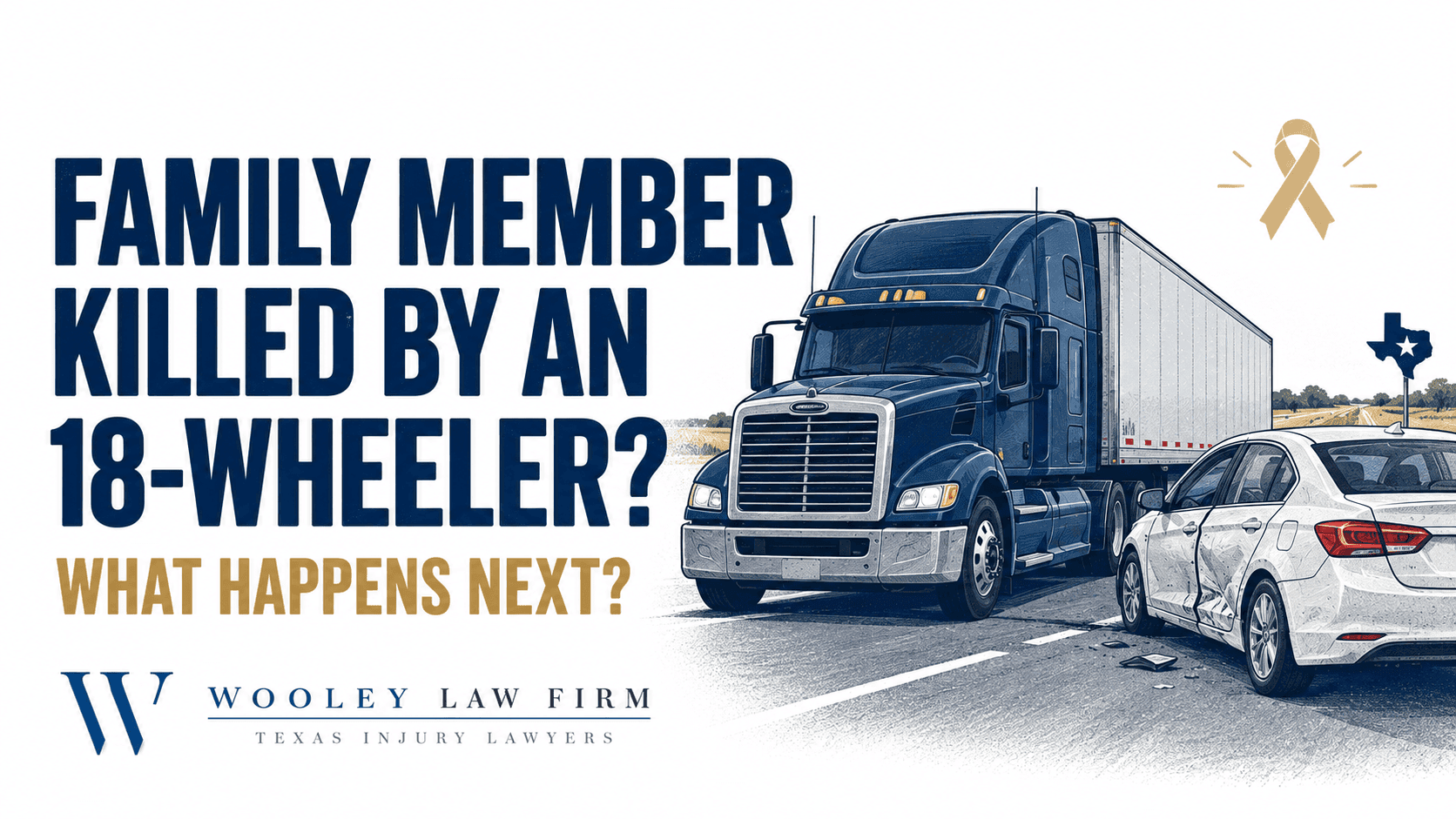
Losing a husband, wife, child, or parent in an 18-wheeler accident is devastating. When someone dies suddenly in a truck wreck, families are left grieving while also trying to understand what happened, who was responsible, and what they are supposed to do next.
There may be questions about the police investigation, funeral arrangements, insurance coverage, and whether the trucking company could have prevented the collision.
For many families, one of the most difficult questions is whether their loved one's death was caused by someone else's negligence.
If your family member was killed in an 18-wheeler wreck in Dallas, Texas law may allow surviving spouses, children, and parents to pursue a wrongful death claim against the responsible driver, trucking company, or other legally responsible parties.
These claims can provide compensation for certain financial and personal losses. They can also help families investigate how the collision occurred and pursue accountability for negligent conduct.
However, fatal truck accident cases require a careful investigation. Important evidence may be stored inside the tractor-trailer, maintained by the trucking company, or located with other businesses involved in the transportation operation.
Some evidence can disappear long before a lawsuit is filed.
At The Wooley Law Firm, we represent families pursuing wrongful death claims throughout Dallas, Fort Worth, and North Texas. We understand that no financial recovery can replace a loved one. Our role is to help families understand their rights, investigate what happened, and pursue accountability when negligence causes a preventable death.
What Should a Family Do After a Fatal 18-Wheeler Accident in Dallas?
In the days following a fatal truck collision, a family may receive calls from law enforcement, insurance adjusters, investigators, or representatives of the trucking company.
At the same time, family members may be trying to obtain information about where the crash occurred, what caused it, and whether anyone will be held responsible.
There are several matters families should consider.
1. Obtain information about the crash investigation.
Identify the law enforcement agency investigating the collision and obtain the crash report when it becomes available.
Fatal 18-wheeler wrecks in Dallas may be investigated by the Dallas Police Department, Dallas County Sheriff's Department, Texas Department of Public Safety, or another agency with jurisdiction.
The initial police report may contain important information, but it does not necessarily provide a complete explanation of the collision.
2. Preserve any information your family already has.
Keep photographs, videos, text messages, witness contact information, and communications with insurance companies.
If your loved one had a dash camera or cellphone containing relevant information, preserve those devices and their contents.
3. Be cautious about signing insurance documents.
A trucking company's insurance representative may contact the family seeking information, requesting documents, or discussing a possible settlement.
Before signing a release or other document affecting legal rights, consider having it reviewed by an attorney.
4. Consider an independent investigation of the trucking company.
The police may investigate whether a traffic violation or criminal offense occurred.
A civil wrongful death investigation may examine additional issues, including company hiring practices, driver supervision, dispatch instructions, maintenance records, electronic truck data, and insurance coverage.
Families do not have to conduct this investigation themselves.
Our Dallas 18-wheeler accident lawyer page explains how commercial truck accident investigations differ from ordinary passenger-vehicle collisions.
Who Can File a Wrongful Death Lawsuit After a Fatal Truck Wreck in Texas?
Texas law identifies specific family members who may bring a wrongful death claim.
Under Texas Civil Practice and Remedies Code § 71.004, the individuals eligible to benefit from a wrongful death lawsuit are:
The deceased person's surviving spouse.
The deceased person's children.
The deceased person's parents.
One or more eligible family members may bring an action for the benefit of all those entitled to recover.
If none of the eligible family members brings the action within three calendar months after the death, the executor or administrator of the estate generally must pursue the claim unless all eligible beneficiaries request otherwise.
This three-month provision does not mean families must file a lawsuit within three months to preserve their wrongful death rights.
Can Adult Children Sue for the Death of a Parent?
Yes. Adult children may have the right to bring a wrongful death claim when their mother or father is killed because of another party's negligence.
Eligibility is not limited to minor children.
Can Parents Sue After Their Adult Child Is Killed by an 18-Wheeler?
Yes. Parents may have wrongful death claims after losing a child, including an adult child, when the legal requirements are met.
Can Brothers and Sisters File a Wrongful Death Lawsuit in Texas?
Generally, siblings are not among the beneficiaries authorized to recover under the Texas Wrongful Death Act.
However, a sibling may sometimes serve in a separate capacity as a personal representative of the deceased person's estate, depending on the circumstances.
The distinction between a wrongful death claim and an estate's survival claim is important.
What Is the Difference Between a Wrongful Death Claim and a Survival Claim?
When someone dies because of injuries sustained in an 18-wheeler accident, there may be two different types of legal claims.
These claims address different losses.
Wrongful Death Claim: Losses Suffered by the Family
A wrongful death claim concerns the legally recoverable losses suffered by surviving spouses, children, and parents because of their loved one's death.
Depending on the evidence, these losses may include:
Loss of financial support.
Loss of household services.
Loss of companionship.
Loss of love, comfort, and society.
Mental anguish.
Loss of parental guidance and care.
Loss of a reasonably expected inheritance.
For example, when a parent is killed in a truck accident, their surviving children may lose financial support, guidance, companionship, and the opportunity to share important milestones with that parent.
Texas law recognizes that these losses extend beyond funeral expenses or lost income.
Survival Claim: Losses Suffered by the Deceased Person Before Death
A survival claim is different.
Under Texas Civil Practice and Remedies Code § 71.021, certain personal injury claims survive the injured person's death.
The survival claim belongs to the estate and generally seeks damages the deceased person could have pursued had they survived.
Depending on the circumstances, these may include:
Medical expenses incurred before death.
Conscious physical pain and suffering before death.
Mental anguish experienced before death.
Other legally recoverable losses arising before death.
For example, suppose a person survives a severe 18-wheeler collision, is transported to a hospital, undergoes emergency treatment, and later dies from the injuries.
The estate may have a survival claim arising from the injuries and legally recoverable losses experienced before death.
Even when death occurs at the crash scene, the circumstances should be evaluated carefully rather than assuming a survival claim exists or does not exist.
A wrongful death claim and a survival claim are not interchangeable. One addresses the eligible family's losses; the other preserves certain claims belonging to the deceased person's estate.
Why Is It Important to Preserve the 18-Wheeler and Trailer After a Fatal Accident?
After a fatal truck accident, one of the most important steps may be preserving the tractor, trailer, and their electronic systems before they are repaired, altered, or returned to service.
A commercial trucking operation may involve several different businesses.
The company responsible for operating the truck may not own the tractor. Another business may own the trailer, and a separate company may have performed maintenance.
The equipment may be transported to different locations after the collision.
An investigation may need to preserve and inspect:
The tractor involved in the collision.
The trailer and its components.
The braking systems.
Tires and wheels.
Headlights, taillights, and reflective markings.
Collision damage and impact points.
Coupling equipment.
Steering components.
Electronic safety systems.
Any damaged or allegedly defective components.
The physical condition of the tractor and trailer may help explain what happened.
For example, an inspection could reveal problems with brakes, tires, lighting, or other components that may have contributed to the collision.
Vehicle damage can also help accident reconstruction experts evaluate the mechanics of the impact.
But once a vehicle has been repaired, disassembled, sold, or placed back into service, important evidence may become more difficult to examine.
A preservation letter can request that the responsible parties retain potentially relevant vehicles, components, records, and electronic information. When necessary, legal action may be appropriate to address preservation or inspection disputes.
Our article on truck owner and leasing company liability after a Dallas 18-wheeler wreck explains why identifying the parties who control the tractor and trailer is important.
Injured in an Accident?
Free consultation. Tell us what happened and learn what options may be available.
What Is the Truck's Black Box, and Can It Show What Caused the Fatal Crash?
Many modern commercial trucks contain electronic systems that may record information about the vehicle's operation.
This information can be valuable in a fatal truck accident investigation, particularly when the truck driver disputes what happened.
Two important sources are the Electronic Control Module (ECM) and Electronic Logging Device (ELD).
Electronic Control Module: Speed, Braking, and Engine Information
Depending on the tractor and its installed systems, an ECM or related event-recording system may contain information such as:
Vehicle speed.
Engine RPM.
Throttle position.
Brake application.
Fault codes.
Certain event-related information.
Not every truck records the same information, and not every system captures or retains data from a particular collision.
However, when the information exists, it may help determine whether the driver was speeding, attempted to brake, or took other actions before impact.
Electronic Logging Device: Driver Hours and Fatigue
Commercial truck drivers subject to federal hours-of-service rules generally must maintain records of their driving and duty status.
Electronic Logging Devices may help investigators examine:
How long the driver had been operating the truck.
Whether the driver had taken required rest periods.
Driving and on-duty time.
Potential hours-of-service violations.
Vehicle movement and duty-status information.
Federal hours-of-service rules are available through the Federal Motor Carrier Safety Administration.
If fatigue or excessive driving time contributed to a fatal collision, electronic logs, dispatch records, trip documents, and related information may become important evidence.
Truck Cameras, GPS, and Other Digital Evidence
Some commercial trucks also have forward-facing cameras, driver-facing cameras, GPS tracking, collision-warning systems, and fleet-management technology.
Depending on the equipment, these systems may help establish:
Whether the driver was distracted.
The truck's location and route.
Whether traffic slowed before the impact.
The timing of braking or collision warnings.
Communications between the driver and dispatch.
Certain records may be overwritten during normal operations or retained only for limited periods.
That is why requesting preservation early can make a substantial difference.
For a more detailed explanation, read our article on 18-wheeler black box evidence after a Dallas-Fort Worth truck wreck.
What Evidence Matters Beyond the Police Crash Report?
Families understandably want to know what the investigating officers concluded.
However, a fatal crash investigation can involve evidence that extends well beyond the initial accident report.
Police Crash Reports and Accident Reconstruction
Depending on the collision, law enforcement may document roadway evidence, vehicle positions, photographs, measurements, witness statements, and possible contributing factors.
Some fatal collisions involve more extensive reconstruction work.
Investigators may evaluate impact angles, vehicle movement, braking evidence, skid or yaw marks, damage patterns, and available video.
A civil accident reconstruction expert may independently analyze this information.
Autopsy and Medical Examiner Records
When a fatal truck collision results in an autopsy or medical examiner investigation, those records may help establish the nature of the injuries and the medical cause of death.
Relevant information may include:
The medical cause of death.
Traumatic injuries sustained during the collision.
Medical findings that help establish causation.
Relevant toxicology or laboratory findings.
Hospital treatment and emergency medical records.
Medical examiner findings may be particularly important when the defense disputes whether the collision caused the death or raises another medical explanation.
An autopsy does not, by itself, establish who was legally responsible for the accident.
That question generally requires examination of the crash evidence, witness information, vehicle data, and applicable law.
Witnesses and Video Footage
Witnesses may have observed the truck's speed, lane position, traffic signals, or conduct immediately before the collision.
Nearby businesses, traffic cameras, other vehicles, and dashboard cameras may also have recorded relevant events.
Some video is retained for only a limited period.
Families and their legal representatives should consider identifying and requesting relevant footage before it disappears.
Our guide to evidence that can help prove an 18-wheeler accident case discusses additional records that may be important in a commercial trucking investigation.
Can the Trucking Company Be Held Responsible for a Fatal 18-Wheeler Accident?
Potentially.
A fatal truck accident may involve negligence by the driver, the trucking company, or another party whose conduct contributed to the collision.
For example, a truck driver may have been:
Speeding.
Distracted.
Following too closely.
Driving while fatigued.
Making an unsafe lane change.
Failing to maintain control.
Failing to respond to stopped traffic.
Operating the truck in violation of applicable safety rules.
Depending on the circumstances, the motor carrier may be legally responsible for the driver's negligence under agency or employment principles.
The trucking company may also face claims based on its own conduct, where supported by the evidence and applicable Texas law.
Negligent Hiring, Training, and Supervision
An investigation may reveal questions about whether the trucking company adequately evaluated the driver's qualifications or properly trained and supervised the driver.
Relevant evidence may include qualification files, driving history, training records, safety policies, and company communications.
Pressure to Meet Delivery Schedules
Dispatch communications and company records may reveal whether unrealistic scheduling or improper operational practices contributed to dangerous driving.
Improper Maintenance
A truck with defective brakes, unsafe tires, or other mechanical problems can pose a serious danger.
Maintenance records and inspections may help determine whether the trucking company or another business failed to address a known safety issue.
These are potential theories of liability, not conclusions that apply to every crash. Each must be evaluated against the facts and governing law.
Can Multiple Companies Be Responsible for a Fatal Truck Wreck?
Yes, depending on their roles and conduct.
A commercial truck involved in a fatal collision may be connected to several businesses.
For example:
The driver may work for a motor carrier.
The tractor may belong to an owner-operator.
A leasing company may own the equipment.
A separate business may own the trailer.
A maintenance contractor may have serviced the brakes.
A cargo-loading company may have loaded the trailer.
A broker may have arranged the shipment.
Not every company connected to the transportation operation is automatically liable.
However, identifying these businesses may uncover additional evidence, legally responsible parties, and potentially applicable insurance coverage.
Our related article, Who Else Can Be Sued Besides the Trucking Company After a Dallas 18-Wheeler Wreck?, explains why a thorough investigation should examine the entire trucking operation.
How Much Insurance Is Available After a Fatal 18-Wheeler Accident?
Commercial trucking companies may carry substantially more liability insurance than an ordinary passenger vehicle.
Under 49 C.F.R. § 387.9, certain for-hire interstate motor carriers transporting nonhazardous property in vehicles weighing 10,001 pounds or more must maintain at least $750,000 in public liability financial responsibility.
Other operations and types of cargo may be subject to different requirements.
Some trucking companies maintain liability insurance coverage exceeding these minimum amounts.
In a fatal truck accident, an attorney may investigate:
Primary Commercial Liability Insurance
The motor carrier's principal liability coverage, subject to its terms and applicable law.
Excess or Umbrella Insurance
Additional coverage that may apply after underlying coverage requirements are satisfied.
Other Potentially Applicable Policies
Depending on the facts, separate policies associated with another legally responsible company may provide coverage.
Other Sources of Recovery
In some cases, recovery may also depend on the assets or financial responsibility of legally responsible parties, not solely the insurance policies identified.
Importantly, the existence of a large insurance policy does not establish negligence or guarantee recovery of the policy limits.
The amount of available insurance is only one part of the legal analysis.
In a fatal 18-wheeler accident, families should have an accurate understanding of the responsible parties, applicable policies, and evidence supporting their claims before making major settlement decisions.
What Compensation Can a Family Recover After a Fatal 18-Wheeler Accident?
No amount of money can bring back a loved one.
However, Texas wrongful death law recognizes that a family may suffer significant financial and personal losses when someone dies because of another party's negligence.
Depending on the circumstances, recoverable damages may include:
Loss of Financial Support
The financial contributions the deceased person reasonably would have provided to eligible family members.
Loss of Companionship and Society
The loss of a spouse's, parent's, or child's companionship, comfort, love, and care.
Mental Anguish
The emotional suffering experienced by eligible surviving family members because of the death.
Loss of Household Services
The value of services the deceased family member would reasonably have provided.
Loss of Inheritance
In appropriate cases, the inheritance that eligible beneficiaries probably would have received had the deceased person lived.
Funeral and Medical Expenses
Certain funeral, burial, and medical expenses may be recoverable when supported by the law and evidence, including through appropriate estate claims or claims by persons legally responsible for those expenses.
Survival Damages
The estate may separately pursue legally recoverable damages arising from the deceased person's injuries before death.
In cases involving the required proof of gross negligence or intentional wrongdoing, exemplary damages may also be available, subject to applicable legal requirements and limitations.
The value of a fatal truck accident case depends on the particular circumstances. There is no standard settlement amount simply because an 18-wheeler was involved.
How Long Does a Family Have to File a Fatal Truck Accident Lawsuit in Texas?
Texas generally provides a two-year statute of limitations for wrongful death claims, measured from the date of death.
See Texas Civil Practice and Remedies Code § 16.003.
Different rules may apply to survival claims, certain claims involving governmental entities, minors, or other unusual circumstances.
Families should not assume that every possible claim shares the same deadline.
More importantly, the legal filing deadline is not the same as the practical deadline for preserving evidence.
A family may have substantial time remaining to file a lawsuit while critical electronic data or surveillance video is already at risk of being lost.
That is one reason early investigation matters even when the family has no immediate intention of filing suit.
What if the Truck Driver Was Criminally Charged After the Fatal Collision?
Sometimes a fatal 18-wheeler collision results in criminal charges against a driver.
Depending on the circumstances, the charges may involve intoxication, reckless driving, manslaughter, or another alleged offense.
A criminal case and a civil wrongful death case serve different purposes.
Criminal proceedings concern alleged violations of criminal law.
A wrongful death lawsuit concerns civil liability and the compensation available to eligible family members.
A family does not necessarily have to wait for criminal charges or a criminal conviction to pursue a wrongful death claim.
Similarly, the absence of criminal charges does not automatically mean the trucking company or driver was free from negligence.
The civil investigation must evaluate the evidence independently.
Frequently Asked Questions After a Fatal Dallas 18-Wheeler Accident
Can I sue if my spouse was killed by an 18-wheeler in Dallas?
Potentially. A surviving spouse is among the family members authorized to bring a Texas wrongful death claim when another party's legally actionable conduct caused the death.
Can I bring a wrongful death claim if my parent was killed by a truck?
Yes. Children, including adult children, may be eligible to bring a wrongful death action under Texas law.
What if the trucking company says my family member caused the crash?
The trucking company's position does not end the investigation. Electronic truck data, witness statements, vehicle evidence, reconstruction, and other information may help determine responsibility. Texas proportionate responsibility rules may affect a recovery depending on the evidence.
What if my family member died at the scene?
A death at the scene may still support a wrongful death claim. Whether a separate survival claim exists and what damages it may include depends on the circumstances and supporting evidence.
Do I need to wait for the autopsy report before contacting a lawyer?
No. Medical examiner records may become important, but other evidence may need to be preserved before the autopsy and crash investigations are completed.
Can we sue the trucking company if the driver was an independent contractor?
Possibly. The answer depends on the actual relationships among the driver, motor carrier, equipment owners, and other parties, together with the applicable law. An independent-contractor designation does not, by itself, resolve every potential basis for liability.
What if the insurance company offers a settlement shortly after the death?
Families should carefully review any proposed settlement and release before signing. A release may permanently affect the rights of the individuals who sign it, and the full extent of the family's claims or available insurance may not yet be understood.
Lost a Family Member in an 18-Wheeler Accident in Dallas? The Wooley Law Firm Can Help.
When someone dies in a truck accident, the family deserves an opportunity to understand what happened.
Was the driver distracted or fatigued?
Was the truck properly maintained?
Did the trucking company ignore safety problems?
Could the collision have been prevented?
These questions deserve careful investigation.
At The Wooley Law Firm, we represent families pursuing wrongful death claims involving serious car accidents, 18-wheelers, tractor-trailers, and commercial vehicles throughout Dallas, Fort Worth, and North Texas.
We can investigate the circumstances of the collision, identify the responsible parties, work to preserve critical trucking evidence, review potential insurance coverage, and help families understand their options under Texas law.
We know that contacting a lawyer after losing a loved one is not an easy decision. Our goal is to provide clear answers, respectful communication, and legal representation focused on your family's needs.
If your husband, wife, child, mother, or father was killed in an 18-wheeler accident, The Wooley Law Firm offers free consultations to discuss your family's legal rights.
Call (214) 699-6524 or visit The Wooley Law Firm to contact our office.
You don't pay attorney's fees unless we win.
Disclaimer: This article is for general informational purposes only and is not legal advice. Reading it does not create an attorney-client relationship. Every wrongful death case depends on its particular facts, applicable law, and evidence. Past results do not guarantee future outcomes.
Topics
Share This Article

Andrew J. Wooley
Personal Injury Attorney
Andrew J. Wooley is a dedicated personal injury attorney based in Dallas, Texas. He focuses on helping accident victims recover fair compensation for their injuries. With a commitment to personalized service, Andrew works directly with each client to understand their unique situation and fight for their rights.