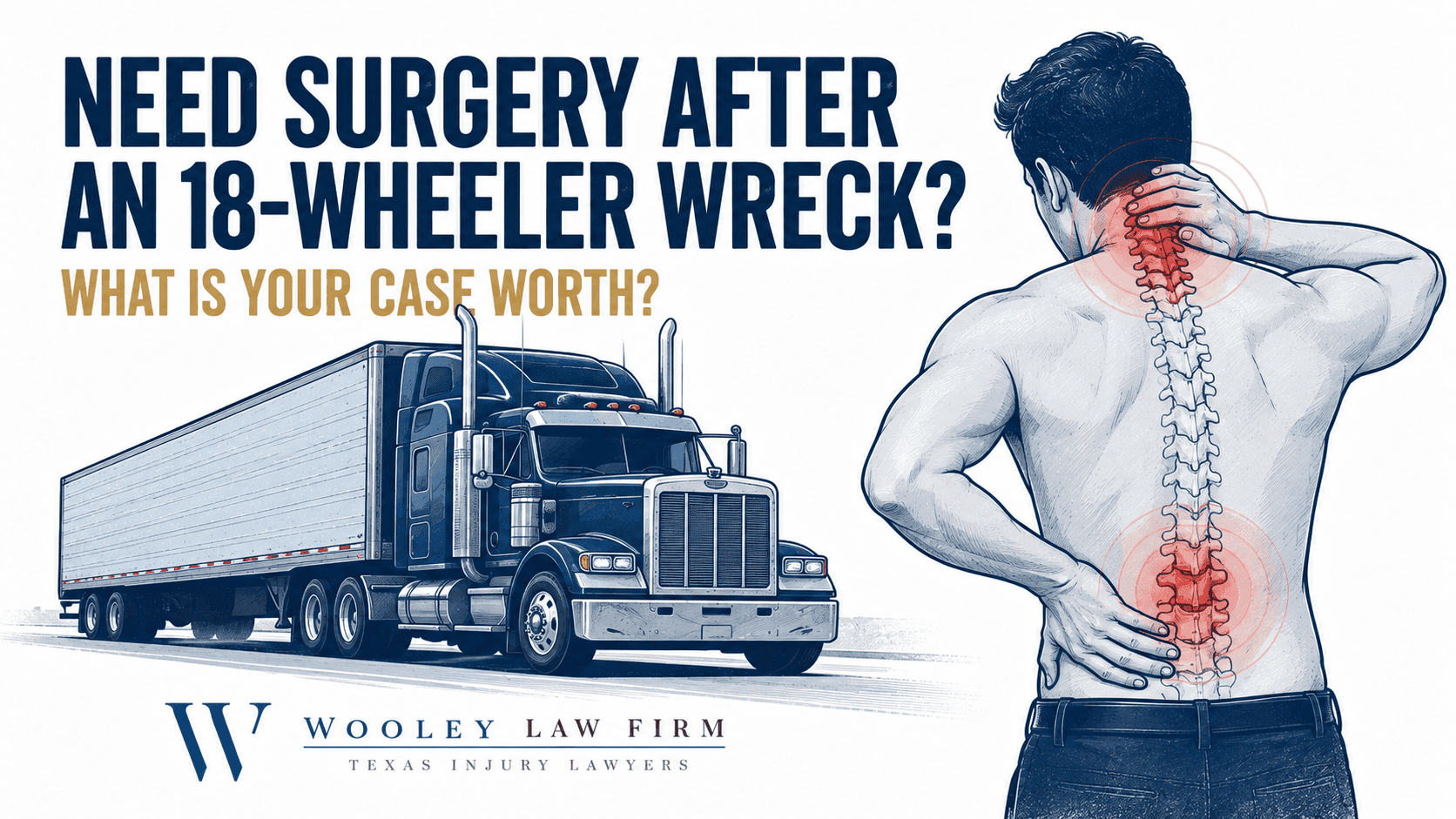
If you were injured in an 18-wheeler accident in Dallas and your doctor has recommended neck surgery, back surgery, or another major medical procedure, you may be wondering: How much is my truck accident case worth?
You may have already undergone surgery. Perhaps your doctor has recommended a cervical fusion, lumbar fusion, discectomy, or shoulder surgery. Or maybe you are still undergoing injections, physical therapy, and other treatment while trying to avoid an operation.
Regardless of where you are in your recovery, a serious injury requiring surgery can have lifelong consequences.
A Dallas truck accident settlement involving surgery may be worth substantially more than a claim involving minor injuries. However, there is no guaranteed settlement amount simply because surgery is recommended or performed.
The value of your case depends on several factors, including the severity of your injuries, whether the 18-wheeler wreck caused or aggravated those injuries, the medical treatment you require, your future medical expenses, lost earning capacity, available insurance coverage, and the evidence establishing the trucking company's liability.
At The Wooley Law Firm, we represent people seriously injured in 18-wheeler accidents throughout Dallas, Fort Worth, and North Texas. We understand that when a truck wreck results in surgery, the consequences can extend far beyond the initial hospital bills.
How Much Is an 18-Wheeler Accident Worth if You Need Surgery?
There is no standard settlement amount for a Dallas 18-wheeler accident involving surgery.
Two people may undergo the same operation but have dramatically different claims.
For example, one person may undergo a cervical fusion following a truck collision, recover well, and eventually return to work without significant restrictions.
Another person may undergo the same surgery but experience permanent nerve damage, chronic pain, reduced mobility, and an inability to return to their previous employment.
Although both underwent similar procedures, the long-term consequences are very different.
When evaluating a truck accident surgery settlement, important considerations include:
Whether the trucking company or another party caused the collision.
The nature and severity of the injuries.
Whether surgery was performed or merely recommended.
The cost of past and future medical treatment.
Whether the injury resulted in permanent impairment.
Whether additional surgeries may be necessary.
The effect on the injured person's ability to work.
Whether the victim can return to their previous occupation.
Physical pain, mental anguish, and limitations on daily activities.
Whether the injury was new or aggravated a preexisting condition.
The amount of available commercial insurance coverage.
The strength of the medical evidence connecting the surgery to the truck wreck.
A serious truck wreck claim should be evaluated based on the full impact of the injuries, not simply the number printed on a hospital bill.
Our related article, Truck Accident Damages: What Is Your Case Worth After a Dallas 18-Wheeler Wreck?, explains the broader categories of compensation potentially available under Texas law.
Neck Surgery After an 18-Wheeler Accident in Dallas
Neck injuries are among the potentially serious consequences of a collision involving a tractor-trailer.
A violent impact can place substantial forces on the cervical spine. Depending on the circumstances, an injured person may develop or experience worsening of a herniated disc, nerve compression, or another cervical spine condition.
Some individuals require surgery after conservative treatment fails to relieve their symptoms.
Common Neck Surgeries After a Truck Wreck
Anterior Cervical Discectomy and Fusion (ACDF)
An ACDF procedure generally involves removing a damaged cervical disc, relieving pressure on affected nerves or the spinal cord, and fusing adjacent vertebrae.
Cervical Disc Replacement
In appropriate cases, a surgeon may replace a damaged disc with an artificial disc rather than performing a fusion.
Cervical Decompression Surgery
A surgeon may recommend a procedure to relieve pressure on nerves or the spinal cord when a person's symptoms and diagnostic findings support that treatment.
These procedures can involve substantial medical expenses, time away from work, rehabilitation, and possible long-term limitations.
Some patients experience significant improvement, while others continue to experience pain, weakness, numbness, or restricted movement.
If you need neck surgery after an 18-wheeler accident in Dallas, the trucking company's insurance carrier may challenge whether the collision actually caused the condition requiring surgery.
That makes the medical evidence particularly important.
Back Surgery After an 18-Wheeler Wreck in Dallas
A serious 18-wheeler collision can also cause or aggravate injuries to the lumbar spine.
These injuries may affect an individual's ability to sit, stand, walk, lift, bend, or perform physically demanding work.
For some victims, symptoms continue even after months of conservative treatment.
Common Back Surgeries After a Truck Accident
Lumbar Fusion
Lumbar fusion is sometimes recommended when certain spinal conditions require stabilization. Recovery may involve substantial restrictions and rehabilitation.
Lumbar Discectomy or Microdiscectomy
These procedures may be performed to remove disc material compressing a nerve.
Lumbar Laminectomy or Decompression
A surgeon may recommend decompression to relieve pressure on nerves or other structures in the spinal canal.
The need for surgery does not automatically establish that the truck wreck caused the injury. But when the medical evidence supports that connection, the operation and its consequences can become major components of the damages claim.
For someone whose livelihood depends on physical labor, a back injury requiring surgery can have particularly serious financial consequences.
A construction worker, mechanic, warehouse employee, electrician, plumber, or delivery driver may be unable to return to the same occupation after a serious spinal injury.
That loss of earning capacity can sometimes be more financially significant than the cost of the operation itself.
What if My Doctor Recommended Surgery, but I Have Not Had It Yet?
One of the most common questions after a serious truck wreck is whether a recommended surgery increases the value of a personal injury case.
A medically supported recommendation for surgery can be important evidence of the severity of an injury, even if the surgery has not yet occurred.
However, insurance companies may evaluate recommended surgery differently from completed surgery.
For example, suppose an MRI reveals a lumbar disc herniation and a spine surgeon recommends a lumbar fusion.
The injured person may decide to postpone surgery because of financial concerns, family responsibilities, fear of complications, or a desire to continue conservative treatment.
The trucking company's insurer may argue that:
The surgery is speculative.
The person may never undergo the procedure.
Conservative treatment may be sufficient.
The surgery is unrelated to the truck wreck.
The proposed procedure is not medically necessary.
The estimated future medical expenses are excessive.
A Dallas truck accident lawyer may need to obtain medical opinions, treatment recommendations, cost estimates, and other evidence showing whether the proposed procedure is reasonably probable and related to the collision.
You should not undergo unnecessary surgery simply to increase the value of a personal injury claim. Medical decisions should be made with your treating physicians based on your health and treatment needs, not the insurance company's settlement position.
Can I Recover Future Medical Expenses After an 18-Wheeler Wreck?
Yes. Depending on the evidence, Texas law allows injured people to seek compensation for reasonably probable future medical expenses caused by another party's negligence.
This can be especially significant when a truck accident victim requires spinal surgery, joint surgery, or ongoing medical treatment.
Future medical needs may include:
Additional surgeries.
Postoperative physical therapy.
Rehabilitation.
Pain management.
Medical imaging and diagnostic testing.
Specialist appointments.
Prescription medications.
Assistive devices.
Long-term treatment for permanent injuries.
In some serious cases, physicians may anticipate additional treatment years after the initial collision.
A future medical expenses claim generally requires more than speculation. Medical testimony, treatment plans, reasonable cost projections, and other supporting evidence may be necessary.
Texas law also affects what past medical expenses may be recovered. Under Texas Civil Practice and Remedies Code § 41.0105, recovery of medical expenses is limited to amounts actually paid or incurred, as interpreted by Texas courts.
In an appropriate case, a detailed evaluation of future medical needs may be important to understanding the full value of a truck accident claim.
Injured in an Accident?
Free consultation. Tell us what happened and learn what options may be available.
What if I Cannot Return to Work After My Surgery?
A serious neck or back injury can affect much more than your medical expenses.
For some truck accident victims, the greatest financial loss is the inability to return to work.
Consider someone who earned a living performing physical labor before an 18-wheeler collision.
Following a lumbar fusion, their doctor may impose permanent lifting restrictions or recommend that they avoid physically demanding activities.
The injured person may no longer be able to perform their previous job.
Even if they can return to some form of employment, they may earn substantially less money than before the wreck.
Depending on the evidence, an injured person may seek compensation for:
Past Lost Wages
Income lost while recovering from injuries, undergoing surgery, and attending medical treatment.
Future Loss of Earning Capacity
The reduction in the person's ability to earn income in the future because of crash-related injuries.
Employment Benefits and Other Financial Losses
In appropriate cases, evidence of lost benefits and related financial consequences may also be relevant.
Proving diminished earning capacity may require employment records, tax returns, medical restrictions, vocational assessments, and economic expert testimony.
A person who undergoes neck or back surgery after a Dallas truck wreck should not assume that the insurance company will automatically include these losses in its settlement offer.
What if I Had Degenerative Disc Disease Before the Truck Wreck?
This is one of the most important issues in serious neck and back injury claims.
Trucking companies and commercial insurance carriers may obtain prior medical records and imaging studies to investigate whether the injured person had spinal problems before the collision.
An MRI performed after a wreck may reveal findings such as:
Degenerative disc disease.
Disc desiccation.
Disc bulges.
Herniated discs.
Spinal stenosis.
Osteophytes.
Facet arthropathy.
Nerve compression.
The trucking company's defense may argue that these findings developed over time rather than because of the crash.
But having a preexisting spinal condition does not automatically prevent someone from recovering compensation after an 18-wheeler wreck.
A Truck Wreck Can Aggravate a Preexisting Injury
Texas law may allow compensation when another party's negligence aggravates a preexisting condition.
For example, someone may have degenerative changes in their spine but experience little or no significant pain before an 18-wheeler collision.
After the crash, that person may develop severe neck pain, radiating arm symptoms, weakness, or other problems requiring treatment.
The relevant legal question is not simply whether degeneration existed before the wreck.
The investigation must determine whether the collision caused a new injury or worsened an existing condition, and what damages resulted from that change.
Why Prior Medical Records Matter
In a disputed spinal surgery case, important evidence may include:
Medical records before the collision.
Prior MRI or X-ray studies.
Emergency room records immediately after the wreck.
The timing and development of symptoms.
Post-collision MRI findings.
Records documenting failed conservative treatment.
The treating surgeon's opinions.
Expert medical testimony when necessary.
If the medical evidence supports that the collision aggravated a previously manageable condition and made surgery necessary, the injured person may have a claim for the resulting harm.
However, the trucking company may contest that connection.
The Wooley Law Firm understands the importance of investigating both the accident and the medical history when presenting a serious neck or back injury claim.
Why Trucking Companies Fight Surgery Claims
A truck accident involving surgery can create substantial potential financial exposure for a trucking company and its insurance carrier.
For that reason, the defense may closely examine the medical records, treatment history, and circumstances surrounding the wreck.
Common arguments include:
"Your Injury Existed Before the Accident"
The insurer may claim that the MRI reveals age-related degeneration rather than trauma.
"The Truck Wreck Was Not Severe Enough to Cause Surgery"
The company may use photographs, vehicle damage estimates, or reconstruction opinions to argue that the forces involved could not have caused the claimed injuries.
"You Waited Too Long to Get Treatment"
The defense may point to a gap between the collision and medical treatment to question whether the wreck caused the condition.
"Your Surgery Was Unnecessary"
The insurance company may retain medical experts to challenge the treating surgeon's recommendations.
"You Would Have Needed Surgery Anyway"
Even when the crash preceded surgery, the defense may argue that the procedure was inevitable because of an underlying degenerative condition.
"You Were Partially Responsible for the Wreck"
The trucking company may dispute liability or argue that the injured person contributed to the crash.
Under Texas Civil Practice and Remedies Code Chapter 33, proportionate responsibility can reduce recoverable damages. Generally, a claimant whose responsibility exceeds 50% cannot recover damages under that chapter.
These arguments show why a serious truck accident case requires more than collecting medical bills.
The injured person must be able to establish the trucking defendant's responsibility, connect the injury and treatment to the collision, and support the amount of compensation requested.
Does Commercial Truck Insurance Increase the Value of a Surgery Case?
One important difference between an ordinary car wreck and an 18-wheeler accident is the potential availability of commercial insurance coverage.
Certain federally regulated, for-hire interstate motor carriers transporting nonhazardous property in qualifying vehicles generally must maintain at least $750,000 in public liability financial responsibility. Different requirements may apply depending on the carrier, cargo, vehicle, and operation.
These requirements are found in 49 C.F.R. § 387.9.
Some trucking companies carry policies with limits above the applicable minimum requirements.
Depending on the circumstances, there may also be excess coverage, umbrella policies, or other potentially applicable policies.
However, the existence of a commercial insurance policy does not mean the entire policy limit is available or that the insurer must pay it.
Coverage depends on the policy terms, insured parties, applicable law, exclusions, and facts of the collision.
An investigation may need to identify coverage associated with the:
Truck driver.
Motor carrier.
Tractor owner.
Trailer owner.
Leasing company.
Other potentially responsible businesses.
In some cases, the driver, tractor owner, and trailer owner are different parties.
Our article on truck owner and leasing company liability after a Dallas 18-wheeler wreck discusses why identifying each business involved in the trucking operation may be important.
For victims facing major surgeries, permanent disability, or long-term medical needs, a thorough investigation of available insurance coverage can be essential.
How Do You Prove the 18-Wheeler Driver or Trucking Company Caused the Wreck?
Even a catastrophic injury does not automatically establish liability.
A person who needs surgery after a collision must still establish that a legally responsible party caused the wreck and resulting damages.
Potential causes of an 18-wheeler accident include:
Distracted driving.
Driver fatigue.
Speeding.
Following too closely.
Unsafe lane changes.
Failure to control speed.
Improper braking.
Negligent maintenance.
Unsafe company practices.
Violations of applicable trucking safety regulations.
These issues become especially important when the trucking company disputes the driver's responsibility.
Evidence may include the truck's electronic control module, GPS and telematics records, electronic logging-device information, dash-camera footage, maintenance records, driver qualification records, and dispatch communications.
Some evidence may be overwritten or lost if it is not preserved promptly.
Our article on 18-wheeler black box data after a Dallas-Fort Worth truck wreck explains how electronic information may help establish what happened before a collision.
A Dallas truck accident lawyer can investigate the wreck while medical providers evaluate and treat the injuries.
Both sides of the case are important.
Should I Settle My Truck Accident Case Before Having Surgery?
If your doctor has recommended surgery after an 18-wheeler wreck, you should be cautious about accepting an insurance settlement before fully evaluating your medical situation.
A settlement typically requires a release of claims against specified parties.
Once you sign a broad final release, you generally cannot return later and demand additional compensation from those released parties simply because your injuries became worse or your surgery was more expensive than expected.
Before considering settlement, important questions include:
Is surgery medically recommended?
How likely is it that the surgery will occur?
What is the expected cost?
How much rehabilitation will be necessary?
Will additional procedures be required?
Are permanent restrictions expected?
How will the injury affect future employment?
Are there medical liens or reimbursement claims?
Have all potentially responsible parties and insurance policies been identified?
A well-supported future medical claim may sometimes be evaluated before surgery actually takes place.
However, settling before the full medical prognosis is reasonably understood can expose an injured person to substantial financial risk.
How Long Do I Have to File a Dallas Truck Accident Lawsuit?
In many Texas personal injury cases, the general statute of limitations is two years from the date the claim accrues, commonly the date of the collision.
See Texas Civil Practice and Remedies Code § 16.003.
Exceptions and different deadlines can apply, including certain claims involving government entities.
Importantly, undergoing treatment or waiting for surgery does not ordinarily suspend the filing deadline.
That means you should not assume you can wait until every medical procedure is completed before contacting an attorney.
Preserving trucking records, investigating liability, and identifying available coverage may need to begin well before your treatment ends.
Frequently Asked Questions About Dallas Truck Accident Surgery Settlements
How much is a neck surgery settlement after an 18-wheeler accident in Dallas?
There is no guaranteed amount. The potential settlement depends on the type of surgery, medical expenses, future treatment, permanent limitations, lost earning capacity, liability evidence, and insurance coverage. A cervical fusion case involving permanent impairment may have substantially different damages from one involving a successful recovery without lasting limitations.
Is a truck accident case worth more if I have back surgery?
Back surgery may significantly affect the damages in a truck accident claim, particularly when the procedure is medically necessary, related to the collision, and accompanied by substantial expenses or long-term limitations. However, surgery alone does not establish the value of the case.
What if I need a cervical fusion after an 18-wheeler wreck?
A cervical fusion can be an important component of a serious truck accident claim. The evaluation should consider the cost of treatment, whether the wreck caused or aggravated the underlying condition, the recovery period, any lasting impairment, and future medical needs.
Can I recover compensation if I have degenerative disc disease?
Potentially. If the collision aggravated an existing condition or caused a new injury, Texas law may permit compensation for the resulting harm. Medical records and expert opinions may be important in establishing that relationship.
What if my surgeon recommends surgery but I cannot afford it?
A recommended procedure may be relevant to a future medical damages claim even if it has not been performed. A lawyer can review the available medical evidence and discuss potential legal and financial issues, while treatment decisions should remain between you and your medical providers.
Will the trucking company pay for my future surgeries?
If the trucking company is legally responsible and future surgery is sufficiently supported by the evidence, the reasonably probable cost of that treatment may be included in a damages claim. Payment is not automatic, and available coverage and other legal issues may affect recovery.
Do I need a Dallas truck accident lawyer if the insurance company already accepted fault?
Accepting responsibility for the collision does not necessarily mean the insurer agrees about your medical conditions, the need for surgery, your future expenses, or the value of your claim. Serious surgical injury cases can remain disputed even when liability is not.
Need Neck or Back Surgery After an 18-Wheeler Wreck in Dallas? Contact The Wooley Law Firm.
If an 18-wheeler accident left you needing neck surgery, back surgery, spinal fusion, shoulder surgery, or another major medical procedure, your case deserves careful investigation.
You may be facing substantial medical bills, time away from work, uncertainty about your health, and permanent changes to your daily life.
Meanwhile, the trucking company and its insurance carrier may already be investigating the collision, reviewing your medical history, and preparing arguments to reduce or deny your claim.
The Wooley Law Firm represents victims of serious 18-wheeler and commercial truck accidents throughout Dallas, Fort Worth, and North Texas.
We investigate trucking company negligence, preserve evidence, identify potentially responsible parties, evaluate insurance coverage, and pursue compensation for the full extent of our clients' legally recoverable injuries and losses.
If you have undergone surgery or have been told you need an operation after a Dallas truck wreck, contact our office to discuss your legal options.
Call The Wooley Law Firm at (214) 699-6524 for a free consultation.
You don't pay unless we win.
Disclaimer: This article provides general information and is not legal advice. Reading it does not create an attorney-client relationship. Each case depends on its specific facts, medical evidence, applicable law, and available insurance coverage. Past results do not guarantee future outcomes.
Topics
Share This Article

Andrew J. Wooley
Personal Injury Attorney
Andrew J. Wooley is a dedicated personal injury attorney based in Dallas, Texas. He focuses on helping accident victims recover fair compensation for their injuries. With a commitment to personalized service, Andrew works directly with each client to understand their unique situation and fight for their rights.