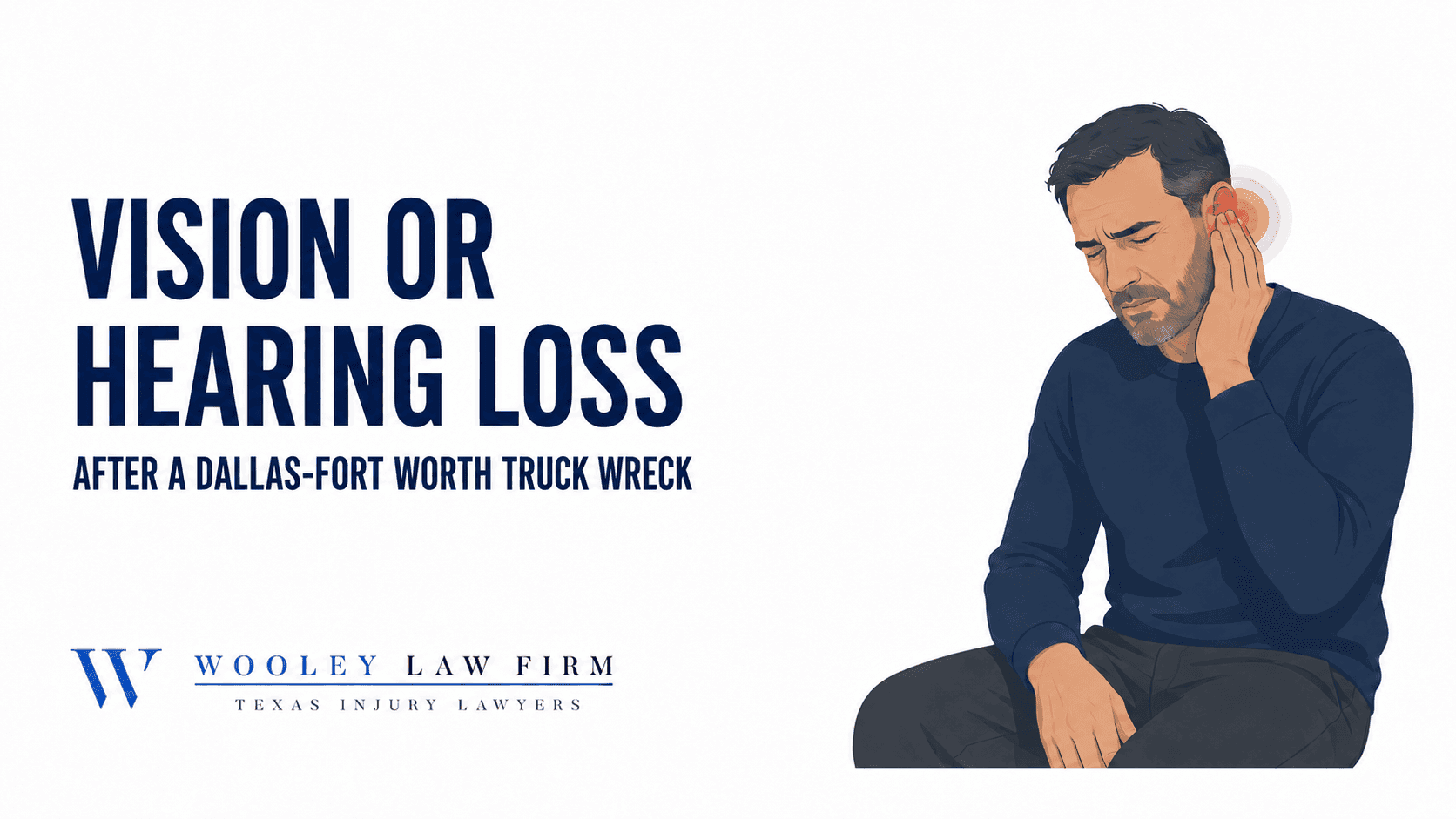
A collision with an 18-wheeler can permanently change how a person sees, hears, communicates, works, drives, and interacts with the world.
The force of a truck wreck may damage the eyes, optic nerves, ears, eardrums, inner-ear structures, auditory nerves, or areas of the brain responsible for processing sight and sound. A victim may experience partial vision loss, blindness, blurred or double vision, hearing impairment, deafness, tinnitus, balance problems, or difficulty understanding speech.
Some sensory injuries are obvious immediately after the crash. Others become apparent hours or days later when the victim develops flashes of light, new floaters, worsening vision, ringing in the ears, muffled hearing, dizziness, or sudden hearing loss.
Eye trauma can cause permanent vision damage, and conditions such as retinal detachment require prompt treatment to reduce the risk of blindness. Sudden hearing loss should also be treated as a medical emergency rather than dismissed as temporary congestion or a routine consequence of the collision.
If you or someone you love suffered vision or hearing loss after an 18-wheeler, tractor-trailer, semi-truck, or commercial-vehicle wreck in Dallas-Fort Worth, your claim may involve emergency treatment, surgery, assistive devices, rehabilitation, lost income, permanent impairment, and substantial changes to your quality of life.
The Wooley Law Firm represents people seriously injured in wrecks involving:
18-wheelers and tractor-trailers
Semi-trucks
Flatbed trucks
Box trucks
Delivery trucks and vans
Tanker trucks
Dump trucks
Construction vehicles
Garbage and sanitation trucks
Buses and other commercial vehicles
Learn more about our representation of injured truck-wreck victims on our 18-wheeler and truck accident lawyer page.
Call 214-699-6524 for a free consultation. You do not pay attorney’s fees unless we recover compensation for you.
How Truck Wrecks Cause Vision and Hearing Loss
An 18-wheeler collision can expose the head, face, eyes, and ears to enormous force.
Vision or hearing loss may result when:
The head strikes the steering wheel or dashboard
The side of the head strikes a window or door
Broken glass enters the eye
The passenger compartment collapses inward
An airbag strikes the face or ear
A victim is ejected from the vehicle
A truck fire causes burns or smoke exposure
Hazardous chemicals contact the eyes
An explosion creates an intense pressure wave
Falling cargo strikes the head or face
A skull or facial fracture damages nearby nerves
A traumatic brain injury affects sensory processing
A rollover causes repeated head impacts
A victim becomes trapped beneath or beside a trailer
The same collision may cause facial fractures, eye injuries, hearing loss, brain trauma, and permanent scarring.
Learn more about facial injuries, scarring, and disfigurement after a Dallas-Fort Worth truck wreck.
Vision Loss After an 18-Wheeler Wreck
Vision loss following a truck accident may be temporary, progressive, or permanent.
A victim may experience:
Complete blindness
Partial blindness
Loss of vision in one eye
Reduced peripheral vision
Blurred vision
Double vision
Blind spots
Light sensitivity
Difficulty focusing
Changes in depth perception
Reduced night vision
Flashes or floaters
Eye pain
Difficulty tracking moving objects
Even limited changes in vision may interfere with driving, reading, using a computer, walking safely, and performing job duties.
Common Eye Injuries After a Truck Accident
A truck wreck can injure the eye itself, the structures surrounding it, or the nerves connecting the eye to the brain.
Corneal Injuries
The cornea is the clear outer surface at the front of the eye.
Broken glass, dirt, chemicals, or other debris may cause:
Corneal abrasions
Cuts
Chemical burns
Foreign-body injuries
Infection
Scarring
Corneal injuries may cause pain, tearing, redness, light sensitivity, and blurred vision. Deep injuries or resulting scars may permanently affect sight.
Retinal Tears and Retinal Detachment
The retina is the light-sensitive tissue at the back of the eye.
Blunt trauma may contribute to a retinal tear. A tear may allow fluid to collect beneath the retina and cause it to detach from its normal position.
Possible symptoms include:
Sudden flashes of light
A sudden increase in floaters
A shadow in the field of vision
A curtain-like effect across the vision
Sudden vision loss
Retinal detachment is a medical emergency. Delayed treatment can increase the risk of permanent vision loss or blindness.
Optic-Nerve Damage
The optic nerve carries visual signals from the eye to the brain.
A collision may damage the optic nerve through:
Direct trauma
Swelling
Bleeding
Loss of blood flow
Skull fractures
Compression
Traumatic brain injury
Optic-nerve damage may cause reduced visual sharpness, loss of color perception, blind spots, or permanent blindness.
Orbital Fractures
The orbit is the bony structure surrounding the eye.
An orbital fracture may damage:
Eye muscles
Nerves
Blood vessels
The eye itself
Nearby facial structures
A victim may experience double vision, numbness, eye-movement problems, swelling, or a sunken appearance of the eye.
Globe Rupture
A severe impact or penetrating object may rupture the eyeball.
This is an emergency that may result in permanent vision loss and may require immediate surgery.
Vitreous Hemorrhage
Trauma may cause bleeding into the clear gel inside the eye.
The victim may see:
Floaters
Haze
Shadows
Cobweb-like shapes
Reduced vision
The underlying cause must be evaluated because the bleeding may be associated with retinal damage.
Chemical Eye Injuries
Truck crashes involving industrial materials, fuel, cleaning agents, or hazardous cargo may expose a victim’s eyes to corrosive substances.
Chemical eye injuries require immediate medical attention. Prompt flushing and specialized treatment may reduce damage, but severe exposures can cause corneal scarring, infection, and permanent blindness.
Burns to the Eyes and Eyelids
Fire, heated air, electrical exposure, or chemicals may damage:
Eyelids
Tear ducts
Corneas
Conjunctiva
Other eye structures
Eyelid damage may prevent the eye from closing completely, increasing the risk of dryness, infection, and additional corneal injury.
Learn more about burn injuries after a Dallas-Fort Worth truck wreck.
Warning Signs of a Serious Eye Injury
A truck-wreck victim should seek immediate medical care for:
Sudden vision loss
Blurred or double vision
New flashes or floaters
A shadow or curtain across the vision
Severe eye pain
Blood inside or around the eye
An object lodged in the eye
An irregularly shaped pupil
Chemical exposure
Difficulty moving the eye
Light sensitivity
Loss of peripheral vision
Increasing swelling
Severe headache with visual changes
Eye emergencies can include blunt injuries, cuts, chemical exposure, and foreign objects. Untreated eye trauma may result in permanent vision loss.
How Doctors Diagnose Vision Injuries
Evaluation may involve an emergency physician, ophthalmologist, retinal specialist, neurologist, or facial surgeon.
Testing may include:
Visual-acuity testing
Pupil examination
Eye-pressure testing
Slit-lamp examination
Dilated retinal examination
Visual-field testing
Eye-movement testing
CT scans
MRI scans
Ultrasound
Optical imaging
Neurological evaluation
Repeated evaluations may be necessary because swelling, bleeding, retinal damage, or nerve symptoms may change after the collision.
Treatment for Vision Loss After a Truck Wreck
Treatment depends on the injured structure and the severity of the damage.
Possible treatment includes:
Prescription eye drops
Antibiotics
Protective eye shields
Removal of foreign objects
Corneal repair
Retinal laser treatment
Retinal surgery
Repair of orbital fractures
Surgery to relieve pressure
Optic-nerve evaluation
Eyelid reconstruction
Eye-muscle surgery
Prescription glasses
Low-vision rehabilitation
Assistive technology
Retinal tears may be treated with laser or freezing procedures, while detached retinas often require surgery. Early treatment is important to preserve as much vision as possible.
Blindness and Permanent Vision Impairment
Permanent vision loss may affect one eye or both eyes.
The consequences may include:
Loss of depth perception
Reduced peripheral awareness
Inability to drive
Difficulty reading
Problems using computers
Increased fall risk
Difficulty identifying faces
Inability to perform detailed work
Loss of independence
Need for mobility training
Need for assistive technology
Employment restrictions
A person with blindness or low vision may need:
Screen-reading software
Magnification equipment
Mobility training
Orientation services
Transportation assistance
Home modifications
Vocational rehabilitation
Assistance with household tasks
The fact that a person retains some sight does not mean the injury is minor. Partial vision loss can still permanently change daily life and employment.
Hearing Loss After an 18-Wheeler Wreck
A truck collision can damage the outer ear, middle ear, inner ear, auditory nerve, or portions of the brain that process sound.
Hearing loss may affect one ear or both ears and may be temporary or permanent.
Symptoms may include:
Muffled hearing
Difficulty understanding speech
Inability to hear certain frequencies
Sudden deafness
Ringing or buzzing
Ear pain
Pressure or fullness
Sensitivity to sound
Dizziness
Balance problems
Difficulty locating sounds
Trouble following conversations in noisy environments
Hearing loss can result from trauma, loud noise, nerve damage, and other injuries.
Types of Hearing Loss After a Truck Accident
Conductive Hearing Loss
Conductive hearing loss occurs when sound cannot travel properly through the outer or middle ear.
Possible causes after a truck wreck include:
Ruptured eardrum
Blood or fluid in the middle ear
Damage to the ear canal
Dislocation of the tiny middle-ear bones
Swelling
Foreign objects
Some conductive hearing loss may improve with treatment or surgery, depending on the damage.
Sensorineural Hearing Loss
Sensorineural hearing loss involves damage to the inner ear or auditory nerve.
It may result from:
Head trauma
Skull fractures
Explosion pressure
Extremely loud noise
Reduced blood flow
Nerve damage
Traumatic brain injury
Sensorineural hearing loss may be permanent.
Mixed Hearing Loss
A victim may have both conductive and sensorineural damage.
For example, a truck explosion may rupture the eardrum while also damaging delicate inner-ear structures.
Acoustic Trauma and Explosions
A crash involving an explosion, tire rupture, airbag deployment, metal impact, or sudden extremely loud sound may cause acoustic trauma.
Acoustic trauma damages the hearing structures of the inner ear and can cause sensory hearing loss.
The victim may experience:
Immediate hearing reduction
Ringing in the ears
Ear pain
Sound distortion
Difficulty understanding speech
Permanent hearing impairment
Very loud impulse sounds can permanently damage sensitive inner-ear structures.
Injured in an Accident?
Free consultation. Tell us what happened and learn what options may be available.
Ruptured Eardrum After a Truck Wreck
A ruptured eardrum may result from:
Sudden pressure changes
Airbag deployment
An explosion
Direct impact
Penetrating debris
Skull or facial trauma
Symptoms may include:
Sudden ear pain
Hearing loss
Ringing
Fluid or blood draining from the ear
Dizziness
Nausea
Some eardrum injuries heal, while others require surgical repair. A ruptured eardrum should be evaluated promptly.
Sudden Hearing Loss Is an Emergency
A victim who suddenly loses hearing after a collision should not assume the ear is merely blocked or that the symptoms will resolve without treatment.
Sudden sensorineural hearing loss requires prompt evaluation. Pure-tone audiometry may be used to measure the severity and pattern of hearing loss, and early treatment may be important.
Warning signs include:
Sudden deafness in one or both ears
Hearing loss noticed upon waking
A sudden “pop” followed by reduced hearing
Ringing with hearing loss
Dizziness with reduced hearing
Difficulty understanding speech
Tinnitus After an 18-Wheeler Collision
Tinnitus is the perception of sound when no outside sound is present.
A victim may hear:
Ringing
Buzzing
Hissing
Clicking
Roaring
Pulsing
Tinnitus may be temporary or permanent. It can interfere with:
Sleep
Concentration
Communication
Work
Emotional health
Enjoyment of quiet activities
Some people find tinnitus more disruptive than the measurable hearing loss itself.
Balance Problems and Inner-Ear Injuries
The inner ear contributes to both hearing and balance.
A truck-wreck victim with inner-ear trauma may experience:
Vertigo
Dizziness
Nausea
Unsteadiness
Falls
Difficulty walking in the dark
Motion sensitivity
Difficulty driving
Balance problems may make work and daily activities unsafe even when hearing loss is limited.
Auditory-Nerve and Brain Injuries
The ear may receive sound normally, but trauma can interfere with the transmission or processing of sound signals.
Auditory neuropathy is a hearing disorder in which sound reaches the inner ear, but signal transmission from the inner ear to the brain is impaired.
A traumatic brain injury may also affect how the brain understands sound.
The victim may be able to detect noise but have difficulty:
Understanding words
Following rapid speech
Separating voices from background noise
Remembering spoken information
Locating the source of a sound
Learn more about traumatic brain injuries after a Dallas-Fort Worth car or truck wreck.
How Doctors Diagnose Hearing Loss
Medical evaluation may involve an emergency physician, ear-nose-and-throat specialist, audiologist, neurologist, or vestibular specialist.
Testing may include:
Examination of the ear canal and eardrum
Pure-tone audiometry
Speech-recognition testing
Tympanometry
Auditory brainstem testing
Balance testing
CT scans
MRI scans
Neurological examination
Testing should identify whether the hearing loss is conductive, sensorineural, mixed, or related to the brain’s processing of sound.
Treatment for Hearing Loss After a Truck Accident
Treatment depends on the location and extent of the damage.
Possible treatment includes:
Medication
Eardrum repair
Surgery on middle-ear structures
Hearing aids
Bone-anchored hearing devices
Cochlear implants
Assistive listening devices
Tinnitus treatment
Balance rehabilitation
Communication training
Speech-reading instruction
Counseling
Vocational rehabilitation
Not every form of hearing loss can be restored. Some victims require lifelong use of hearing devices and communication accommodations.
Hearing Aids and Cochlear Implants
A hearing aid amplifies sound. It does not necessarily restore normal hearing.
The injured person may still struggle with:
Background noise
Sound direction
Telephone conversations
Group discussions
High-frequency sounds
Speech clarity
Some people with severe sensorineural hearing loss may be evaluated for a cochlear implant. A cochlear implant does not recreate natural hearing and may require surgery, programming, training, and ongoing follow-up.
A serious claim should account for future device replacement, batteries, accessories, programming, maintenance, and specialist care.
How Sensory Loss Changes Daily Life
Vision and hearing help people navigate nearly every ordinary activity.
A victim may have difficulty:
Driving
Reading
Using a computer
Watching television
Crossing streets
Recognizing people
Following conversations
Hearing alarms
Locating approaching vehicles
Using a telephone
Attending meetings
Shopping independently
Caring for children
Participating in hobbies
Sleeping
Working safely
A person who loses vision may become more dependent on hearing. A person who loses hearing may rely more heavily on vision.
When a crash damages both senses, the consequences may be especially profound.
The Effect on Employment and Earning Capacity
Vision or hearing loss may prevent a victim from returning to the same job.
These injuries may be particularly significant for people whose work requires:
Commercial driving
Operating machinery
Reading fine print
Detailed visual inspection
Recognizing warning signals
Hearing instructions
Telephone communication
Public interaction
Teaching
Construction work
Law enforcement
Healthcare
Music or sound production
Working around traffic
Employment consequences may include:
Missed work
Reduced hours
Loss of overtime
Reassignment
A lower-paying position
Vocational retraining
Early retirement
Permanent inability to work
A claim may include both past lost wages and loss of future earning capacity.
Physical Impairment Caused by Vision or Hearing Loss
Physical impairment concerns how the injury limits the victim’s ability to participate in normal life.
Examples may include the loss of the ability to:
Drive
Read comfortably
Travel independently
Exercise safely
Communicate normally
Attend concerts or social events
Hear family members
Watch children safely
Participate in a former occupation
Enjoy music, television, or conversation
Live without assistive devices
These losses are not fully measured by medical bills.
Mental Anguish and Emotional Trauma
Loss of vision or hearing may cause:
Depression
Anxiety
Post-traumatic stress
Fear of driving
Social withdrawal
Frustration
Isolation
Sleep problems
Loss of confidence
Grief over lost independence
A person may become embarrassed about repeatedly asking others to speak louder or may avoid unfamiliar places because of difficulty seeing.
Mental-health treatment and counseling may be an important part of recovery.
Future Medical and Assistive Needs
Sensory injuries may require ongoing care throughout the victim’s lifetime.
Future needs may include:
Ophthalmology care
Retinal treatment
Eye surgery
Audiology appointments
Hearing-aid replacement
Cochlear-implant maintenance
Assistive listening devices
Screen-reading software
Magnification devices
Mobility training
Transportation assistance
Home safety modifications
Communication services
Psychological counseling
Vocational rehabilitation
A life-care planner or other qualified expert may be needed to evaluate long-term care and assistive-technology costs.
Compensation for Vision or Hearing Loss
Depending on the facts, compensation may be available for:
Emergency medical care
Hospitalization
Eye surgery
Ear surgery
Specialist treatment
Diagnostic testing
Hearing aids
Cochlear implants
Vision aids
Rehabilitation
Future medical care
Lost wages
Loss of earning capacity
Physical pain and suffering
Mental anguish
Physical impairment
Disfigurement
Transportation expenses
Assistive technology
Out-of-pocket expenses
Property damage
A serious sensory-loss case should not be evaluated solely by the amount of the initial medical bills.
The long-term effect on independence, communication, employment, safety, and quality of life may represent a substantial part of the claim.
Read more about potential compensation in our guide to truck accident damages after a Dallas 18-wheeler wreck.
Who May Be Responsible for a Truck Wreck Causing Sensory Loss?
Truck-wreck cases may involve multiple responsible parties.
The Truck Driver
A commercial driver may cause the collision through:
Speeding
Following too closely
Fatigued driving
Distracted driving
Unsafe lane changes
Failure to check blind spots
Running a red light
Driving while impaired
Making an unsafe wide turn
Failure to control speed
Failure to maintain a proper lookout
The Trucking Company
A motor carrier may be responsible for the driver’s conduct and its own negligence.
Company failures may include:
Hiring an unqualified driver
Inadequate training
Negligent supervision
Retaining an unsafe driver
Pressuring drivers to meet unsafe schedules
Failing to inspect or maintain the truck
Ignoring safety violations
Unsafe dispatch practices
The Cargo Loader or Shipper
Improperly secured cargo may fall from a trailer, enter a passenger compartment, or cause the truck to roll over or lose control.
Flatbed cargo involving steel, lumber, pipe, machinery, and construction materials can cause severe eye, face, and head trauma.
Learn more about flatbed truck accidents, cargo securement, and liability.
A Maintenance or Repair Company
A maintenance provider may share responsibility when negligent work contributes to:
Brake failure
Tire separation
Steering problems
Wheel detachment
Trailer separation
Electrical failure
Fire or explosion
A Truck or Parts Manufacturer
A defective truck component may cause or worsen the wreck.
Potential defects may involve:
Brakes
Tires
Steering systems
Coupling devices
Fuel systems
Batteries
Airbags
Underride guards
Other safety equipment
Evidence That Should Be Preserved
The trucking company and its insurer may begin investigating before the victim leaves the hospital.
Important evidence may include:
Engine control module data
Electronic logging-device records
GPS and telematics data
Dash-camera footage
Driver-facing camera footage
Dispatch communications
Cellphone records
Driver qualification files
Training records
Hours-of-service logs
Maintenance records
Inspection reports
Cargo records
Hazardous-material documents
Bills of lading
Post-crash inspection materials
Photographs and videos
Surveillance footage
Witness statements
Police body-camera footage
911 recordings
Physical vehicle evidence
Electronic data may be overwritten or lost unless prompt steps are taken to preserve it.
Learn more about the evidence that matters after a Texas 18-wheeler wreck and 18-wheeler black-box data after a Dallas-Fort Worth truck crash.
Medical Evidence Needed for a Vision or Hearing Loss Claim
Relevant medical evidence may include:
Ambulance records
Emergency-room records
Ophthalmology records
Retinal imaging
Visual-field testing
Audiology testing
Hearing evaluations
ENT records
Surgical reports
Neurological records
Rehabilitation records
Hearing-device estimates
Assistive-technology recommendations
Future-treatment opinions
Work restrictions
Functional-capacity evaluations
Life-care planning
The evidence should explain:
Which structures were injured
Whether the loss is permanent
Whether symptoms may worsen
What treatment is required
Which devices will require replacement
How the injury affects work
How the injury changes daily life
How Insurance Companies Defend Sensory-Loss Claims
Even when a victim has documented vision or hearing loss, the trucking company’s insurer may attempt to reduce the claim.
The insurance company may argue that:
The condition existed before the wreck
The loss is age-related
The symptoms are temporary
Hearing aids fully correct the problem
Glasses restore normal vision
The victim can return to the same work
Future treatment is speculative
The collision did not cause the injury
The victim shares responsibility for the wreck
A hearing aid does not necessarily restore normal hearing, and corrective lenses cannot repair every traumatic vision injury.
A settlement should not be finalized before the prognosis, future treatment, assistive-device needs, and employment consequences are understood.
What to Do After Vision or Hearing Changes Following a Truck Wreck
Seek Immediate Medical Care
Sudden vision loss, retinal-detachment symptoms, severe eye trauma, and sudden hearing loss require prompt medical evaluation.
Report Every Symptom
Tell medical providers about:
Blurred vision
Double vision
Flashes or floaters
Blind spots
Eye pain
Reduced hearing
Ringing
Ear pressure
Dizziness
Balance problems
Difficulty understanding speech
Attend Specialist Appointments
Follow recommendations for ophthalmology, retinal specialists, audiology, ENT care, neurology, and rehabilitation.
Preserve Medical and Financial Records
Keep:
Medical bills
Testing records
Device estimates
Work restrictions
Employment records
Prescription receipts
Travel expenses
Insurance communications
Document Daily Limitations
Record how the injury affects:
Driving
Reading
Communication
Work
Sleep
Household activities
Parenting
Social interaction
Independence
Avoid a Premature Settlement
Do not resolve the claim before the permanence of the sensory loss and the cost of future care are understood.
Contact a Truck Wreck Lawyer Promptly
Early legal involvement can help preserve truck data, obtain video, locate witnesses, and identify every responsible party.
How The Wooley Law Firm Handles Vision and Hearing Loss Claims
A sensory-loss claim requires more than sending medical bills to an insurance adjuster.
Depending on the facts, The Wooley Law Firm may:
Investigate the collision
Obtain the crash report
Send evidence-preservation demands
Secure electronic truck data
Identify the driver and motor carrier
Investigate cargo-loading companies
Review driver qualification records
Examine hours-of-service evidence
Obtain maintenance and inspection records
Locate witnesses
Obtain available video footage
Analyze medical and specialist records
Document assistive-device needs
Calculate lost wages
Evaluate reduced earning capacity
Investigate available insurance coverage
Consult qualified experts
File suit when necessary
Prepare the case for trial
The goal is to determine why the wreck happened, identify every responsible party, and show how the loss of vision or hearing has changed the victim’s health, work, independence, and daily life.
Dallas-Fort Worth Vision and Hearing Loss Lawyer
The Wooley Law Firm represents seriously injured people throughout:
Dallas
Fort Worth
Arlington
Irving
Garland
Mesquite
Richardson
Plano
Frisco
McKinney
Allen
Denton
Lewisville
Carrollton
Grand Prairie
Grapevine
Mansfield
Keller
Southlake
North Texas
We also handle serious commercial-truck injury cases throughout Texas.
If you or a loved one suffered blindness, partial vision loss, deafness, tinnitus, or another serious sensory injury after an 18-wheeler wreck, call 214-699-6524.
You can also learn more by visiting our Dallas truck accident lawyer page.
Your consultation is free and confidential. You do not pay attorney’s fees unless we obtain a recovery for you.
Frequently Asked Questions About Vision or Hearing Loss After a Truck Wreck
Can an 18-wheeler wreck cause vision loss without directly striking the eye?
Yes. Head trauma, optic-nerve damage, bleeding, swelling, loss of blood flow, or traumatic brain injury may affect vision even without direct penetration of the eye.
What are the warning signs of retinal detachment?
Warning signs may include sudden flashes, new floaters, a shadow in the field of vision, or a curtain-like effect. Retinal detachment is an emergency because delayed treatment can result in permanent vision loss.
Can vision loss develop after leaving the hospital?
Yes. Bleeding, swelling, retinal tears, nerve injuries, and other problems may become more noticeable after the initial emergency evaluation.
New or worsening visual symptoms should be reported immediately.
Can a truck explosion cause permanent hearing loss?
Yes. A powerful impulse sound or pressure wave may damage the eardrum, middle ear, inner ear, or auditory nerve. Acoustic trauma can cause permanent sensory hearing loss.
Is sudden hearing loss an emergency?
Yes. Sudden sensorineural hearing loss should be evaluated promptly. A person should not assume the ear is simply blocked or wait several days to see whether hearing returns.
Can tinnitus be included in a truck-accident claim?
Tinnitus may be part of the claim when it was caused or aggravated by the wreck and affects sleep, concentration, work, communication, or quality of life.
Do hearing aids restore normal hearing?
Not always. Hearing aids may improve access to sound, but many users continue to struggle with speech clarity, background noise, and locating sounds.
Can I recover the future cost of hearing aids or assistive devices?
Future device expenses may be recoverable when supported by appropriate medical, audiological, vocational, or economic evidence.
Can I recover compensation if I can no longer drive?
The loss of driving ability may be relevant to physical impairment, transportation costs, employment losses, and the overall effect of the injury.
What if I already wore glasses or hearing aids before the wreck?
A preexisting condition does not automatically prevent recovery. The issue may be whether the truck wreck caused a new injury or aggravated the previous vision or hearing loss.
How long do I have to file a truck-accident claim in Texas?
Texas law imposes deadlines on personal-injury claims. Different or shorter notice requirements may apply when a government-owned truck or public entity is involved.
Important truck data and video may disappear well before the legal deadline, so the investigation should begin promptly.
How much does it cost to hire The Wooley Law Firm?
The Wooley Law Firm handles personal-injury cases on a contingency-fee basis. You pay no upfront attorney’s fee and owe no attorney’s fee unless the firm obtains a recovery for you.
Speak With a Dallas-Fort Worth Truck Wreck Lawyer
Vision and hearing connect people to their families, work, surroundings, and independence.
Losing either sense can permanently affect communication, mobility, employment, driving, safety, and enjoyment of life. Meanwhile, the trucking company and its insurer may already be collecting evidence and building their defense.
You deserve someone protecting your interests.
Call The Wooley Law Firm at 214-699-6524 for a free consultation about vision or hearing loss caused by a Dallas-Fort Worth truck wreck.
You do not pay attorney’s fees unless we win.
Disclaimer:
This article is provided for general informational purposes only and does not constitute medical or legal advice. Sudden vision loss, retinal-detachment symptoms, serious eye trauma, chemical eye exposure, or sudden hearing loss may be medical emergencies. Seek immediate medical attention for new or worsening symptoms after a collision. Reading this article or contacting The Wooley Law Firm does not create an attorney-client relationship. Every case is different, and past results do not guarantee a similar outcome. Legal deadlines may apply, so you should consult a qualified Texas attorney regarding your specific circumstances.
Topics
Share This Article

Andrew J. Wooley
Personal Injury Attorney
Andrew J. Wooley is a dedicated personal injury attorney based in Dallas, Texas. He focuses on helping accident victims recover fair compensation for their injuries. With a commitment to personalized service, Andrew works directly with each client to understand their unique situation and fight for their rights.