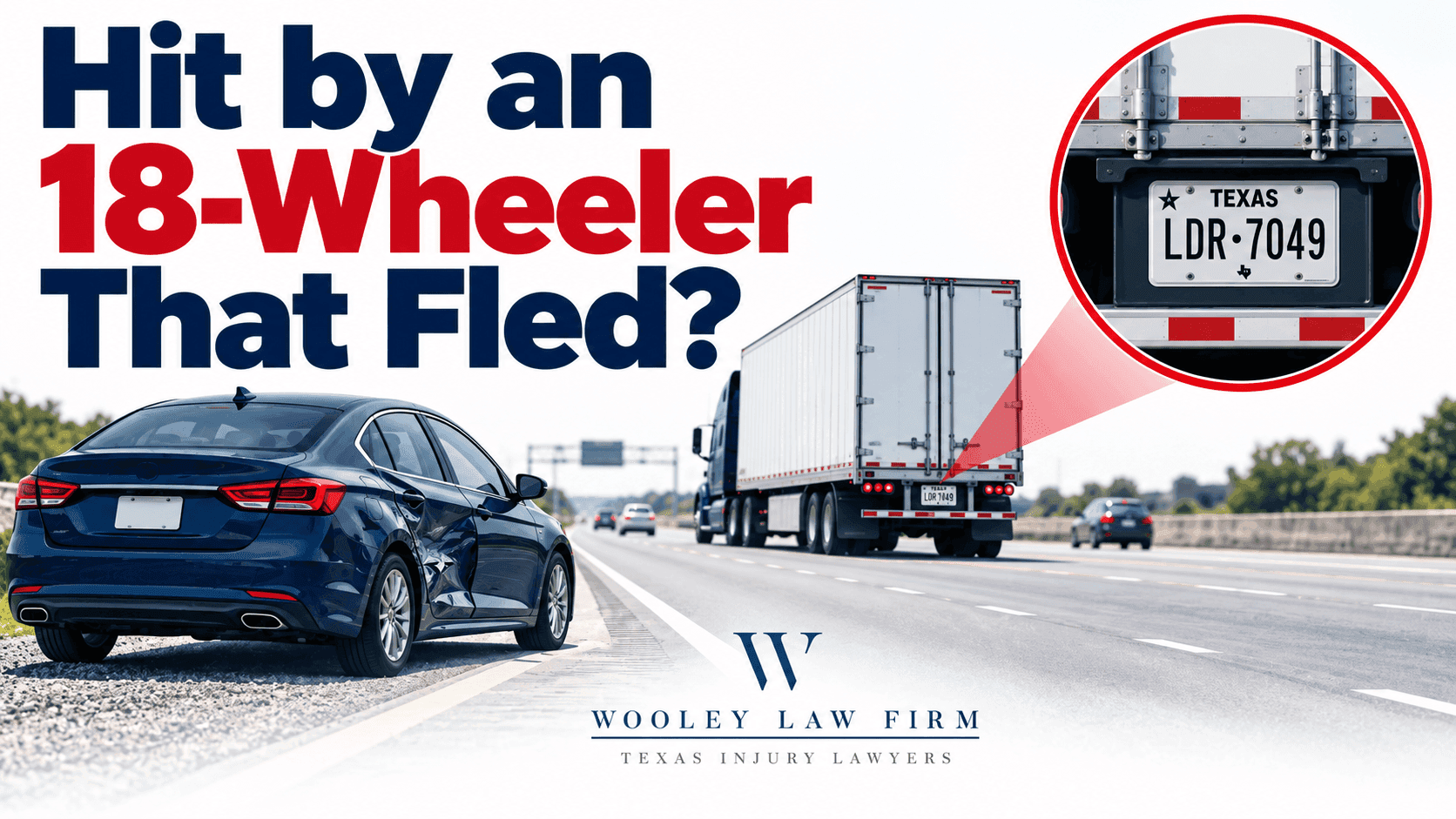
An 18-wheeler hits your vehicle, injures you, and keeps driving. You may have a photograph of the trailer, a partial license plate, or only a few details about the truck. Now you are dealing with medical treatment, vehicle damage, and a difficult question: How do you find the trucking company and its insurance when the driver never stopped?
You may still have options. A trailer plate, company marking, witness, or video can provide a starting point for identifying a fleeing commercial truck. If the truck cannot be identified, your own insurance may provide coverage, depending on your policy and the circumstances.
At The Wooley Law Firm, we have received an increase in calls from people injured after an 18-wheeler hit their vehicle and fled the scene. We have helped injured clients track down the trucks involved and identify their insurance. Every investigation is different, but a driver leaving does not necessarily end your opportunity to pursue a claim.
Our Dallas truck wreck lawyer can review the information you have, investigate potential leads, and help you understand your options.
What Should You Do After an 18-Wheeler Hits You and Leaves?
Your safety and medical needs come first. Do not chase the truck or put yourself in traffic to photograph it.
If you can do so safely:
Call 911. Explain that a commercial truck struck your vehicle and left. Report your location, injuries, the truck’s direction of travel, and any identifying details.
Get medical attention. Tell your provider how the collision happened and describe your symptoms accurately.
Save photographs and video. Preserve original files showing the truck, trailer, plates, vehicle damage, and scene.
Get witness information. A witness may have seen a company name, captured a plate, or recorded the impact.
Write down what you remember. Include the time, highway, direction, lane, nearby exit, and how the truck moved.
Notify your insurer promptly. Report the hit-and-run and ask about potentially available coverage.
Contact a lawyer about preserving evidence. Video and electronic records may be overwritten or become harder to obtain.
You do not need a complete evidence package before contacting us. Tell us what you have, even if it is only a photograph of the trailer or an incomplete plate number.
Can a Lawyer Find a Hit-and-Run 18-Wheeler With Only a Trailer Plate?
A trailer plate can be an important lead, even when you never saw the tractor’s plate or the driver.
The tractor and trailer may belong to different businesses. A trailer may be owned by a leasing company and used by a separate motor carrier. Identifying the registered trailer owner may therefore be the beginning of an investigation rather than the final answer.
Depending on the available evidence and lawful access to records, an investigation may seek to establish:
Who owned the trailer on the collision date.
Which company leased or controlled it.
Which tractor was pulling it.
Which driver was assigned to that tractor.
Whether trip records place that equipment near the collision.
Which insurance policies potentially apply.
Trailer ownership alone does not establish responsibility for the wreck. The evidence must connect the equipment to the collision and identify the people or companies legally responsible.
Save the plate exactly as it appears, including the state or province. If you are unsure whether a character is a letter or number, keep the original photograph rather than relying on a typed transcription.
This can be especially important when an 18-wheeler’s trailer hits your car during a lane change. You may have had a clear view of the trailer while never seeing the tractor’s identifying information.
How Can a Dallas Truck Wreck Lawyer Investigate a Fleeing Truck?
An investigation works outward from the facts you can provide. The exact collision time and location help connect a particular truck to your vehicle, rather than simply finding a truck that looks similar.
Truck markings, plates, and equipment numbers
Useful details can include a USDOT number, company name, trailer number, logo, distinctive paint, or markings on the tractor door. Even a photograph that seems unhelpful at first may contain an identifying detail.
Dashcam, business, and other available video
Potential sources include your dashcam, witnesses’ cameras, nearby businesses, truck stops, and other vehicles.
A camera visible near the roadway does not necessarily record or retain footage. When recordings exist, access and retention practices vary. Prompt, targeted requests may help preserve relevant evidence.
License plate recognition records
Plate recognition records may provide investigative leads when available through lawful channels. Access, retention, and image quality vary; a lawyer cannot guarantee that a particular system captured the truck or that its records can be obtained.
Our article about license plate photographs and Dallas wreck claims explains how vehicle images can become relevant evidence.
Injured in an Accident?
Free consultation. Tell us what happened and learn what options may be available.
Dispatch, GPS, and trip records
Once a potential carrier is identified, relevant evidence may include dispatch messages, GPS information, electronic logging device records, delivery paperwork, equipment assignments, and onboard video.
These records may help determine whether a particular tractor and trailer were at the collision location. A preservation request identifies relevant evidence that should be retained; obtaining it may require cooperation, a subpoena, or litigation.
Vehicle damage and physical evidence
Scrapes, paint transfer, impact height, broken components, and damage patterns may help explain how contact occurred. Photographs should document the entire vehicle and close views of the damage.
A matching company name or similar truck is a lead. The investigation still needs evidence connecting that truck to your wreck.
How Do You Find the Trucking Company’s Insurance?
Finding a business associated with a trailer is only one step. The next question is which carrier operated the truck and which coverage applied when the collision occurred.
For interstate carriers, FMCSA’s Licensing and Insurance system provides a public starting point for researching operating authority and insurance filings.
A filing does not establish every policy term, exclusion, or available insurance layer. Further investigation may be needed to verify coverage for the collision date, driver, vehicle, and operation.
Depending on the facts, potentially relevant coverage may include the motor carrier’s commercial auto liability policy, other applicable commercial policies, or your own uninsured/underinsured motorist coverage.
Identifying an insurer also does not mean that it will accept fault. A lawyer must still address how the wreck happened, what injuries it caused, and the losses supported by the evidence.
What If the Trucking Company Denies Its Driver Hit You?
A carrier or insurer may dispute whether its truck was involved, whether contact occurred, or whether its driver caused the crash. The driver may claim not to have noticed any impact.
Those disputes make independent evidence important.
A photograph of the trailer, a witness statement, location records, and consistent vehicle damage may help support your account. Each piece should be evaluated together with the rest of the evidence.
Our discussion of disputed lane-change wrecks and insurance denials explains why an insurer’s initial position does not necessarily resolve a fault dispute.
Leaving the scene does not automatically prove who caused the original collision. A civil claim still requires evidence of responsibility, causation, and damages.
Is It Illegal for a Truck Driver to Leave an Injury Crash in Texas?
Under Texas Transportation Code Chapter 550, a driver involved in a collision that results, or is reasonably likely to result, in injury or death must stop, determine whether someone needs aid, and remain to fulfill the applicable duties. Those duties include providing identifying and insurance information and reasonable assistance.
Criminal investigation and a civil injury claim serve different purposes. You generally do not need a criminal conviction before pursuing a civil claim. Whether a particular driver committed an offense depends on the facts and applicable law.
Cooperate with law enforcement, provide any new identifying evidence, and keep your report number. A lawyer can also investigate the civil claim while the police investigation proceeds.
Who Pays If the Hit-and-Run Truck Is Never Found?
Your own coverage deserves careful review even while efforts to identify the truck continue.
Uninsured motorist coverage
Uninsured motorist coverage may apply to an unidentified hit-and-run vehicle. However, Texas Insurance Code § 1952.104 requires actual physical contact between the unknown vehicle and the insured person or property for this coverage.
If an unidentified trailer struck your car, preserving evidence of that contact matters. A truck forcing you off the road without touching you raises a different coverage issue and requires individual review.
Coverage also depends on insured status, policy terms, limits, and applicable requirements.
Collision coverage
Collision coverage may help pay for vehicle repairs or a total loss, subject to the policy and deductible. It does not compensate you for bodily injuries.
PIP or medical payments coverage
If available, personal injury protection or medical payments coverage may help with certain expenses under the policy. PIP may also provide specified lost-income benefits.
Do not assume that having “full coverage” answers which benefits apply. Ask for the declarations page and the complete policy, including endorsements. Report the claim promptly and review your obligations before signing a release.
What Compensation Can You Pursue After a Hit-and-Run Truck Wreck?
Depending on the evidence, applicable law, and coverage, a claim may seek compensation for:
Past and future medical expenses.
Lost wages and reduced earning capacity.
Physical pain and mental anguish.
Physical impairment and disfigurement.
Vehicle damage and other recoverable property losses.
The value depends on the injuries, treatment, prognosis, effect on your life, liability evidence, and available recovery sources.
Document how the wreck affects your work and daily activities. Preserve bills, medical records, repair estimates, and receipts. Our guide to photographing bruises, cuts, and swelling after a truck wreck explains another way to preserve evidence of your injuries.
How Long Do You Have to Take Action?
Texas Civil Practice and Remedies Code § 16.003 generally establishes a two-year limitations period for personal injury claims. Exceptions and different rules may apply, and insurance claims can involve separate deadlines and duties.
Do not assume that an unidentified driver or an ongoing police investigation extends your deadline. Locating the responsible parties and completing the steps needed to pursue them can take time.
Evidence may disappear much sooner than the lawsuit deadline. Contacting a lawyer promptly allows the investigation to begin while potential leads are still available.
Frequently Asked Questions About Dallas 18-Wheeler Hit-and-Run Wrecks
Can I contact a lawyer without knowing the trucking company?
Yes. Share the collision location, approximate time, photographs, witness information, and anything you remember. A lawyer can evaluate potential leads without requiring you to solve the identification problem first.
Is a partial trailer plate worth saving?
Yes. Preserve it along with the issuing state, trailer description, time, and location. A partial plate does not guarantee identification, but it may help narrow an investigation.
Can I pursue a claim if the truck had an out-of-state plate?
An out-of-state plate does not, by itself, prevent a claim arising from a Dallas collision. It may require investigation involving another state’s registration records and an interstate carrier’s operations.
Should I wait for the police to find the truck before calling a lawyer?
You can consult a lawyer while the police investigation continues. The lawyer can evaluate evidence preservation, potential civil claims, and your own insurance coverage.
Does finding the trailer owner guarantee compensation?
No. Identifying an owner is an investigative step. Responsibility, insurance coverage, injuries, and damages still need to be established.
Injured by an 18-Wheeler That Left the Scene in Dallas? Contact The Wooley Law Firm.
Whether the collision happened on I-35E, I-635, I-20, I-30, US-75, or another Dallas-area road, the information you saved may provide a starting point.
The Wooley Law Firm has helped injured clients track down 18-wheelers that fled the scene and identify their insurance. We can review the details of your wreck, evaluate available leads, and explain potential options for pursuing compensation.
You do not need to know the driver’s name or have the insurance information before reaching out.
Call (214) 699-6524 or contact The Wooley Law Firm for a free consultation. You don’t pay an attorney’s fee unless we recover compensation for you.
This article is for general informational purposes only and is not legal advice. Reading it does not create an attorney-client relationship. Every case is different, and past results do not guarantee a similar outcome.
Topics
Share This Article

Andrew J. Wooley
Personal Injury Attorney
Andrew J. Wooley is a dedicated personal injury attorney based in Dallas, Texas. He focuses on helping accident victims recover fair compensation for their injuries. With a commitment to personalized service, Andrew works directly with each client to understand their unique situation and fight for their rights.