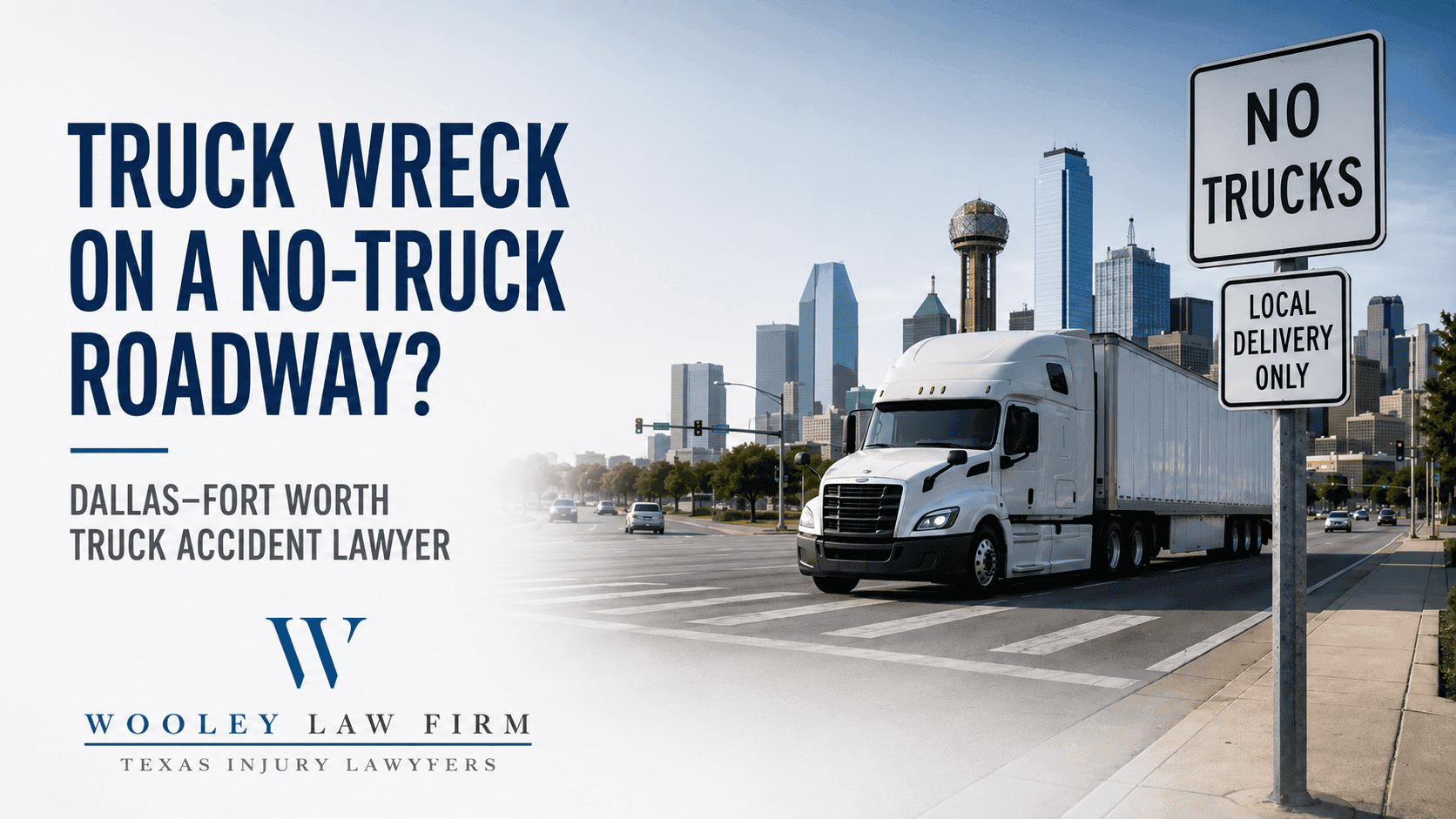
Dallas-Fort Worth Truck Accident Lawyer for Crashes Involving Truck Route Violations
A serious truck wreck can change your life in seconds. When the crash involves an 18-wheeler, dump truck, box truck, delivery truck, construction vehicle, or other commercial motor vehicle, the injuries are often severe. Medical bills start piling up. You may be out of work. Your vehicle may be totaled. You may not know who to call, what insurance company is responsible, or why the truck was even on that road in the first place.
In Dallas-Fort Worth, some roads are marked with signs such as “No Trucks,” “No Through Trucks,” “Truck Route,” “Restricted Truck Lane,” weight-limit signs, low-clearance warnings, or other commercial vehicle restrictions. These rules are not there by accident. Certain streets are too narrow, too residential, too close to schools, too congested, or otherwise unsafe for large trucks.
When a commercial motor vehicle ignores a no-truck roadway restriction and causes a crash, that violation may become important evidence in a personal injury or wrongful death claim.
If you were injured in a truck wreck in Dallas, Fort Worth, Arlington, Plano, Irving, McKinney, Grand Prairie, Frisco, Garland, Carrollton, Lewisville, Denton, Mesquite, or anywhere in North Texas, The Wooley Law Firm can investigate what happened, preserve critical trucking evidence, and pursue accountability from the driver, trucking company, and any other responsible party.
Call (214) 699-65-24. You don’t pay unless we win. Contact Us Today!
What Is a “No Truck” Roadway?
A “no truck” roadway is generally a street, route, lane, or area where certain commercial vehicles are prohibited or restricted. The restriction may apply to:
18-wheelers;
tractor-trailers;
dump trucks;
concrete trucks;
garbage trucks;
box trucks;
flatbed trucks;
vehicles pulling trailers;
oversized or overweight vehicles;
vehicles carrying hazardous materials; or
commercial vehicles using the roadway as a shortcut or through route.
The exact rule depends on the roadway, the posted sign, and the city ordinance. Some roads prohibit certain trucks entirely. Others prohibit only “through trucks.” That usually means a commercial vehicle may be allowed to enter the restricted area only if it has a legitimate pickup, delivery, construction site, terminal, or local destination nearby.
That distinction matters after a crash.
A trucking company may claim the driver was making a delivery, following GPS, avoiding traffic, or taking a route recommended by dispatch. A proper truck accident investigation can determine whether the truck had a lawful reason to be on that road or whether the driver and company ignored a safety restriction.
Why No-Truck Roadway Crashes Are Dangerous
Dallas-Fort Worth has major freight corridors, including I-20, I-30, I-35E, I-35W, I-45, I-635, U.S. 75, U.S. 287, Loop 12, SH 183, SH 114, SH 121, SH 360, and the President George Bush Turnpike. These highways are commonly used by commercial motor vehicles and interstate freight traffic.
Local roads are different.
Residential streets, school zones, neighborhood roads, and smaller commercial corridors may not be designed for large trucks. Cities restrict truck traffic because commercial vehicles create risks that ordinary passenger vehicles do not, including:
wide turns at intersections;
longer stopping distances;
large blind spots;
reduced visibility for nearby drivers;
increased rollover risk;
damage to pavement, curbs, bridges, and shoulders;
danger near schools, parks, crosswalks, and neighborhoods;
difficulty navigating narrow lanes;
difficulty turning around safely;
increased risk to pedestrians and cyclists; and
catastrophic crash forces when a truck collides with a smaller vehicle.
A loaded 18-wheeler can weigh tens of thousands of pounds more than a passenger car. When a truck driver takes that vehicle onto a roadway not designed for commercial truck traffic, everyone nearby is placed at risk.
Rules That May Apply After a DFW Truck Wreck on a Restricted Roadway
There is not one single Texas law that covers every “No Trucks” roadway in the same way. These cases often involve a combination of federal motor carrier regulations, Texas transportation laws, TxDOT guidance, and local city ordinances.
Federal Motor Carrier Rules Require Truck Drivers to Follow Local Laws
Federal motor carrier regulations require every commercial motor vehicle to be operated in accordance with the laws, ordinances, and regulations of the jurisdiction where it is being operated. See 49 C.F.R. § 392.2.
That rule matters in a Dallas-Fort Worth truck accident case. If a city has adopted a truck-route ordinance, no-through-truck restriction, or commercial vehicle routing rule, a truck driver cannot ignore that local rule simply because the driver is operating a commercial vehicle.
At a minimum, commercial drivers must comply with local traffic laws and ordinances. If a federal motor carrier safety rule imposes a higher standard of care, the federal rule may also matter.
Texas Transportation Code § 545.0651: Restricted Truck Lanes
Texas law recognizes restricted truck lanes in certain circumstances. Texas Transportation Code § 545.0651 allows certain authorities, including the Texas Transportation Commission and municipalities, to restrict classes of vehicles to designated lanes on qualifying highways under the statute’s requirements.
This rule is different from a neighborhood “No Trucks” sign, but it is important because many serious truck crashes happen on DFW highways. When a truck driver violates a restricted truck lane rule, that violation may help show the driver failed to follow a safety rule designed to reduce crash risk.
TxDOT Guidance on Truck Routes and Restricted Truck Lanes
TxDOT provides guidance on truck routes and restricted truck lanes. TxDOT’s restricted truck lane guidance states that TxDOT, cities, and counties are allowed to enact lane restrictions under certain circumstances, and that these restrictions typically prohibit trucks with three or more axles from using a particular traffic lane of a freeway with three or more lanes.
TxDOT’s restricted-truck-lane guidance also identifies the legal authority for these rules as Texas Transportation Code §§ 545.0651–545.0653 and 43 Texas Administrative Code §§ 25.601–25.604.
This can become important evidence in a commercial vehicle crash. Trucking companies often argue that the driver was simply following traffic flow, GPS, or dispatch instructions. But where truck-route signs, restricted-lane signs, or no-through-truck signs are posted, commercial drivers are expected to see them, understand them, and comply with them.
DFW Cities With Truck-Route or No-Through-Truck Rules
Truck-route rules are often city-specific. In Dallas-Fort Worth, a truck driver may be subject to different local rules depending on whether the crash happened in Dallas, Fort Worth, Arlington, Plano, Irving, McKinney, Grand Prairie, Frisco, Garland, Carrollton, Lewisville, or another North Texas city.
The applicable ordinance depends on the exact location of the crash. That is why a truck accident lawyer should identify the city, roadway, signs, truck-route map, traffic register, and local code provisions that applied at the time of the collision.
Dallas Truck Route Ordinances
Dallas addresses truck routes in Chapter 28, Article X of the Dallas City Code.
Those provisions include rules regarding:
operation within the Central Business District;
operation in public parks;
designated routes for trailers, semitrailers, or pole trailers;
departures from designated routes;
hours on residential streets;
justification for departing from a designated truck route;
signs; and
alternate routes.
Important sections include Dallas City Code §§ 28-69 through 28-75.
These rules may matter if a commercial motor vehicle was involved in a crash after leaving a designated truck route, entering a restricted area, operating on a residential street, or using a local road as a shortcut.
Fort Worth Truck Route Ordinance
Fort Worth also has truck-route rules. Fort Worth Code § 22-112 provides that a person may not operate or cause to be operated a commercial motor vehicle, truck-tractor, trailer, semitrailer, or combination through the city in inter-city travel, without a local destination or point of origin, except on designated truck routes.
Fort Worth’s public truck-route page also states that truck-tractors, trailers, semitrailers, or commercial vehicles may only use city streets designated as truck routes unless the destination or point of origin is outside those routes. See the City of Fort Worth’s Truck Routes page.
That rule is important because it addresses both drivers and companies. It does not just say a driver cannot operate the truck there. It also prohibits a person from causing the vehicle to be operated in violation of the rule.
That language may matter when a trucking company, dispatcher, broker, or other party planned, approved, or encouraged the unsafe route.
Arlington Truck Routes
Arlington publishes an approved truck-route map for commercial motor vehicles. The map states that commercial motor vehicles must operate on truck routes within the City of Arlington. It also states that commercial vehicles may use commercial delivery routes only when necessary to load or unload at their intended destination.
Arlington’s truck-route materials also address deviations from established routes. When a truck must deviate from an established truck route or commercial delivery route for access to a destination, the driver should leave the route only as necessary and return by the shortest permissible route.
This is useful in an Arlington truck wreck case because the question is not simply whether the truck was near a delivery location. The question is whether the truck followed the designated route, deviated only when necessary, and returned to the truck route as required.
Injured in an Accident?
Free consultation. Tell us what happened and learn what options may be available.
Plano Truck Routes
Plano’s Code of Ordinances includes commercial vehicle provisions in Chapter 12, Article VI. Plano Code § 12-134 addresses designated truck routes. Plano also has provisions addressing signs and markings for truck routes, alternate routes during repair of truck routes, and streets prohibited to certain vehicles.
These rules may matter when a crash involves a commercial vehicle using a Plano roadway that was not designated for truck traffic or when a driver claims there was no clear route restriction.
McKinney Truck Routes
McKinney’s Code of Ordinances includes Chapter 62, Article VII, titled “Truck Routes”.
If an 18-wheeler, dump truck, or other commercial vehicle causes a crash in McKinney, the investigation should determine whether the truck was traveling on a designated truck route, whether the driver had a legitimate local destination, and whether the driver’s route complied with McKinney’s truck-route rules.
Irving Truck Routes
Irving’s Code of Ordinances includes Chapter 21, Article XV, titled “Trucks”. Irving Code § 21-191.1 addresses truck routes.
Irving is a major freight area because of its proximity to DFW Airport, SH 183, SH 114, Loop 12, I-635, and major commercial corridors. If a truck crash happens on a restricted local road in Irving, the investigation should include Irving’s truck-route ordinance, the posted signs, GPS data, dispatch records, and delivery documents.
Grand Prairie Truck Routes
Grand Prairie has truck-route provisions in Chapter 25 of its Code of Ordinances. Grand Prairie Code § 25-31 addresses truck routes and states that certain vehicles may not operate on public streets except on streets designated as truck routes in the traffic register.
Grand Prairie’s code also requires the city to maintain a traffic register that serves as the official listing of speed limits, special parking zones, school zones, truck routes, and hazardous-material routes.
That traffic register may be important evidence after a truck wreck. It may help determine whether the roadway was a designated truck route, whether hazardous-material routing rules applied, and whether the driver was operating where the vehicle was allowed to travel.
Frisco Truck Routes
Frisco also recognizes designated truck-route issues in city planning and traffic materials. In city staff materials, Frisco has identified certain roads as not being truck routes and noted that trucks may use those roads only if making a local delivery in the area.
Frisco is growing quickly, and truck traffic near construction zones, subdivisions, commercial developments, and major corridors can create serious risks. In a Frisco truck wreck case, the investigation should determine whether the commercial vehicle was traveling on a designated truck route, making a legitimate local delivery, or using a non-truck route as a shortcut.
Garland, Carrollton, and Lewisville Truck Wrecks
Other DFW cities, including Garland, Carrollton, and Lewisville, may have commercial vehicle rules, enforcement programs, weight restrictions, traffic-control restrictions, parking rules, or truck-route provisions that apply depending on the roadway.
The safest approach is to verify the exact ordinance, traffic schedule, official truck-route map, or posted roadway restriction for the city where the crash happened. These rules can vary by city, road, vehicle type, vehicle weight, number of axles, destination, and whether the vehicle was using the road as a through route.
For a truck wreck case, the investigation should not assume the rule. It should confirm the applicable ordinance, the posted signs, the route map, and the driver’s actual route.
Why Truck Route Violations Matter in a Personal Injury Case
After a serious truck crash, the trucking company may try to make the collision sound like a simple mistake. They may say the driver missed a sign, misunderstood the road, followed GPS, or briefly entered the wrong street.
But a no-truck roadway violation may reveal a bigger safety problem.
It may show that:
the driver failed to follow posted traffic-control signs;
the driver failed to comply with local ordinances;
the driver failed to safely plan the route;
the motor carrier failed to train the driver;
dispatch sent the driver down an unsafe road;
the company relied on improper GPS routing;
the company ignored truck-route restrictions;
the driver used a residential street as a shortcut;
the company failed to supervise its drivers; or
the truck was operating in an area where it should not have been.
In a serious injury truck accident case, the question is not just whether the truck hit someone. The question is why the truck was on that roadway in the first place.
Common Types of Truck Wrecks on Restricted Roads
When large commercial vehicles enter roads where they do not belong, several types of crashes can happen.
Wide-Turn Truck Accidents
Tractor-trailers need extra room to turn. On a narrow street or tight intersection, a truck driver may swing wide, cross into another lane, strike a stopped vehicle, hit a curb, or trap a passenger vehicle beside the trailer.
Wide-turn truck accidents often happen at intersections, neighborhood entrances, parking lots, loading docks, and commercial driveways.
Rear-End Truck Accidents
Commercial vehicles need more time and distance to stop. If a truck is traveling on a street with frequent traffic lights, school zones, crosswalks, driveways, or stop-and-go congestion, the driver may not be able to stop in time.
A rear-end truck wreck involving an 18-wheeler, dump truck, or loaded commercial vehicle can cause serious neck, back, head, and spinal injuries.
Sideswipe Truck Accidents
Large trucks have major blind spots. On narrow roads, a truck may drift, crowd another vehicle, or sideswipe a car traveling beside it.
Pedestrian and Bicycle Truck Accidents
No-truck restrictions are especially important near neighborhoods, schools, trails, parks, and walkable commercial areas. A truck driver who fails to see a pedestrian or cyclist in a blind spot can cause devastating injuries.
Rollover and Load-Shift Crashes
Some local roads have sharp turns, uneven surfaces, steep grades, or tight intersections. A commercial vehicle carrying a heavy or unstable load may roll over or shift cargo if the road is not suited for that vehicle.
Bridge, Overpass, or Clearance Collisions
Some truck restrictions exist because of low clearances, bridge weight limits, or roadway design. When a truck hits an overpass, bridge, sign, or utility structure, debris and sudden stops can endanger everyone nearby.
Truck Route Planning Matters
Safe truck driving begins before the truck starts moving.
A responsible motor carrier should plan routes that account for:
designated truck routes;
no-through-truck restrictions;
restricted truck lanes;
low bridges and clearance limits;
bridge and roadway weight limits;
construction zones;
school zones;
residential streets;
hazardous-material restrictions;
delivery windows;
loading and unloading areas;
safe turnarounds;
traffic-control signs; and
routes suitable for the size and weight of the vehicle.
A regular consumer GPS app may send a passenger car down a shortcut that is completely inappropriate for an 18-wheeler. Trucking companies should use routing systems, dispatch practices, and safety policies designed for commercial vehicles.
When a company sends a driver onto a restricted roadway without proper routing, the case may involve more than driver negligence. It may involve negligent training, negligent supervision, negligent dispatch, negligent route planning, or unsafe company policies.
What If the Truck Driver Claims There Was a Delivery Nearby?
A truck driver may be allowed to leave a designated truck route when necessary to reach a legitimate local destination, such as a delivery location, construction site, warehouse, terminal, or loading dock.
But that does not end the investigation.
The key questions include:
Where was the truck actually going?
Did the truck have a legitimate destination on or near the restricted roadway?
Was the truck using the road as a shortcut?
Was there a safer legal route available?
Did the driver travel farther on the restricted roadway than necessary?
Did the driver pass clear “No Trucks” or “No Through Trucks” signs?
Did dispatch instruct the driver to take that route?
Did the company know trucks were restricted from that roadway?
Did the driver’s route match the delivery paperwork?
Did GPS data confirm or contradict the driver’s explanation?
Did the company use a truck-specific routing system?
A trucking company should not be allowed to excuse an unsafe route without producing the records showing why the truck was there.
Evidence a DFW Truck Accident Lawyer Should Preserve
A no-truck roadway crash should be investigated quickly. Important evidence can disappear within days or weeks.
Key evidence may include:
photographs of “No Trucks,” “No Through Trucks,” or truck-route signs;
photographs of restricted truck lane signs;
photographs of the intersection or roadway;
police crash reports;
dash camera footage;
nearby business or home surveillance video;
911 calls;
witness statements;
truck GPS data;
electronic logging device data;
dispatch records;
delivery instructions;
bills of lading;
route plans;
driver qualification files;
company safety policies;
prior complaints about trucks on that roadway;
city truck-route maps;
roadway design documents;
construction detour records;
vehicle inspection records;
onboard communication records;
cell phone records; and
prior similar incidents involving the same driver or company.
In many cases, the truck driver may not be the only responsible party. The motor carrier, dispatcher, broker, shipper, maintenance company, vehicle owner, or another party may have contributed to the unsafe route or dangerous operation.
How a No-Truck Roadway Violation Can Affect a Truck Accident Claim
A roadway restriction may help prove negligence because it shows that a safety rule existed before the crash. If a commercial vehicle violated that rule, the violation may support claims that the driver or trucking company failed to act reasonably.
Depending on the facts, a no-truck roadway violation may support claims involving:
negligence;
negligence per se;
negligent hiring;
negligent training;
negligent supervision;
negligent entrustment;
negligent route planning;
unsafe dispatch practices;
failure to follow federal motor carrier regulations;
failure to follow local ordinances;
failure to obey traffic-control signs; and
gross negligence in serious cases.
Every case depends on the specific facts, the roadway, the signs, the applicable ordinance, the type of truck, the purpose of the trip, and the conduct of the driver and motor carrier.
Injuries Caused by Truck Wrecks on Restricted Roads
Truck crashes on local streets can cause life-changing injuries, including:
traumatic brain injuries;
concussions;
spinal injuries;
herniated discs;
broken bones;
shoulder injuries;
knee injuries;
hip injuries;
burns;
crush injuries;
internal injuries;
amputations;
scarring and disfigurement;
psychological trauma;
chronic pain;
permanent impairment; and
wrongful death.
These cases are especially devastating when the crash happens on a neighborhood road, school route, or local street where a large commercial vehicle should not have been operating.
What to Do After a Truck Wreck in Dallas-Fort Worth
If you were hit by an 18-wheeler, dump truck, box truck, delivery truck, or other commercial vehicle on a roadway marked “No Trucks,” “No Through Trucks,” “Truck Route,” or “Restricted Truck Lane,” take the issue seriously.
After a crash, you should:
Call 911 and report the collision.
Get medical treatment as soon as possible.
Photograph the truck, roadway, signs, lane markings, intersection, and damage.
Write down the trucking company name, DOT number, license plate, and trailer number.
Identify witnesses.
Preserve any dash camera footage.
Avoid giving recorded statements without legal advice.
Contact a DFW truck accident lawyer quickly so evidence can be preserved.
The trucking company and its insurance carrier may begin investigating immediately. Injured people should have someone protecting their side of the case just as quickly.
The Wooley Law Firm Handles Serious DFW Truck Accident Cases
At The Wooley Law Firm, we investigate serious commercial motor vehicle crashes across Dallas-Fort Worth. When a truck wreck happens on a restricted roadway, we look closely at why the truck was there, who planned the route, what signs were posted, what records exist, and whether the motor carrier followed the safety rules that apply to commercial vehicles.
Truck accident cases are different from ordinary car wrecks. They often involve federal regulations, local ordinances, company safety policies, electronic data, dispatch records, driver qualification files, maintenance records, and multiple insurance layers.
If you were injured in a crash involving an 18-wheeler, dump truck, box truck, delivery truck, or other commercial motor vehicle on a no-truck roadway in Dallas-Fort Worth, The Wooley Law Firm can help investigate what happened.
Call (214) 699-65-24. You don’t pay unless we win. Contact Us Today!
Call a Dallas-Fort Worth Truck Wreck Lawyer Today
If you or a loved one was injured in a commercial motor vehicle crash in Dallas, Fort Worth, Arlington, Plano, Irving, McKinney, Grand Prairie, Frisco, Garland, Carrollton, Lewisville, Denton, Mesquite, or anywhere in North Texas, contact The Wooley Law Firm.
A truck that ignores a no-truck roadway, no-through-truck restriction, truck-route ordinance, or restricted truck-lane rule can put everyone nearby at risk. When that decision causes serious injuries, the driver and trucking company should be held accountable.
Frequently Asked Questions About Truck Wrecks on No-Truck Roadways
Can an 18-wheeler drive on a “No Trucks” roadway?
Usually, no. However, some restrictions allow trucks to enter a restricted area only when necessary for a local pickup, delivery, jobsite, or other legitimate destination. Whether the truck was allowed on the road depends on the sign, local ordinance, route, and purpose of the trip.
What does “No Through Trucks” mean?
“No Through Trucks” generally means commercial trucks cannot use the roadway simply to pass through the area or take a shortcut. A truck may be allowed if it has a legitimate destination in the restricted area, but it should not use that street as a through route.
Can a truck driver blame GPS for being on a restricted road?
A truck driver may claim that GPS sent them the wrong way, but that does not automatically excuse the violation. Commercial drivers and trucking companies are responsible for safe route planning. A company should use routing systems and policies appropriate for commercial vehicles.
Can a truck route violation help prove negligence?
Yes. If a truck violated a posted roadway restriction, local ordinance, or restricted truck-lane rule and caused a crash, that violation may be important evidence that the driver or company failed to follow safety rules.
Are no-truck roadway rules the same in every DFW city?
No. Truck-route and no-through-truck rules often come from local city ordinances. Dallas, Fort Worth, Arlington, Plano, Irving, McKinney, Grand Prairie, Frisco, and other cities may have different rules. That is why the specific location of the crash matters.
Who may be responsible for a crash on a no-truck roadway?
Potentially responsible parties may include the truck driver, trucking company, motor carrier, dispatcher, broker, shipper, vehicle owner, maintenance company, or another party depending on the facts.
What evidence should be preserved after this type of truck wreck?
Important evidence includes photographs of signs, dash camera footage, surveillance video, GPS data, dispatch records, delivery documents, electronic logs, driver files, company routing policies, city truck-route maps, and local traffic registers.
Should I call a lawyer after a truck wreck in Dallas-Fort Worth?
Yes. Truck wreck cases often involve evidence that can disappear quickly, including GPS data, dash camera footage, electronic logs, dispatch records, and company route planning documents. A truck accident lawyer can send preservation letters, investigate the applicable truck-route rules, identify all responsible parties, and deal with the insurance companies.
This article is for general informational purposes only and is not legal advice. Reading this article does not create an attorney-client relationship. Every truck accident case depends on the specific facts, the applicable law, the roadway, the signs, the city ordinance, the available evidence, and the injuries involved. If you were injured in a crash, you should speak with a qualified attorney about your specific situation.
Topics
Share This Article

Andrew J. Wooley
Personal Injury Attorney
Andrew J. Wooley is a dedicated personal injury attorney based in Dallas, Texas. He focuses on helping accident victims recover fair compensation for their injuries. With a commitment to personalized service, Andrew works directly with each client to understand their unique situation and fight for their rights.