After an 18-wheeler accident in Dallas, you may be facing medical appointments, missed paychecks, a damaged vehicle, and calls from an insurance adjuster. You need answers about who will pay—and what you should do to protect your claim.
If a truck driver or trucking company caused your injuries, you may be entitled to compensation for medical expenses, lost income, pain, physical limitations, and other losses. Recovering that compensation requires evidence showing how the collision happened and how it affected your life.
The Wooley Law Firm represents people injured in commercial truck collisions throughout Dallas and North Texas. Our Dallas 18-wheeler accident lawyer can evaluate the crash, investigate potentially responsible parties, and explain your options.
Call (214) 699-6524 for a free consultation.
What Should You Do After an 18-Wheeler Accident in Dallas?
Your health comes first. Call 911 when emergency assistance is needed, and obtain appropriate medical care. Do not put yourself in traffic or delay treatment to collect evidence.
If you can safely do so—or someone can help—take these steps:
Photograph both the tractor and trailer. Capture license plates, company names, USDOT numbers, and identifying markings.
Document the scene. Photograph vehicle damage, lane markings, debris, traffic signals, and final vehicle positions.
Get witness information. Save names and telephone numbers.
Preserve original recordings. Keep dashcam footage, photographs, and videos in their original form.
Keep your paperwork. Save medical records, bills, work restrictions, towing receipts, and insurance correspondence.
Get advice before signing a settlement release. Understand which claims the release would resolve.
You do not need to complete an investigation yourself before contacting an attorney. Many injured people leave the scene by ambulance and have few photographs.
How Can a Dallas 18-Wheeler Accident Lawyer Help?
A truck accident investigation should answer three central questions: Who caused the collision? What evidence proves it? What losses did the collision cause?
An attorney can investigate the driver and motor carrier, identify relevant insurance policies, request preservation of evidence, review medical documentation, and handle communications with the liability insurer.
For example, after a trailer sideswipes a car, the driver may claim the car entered the truck’s lane. Photographs, damage patterns, witnesses, and available video may help determine which vehicle moved.
After a rear-end collision, the carrier may argue that traffic stopped unexpectedly. The investigation may examine following distance, speed, visibility, braking, and the driver’s attention before impact.
The details matter whether the collision occurred on Central Expressway, I-635, I-30, or another Dallas roadway. Our guide to 18-wheeler wrecks on I-35E in Dallas discusses issues that can arise in freeway truck collisions.
What Evidence Can Help Prove a Truck Accident Claim?
The police report is a starting point. Other evidence may help explain the moments before impact and whether unsafe company practices contributed.
Depending on the truck, its equipment, and the circumstances, relevant evidence may include:
Truck and nearby surveillance-camera footage.
Engine-control-module or other electronic vehicle data.
GPS, telematics, and electronic logging records.
Dispatch communications and delivery schedules.
Driver training and qualification records.
Inspection, maintenance, and repair records.
Cargo-loading documents.
Witness accounts and vehicle inspections.
Different systems record different information. An electronic logging device is not interchangeable with an engine-control module, and not every truck records video.
If fatigue is suspected, the investigation may compare driving logs with dispatch messages, trip timing, and other records. The Federal Motor Carrier Safety Administration’s hours-of-service rules establish driving and duty limits for covered drivers, subject to exceptions. Whether those rules apply—and whether a violation contributed to the crash—requires a case-specific review.
Some recordings and electronic information may be overwritten during routine operations. A preservation request can put the recipient on notice to retain relevant evidence, although additional legal steps may be necessary.
Injured in an Accident?
Free consultation. Tell us what happened and learn what options may be available.
Can You Bring a Claim Against the Trucking Company?
Potentially. The investigation should determine who employed the driver, which motor carrier operated the truck, and what each company did.
Depending on the evidence and applicable law, a claim may involve the driver’s employer, a company responsible for unsafe maintenance, or a business that improperly loaded cargo. A defective component may raise separate product-liability questions.
Owning a tractor or trailer does not, by itself, establish liability. There must be a valid legal basis for holding that person or company responsible.
The business name on the trailer may also differ from the company operating the tractor. Identifying those relationships can be important when locating defendants, records, and insurance coverage.
What Compensation May Be Available After a Dallas Truck Wreck?
The recoverable damages depend on the injuries, proof, responsibility for the collision, and applicable law. They may include:
Medical expenses
A claim may include recoverable expenses for emergency care, hospitalization, surgery, rehabilitation, medication, and other treatment. Future medical expenses require evidence supporting the care likely to be needed.
Lost income and reduced earning capacity
Missing work can create immediate financial pressure. Relevant proof may include pay records, employer verification, tax documents, and medical restrictions.
If an injury affects your ability to earn a living in the future, the claim may also involve lost earning capacity. That requires examining your work, physical abilities, qualifications, and expected limitations.
Pain, impairment, and disfigurement
The consequences of a serious injury extend beyond bills. Depending on the facts, compensation may address physical pain, mental anguish, physical impairment, and disfigurement.
Medical records and concrete examples can help explain these losses: difficulty sleeping, needing assistance bathing, being unable to lift a child, or losing the ability to perform ordinary household tasks.
Fatal injuries
When a collision causes a death, eligible family members and the estate may have different claims. Our Texas wrongful death representation page explains how The Wooley Law Firm helps families evaluate their options.
How Much Is an 18-Wheeler Accident Case Worth?
There is no reliable settlement amount based solely on the fact that an 18-wheeler was involved.
A meaningful evaluation considers:
The strength of the liability evidence.
The nature and duration of the injuries.
Whether surgery or future treatment is reasonably necessary.
Past and future effects on employment.
Permanent limitations and daily-life consequences.
Available insurance and other potential recovery sources.
Disputes over causation or responsibility.
A commercial insurance policy does not automatically make a claim worth its limits. The evidence must support the damages being sought.
Before accepting a settlement, understand your medical outlook and what the release covers. A final settlement generally prevents you from seeking additional compensation from the released parties for the same claim later.
What If the Insurance Company Blames You?
An adjuster’s position does not decide legal responsibility.
A trucking insurer may claim that you drove in a blind spot, stopped too quickly, or moved into the truck’s lane. Those statements should be tested against the available evidence.
Under Texas proportionate-responsibility law, a claimant generally cannot recover in a covered negligence case if their responsibility exceeds 50%. If responsibility is 50% or less, recoverable damages are generally reduced by the claimant’s percentage of responsibility.
For that reason, evidence about lane position, vehicle movement, braking, and visibility can affect both liability and the amount recoverable.
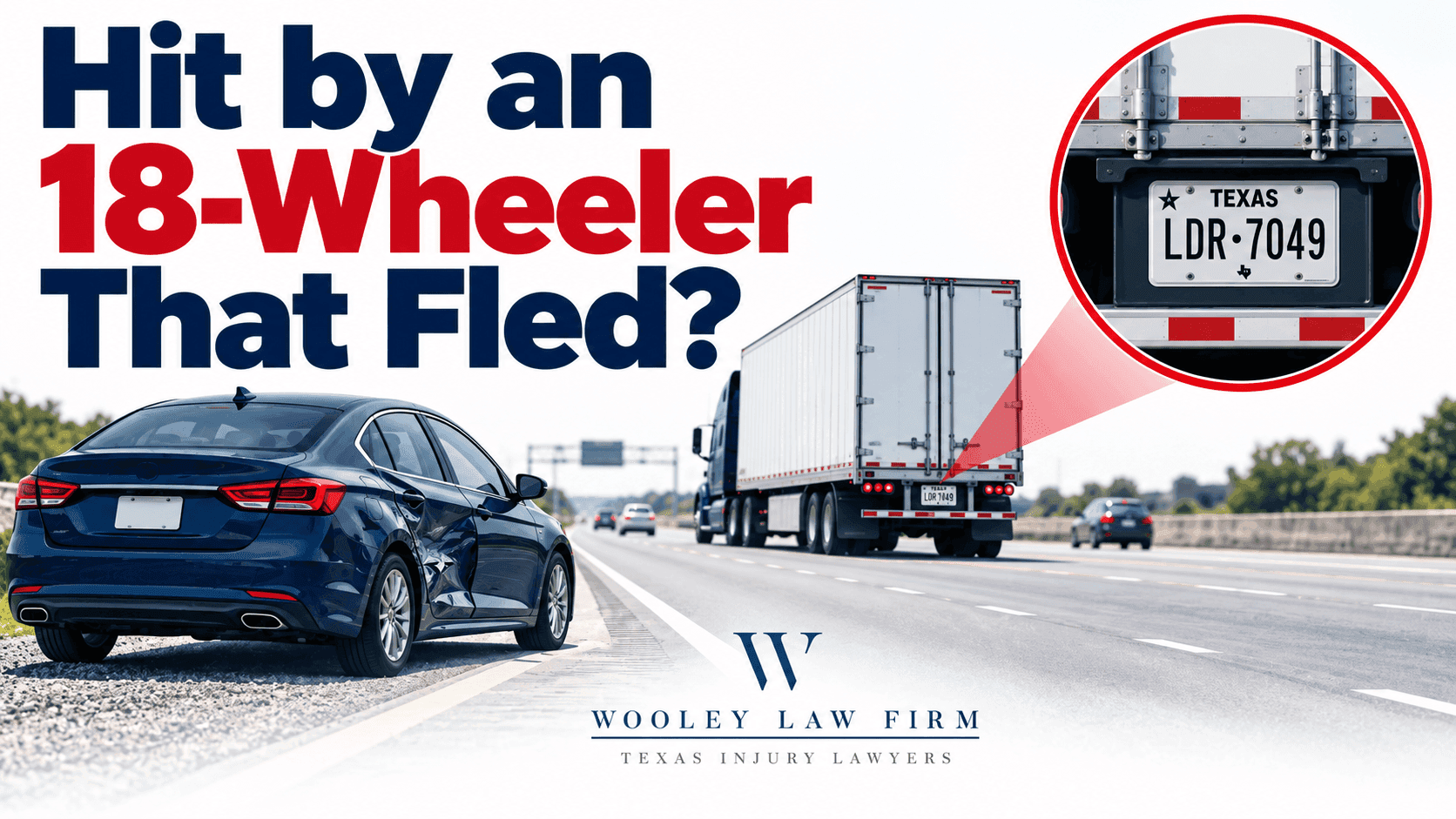
What If the 18-Wheeler Driver Left the Scene?
A fleeing driver can make the investigation harder, but incomplete identifying information does not necessarily end the claim.
A trailer plate, company marking, photograph, witness account, or nearby recording may provide a useful lead. Identifying the trailer owner may help investigators determine who possessed or operated it when the collision occurred.
The available options depend on the evidence and insurance coverage. Read our guide to an 18-wheeler that fled the scene in Dallas.
How Long Do You Have to File a Truck Accident Lawsuit in Texas?
Under Texas Civil Practice and Remedies Code Section 16.003, many personal-injury lawsuits must be filed within two years after the claim accrues, usually the collision date.
Exceptions and different requirements can apply. Government-related claims, claims involving children, and other circumstances require individual analysis.
Do not assume that opening an insurance claim or negotiating with an adjuster extends the lawsuit deadline. Evidence preservation also deserves attention well before that deadline approaches.
Why Consider The Wooley Law Firm?
Choosing a lawyer means choosing someone to investigate the collision, explain your options, and present the evidence supporting your claim.
Attorney Andrew J. Wooley has a background in insurance defense and now represents injured people. That experience informs his understanding of how insurers evaluate and defend injury claims.
His professional recognition includes:
Texas Rising Stars recognition for 2026.
National Trial Lawyers Top 40 Under 40 recognition.
Million Dollar Advocates Forum membership.
America’s Top 100 High Stakes Litigators recognition for 2026.
These recognitions provide background about the attorney. Every claim still requires its own investigation, evidence, and legal analysis.
Frequently Asked Questions About Dallas 18-Wheeler Accidents
Can I pursue a claim if I had a prior injury?
Yes, a prior condition does not automatically prevent a claim. You may be able to recover for a new injury or an aggravation caused by the collision. Medical history, earlier symptoms, imaging, and treating-provider opinions may help distinguish those issues.
Do I have to give the trucking insurer a recorded statement?
No, you can seek legal advice before agreeing to a recorded statement requested by the other party’s liability insurer. Your own insurance policy may impose separate reporting and cooperation duties.
Will my truck accident case go to trial?
It's rare. Some claims settle, while others require litigation or trial. The path depends on liability disputes, damages, coverage, and whether the parties can reach an acceptable agreement.
Can I contact a lawyer before treatment is finished?
Yes. An attorney can evaluate liability and preservation issues while treatment continues. You do not need a final diagnosis or complete set of medical bills to request a consultation.
Talk With an 18-Wheeler Accident Lawyer in Dallas
If you were injured in a Dallas truck wreck, you deserve clear answers about the investigation, insurance, and your potential claim.
The Wooley Law Firm can review what happened and explain the next steps.
Call (214) 699-6524 or request a free consultation.
This article is for general informational purposes only and is not legal advice. Reading it does not create an attorney-client relationship. Every case is different, and past results do not guarantee a similar outcome.
Topics
Share This Article

Andrew J. Wooley
Personal Injury Attorney
Andrew J. Wooley is a dedicated personal injury attorney based in Dallas, Texas. He focuses on helping accident victims recover fair compensation for their injuries. With a commitment to personalized service, Andrew works directly with each client to understand their unique situation and fight for their rights.