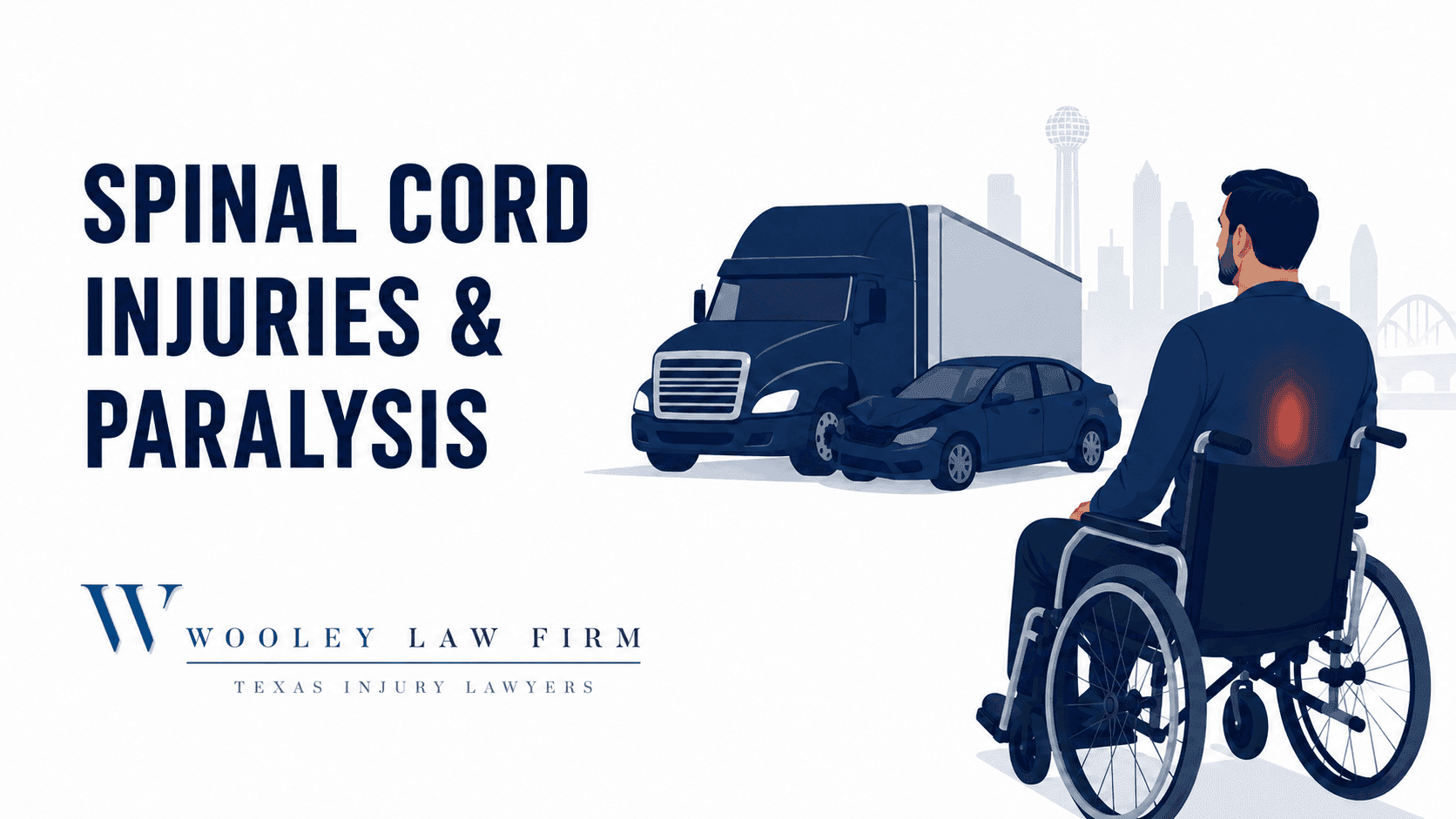
A collision with an 18-wheeler can cause injuries that permanently change how a person moves, works, cares for their family, and lives independently. Among the most devastating injuries are spinal cord damage, paraplegia, quadriplegia, and other forms of paralysis.
A spinal cord injury is not the same as an ordinary back injury. The spinal cord carries messages between the brain and the rest of the body. When it is bruised, compressed, torn, or otherwise damaged in a truck wreck, the victim may experience permanent changes in strength, sensation, movement, and bodily functions below the injury.
For someone injured in Dallas, Fort Worth, Arlington, Plano, Frisco, Irving, Garland, Denton, or another North Texas community, the consequences can include emergency surgery, lengthy hospitalization, inpatient rehabilitation, lost income, home modifications, mobility equipment, attendant care, and lifelong medical treatment.
The Wooley Law Firm represents people seriously injured in crashes involving:
18-wheelers and tractor-trailers
Semi-trucks
Box trucks
Delivery vehicles
Flatbed trucks
Tanker trucks
Dump trucks
Construction vehicles
Buses and commercial vehicles
Learn more about our representation of injured truck-wreck victims on our Dallas 18-wheeler and truck accident lawyer page.
Call 214-699-6524 for a free consultation. You do not pay attorney’s fees unless we recover compensation for you.
What Is a Spinal Cord Injury?
The spinal cord is a long bundle of nerve tissue that extends from the brain through the spinal canal. It communicates signals between the brain and the body.
When the spinal cord is damaged, those signals may be interrupted. Depending on the location and severity of the injury, a victim may lose sensation, strength, movement, or control of bodily functions below the damaged area.
Spinal cord injuries can involve:
Bruising or contusion of the spinal cord
Compression caused by swelling, bleeding, bone fragments, or damaged discs
Tearing of spinal cord tissue
Severing or transection of the spinal cord
Damage caused by displaced vertebrae
Loss of blood flow to spinal cord tissue
Secondary damage caused by inflammation and swelling
Paralysis may occur immediately after the wreck. In some cases, neurological function may worsen as bleeding, swelling, and secondary damage develop after the initial trauma.
This is one reason emergency evaluation is critical when a truck-wreck victim experiences weakness, numbness, tingling, loss of coordination, difficulty walking, or loss of bladder or bowel control.
How Truck Wrecks Cause Spinal Cord Damage
An 18-wheeler collision can expose occupants of a passenger vehicle to violent forces that bend, twist, compress, or fracture the spine.
Spinal cord injuries may result from:
A tractor-trailer rear-ending a passenger vehicle
A truck crushing a smaller vehicle during a wide turn
A sideswipe that forces a vehicle into a barrier or other traffic
A rollover accident
An underride collision
A jackknifed trailer sweeping across traffic lanes
A head-on collision
Falling or shifting cargo
Vehicle-roof collapse
Passenger-compartment intrusion
A victim being ejected from the vehicle
A multi-vehicle pileup
Delayed extraction from a crushed vehicle
Even a collision that happens at a relatively low speed may cause serious injury because of the truck’s size, weight, and force. Read more about why a low-speed 18-wheeler wreck can still cause serious injuries.
Wide-turn crashes can be particularly dangerous because a passenger vehicle may become trapped between the trailer and a curb, barrier, or another vehicle. Learn more about wide-turn 18-wheeler accidents in Dallas-Fort Worth.
Complete and Incomplete Spinal Cord Injuries
Spinal cord injuries are often classified as either complete or incomplete.
Complete Spinal Cord Injury
A complete spinal cord injury generally involves a total loss of motor and sensory function below the level of the injury.
A person with a complete injury may have no voluntary movement or sensation below the damaged area. However, the exact outcome depends on the injury level, complications, treatment, and other medical factors.
Incomplete Spinal Cord Injury
An incomplete spinal cord injury means some signals can still travel between the brain and the body below the injury site.
A person with an incomplete injury may retain:
Some sensation
Limited voluntary movement
Greater function on one side of the body
Movement in certain muscle groups
The ability to feel pressure but not temperature
The ability to move but not walk independently
Incomplete injuries vary significantly. Some people regain substantial function through treatment and rehabilitation, while others remain severely impaired.
Central cord syndrome is one form of incomplete spinal cord injury. It commonly affects the arms and hands more severely than the legs and may result from trauma to the cervical spinal cord.
Paraplegia After an 18-Wheeler Wreck
Paraplegia generally refers to paralysis affecting the lower portion of the body, including the legs.
It is commonly associated with injuries to the thoracic, lumbar, or sacral regions of the spine. A lower spinal cord injury may affect the legs and lower body while allowing the victim to retain use of the arms and hands.
A person with paraplegia may experience:
Loss of movement in both legs
Partial or total loss of sensation
Difficulty controlling the trunk
Loss of bladder or bowel control
Sexual dysfunction
Muscle spasms
Chronic nerve pain
Circulation problems
Increased risk of pressure injuries
Difficulty regulating body temperature
Loss of independence
The need for a wheelchair or mobility equipment
Some people with paraplegia can live independently with appropriate rehabilitation, equipment, accessible housing, and support. Others require extensive daily assistance.
Quadriplegia or Tetraplegia After a Truck Accident
Quadriplegia, also called tetraplegia, generally affects all four limbs and the torso.
It is most often associated with an injury to the cervical spinal cord in the neck. Injuries higher on the spinal cord generally affect more of the body than injuries lower on the cord.
Depending on the level and severity of the injury, quadriplegia may cause:
Loss of arm and leg movement
Limited hand or finger function
Loss of sensation
Difficulty sitting upright
Breathing problems
Weak coughing
Increased risk of pneumonia
Loss of bladder or bowel control
Sexual dysfunction
Difficulty regulating blood pressure
The need for feeding assistance
The need for ventilator support
Dependence on caregivers for daily activities
A person with a high cervical injury may require round-the-clock assistance, respiratory equipment, specialized transportation, and substantial home modifications.
Symptoms of a Spinal Cord Injury After a Truck Wreck
Symptoms depend on the location and severity of the spinal cord damage.
Potential warning signs include:
Severe neck or back pain
Weakness in the arms or legs
Numbness or tingling
Loss of sensation
Difficulty walking
Loss of balance
Poor coordination
Inability to move a limb
Loss of bladder or bowel control
Difficulty breathing
Muscle spasms
Abnormal posture
Pressure or pain in the neck, head, or back
Loss of sexual function
Changes in sensitivity to heat, cold, or touch
A person should not assume that the absence of immediate paralysis means the spinal cord is unharmed. Swelling and bleeding can contribute to progressive neurological damage after the initial injury.
When spinal injury is suspected, emergency responders may immobilize the neck and spine to help prevent additional movement and damage.
Emergency Signs That Require Immediate Medical Attention
A truck-wreck victim needs emergency evaluation when experiencing:
Sudden weakness or paralysis
Numbness in the arms, hands, legs, or feet
Loss of bladder or bowel control
Difficulty breathing
Severe neck or back pain
Loss of balance or coordination
Numbness around the groin or inner thighs
Inability to stand or walk
Worsening neurological symptoms
Compression of the cauda equina—the bundle of nerves below the end of the spinal cord—can cause lasting weakness, paralysis, and loss of bladder or bowel function if not treated promptly.
This article is not a substitute for emergency medical treatment. Call 911 or seek immediate medical attention when a spinal cord injury is suspected.
How Doctors Diagnose Spinal Cord Injuries
A spinal cord injury may be evaluated by emergency physicians, trauma surgeons, orthopedic surgeons, neurologists, neurosurgeons, and rehabilitation specialists.
The diagnostic process may include:
Physical and Neurological Examination
Doctors may assess:
Muscle strength
Reflexes
Sensation
Coordination
Ability to move the extremities
Response to touch or pressure
Bladder or bowel function
Breathing ability
X-Rays
X-rays may identify vertebral fractures, dislocations, instability, or alignment problems.
CT Scans
A CT scan can provide detailed images of the bones and may help identify fractures, bone fragments, bleeding, or narrowing of the spinal canal.
MRI Scans
An MRI may reveal damage to the spinal cord, discs, ligaments, nerves, and surrounding soft tissue. It can also identify compression, swelling, bleeding, or disc herniation.
Injured in an Accident?
Free consultation. Tell us what happened and learn what options may be available.
Additional Testing
Doctors may conduct repeated neurological examinations because a patient’s condition can change during the hours or days after the injury.
Treatment After a Traumatic Spinal Cord Injury
Treatment depends on the location and severity of the injury, associated fractures, breathing problems, and the victim’s overall medical condition.
Immediate care may include:
Spinal immobilization
Stabilization of breathing and circulation
Treatment of internal bleeding
Surgery
Traction or bracing
Removal of bone fragments or damaged tissue
Decompression of the spinal cord
Stabilization with rods, screws, plates, or fusion
Treatment of blood-pressure complications
Prevention of blood clots
Respiratory support
Pain management
Treatment may involve a multidisciplinary team of neurosurgeons, orthopedic surgeons, neurologists, rehabilitation physicians, nurses, therapists, psychologists, and social workers.
No lawyer or insurance adjuster should attempt to predict the full value of a spinal cord injury claim before the medical prognosis, rehabilitation needs, and future care requirements are reasonably understood.
Rehabilitation After Paralysis
Rehabilitation often begins during hospitalization and may continue for months or years.
A spinal cord injury rehabilitation program may involve:
Physical therapy
Occupational therapy
Speech or respiratory therapy
Strength and conditioning
Wheelchair training
Transfer training
Balance training
Mobility exercises
Bowel and bladder management
Skin-care education
Pain management
Psychological counseling
Vocational rehabilitation
Driver rehabilitation
Family and caregiver education
Physical therapy may focus on preserving range of motion, strengthening unaffected muscles, managing spasticity, and maximizing independence.
Occupational therapy may help the victim relearn or adapt daily activities such as:
Dressing
Bathing
Eating
Grooming
Cooking
Using a computer
Driving
Returning to work
Spasticity following spinal cord injury can cause stiffness, painful spasms, fatigue, and difficulty walking, sitting, or sleeping.
Long-Term Complications of Spinal Cord Injuries
The effects of a spinal cord injury extend far beyond the inability to walk.
Potential complications include:
Chronic pain
Neuropathic pain
Muscle spasms
Pressure sores
Blood clots
Pneumonia
Urinary tract infections
Kidney complications
Loss of bladder or bowel control
Sexual dysfunction
Osteoporosis
Fractures
Muscle atrophy
Circulation problems
Difficulty regulating body temperature
Changes in blood pressure
Depression
Anxiety
Sleep problems
Loss of independence
A person with paralysis may require regular medical monitoring, preventive care, equipment replacement, medication, therapy, and assistance with daily activities.
These future needs must be considered before resolving a spinal cord injury claim.
How Paralysis Can Change a Person’s Daily Life
A spinal cord injury affects more than a victim’s medical condition.
Before the wreck, the person may have worked full-time, cared for children, exercised, traveled, maintained a home, or lived independently. Afterward, everyday tasks may require assistance, specialized equipment, or major modifications.
A person with paralysis may need help with:
Getting out of bed
Transferring to a wheelchair
Bathing and dressing
Meal preparation
Transportation
Medication management
Medical appointments
Household maintenance
Bowel and bladder care
Preventing pressure injuries
Positioning during sleep
Work-related activities
Family members may become unpaid caregivers. A spouse may have to reduce working hours or leave employment. Parents may have to modify their homes. Children may experience significant changes in their daily routines and relationships.
A serious truck-wreck claim should account for these real-life consequences.
Future Medical and Life-Care Needs
Spinal cord injury cases frequently require an analysis of the victim’s future needs over their expected lifetime.
Potential future expenses include:
Physicians and specialist care
Additional surgeries
Inpatient rehabilitation
Outpatient therapy
Prescription medication
Pain-management treatment
Wheelchairs
Wheelchair replacement
Pressure-relief cushions
Hospital beds
Lifts and transfer equipment
Respiratory equipment
Prosthetic or orthotic devices
Catheters and medical supplies
Home nursing
Personal attendant care
Accessible vehicles
Vehicle modifications
Ramps and widened doorways
Accessible bathrooms
Lowered counters and cabinets
Relocation to accessible housing
Vocational rehabilitation
Psychological counseling
A life-care planner may evaluate the care, equipment, services, and support the victim is likely to need in the future.
An economist may be needed to calculate the long-term cost of that care and the present value of future losses.
Lost Wages and Loss of Earning Capacity
A spinal cord injury may prevent a victim from returning to the same job or working at all.
The claim may involve:
Income lost during hospitalization and rehabilitation
Missed bonuses or overtime
Lost employment benefits
Reduced hours
A move to lower-paying work
Loss of professional advancement
Vocational retraining
Early retirement
Permanent inability to work
Loss of earning capacity is not limited to wages already missed. It concerns the reduction in the person’s ability to earn income over time.
For a young victim, this loss may extend across decades of expected employment.
Compensation After a Dallas-Fort Worth Truck Wreck
Depending on the evidence and circumstances, a person with a spinal cord injury may be able to pursue compensation for:
Past medical expenses
Future medical expenses
Rehabilitation
Lost wages
Loss of earning capacity
Physical pain and suffering
Mental anguish
Physical impairment
Disfigurement
Loss of enjoyment of life
Home modifications
Mobility equipment
Attendant care
Transportation expenses
Property damage
Other out-of-pocket losses
Spinal cord injury cases should not be evaluated using only the medical expenses incurred during the first few weeks after the crash.
The full claim may involve a lifetime of medical, financial, physical, and personal losses.
Read more about the categories of compensation that may be available in our guide to truck accident damages after a Dallas 18-wheeler wreck.
Who May Be Responsible for a Truck Wreck Causing Paralysis?
Serious truck-accident cases frequently involve multiple responsible parties.
Potential defendants may include:
The Truck Driver
A commercial driver may cause a wreck by:
Speeding
Following too closely
Driving while fatigued
Texting or using a phone
Making an unsafe lane change
Failing to check blind spots
Running a red light
Driving while impaired
Making an unsafe wide turn
Failing to maintain a proper lookout
Driving too fast for traffic or weather conditions
Violating hours-of-service rules
The Trucking Company
A motor carrier may be responsible for its own negligence and, in appropriate circumstances, the negligence of its driver.
Company negligence may include:
Hiring an unqualified driver
Inadequate driver training
Failure to supervise drivers
Retaining a driver with an unsafe history
Pressuring drivers to violate safety rules
Failure to inspect or maintain trucks
Unsafe dispatch practices
Failure to enforce fatigue policies
Failure to investigate prior crashes
Failure to comply with drug and alcohol testing requirements
The Cargo Loader or Shipper
Improperly loaded or unsecured cargo can cause a truck to roll over, jackknife, lose control, or spill cargo into traffic.
Learn more about flatbed truck crashes, cargo securement, and third-party liability.
A Maintenance or Repair Company
A third-party maintenance provider may be responsible when negligent repairs contribute to brake failure, tire failure, steering problems, trailer separation, or another mechanical malfunction.
The Truck or Parts Manufacturer
Defective brakes, tires, steering components, coupling devices, or safety systems may contribute to a serious collision.
Evidence That Should Be Preserved
The trucking company may begin its investigation while the victim is still undergoing emergency treatment.
Important evidence may include:
Engine control module data
Electronic logging device records
GPS and telematics information
Dash-camera footage
Driver-facing camera footage
Dispatch communications
Cellphone records
Hours-of-service records
Driver qualification files
Training records
Maintenance and inspection records
Cargo-loading records
Bills of lading
Weight tickets
Drug and alcohol testing records
Post-crash inspection materials
Photographs and videos
Surveillance footage
Witness statements
Police body-camera footage
911 calls
Vehicle-damage evidence
Trucking company policies
Some electronic information may be overwritten or lost unless the trucking company receives a prompt preservation demand.
The sooner an investigation begins, the greater the opportunity to identify and preserve important evidence. The Wooley Law Firm emphasizes early evidence preservation in serious commercial-truck cases.
How Insurance Companies Defend Paralysis Claims
A spinal cord injury is serious, but that does not mean the trucking company’s insurer will voluntarily pay fair compensation.
The insurance company may attempt to:
Blame the injured person
Dispute how the wreck happened
Argue that the truck driver was not working
Minimize the impact
Attribute symptoms to a preexisting condition
Challenge the necessity of treatment
Dispute future medical recommendations
Underestimate attendant-care needs
Challenge the victim’s expected working life
Minimize physical impairment
Dispute the cost of future equipment
Offer a settlement before the prognosis is known
Obtain a broad medical authorization
Request a recorded statement
Monitor social-media activity
A quick settlement cannot be reopened merely because the victim later needs additional surgery, a replacement wheelchair, more attendant care, or expensive home modifications.
The future consequences must be carefully evaluated before the case is resolved.
What to Do After a Suspected Spinal Cord Injury
Obtain Emergency Medical Treatment
Call 911 and avoid unnecessary movement when a spinal injury is suspected.
Follow Treatment Recommendations
Attend appointments with specialists, therapy providers, and rehabilitation professionals.
Report Every Symptom
Tell medical providers about weakness, numbness, bladder or bowel changes, breathing problems, balance issues, sexual dysfunction, pain, and changes in sensation.
Preserve Documents
Keep medical records, bills, employment records, receipts, insurance letters, and records of out-of-pocket expenses.
Document Daily Limitations
A journal may help record:
Pain and spasms
Sleep problems
Mobility limitations
Assistance from family members
Missed work
Medical appointments
Activities the victim can no longer perform
Equipment problems
Emotional difficulties
Avoid Signing a Quick Settlement
Do not resolve the claim before understanding the medical prognosis, future care needs, loss of earning capacity, and available insurance coverage.
Contact a Truck Wreck Lawyer Promptly
Early involvement allows an attorney to investigate the trucking company, preserve electronic data, identify responsible parties, and document the long-term consequences of the injury.
How The Wooley Law Firm Handles Spinal Cord Injury Claims
A paralysis case requires more than sending hospital bills to an adjuster.
Depending on the circumstances, The Wooley Law Firm may:
Investigate the crash
Obtain the police report
Send evidence-preservation notices
Secure electronic truck data
Identify the driver, carrier, shipper, broker, and other companies
Obtain driver qualification records
Investigate hours-of-service violations
Review maintenance and inspection records
Interview witnesses
Obtain available video footage
Review medical records
Document rehabilitation needs
Calculate lost income
Evaluate loss of earning capacity
Consult qualified medical and economic experts
Investigate available insurance coverage
File a lawsuit when necessary
Prepare the case for trial
The objective is to show not only why the wreck happened, but how the spinal cord injury will affect the victim and family for years to come.
Dallas-Fort Worth Spinal Cord Injury and Paralysis Lawyer
The Wooley Law Firm represents seriously injured people throughout:
Dallas
Fort Worth
Arlington
Irving
Garland
Mesquite
Richardson
Plano
Frisco
McKinney
Allen
Denton
Lewisville
Carrollton
Grand Prairie
Grapevine
Mansfield
Keller
Southlake
North Texas
We also handle serious truck and commercial-vehicle injury claims throughout Texas.
If you or someone you love suffered spinal cord damage, paraplegia, quadriplegia, or paralysis after an 18-wheeler wreck, call 214-699-6524.
You can also learn more by visiting our Dallas truck accident lawyer page.
Your consultation is free and confidential. You do not pay attorney’s fees unless we obtain a recovery for you.
Frequently Asked Questions About Spinal Cord Injuries After Truck Wrecks
Can a truck wreck cause paralysis without severing the spinal cord?
Yes. Paralysis may result from bruising, compression, swelling, bleeding, vertebral displacement, or other damage without the spinal cord being completely severed.
What is the difference between paraplegia and quadriplegia?
Paraplegia generally affects the legs and lower portion of the body. Quadriplegia, also called tetraplegia, affects all four limbs and the torso. The extent of paralysis depends largely on the location and severity of the spinal cord injury.
Can someone recover from an incomplete spinal cord injury?
Some people with incomplete injuries regain sensation or movement through healing, surgery, rehabilitation, and therapy. Outcomes vary significantly, and no attorney or insurance company can guarantee a particular recovery.
What is central cord syndrome?
Central cord syndrome is a form of incomplete cervical spinal cord injury. It often causes greater weakness or loss of function in the arms and hands than in the legs.
Can spinal cord injury symptoms get worse after the crash?
Yes. Bleeding, swelling, inflammation, and secondary cellular damage may cause neurological symptoms to develop or worsen after the initial trauma.
Who pays for lifelong medical care after an 18-wheeler wreck?
The answer depends on liability, insurance coverage, and the available evidence. A claim against a negligent truck driver, trucking company, cargo company, maintenance contractor, manufacturer, or other responsible party may include future medical and attendant-care expenses.
Can family caregiving be included in a paralysis claim?
The value of necessary attendant care and assistance may be relevant even when some care is initially provided by family members. The exact damages available depend on the facts and applicable Texas law.
What if I had a prior neck or back condition?
A preexisting condition does not automatically prevent recovery. The key issue may be whether the truck wreck caused a new injury or aggravated an existing condition.
Insurance companies often use preexisting conditions to minimize claims, making medical documentation particularly important.
How long do I have to file a truck-accident lawsuit in Texas?
Texas law imposes filing deadlines. Shorter notice requirements may apply when a government-owned truck or public entity is involved.
Because truck data and other evidence may disappear much sooner, an investigation should begin promptly.
How much does it cost to hire The Wooley Law Firm?
The Wooley Law Firm handles personal-injury claims on a contingency-fee basis. You pay no upfront attorney’s fee and owe no attorney’s fee unless the firm obtains a recovery for you.
Speak With a Dallas-Fort Worth Truck Wreck Lawyer
A spinal cord injury can affect every aspect of a person’s future.
The victim may be facing paralysis, repeated medical procedures, intensive rehabilitation, permanent employment limitations, and a lifelong need for assistance. Meanwhile, the trucking company and its insurance carrier may already be investigating the wreck and building their defense.
You deserve someone protecting your interests.
Call The Wooley Law Firm at 214-699-6524 for a free consultation about a spinal cord injury caused by a Dallas-Fort Worth truck wreck.
You do not pay attorney’s fees unless we win.
Disclaimer:
This article is provided for general informational purposes only and does not constitute medical or legal advice. Seek immediate medical attention if you believe you may have suffered a spinal cord injury. Reading this article or contacting The Wooley Law Firm does not create an attorney-client relationship. Every case is different, and past results do not guarantee a similar outcome. Legal deadlines may apply, so you should consult a qualified Texas attorney regarding your specific circumstances.
Topics
Share This Article

Andrew J. Wooley
Personal Injury Attorney
Andrew J. Wooley is a dedicated personal injury attorney based in Dallas, Texas. He focuses on helping accident victims recover fair compensation for their injuries. With a commitment to personalized service, Andrew works directly with each client to understand their unique situation and fight for their rights.