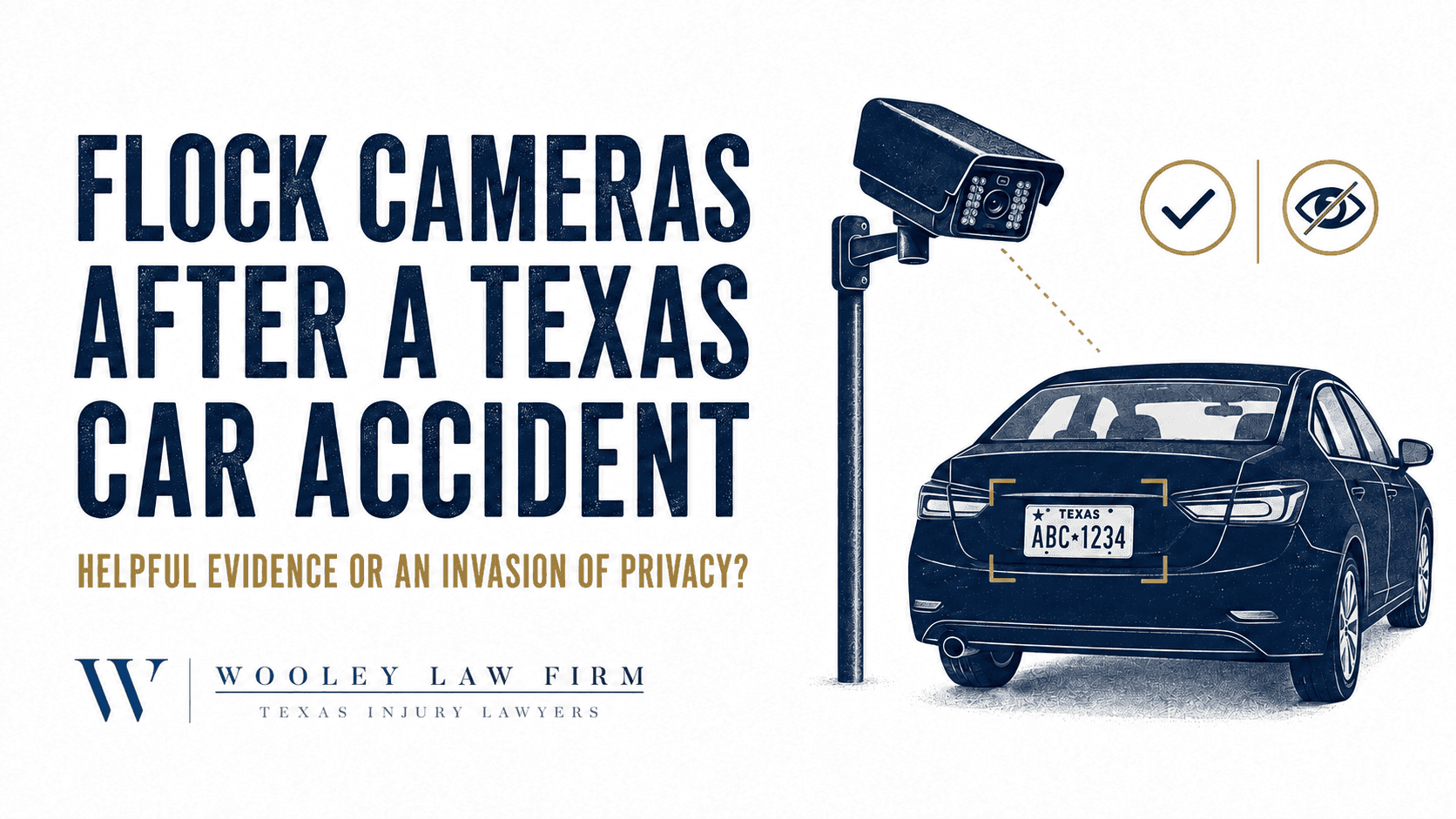
There may be approximately 4,000 Flock cameras operating across the Dallas-Fort Worth area. The exact number is difficult to confirm because there is no single public registry listing every camera operated by police departments, the Texas Department of Public Safety, homeowners associations, apartment complexes, retailers, and other private businesses.
What is clear is that Flock cameras have become common throughout North Texas. Dallas alone has more than 650 Flock license plate reader cameras, while Carrollton reportedly operates between 50 and 60. Other cities, law enforcement agencies, neighborhoods, and businesses operate their own cameras.
For someone injured by a hit-and-run driver, this growing network can be extremely helpful. The Wooley Law Firm has handled cases in which Flock camera information was used to help identify and track down a driver who fled after causing a collision.
However, the same technology that can solve a hit-and-run case may also create a searchable record of where innocent people travel. Flock cameras generally photograph vehicles without first determining whether the driver is suspected of committing a crime.
Flock cameras therefore present an important conflict: they can provide valuable evidence for accident victims while also creating legitimate concerns about privacy, government surveillance, mistaken identifications, data sharing, and misuse.
What Is a Flock Camera?
A Flock camera is an automated license plate reader, commonly called an ALPR.
It is different from an ordinary traffic camera or security camera. A Flock camera is designed to photograph passing vehicles and organize the information so that authorized users can search it.
Depending on the system and quality of the image, a Flock camera may collect or identify:
A vehicle’s license plate number;
The date and time it passed the camera;
The location of the camera;
The vehicle’s color;
Its make or model;
Its body type;
Distinguishing features; and
Images of the vehicle.
Most Flock cameras are used to search for vehicles associated with stolen vehicle reports, warrants, missing persons, and suspected crimes. Texas law enforcement agencies can also share access across jurisdictions, meaning a search may extend well beyond the city where the investigation began.
Flock states that its standard license plate reader data-retention period is 30 days. After that period, the data is ordinarily permanently deleted unless a different retention period is required by law, authorized under the customer’s agreement, or the information has already been preserved as evidence.
That limited window can be critical after a Texas car accident.
How Flock Cameras Can Help After a Hit-and-Run Accident
Hit-and-run cases are often difficult because the injured person may only see the other vehicle for a few seconds.
The victim may remember that the vehicle was a white pickup, a dark SUV, or a delivery van. A witness may obtain only part of the license plate. The collision may happen at night, in bad weather, or while traffic is moving quickly.
A Flock camera may provide the missing information needed to identify the vehicle.
Identifying the Fleeing Vehicle
Police may be able to search Flock records using information such as:
A complete or partial license plate;
The vehicle’s color;
The vehicle’s make or model;
Its body style;
A roof rack, bumper sticker, or other feature;
Fresh collision damage;
The approximate time of the wreck; and
The direction the driver traveled.
For example, suppose a witness sees a damaged black pickup leave a Dallas intersection shortly after a collision. Even if the witness cannot read the plate, officers may be able to search nearby cameras for black pickups traveling through the area during the relevant time.
A camera located several miles away may capture a clearer image of the same vehicle.
Tracking the Vehicle’s Route
One camera detection may place a vehicle near the crash scene. Multiple detections may show the route the vehicle traveled before or after the collision.
That information may help investigators determine:
Which direction the vehicle fled;
Whether it entered another city;
Whether it passed a particular business;
Whether it entered a neighborhood or apartment complex;
Whether additional cameras may have recorded it; and
Where the vehicle may have been parked, stored, or repaired.
This can be especially important in Dallas-Fort Worth because a fleeing driver can travel through several cities in a short period of time.
Identifying the Registered Owner
Once investigators obtain the license plate number, they may be able to identify the vehicle’s registered owner.
That does not necessarily prove who was driving. A vehicle may be driven by a spouse, child, employee, friend, renter, or unauthorized person.
However, identifying the vehicle provides a starting point. An attorney may then investigate:
Who had possession of the vehicle;
Where the owner was at the time of the wreck;
Whether the vehicle had fresh damage;
Whether repairs were made shortly afterward;
Whether the vehicle was reported stolen;
Whether the owner made inconsistent statements;
Whether cellphone or location records support the account; and
Whether witnesses can identify the driver.
Flock camera information may not prove the entire case by itself, but it can lead investigators to the evidence needed to identify the responsible driver.
Our Experience Using Flock Cameras in Hit-and-Run Cases
The Wooley Law Firm has handled personal injury cases in which Flock camera information helped track down hit-and-run drivers.
In those cases, the camera data did not replace the need for a complete investigation. Instead, it provided an important lead that helped identify a vehicle and trace where it traveled.
Once the suspected vehicle was located, additional evidence could be collected, including:
Photographs of vehicle damage;
Paint transfer;
Broken vehicle parts;
Repair records;
Police reports;
Insurance information;
Witness statements;
Other surveillance video;
Driver admissions; and
Electronic records.
Without the camera information, the injured person may never have learned who caused the collision.
That is one of the strongest arguments in favor of Flock cameras. A driver should not be able to avoid responsibility simply by leaving an injured person on the side of the road.
The Evidence May Disappear After 30 Days
Flock’s standard policy provides for license plate reader data to be retained for 30 calendar days before it is permanently deleted. Customer agreements or applicable laws may permit different retention periods, and information downloaded or preserved for an investigation may remain available separately.
Thirty days can pass quickly after a serious collision.
An injured person may spend the first few weeks:
Receiving emergency treatment;
Undergoing surgery;
Attending medical appointments;
Dealing with a totaled vehicle;
Attempting to obtain the crash report;
Speaking with insurance adjusters; and
Recovering from the physical and emotional effects of the accident.
By the time the victim realizes that Flock evidence may exist, the original information may have already been deleted.
This is why a prompt investigation is important.
An attorney handling a hit-and-run case may need to:
Identify likely camera locations near the collision;
Determine who owns or controls each camera;
Contact the investigating police agency;
Send written evidence-preservation notices;
Request that relevant database searches be performed;
Seek reports and downloaded images;
Request authentication information; and
Use subpoenas or formal discovery when available.
A preservation letter does not guarantee access to the information. It may, however, place the person or organization controlling the evidence on notice that the information is relevant to a legal claim and should not be destroyed.
Approximately 4,000 Cameras Can Create a Powerful DFW Tracking Network
One camera records a vehicle at one location.
A network of approximately 4,000 cameras may reveal much more.
A vehicle traveling through Dallas-Fort Worth could pass multiple Flock cameras during an ordinary trip. Those cameras may record when the vehicle:
Left a neighborhood;
Entered another city;
Passed a shopping center;
Traveled along a major roadway;
Visited a business;
Entered an apartment complex; or
Returned home.
There is no centralized public list showing every Flock camera in Texas. Cameras may be operated by local police departments, DPS, private retailers, neighborhood groups, and other organizations. DPS has also entered data-sharing partnerships with more than 200 county and local law enforcement agencies across Texas.
For a hit-and-run victim, this type of network may be extremely useful. A vehicle that escapes one jurisdiction may be detected minutes later by a camera in another city.
For the general public, the same network creates the possibility that a person’s ordinary movements can be reconstructed even though that person is not suspected of committing a crime.
Injured in an Accident?
Free consultation. Tell us what happened and learn what options may be available.
Are Flock Cameras an Invasion of Privacy?
Flock cameras photograph vehicles traveling on public roads, where drivers generally have a reduced expectation of privacy regarding what can be seen by others.
The privacy concern, however, is not limited to one camera observing one license plate.
The larger concern is that thousands of observations can be collected, stored, searched, and combined. Over time, vehicle-location information may reveal highly personal details about someone’s life.
Depending on the number and placement of cameras, the information could potentially suggest:
Where a person lives;
Where the person works;
Which doctors or hospitals the person visits;
Where the person worships;
Which political meetings or protests the person attends;
Which attorney the person visits;
Who the person regularly visits; and
When the person is usually away from home.
North Texas residents have recently raised these concerns in cities such as Carrollton. Some residents have argued that enough location data could allow authorities to reconstruct where a person works, worships, receives medical care, or spends time with family.
The concern is not that a license plate is secret. License plates are visible to anyone on the road.
The concern is the creation of a large, searchable database that may allow government agencies or private entities to follow a vehicle’s movements across a wide geographic area.
The Risk of Improper Searches and Misuse
Flock requires users to provide a reason when performing a search. Law enforcement agencies may also adopt policies requiring case numbers, supervisory approval, audits, or disciplinary action for improper searches.
However, requiring a written reason does not eliminate the possibility of misuse.
Reported audits have found vague search explanations such as “investigation,” “sus vehicle,” “test,” and even random letters. Recent reporting has also identified allegations that officers in several jurisdictions used Flock systems to improperly search for romantic interests or colleagues.
Potential misuse could include:
Tracking a former spouse or romantic partner;
Searching for a coworker;
Monitoring someone involved in a personal dispute;
Using the system without a legitimate investigation;
Sharing information with an unauthorized person;
Conducting an overly broad search;
Using credentials belonging to another employee; or
Accessing data for a purpose unrelated to public safety.
Audit logs can help identify improper activity after it occurs. They do not necessarily prevent the improper search from happening.
Strong safeguards should therefore include meaningful oversight, regular auditing, limited access, detailed search requirements, and serious consequences for abuse.
Flock Cameras Can Make Mistakes
License plate reader technology is not perfect.
A camera may incorrectly read a plate because it is:
Dirty;
Damaged;
Bent;
Obstructed;
Poorly illuminated;
Moving quickly;
From another state; or
Similar to another plate.
The system may also correctly photograph a vehicle but incorrectly suggest that the vehicle was involved in an accident or crime.
A camera image generally does not prove:
Who was driving;
Why the vehicle was in the area;
Whether the vehicle was involved in the collision;
Whether the driver knew a wreck occurred;
Whether the plate was stolen or altered; or
Whether the vehicle shown matches a witness’s description.
A Flock detection should therefore be treated as one piece of evidence, not unquestionable proof.
An attorney may need to examine:
The original image;
The plate number generated by the system;
The date and time;
The camera location;
Other detections of the same vehicle;
Search and audit records;
Authentication documents;
Vehicle-registration information; and
Evidence connecting the vehicle to the accident.
Flock states that customers can download an affidavit intended to authenticate license plate reader images for use as evidence. Flock also provides a process for validating certain previously downloaded images.
Flock Evidence Can Help—or Hurt—Your Personal Injury Case
Accident victims should not assume that electronic evidence will always help them.
The insurance company or defense attorney may also attempt to obtain Flock information.
How It Could Help Your Claim
Flock data may help establish:
The other vehicle was near the crash scene;
The vehicle fled in a particular direction;
The defendant’s account is inaccurate;
A commercial vehicle followed a particular route;
The vehicle had not been stolen;
The driver traveled to a repair shop after the collision; or
A company vehicle was operating when the company claimed it was not.
How It Could Be Used Against You
The defense may use Flock information to argue:
Your vehicle was not where you said it was;
You traveled a different route;
Your timeline is inaccurate;
Someone else was driving;
Your vehicle remained drivable after the accident;
You went somewhere inconsistent with your testimony; or
Your account conflicts with electronic evidence.
A camera detection may have an innocent explanation. However, even a small inconsistency can be used to challenge a person’s credibility.
Accident victims should avoid guessing when giving recorded statements, answering discovery, or testifying. It is better to say that you do not remember an exact time than to provide an incorrect answer that later conflicts with digital evidence.
Flock Cameras in Commercial Truck and Delivery Vehicle Cases
Flock information may also be important in claims involving:
18-wheelers;
Delivery vans;
Box trucks;
Construction vehicles;
Dump trucks;
Rideshare vehicles;
Company cars; and
Government vehicles.
A Flock detection may help establish:
The truck’s route;
When it entered or left a particular area;
Whether it deviated from an assigned route;
Whether it was operating outside permitted hours;
Whether it passed a location shortly before the wreck;
Whether it traveled after the company claimed it was disabled; and
The identity of a vehicle whose company markings were unclear.
Flock evidence should be compared with other commercial vehicle evidence, including:
Electronic logging device information;
GPS and telematics data;
Dispatch records;
Bills of lading;
Driver qualification records;
Hours-of-service records;
Dash camera video;
Cellphone records; and
Maintenance and inspection documents.
In some cases, Flock information may help identify the correct truck or company so that this additional evidence can be preserved.
Who Owns the Camera Data?
The answer depends on who operates the camera.
Flock cameras may be owned or controlled by:
A police department;
The Texas Department of Public Safety;
A city or county;
A homeowners association;
An apartment complex;
A shopping center;
A retailer;
A school;
A hospital;
A property-management company; or
Another private business.
Flock states that its customers control their data. A person seeking evidence will generally need to contact the customer or organization operating the camera rather than simply asking Flock to provide access.
Records held by a governmental agency may sometimes be requested under the Texas Public Information Act, but law enforcement and other exceptions may apply.
Information held by a private organization may require:
Voluntary cooperation;
A preservation letter;
A subpoena;
A court order; or
Formal discovery after a lawsuit is filed.
The existence of a camera does not automatically give an accident victim or attorney the right to search the database.
What Should You Do After a Texas Hit-and-Run Accident?
Call 911
Report the collision immediately. Provide the fleeing vehicle’s description, direction of travel, and as much of the license plate as you remember.
Do not chase the other driver. Doing so may place you and others in additional danger.
Photograph the Scene
When it is safe, photograph:
Your vehicle;
The impact damage;
Paint transfer;
Broken vehicle parts;
Debris;
Tire marks;
The roadway;
Traffic signals;
Nearby businesses; and
Visible cameras.
A small piece of broken trim or transferred paint may later help identify the fleeing vehicle.
Write Down What You Remember
Record the other vehicle’s:
Color;
Size;
Make or model;
Body type;
License plate information;
Direction of travel;
Existing or new damage;
Stickers or markings; and
Driver description.
Do this as soon as possible while your memory is fresh.
Look for Cameras
Possible camera locations include:
Neighborhood entrances;
Apartment complexes;
Gas stations;
Retail centers;
Schools;
Businesses;
Parking garages;
Homes with doorbell cameras; and
Major intersections.
Do not assume that police will automatically identify and preserve every available recording.
Seek Medical Treatment
Your health comes first. Do not delay necessary medical care to search for the driver or inspect nearby cameras.
Notify Your Insurance Company
Report the collision promptly, particularly if you may need to make an uninsured motorist, personal injury protection, medical payments, or collision claim.
Be accurate, but do not speculate about facts you do not know.
Contact an Attorney Quickly
An attorney may be able to identify potential Flock cameras and send preservation requests before the information is deleted.
What If the Hit-and-Run Driver Is Never Found?
You may still have a claim under your own insurance policy.
Uninsured motorist coverage may apply when an unknown driver causes a collision and leaves the scene. The exact requirements depend on the policy, the circumstances, and whether the insurer disputes that another vehicle caused the accident.
Other potentially available coverage may include:
Personal injury protection;
Medical payments coverage;
Collision coverage;
Health insurance; and
Disability coverage.
Insurance companies may dispute:
Whether another vehicle was involved;
Whether physical contact occurred;
How the collision happened;
Whether the injuries were caused by the wreck; and
Whether the policy’s notice requirements were satisfied.
Evidence such as Flock data, surveillance video, witness statements, paint transfer, debris, vehicle damage, 911 recordings, and medical records can become especially important.
What Safeguards Should Apply to Flock Cameras?
Flock cameras can serve a legitimate public-safety purpose. They can also collect information about thousands of innocent drivers.
Communities should insist on safeguards such as:
A short, clearly defined retention period;
Access limited to trained, authorized users;
A legitimate case-related reason for each search;
Case numbers or incident numbers when possible;
Regular audits of search activity;
Publicly available use policies;
Restrictions on sharing with outside agencies;
Clear rules governing federal access;
Procedures for correcting mistaken plate matches;
Notice when private cameras are shared with police;
Meaningful penalties for improper use; and
Warrant requirements for broad or long-term tracking when required by law.
The public should not have to choose between solving serious hit-and-run cases and protecting basic privacy rights.
Both goals matter.
A Valuable Investigative Tool With Serious Privacy Consequences
Flock cameras can make a significant difference in a Texas personal injury case.
They may help identify a driver who left an injured person at the scene. They may place a vehicle near the collision, show which direction it fled, or lead investigators to additional video and physical evidence.
We have seen Flock information used to track down hit-and-run drivers who might otherwise have escaped responsibility.
At the same time, approximately 4,000 cameras across Dallas-Fort Worth could create a broad network capable of recording the ordinary travels of people who are not suspected of committing any crime.
The usefulness of the technology does not eliminate the privacy concern. The privacy concern does not eliminate the technology’s value to an injured accident victim.
Flock cameras should be used with transparency, strict limits, meaningful oversight, and accountability for misuse.
Speak With a Dallas Hit-and-Run Accident Lawyer
If you were injured by a driver who fled the scene, important electronic evidence may disappear in as little as 30 days.
The Wooley Law Firm investigates hit-and-run accidents in Dallas-Fort Worth and throughout Texas. Depending on the facts, our investigation may include:
Identifying nearby Flock cameras;
Sending evidence-preservation notices;
Requesting surveillance recordings;
Locating witnesses;
Examining vehicle debris;
Reviewing police records;
Investigating the registered owner;
Pursuing the at-fault driver’s insurance; and
Making an uninsured motorist claim when the driver cannot be found.
Even if police have not identified the other driver, you may still have options for recovering compensation.
Contact The Wooley Law Firm to discuss your Texas hit-and-run accident claim.
Frequently Asked Questions About Flock Cameras and Accident Claims
Can a Flock camera identify a hit-and-run driver?
A Flock camera may identify the vehicle’s license plate, make, model, color, body type, location, or direction of travel. Additional evidence is usually needed to prove who was driving.
Are there really around 4,000 Flock cameras in DFW?
Approximately 4,000 cameras are believed to operate throughout the Dallas-Fort Worth area, but the exact number is difficult to verify. There is no centralized public registry covering cameras operated by law enforcement, DPS, businesses, neighborhoods, and other private organizations.
How long does Flock retain camera information?
Flock’s standard retention period for license plate reader data is 30 calendar days. Different terms may apply under a customer agreement, applicable law, or when information has been preserved as evidence.
Can my attorney get Flock camera records?
Possibly. Access depends on who controls the camera, whether the information still exists, whether police preserved it, and whether a public records request, subpoena, court order, or formal discovery is available.
Does a Flock image prove who was driving?
No. A Flock camera generally identifies a vehicle, not the person driving it. Witness testimony, admissions, cellphone evidence, ownership records, physical damage, and other evidence may be necessary.
Can Flock camera evidence be used in court?
Potentially. The evidence must be relevant and properly authenticated. Flock states that customers can download image-certification affidavits for certain records and offers a validation process for qualifying downloaded images.
Can the insurance company use Flock information against me?
Yes. An insurer or defense attorney may use it to challenge your timeline, route, vehicle use, identity of the driver, or description of the accident.
What should I do immediately after a hit-and-run?
Call 911, document the scene, write down everything you remember, identify nearby cameras, seek medical treatment, notify your insurer, and speak with an attorney promptly.
Disclaimer: This article is provided for general informational purposes only and does not constitute legal advice. The availability, retention, admissibility, and disclosure of Flock camera information depend on the facts, applicable law, the organization controlling the data, and the procedural status of the case. Past results do not guarantee a similar outcome.
Topics
Share This Article

Andrew J. Wooley
Personal Injury Attorney
Andrew J. Wooley is a dedicated personal injury attorney based in Dallas, Texas. He focuses on helping accident victims recover fair compensation for their injuries. With a commitment to personalized service, Andrew works directly with each client to understand their unique situation and fight for their rights.
Related Local News
Recent related coverage