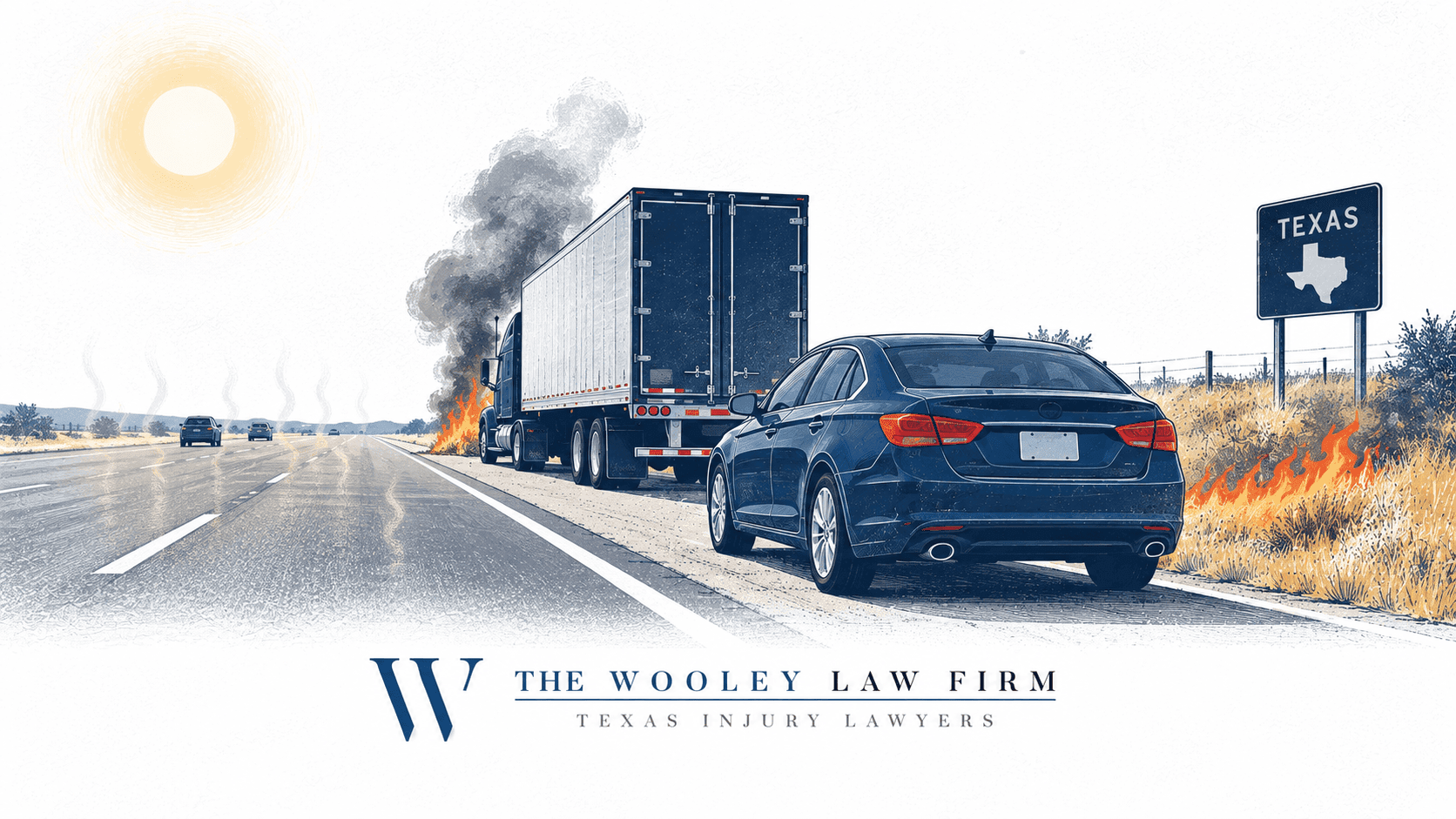
If it seems like there have been an unusual number of vehicle fires, roadside fires, burning trucks, and grass fires along Texas highways this summer, you are not imagining the conditions that can make these incidents more dangerous.
Texas has experienced periods of extreme heat, drought, and rapidly drying vegetation during the summer of 2026. Those conditions do not necessarily cause a properly functioning vehicle to suddenly catch fire. But they can create a dangerous combination:
Vehicles are operating under extreme heat and mechanical stress, while the grass and vegetation next to Texas roads are dry enough that a small spark or hot component can ignite a much larger fire.
Texas A&M Forest Service has specifically warned Texans that vehicles and trailers can start wildfires through hot catalytic converters, tire blowouts, sparks from wheel rims, dragging trailer chains, and other overheated or malfunctioning equipment.
And this summer, North Texas has seen several dramatic examples of what can happen when vehicles, crashes, mechanical problems, extreme heat, and dry vegetation come together.
Why Extreme Texas Heat Can Make Vehicle Fires More Dangerous
A car does not ordinarily catch fire simply because the outside temperature reaches 100 degrees.
But extreme heat can place additional stress on systems that are already worn, damaged, poorly maintained, or malfunctioning.
That can include:
Tires
Batteries and electrical systems
Fuel systems
Cooling systems
Brakes
Wheel bearings
Exhaust systems
Catalytic converters
Trailer components
Commercial-truck braking systems
At the same time, dry roadside vegetation can provide an abundant source of fuel once an ignition occurs.
That is why a mechanical failure that might ordinarily result in a disabled vehicle can become far more dangerous during a hot, dry Texas summer.
Dry Grass Can Ignite From the Bottom of a Vehicle
One of the most overlooked risks involves something almost every Texas driver has done at some point: pulling onto grass on the side of the road.
According to the Texas A&M Forest Service, a vehicle's catalytic converter can operate at temperatures between approximately 550 and 1,600 degrees and can become even hotter when it malfunctions.
That can be hot enough to ignite dry grass underneath a parked or idling vehicle.
Texas saw an extraordinary example during the summer of 2026.
The Mays Fire Was Reportedly Started by a Vehicle Parked Over Dry Grass
On August 1, 2026, the Mays Fire began east of Brady in San Saba County.
Texas A&M Forest Service determined that the wildfire began after a motorist parked and idled a vehicle over tall, dry grass.
What began underneath a vehicle ultimately developed into a wildfire that burned thousands of acres.
That incident illustrates why something that appears harmless—pulling a vehicle onto dry vegetation—can become extremely dangerous during drought conditions.
Tire Blowouts Can Also Start Roadside Fires
Texas heat is especially hard on tires.
Hot pavement, high speeds, heavy loads, underinflation, worn tires, and existing tire damage can increase the risk of a blowout.
A blowout is dangerous enough by itself. But during extremely dry conditions, it may create another hazard.
Texas A&M Forest Service warns that after a tire fails, a wheel rim can strike the pavement and create sparks capable of igniting roadside vegetation.
This issue can be particularly serious with 18-wheelers and commercial trucks, which may travel hundreds of miles in extreme heat while carrying substantial loads.
A truck that loses a tire or wheel component may continue traveling before the driver realizes how serious the problem is.
During that time, metal components may scrape the roadway and potentially create sparks.
If you were seriously injured in a commercial-vehicle collision, our Dallas truck accident lawyer page explains some of the additional evidence that may need to be investigated after an 18-wheeler wreck.
Dragging Trailer Chains Can Throw Sparks Into Dry Grass
Trailer safety chains are another potential ignition source.
A loose chain dragging against pavement can repeatedly produce sparks as a truck, trailer, boat, RV, or commercial vehicle travels down the highway.
Normally, those sparks may disappear almost immediately.
But when the grass along I-35E, I-30, I-20, I-45, US-75, I-635, or another Texas highway is extremely dry, a single spark can potentially start a roadside fire.
Texas A&M Forest Service specifically recommends that drivers secure trailer chains so they cannot drag along the pavement.
For trucking companies, this is also why routine vehicle and trailer inspections matter.
A commercial truck should not be sent down the highway with obvious tire problems, loose components, defective brakes, overheated wheel bearings, damaged wiring, or other dangerous mechanical conditions.
Overheated Brakes and Wheel Bearings Can Lead to Truck Fires
Commercial trucks generate tremendous amounts of heat.
Their brakes work harder because of the vehicle's weight, particularly during repeated stops, heavy traffic, steep grades, or emergency braking.
A brake that drags or fails to release properly can overheat.
A failing wheel bearing can also produce enormous friction and heat.
Depending on the failure, that heat can damage nearby tires, grease, wiring, brake components, or other materials and potentially lead to a truck or trailer fire.
When an 18-wheeler catches fire, investigators may need to determine whether the incident began with:
A tire failure
A wheel-bearing failure
Overheated brakes
Improper brake adjustment
An electrical problem
A fuel leak
An engine problem
A trailer defect
Poor maintenance
Road debris or collision damage
Those questions can become especially important when a truck fire occurs immediately before or after a serious collision.
Injured in an Accident?
Free consultation. Tell us what happened and learn what options may be available.
Collisions Can Damage Fuel and Electrical Systems
Some vehicle fires begin only after a crash.
A violent collision can crush or rupture parts of a vehicle that were never intended to be exposed.
Depending on the vehicle and the severity of the impact, a wreck may damage:
Fuel tanks
Fuel lines
Batteries
High-voltage battery systems
Wiring
Electrical connectors
Engine components
Exhaust components
A fire can therefore become a secondary event following the initial collision.
That distinction matters.
When someone suffers serious injuries in a fiery crash, the investigation should not simply conclude that "the car caught fire."
The more important questions may be:
Why did the crash happen? Why did the vehicle ignite? Could the fire have been prevented?
Victims who suffer burns in these crashes may face painful treatment, surgery, permanent scarring, disfigurement, nerve damage, infection risks, and long-term rehabilitation. We discuss those issues further in our guide to burn injuries after a Dallas-Fort Worth truck wreck.
Texas Has Seen Several Serious Vehicle and Roadside Fires This Summer
Several incidents during the summer of 2026 show how serious vehicle and fire emergencies have become across North Texas.
Southlake: Officer Pulls Driver From Burning Vehicle
In a highly publicized summer incident on Highway 114 in Southlake, an officer saw a vehicle traveling down the highway while smoke was pouring from it.
The vehicle stopped and flames developed underneath it. The driver was unable to get out on his own.
A Southlake police officer broke the window and pulled the driver from the vehicle before it became engulfed in flames.
The incident was captured on police video and received widespread local attention in July.
Dallas: Vehicle Catches Fire After Multi-Vehicle Crash
On August 26, 2026, Dallas police investigated a three-vehicle collision on Wheatland Road in the Red Bird area.
When first responders arrived, one of the wrecked vehicles was on fire. Two people were taken to hospitals, according to local reporting.
The cause of the collision remained under investigation at the time of the initial reports.
A crash involving a vehicle fire may require an investigation into both the collision itself and the origin of the fire.
Grand Prairie: At Least 30 Vehicles Burned
On August 23, 2026, Grand Prairie firefighters responded to what was initially reported as a grass fire near East Avenue J.
When firefighters arrived, at least 30 vehicles were burning in a commercial parking area.
The cause was still being investigated in the initial reports, so it would be wrong to assume that a particular vehicle started that fire. But the incident demonstrates how quickly a fire can spread from vegetation or surrounding materials into vehicles during extremely hot and dry conditions.
Rendon: RV Fire Spreads Into Brush and Trees
On August 28, 2026, firefighters responded to an RV fire in Rendon in Tarrant County.
The RV was reportedly fully involved when crews arrived, and the fire was spreading into surrounding brush, trees, and nearby structures.
The response eventually involved dozens of emergency vehicles from multiple agencies. Two firefighters were hospitalized following the response.
This is precisely what makes vehicle fires more dangerous during severe drought: the danger may not remain confined to the vehicle.
Texas Wildfire Conditions Have Been Especially Dangerous
The broader fire environment helps explain why vehicle-related ignition sources deserve extra attention right now.
Texas A&M Forest Service reported that during August 2026 alone, it responded to 313 wildfires that burned 121,774 acres.
The agency said the rapid development of a flash drought increased both wildfire occurrence and fire intensity during August.
For 2026 through early September, Texas A&M Forest Service had already responded to 1,078 wildfires covering 301,528 acres.
Those numbers do not mean that all—or even most—of those fires were caused by vehicles.
They do show just how receptive Texas vegetation has become to ignition.
A Vehicle Fire Does Not Automatically Mean the Driver Was Negligent
After a vehicle catches fire, it is important not to jump to conclusions.
Some fires may result from sudden mechanical failures that no driver could reasonably have anticipated.
Others may involve preventable problems.
Depending on the circumstances, an investigation could involve the conduct of:
Another driver who caused the collision
A trucking company
A commercial vehicle owner
A maintenance or repair company
A tire or component manufacturer
A trailer owner
A cargo-loading company
Another business responsible for maintaining the vehicle
The facts and evidence determine responsibility.
If another driver's negligence causes the initial collision and your vehicle catches fire as a result, that driver may still be responsible for the injuries caused by the entire crash sequence.
People seriously injured in an ordinary passenger-vehicle collision can learn more about the claims process on our Dallas car accident lawyer page.
Evidence Should Be Preserved After a Serious Vehicle Fire
A burned vehicle may look like there is nothing left to investigate.
That is not necessarily true.
Investigators may still be able to examine:
The vehicle itself
Tire remnants
Wheel and brake assemblies
Bearings
Electrical components
Fuel-system components
Burn patterns
Photographs and videos
Dash-camera recordings
Nearby surveillance footage
Vehicle diagnostic information
Event Data Recorder information
Maintenance and repair history
Recall information
Inspection records
With commercial vehicles, additional electronic information may exist.
An 18-wheeler's engine control module, telematics system, GPS records, dash cameras, maintenance software, or other electronic systems may contain evidence about what happened immediately before the fire.
Our article about 18-wheeler black box data after a truck wreck explains why this evidence should often be preserved quickly.
Do Not Let a Burned Vehicle Be Destroyed Before It Is Investigated
One of the biggest mistakes after a serious vehicle fire can be allowing the vehicle to be destroyed, salvaged, dismantled, or sold before the cause has been properly investigated.
Insurance companies and vehicle-storage facilities may want to move the vehicle quickly.
But if there is a potential personal-injury, product-liability, trucking, or maintenance claim, the vehicle itself could be critical evidence.
A lawyer may need to send preservation notices and arrange for an expert inspection before anything is altered.
The same principle applies after catastrophic commercial-truck collisions. Electronic information can be overwritten and physical evidence can disappear. Our guide to life-changing injuries after a Dallas-Fort Worth truck wreck discusses why investigating serious crashes early can matter.
What Should You Do If Your Vehicle Starts Smoking or Catches Fire?
If you see or smell smoke while driving:
Pull over to a safe location as soon as possible.
Turn the vehicle off.
Get everyone out of the vehicle.
Move well away from traffic and the burning vehicle.
Call 911.
Do not return to the vehicle to retrieve property once a fire has begun.
Avoid parking a smoking or overheating vehicle over tall, dry grass if there is a safe paved alternative.
If there has also been a collision, seek medical attention for any injuries.
Frequently Asked Questions About Texas Vehicle Fires
Can extreme heat cause my car to catch fire?
Extreme outdoor temperatures alone ordinarily should not cause a properly functioning vehicle to catch fire. However, high temperatures may add stress to already damaged or defective tires, electrical systems, batteries, cooling systems, brakes, and other components.
Dry conditions can also make a small ignition source much more dangerous because nearby vegetation may catch fire quickly.
Can a catalytic converter start a grass fire?
Yes. Texas A&M Forest Service warns that catalytic converters can become hot enough to ignite tall, dry vegetation beneath a parked or idling vehicle.
Can a blown tire start a wildfire?
Potentially. After a tire blowout, a wheel rim or other metal component may contact the roadway and create sparks capable of igniting dry roadside vegetation.
Why are truck fires especially dangerous?
Commercial trucks contain large tires, fuel, electrical components, braking systems, wheel bearings, and sometimes combustible cargo. Mechanical problems involving any of those systems can create significant heat. A truck fire can also block multiple highway lanes or ignite surrounding vegetation.
Who may be responsible if I am injured in a fiery car or truck wreck?
Responsibility depends on why the crash and fire occurred. Potentially responsible parties could include another driver, a trucking company, vehicle owner, maintenance company, component manufacturer, or another business.
Talk With a Dallas Car or Truck Wreck Lawyer After a Serious Vehicle Fire
A fiery collision presents questions that an ordinary crash may not.
It may be necessary to determine both who caused the wreck and why the vehicle caught fire afterward.
The Wooley Law Firm represents people who have suffered serious injuries in car, truck, and 18-wheeler wrecks in Dallas-Fort Worth and throughout Texas.
If you or a loved one suffered serious burns or other injuries in a vehicle fire following a crash, call The Wooley Law Firm at (214) 699-6524 for a free consultation.
You don't pay attorney's fees unless we win.
This article is for general informational purposes only and is not legal advice. Reading it does not create an attorney-client relationship. Every case is different.
Share This Article

Andrew J. Wooley
Personal Injury Attorney
Andrew J. Wooley is a dedicated personal injury attorney based in Dallas, Texas. He focuses on helping accident victims recover fair compensation for their injuries. With a commitment to personalized service, Andrew works directly with each client to understand their unique situation and fight for their rights.
Related Local News
Recent related coverage