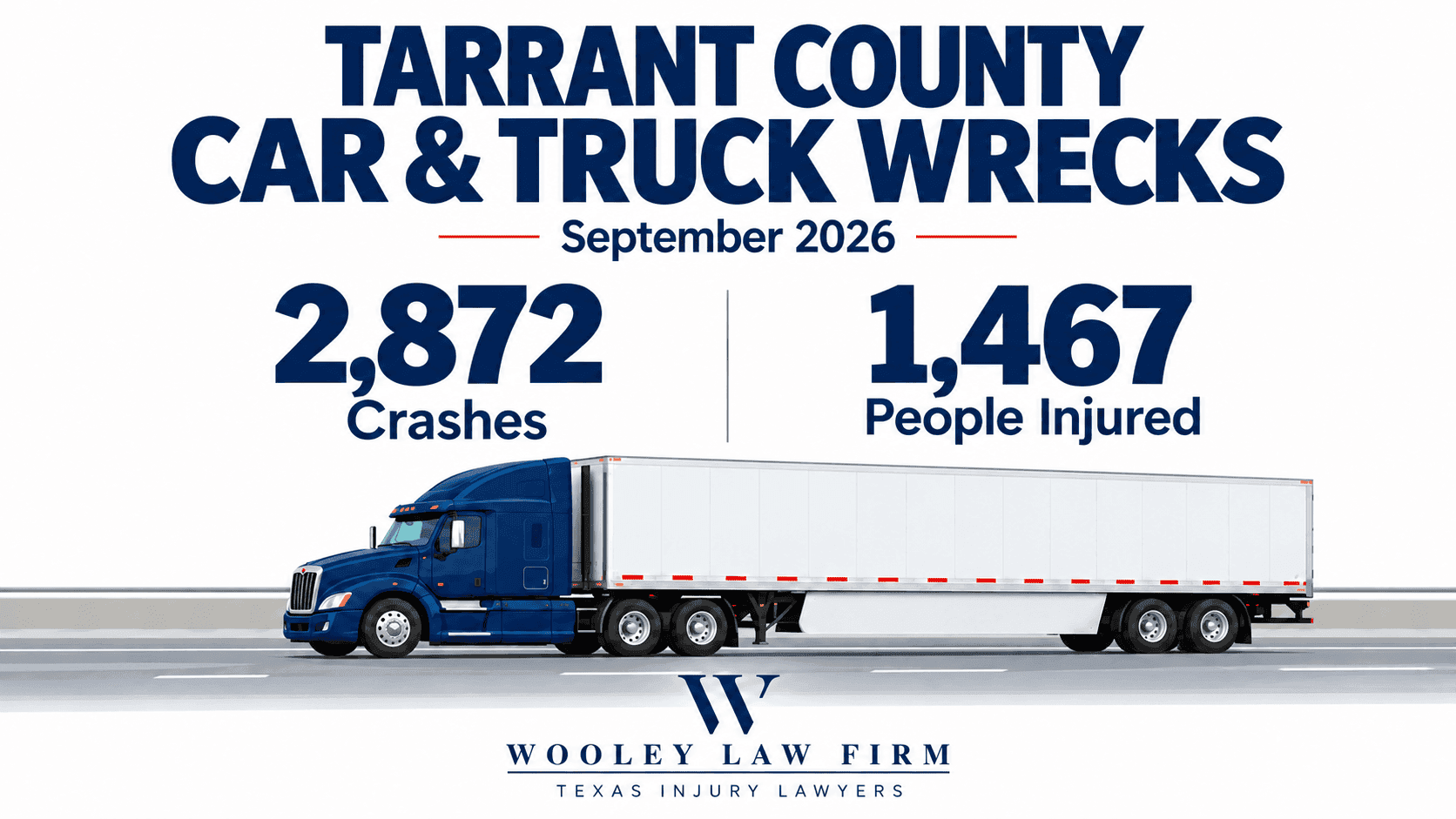
Tarrant County recorded 2,872 reported crashes, 1,467 injured people, and 14 traffic deaths during September 2026, according to our analysis of Texas Department of Transportation CRIS records processed through October 19, 2026.
Fort Worth accounted for more than half of the county’s reported crashes. I-35W had the highest individual roadway-label count, while failure to control speed and driver inattention were the most frequently recorded specific contributing factors.
For someone injured in a September car or truck wreck, the consequences may continue long after the roadway clears. Medical appointments, missed work, vehicle repairs, and insurance requests can become part of daily life.
The Wooley Law Firm represents people injured in car, truck, and commercial vehicle collisions throughout Fort Worth, Arlington, Mansfield, and the rest of Tarrant County.
September 2026 Tarrant County Crash Statistics
From September 1 through September 30, the supplied Tarrant County records show:
2,872 reported crashes
6,012 units involved
7,381 people involved
1,467 injured people
89 suspected serious injuries
14 deaths in 14 fatal crashes
That averages approximately 96 reported crashes and 49 injured people per day.
“People involved” includes people who were not injured. Suspected serious injuries are included within the overall injury total and should not be added to it again.
These figures cover Tarrant County, including Fort Worth, Arlington, Mansfield, Bedford, and other communities. They are not exclusively City of Fort Worth statistics.
Fort Worth Had More Than Half of Tarrant County’s September Crashes
Within the Tarrant County-filtered records, Fort Worth recorded:
1,471 crashes
695 injured people
44 suspected serious injuries
Seven deaths in seven fatal crashes
Fort Worth accounted for approximately 51.2% of the county’s reported crashes and half of its traffic deaths.
Arlington ranked second with 443 crashes. Together, Fort Worth and Arlington accounted for approximately 66.6% of the county total.
The ten cities with the most reported crashes were:
Fort Worth: 1,471 crashes.
Arlington: 443 crashes.
Mansfield: 92 crashes.
Bedford: 72 crashes.
Forest Hill: 71 crashes.
North Richland Hills: 70 crashes.
Grand Prairie: 66 crashes.
Euless: 60 crashes.
Haltom City: 53 crashes.
Grapevine: 53 crashes.
Other city totals included 49 crashes in Hurst and 48 in Saginaw.
For cities extending across county lines, these figures include only crashes returned by the Tarrant County query. They do not necessarily represent the entire city.
Which Tarrant County Highways Had the Most September Wrecks?
I-35W had the highest individual roadway-label count in the September records, followed by I-20, I-820, and I-30.
Leading highway and route labels included:
I-35W: 200 crashes.
I-20: 169 crashes.
I-820: 135 crashes.
I-30: 118 crashes.
SH-360: 98 crashes.
SH-183: 91 crashes.
Business US-287P: 71 crashes.
FM-157: 57 crashes.
SH-121: 57 crashes.
US-377: 52 crashes.
The four leading interstate labels—I-35W, I-20, I-820, and I-30—collectively accounted for 622 crashes, approximately 21.7% of the county total.
These figures show where crashes were recorded. They do not establish which highway presented the greatest risk per mile traveled.
Roadway names can also divide a corridor among highway numbers, frontage roads, business routes, and local names. This analysis preserves the recorded labels rather than automatically combining them.
Our guide to 18-wheeler wrecks on I-35W in Fort Worth discusses evidence and investigation issues that may arise after a commercial truck collision on that corridor.
Most Common Contributing Factors in September Tarrant County Crashes
Failure to control speed and driver inattention appeared far more frequently than any other specific contributing factor in the supplied records.
The leading specific factors were:
Failure to control speed: 571 crashes.
Driver inattention: 563 crashes.
Unsafe lane changes: 262 crashes.
Failure to yield while turning left: 228 crashes.
Following too closely: 174 crashes.
Failure to yield at a stop sign: 113 crashes.
Disregarding a traffic signal: 106 crashes.
Failure to drive in a single lane: 104 crashes.
Under the influence of alcohol: 96 crashes.
Distraction in the vehicle: 89 crashes.
Another 511 crashes included the category “Other—explain in narrative.” Identifying the specific conduct in those cases requires reviewing the individual crash reports.
A single crash can list multiple contributing factors. These counts overlap and should not be added together as separate collisions.
Injured in an Accident?
Free consultation. Tell us what happened and learn what options may be available.
Failure to Control Speed Does Not Necessarily Mean Exceeding the Speed Limit
Failure to control speed appeared in 571 crashes.
That notation does not automatically establish that a driver exceeded the posted speed limit. The report narrative and surrounding evidence are needed to understand the circumstances, including whether traffic was slowing or stopped.
Driver Inattention and In-Vehicle Distraction Are Separate Categories
Driver inattention appeared in 563 crashes, while distraction in the vehicle appeared in 89.
Those classifications should not automatically be described as texting or cellphone use. Identifying the distraction may require reviewing statements, video, records, or other available evidence.
The categories also may overlap within the same collision.
Unsafe Lane Changes and Failure to Yield Can Produce Disputed Claims
Unsafe lane changes appeared in 262 crashes, and failure to yield while turning left appeared in 228.
When drivers give conflicting accounts, useful evidence may include:
Dash-camera recordings.
Nearby surveillance footage.
Independent witness statements.
Vehicle damage and points of impact.
Roadway markings and debris.
The vehicles’ movements before the collision.
A reported contributing factor is one part of the investigation. It is not a final legal determination of responsibility.
Tarrant County Recorded 217 Commercial Vehicle Crashes in September
The September records identify 217 crashes involving commercial motor vehicles, with:
82 injured people
Eight suspected serious injuries
One death in one fatal crash
CMV-involved crashes represented approximately 7.6% of all reported Tarrant County crashes during the month.
The CMV category is broader than 18-wheelers and can include other vehicles classified as commercial motor vehicles. The flag establishes involvement, not that the commercial driver caused the collision.
A commercial truck investigation may require more than the initial police report. Depending on the circumstances, relevant evidence may include onboard video, electronic vehicle data, driver logs, dispatch communications, inspection reports, and maintenance records.
A Fort Worth truck accident lawyer can evaluate the evidence, potentially responsible parties, and available insurance coverage. The firm also provides information for people injured in Arlington commercial truck wrecks.
Injured in September? Your Claim May Still Require Investigation
A person injured in a September collision may still be receiving treatment or learning how the injuries will affect work and daily activities.
The timing of an injury claim depends on factors such as:
Whether responsibility is disputed.
Whether the injuries and losses can be evaluated.
Whether additional treatment is recommended.
Whether more than one vehicle or company was involved.
What insurance coverage applies.
Whether necessary records and evidence are available.
An early offer does not establish that all losses have been considered. Before signing a final release, understand which claims it resolves and how it affects your ability to seek further compensation.
Likewise, an ongoing claim does not necessarily mean that nothing is happening. Medical documentation, investigation, and insurance evaluation can take time.
What Should You Preserve After a Tarrant County Wreck?
Even if several weeks have passed, preserve the evidence you have and tell your attorney about information that may still be available.
Useful materials may include:
The crash report number and investigating agency.
Original photographs and videos.
Witness names and contact information.
Medical records, bills, and treatment instructions.
Prescription and related expense receipts.
Vehicle repair or total-loss documents.
Records of missed work.
Insurance correspondence and proposed settlement documents.
Our guide explains how to obtain a Texas Peace Officer’s Crash Report after a Dallas–Fort Worth collision.
Preserve dash-camera recordings in their original format when possible. Identify nearby businesses that may have recorded the collision, but do not assume their footage remains available.
Photographs of visible injuries may also help document recovery. Our article explains why photographs of bruises, cuts, and swelling matter after a truck wreck.
Necessary medical care always comes first.
What If an Insurance Company Has Already Contacted You?
An adjuster may request a recorded statement, medical authorization, or signed release.
Understand who is requesting the information, what is being requested, and how the documents may affect your claim. Keep copies of correspondence and accurately explain what happened.
Our guide to insurance company calls after a car or truck wreck discusses common requests and issues to consider.
The Wooley Law Firm can review disputed responsibility, proposed settlement terms, and other questions arising from a serious collision.
Frequently Asked Questions About September Tarrant County Crashes
How many crashes occurred in Tarrant County in September 2026?
The supplied CRIS export shows 2,872 reported crashes from September 1 through September 30, 2026.
How many occurred in Fort Worth?
The Tarrant County-filtered records identify 1,471 Fort Worth crashes. This figure covers the Tarrant County portion of the city.
How many people were injured or killed?
The records show 1,467 injured people, including 89 suspected serious injuries, and 14 deaths in 14 fatal crashes.
What were the most common contributing factors?
Failure to control speed appeared in 571 crashes, driver inattention in 563, and unsafe lane changes in 262. Multiple factors may appear in a single crash.
How many commercial vehicle crashes occurred?
The records identify 217 CMV-involved crashes, with 82 injured people and one death.
Can I speak with a lawyer while treatment continues?
Yes. You can discuss the collision, insurance issues, and evidence while receiving treatment. You do not have to wait until medical care is complete to seek an initial consultation.
Injured in a September Fort Worth or Tarrant County Wreck?
The Wooley Law Firm represents people injured in car, 18-wheeler, and other commercial vehicle collisions throughout Tarrant County.
If your wreck happened in Fort Worth, Arlington, Mansfield, Bedford, Forest Hill, North Richland Hills, or another Tarrant County community, our firm can review the facts and explain your options.
Call (214) 699-6524 for a free consultation. You don’t pay unless we win. You can also contact The Wooley Law Firm online.
Data Sources and Methodology
This analysis uses a TxDOT CRIS query export filtered to Tarrant County and crash dates September 1–30, 2026, containing records processed through October 19, 2026. TxDOT maintains reportable crash data submitted by law enforcement and makes public data available through CRIS Query.
The export contains 2,872 unique crash IDs. Injury and death totals count people. Fatal crashes count collisions with at least one recorded death. Suspected serious injuries are included within overall injuries.
CMV totals include records marked “Yes” in the Commercial Motor Vehicle Flag field. Contributing-factor counts represent crashes listing each factor, with multiple factors possible in one collision.
City figures retain the Tarrant County filter. Roadway figures use recorded labels without automatically combining alternate names or related routes.
These provisional figures may differ from earlier publications or later queries. They are not adjusted for population or traffic volume and do not independently establish fault. The analysis and conclusions are those of The Wooley Law Firm, not TxDOT.
This article is for general informational purposes only and is not legal advice. Reading it does not create an attorney-client relationship. Every case is different, and past results do not guarantee a similar outcome.
Topics
Share This Article
Andrew J. Wooley
Personal Injury Attorney
Andrew J. Wooley is a dedicated personal injury attorney based in Dallas, Texas. He focuses on helping accident victims recover fair compensation for their injuries. With a commitment to personalized service, Andrew works directly with each client to understand their unique situation and fight for their rights.
Related Local News
Recent related coverage