
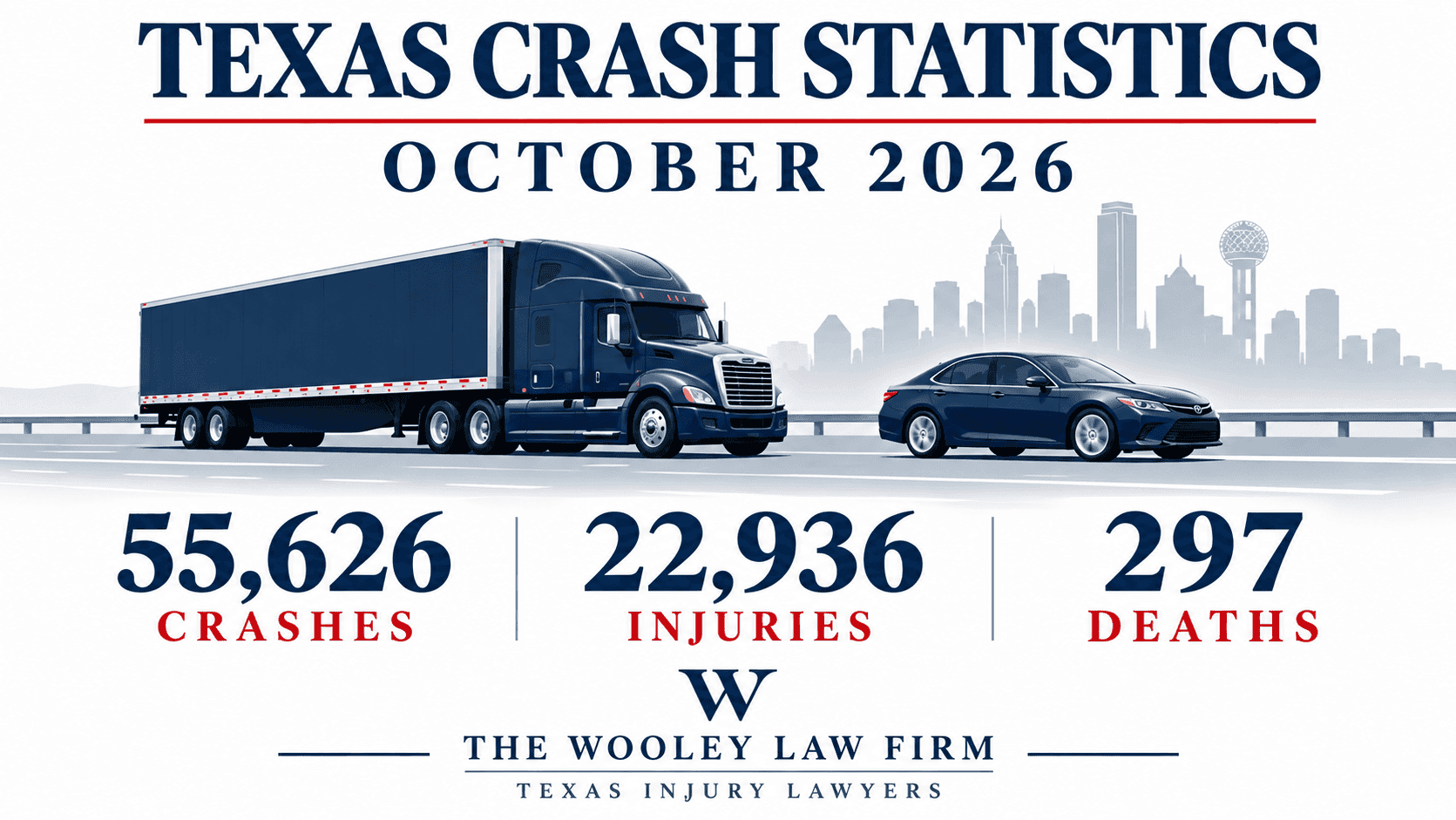
Texas recorded 55,626 reported car and truck crashes during October 2026, according to a Texas Department of Transportation (TxDOT) crash-data query obtained on November 17, 2026. The crashes involved 111,738 units and 136,552 people.
The underlying crash records identify 22,926 reported injuries, 1,622 suspected serious injuries, and 297 traffic deaths across Texas during October.
Commercial motor vehicles were involved in 3,927 crashes, resulting in 42 deaths, 1,304 injuries, and 146 suspected serious injuries.
In North Texas, Dallas recorded 2,243 crashes, while Fort Worth recorded 1,652. Eighteen selected Dallas–Fort Worth cities accounted for a combined 8,091 wrecks during October.
Compared with September 2026, Texas experienced an 11.1% increase in reported crashes, a 9.4% increase in injuries, and an 11.2% increase in suspected serious injuries. Commercial motor vehicle crashes increased 7.3%.
For someone injured in a Dallas car accident or 18-wheeler wreck, these statistics provide important context about collisions occurring throughout Texas. However, an individual injury claim depends on what caused the accident, who was responsible, what injuries resulted, and what evidence is available.
The Wooley Law Firm represents individuals and families injured in serious motor vehicle collisions throughout Dallas–Fort Worth and Texas. Our Dallas car accident lawyer and Dallas truck accident lawyer pages explain how we investigate crashes and help injured Texans pursue compensation.
October 2026 Texas Crash Statistics
According to the TxDOT data compiled for this report, the statewide October 2026 figures include:
55,626 reported crashes
111,738 units involved
136,552 people involved
22,926 reported injuries
1,622 suspected serious injuries
297 traffic deaths
During October's 31 days, those figures represent approximately:
1,794 crashes per day
740 reported injuries per day
52 suspected serious injuries per day
9.6 traffic deaths per day
That means Texas averaged nearly 75 reported motor vehicle crashes every hour during October 2026.
The number of people involved in these accidents does not mean that every person suffered an injury. Similarly, suspected serious injuries are included within the overall injury total and should not be added to it.
The figures also reflect the information available to TxDOT when the data was obtained. Crash reports may be supplemented or corrected as investigations continue.
More Than 22,900 People Were Injured in October Texas Wrecks
October's crash records identify 22,926 reported injuries throughout Texas, including 1,622 suspected serious injuries.
Suspected serious injuries accounted for approximately 7.1% of all reported injuries.
These injuries can have significant consequences for individuals and families, particularly when a collision involves an 18-wheeler, commercial vehicle, high-speed impact, or multiple vehicles.
Serious car and truck accidents can cause:
Traumatic brain injuries and concussions
Herniated discs and spinal injuries
Neck and back injuries
Broken bones and orthopedic injuries
Internal injuries
Nerve damage
Permanent physical limitations
Injuries requiring surgery or prolonged rehabilitation
Some injured motorists require hospitalization immediately after a wreck. Others initially receive emergency treatment but later require additional diagnostic testing, injections, surgery, or ongoing pain management.
Medical expenses may continue for months after the collision.
For people who cannot return to work, lost wages and reduced earning capacity may become additional concerns.
Importantly, an injury's classification in a police crash report does not establish the full extent of its medical or financial consequences. Those questions require an individualized evaluation of medical records, treatment history, employment information, and other evidence.
Commercial Motor Vehicles Were Involved in 3,927 October Texas Crashes
Commercial vehicle collisions continued to account for a significant number of Texas traffic injuries and deaths during October.
According to the October 2026 crash records:
3,927 crashes involved commercial motor vehicles.
42 people died in commercial vehicle-involved crashes.
1,304 people were injured.
146 suspected serious injuries were reported.
Texas averaged approximately 127 commercial motor vehicle crashes per day during October.
Commercial vehicles were involved in approximately 7.1% of all reported Texas crashes but accounted for approximately 14.1% of statewide traffic deaths.
They also accounted for approximately 9.0% of suspected serious injuries.
These figures demonstrate the substantial consequences that can accompany crashes involving commercial vehicles.
However, the commercial motor vehicle category includes more than 18-wheelers. Depending on the vehicle and reporting classification, the category can include tractor-trailers, commercial buses, box trucks, and other qualifying vehicles.
The data does not establish that a commercial driver caused every collision in which a commercial vehicle was involved.
Why Commercial Truck Accidents Can Cause Serious Injuries
When a fully loaded tractor-trailer collides with a passenger vehicle, the difference in size and weight can significantly affect the resulting damage and injuries.
Many commercial trucks can legally operate at gross vehicle weights of up to 80,000 pounds under applicable federal weight limits.
An 18-wheeler may also require substantially more distance to stop than a passenger car, particularly when traveling at highway speeds.
A crash involving a commercial truck may result in:
Severe injuries to passenger vehicle occupants
Multiple vehicle impacts
Extensive property damage
Highway closures
Long-term disabilities
Fatal injuries
Commercial truck accidents can also involve multiple potentially responsible parties, including the driver, motor carrier, maintenance company, or another business involved in operating the truck.
Our Dallas 18-wheeler accident lawyer page explains why investigating commercial truck collisions can require examining evidence beyond the information contained in the police report.
How Did October 2026 Texas Wrecks Compare With September?
Texas reported substantially more crashes during October than September.
According to our September 2026 Texas car and truck wreck statistics, September recorded 50,048 crashes, 20,951 injuries, 1,459 suspected serious injuries, and 298 traffic deaths.
October's figures show the following changes.
Total Texas Crashes Increased 11.1%
Texas recorded 50,048 crashes in September compared with 55,626 in October.
That represents an increase of 5,578 crashes, or approximately 11.1%.
October also had one more calendar day than September, making daily averages useful when comparing the two months.
Reported Injuries Increased 9.4%
September recorded 20,951 injuries.
October recorded 22,926.
That represents 1,975 additional reported injuries, an increase of approximately 9.4%.
Suspected Serious Injuries Increased 11.2%
September recorded 1,459 suspected serious injuries.
October recorded 1,622.
That represents an increase of 163 suspected serious injuries, or approximately 11.2%.
Traffic Deaths Remained Nearly Unchanged
Texas recorded 298 traffic deaths during September and 297 during October.
The difference represents a decrease of one death, or approximately 0.3%.
Although total crashes and injuries increased, the number of reported fatalities remained nearly identical between the two months.
These figures do not establish why crashes increased or whether a particular roadway became more dangerous. Traffic volumes, weather, roadway construction, vehicle miles traveled, and other factors can affect monthly crash totals.
October Had More Crashes Per Day Than September
Because September has 30 days and October has 31, comparing average daily crashes helps provide additional perspective.
During September, Texas averaged approximately:
1,668 crashes per day
698 reported injuries per day
49 suspected serious injuries per day
9.9 traffic deaths per day
During October, Texas averaged approximately:
1,794 crashes per day
740 reported injuries per day
52 suspected serious injuries per day
9.6 traffic deaths per day
October's average daily crash total increased approximately 7.5% compared with September.
This is important because the increase in total monthly collisions cannot be explained solely by October having an additional day.
However, two months of crash data are not sufficient to establish a long-term trend or identify the specific reasons behind the increase.
Commercial Vehicle Crashes Increased 7.3% in October
Commercial motor vehicle-involved crashes also increased during October.
September recorded 3,659 commercial vehicle crashes, compared with 3,927 during October.
That represents an increase of 268 crashes, or approximately 7.3%.
The other commercial vehicle statistics changed as follows:
Reported injuries: Increased from 1,303 in September to 1,304 in October.
Suspected serious injuries: Increased from 142 to 146.
Deaths: Increased from 41 to 42.
While commercial vehicle crash totals increased substantially, the reported number of injuries and deaths remained relatively close to September's figures.
October averaged approximately 127 commercial vehicle-involved crashes per day, compared with approximately 122 during September.
For those injured in 18-wheeler wrecks, the underlying investigation remains essential. Commercial vehicle accident claims may involve driver conduct, trucking company policies, vehicle maintenance, electronic records, and multiple insurance policies.
Dallas and Fort Worth Both Recorded More Crashes in October
The two largest cities in the Dallas–Fort Worth Metroplex both experienced increases in reported crashes during October 2026.
Dallas Recorded 2,243 Crashes
Dallas reported 2,243 collisions in October, compared with 2,036 in September.
That represents an increase of 207 crashes, or approximately 10.2%.
Dallas averaged approximately 72 reported crashes per day during October.
In September, the city averaged approximately 68 crashes per day.
Dallas drivers routinely share major highways and arterial roads with tractor-trailers, commercial delivery vehicles, buses, and other traffic.
Accidents can occur on busy roads such as:
Interstate 35E
Interstate 30
Interstate 20
Interstate 635
U.S. Highway 75
U.S. Highway 67
Loop 12
Dallas North Tollway
A collision involving an 18-wheeler or commercial vehicle may require determining whether the driver was distracted, following too closely, speeding, fatigued, or otherwise operating the vehicle negligently.
The October crash totals alone do not establish how frequently any particular contributing factor occurred in Dallas.
Fort Worth Recorded 1,652 Crashes
Fort Worth reported 1,652 crashes during October, compared with 1,505 in September.
That represents an increase of 147 crashes, or approximately 9.8%.
Fort Worth averaged approximately 53 crashes per day during October, compared with approximately 50 in September.
Major highways serving Fort Worth include I-20, I-30, I-35W, I-820, and U.S. Highway 287.
Commercial vehicles regularly use these roadways to transport goods throughout North Texas and other parts of Texas.
A serious collision involving an 18-wheeler may require reconstructing the crash, identifying the motor carrier, locating insurance coverage, and preserving evidence held by the trucking company.
Which Texas Cities Had the Most Crashes in October 2026?
Houston recorded the highest number of reported crashes among Texas cities during October, followed by San Antonio and Dallas.
The ten highest city totals in the October dataset were:
Houston — 5,552 crashes
San Antonio — 4,359 crashes
Dallas — 2,243 crashes
Fort Worth — 1,652 crashes
El Paso — 1,623 crashes
Austin — 1,027 crashes
Laredo — 806 crashes
Lubbock — 594 crashes
Plano — 574 crashes
Amarillo — 505 crashes
Other Texas cities with substantial reported crash totals included:
Corpus Christi — 480 crashes
Arlington — 434 crashes
Irving — 405 crashes
Waco — 403 crashes
Beaumont — 375 crashes
Conroe — 361 crashes
Denton — 360 crashes
Odessa — 349 crashes
Pasadena — 347 crashes
Grand Prairie — 341 crashes
Brownsville — 332 crashes
Tyler — 301 crashes
The October dataset also identifies 13,144 crashes occurring outside city limits throughout Texas.
These figures are raw crash counts. They are not adjusted for population, road mileage, or traffic volume and therefore should not be used by themselves to determine which Texas city is the most dangerous for drivers.
Selected Dallas–Fort Worth Cities Recorded 8,091 October Crashes
Motor vehicle collisions affected communities throughout Dallas County, Tarrant County, Collin County, Denton County, and surrounding North Texas areas.
The same 18 cities included in our September analysis recorded the following October totals:
Dallas: 2,243 crashes
Fort Worth: 1,652 crashes
Plano: 574 crashes
Arlington: 434 crashes
Irving: 405 crashes
Denton: 360 crashes
Grand Prairie: 341 crashes
Garland: 295 crashes
Frisco: 259 crashes
Lewisville: 247 crashes
Mesquite: 238 crashes
Carrollton: 222 crashes
Richardson: 188 crashes
Rockwall: 132 crashes
McKinney: 131 crashes
Waxahachie: 128 crashes
Mansfield: 126 crashes
Weatherford: 116 crashes
Together, these 18 cities accounted for 8,091 reported crashes during October 2026.
During September, the same cities recorded 7,299 crashes.
That represents an increase of 792 collisions, or approximately 10.9%.
Across the selected cities, the average increased from approximately 243 crashes per day in September to 261 crashes per day during October.
This subtotal does not represent every crash in the Dallas–Fort Worth metropolitan area. It excludes other municipalities, unincorporated areas, and crashes outside city limits.
Nevertheless, using the same group of cities provides a consistent way to compare the monthly totals.
Injured in an Accident?
Free consultation. Tell us what happened and learn what options may be available.
Plano Recorded 574 Crashes
Plano recorded 574 collisions during October, the highest October total among the selected DFW cities outside Dallas and Fort Worth.
Major roadways serving Plano include U.S. 75, SH 121, the Dallas North Tollway, and numerous heavily traveled arterial streets.
Accidents in Plano may involve passenger vehicles, delivery trucks, tractor-trailers, or multiple vehicles.
Determining liability requires examining the circumstances of the particular collision rather than relying on monthly crash counts.
Arlington Recorded 434 Crashes
Arlington reported 434 crashes during October.
Arlington sits between Dallas and Fort Worth and is served by major highways including I-20, I-30, SH 360, and U.S. 287.
These roadways carry significant passenger and commercial traffic.
An accident involving a commercial vehicle may require identifying the truck's driver, motor carrier, and available insurance coverage.
Irving Recorded 405 Crashes
Irving reported 405 collisions during October.
Major roads serving Irving include SH 183, SH 114, Loop 12, I-635, and highways near Dallas/Fort Worth International Airport.
Truck accidents in the Irving area may involve local delivery vehicles, tractor-trailers, airport-related commercial traffic, or other business vehicles.
Depending on the circumstances, investigating a commercial vehicle collision may involve the trucking company, driver, vehicle owner, or other responsible businesses.
Denton Recorded 360 Crashes
Denton recorded 360 crashes during October.
The city is served by I-35, I-35E, I-35W, and U.S. Highway 380.
Commercial trucking, regional traffic, and local drivers share these major transportation corridors.
When an 18-wheeler is involved in a serious Denton-area wreck, preserving electronic vehicle information, camera footage, and driver records may become important.
Which Texas Highways Had the Most Reported Crashes in October?
Interstate highways and major state and federal routes accounted for substantial numbers of reported collisions during October.
The highest roadway-designation totals included:
Interstate 10 — 1,502 crashes
Interstate 35 — 1,304 crashes
Interstate 45 — 1,176 crashes
Interstate 20 — 761 crashes
Interstate 30 — 580 crashes
Interstate 35E — 544 crashes
Interstate 69 — 470 crashes
U.S. Highway 290 — 406 crashes
Interstate 410 — 390 crashes
State Loop 8 — 387 crashes
Other roadways with substantial October totals included:
State Highway 6 — 354 crashes
U.S. Highway 75 — 349 crashes
Interstate 610 — 345 crashes
U.S. Highway 281 — 323 crashes
State Loop 1604 — 305 crashes
Interstate 635 — 286 crashes
Interstate 35W — 275 crashes
U.S. Highway 287 — 198 crashes
U.S. Highway 183 — 195 crashes
U.S. Highway 67 — 195 crashes
These figures represent crashes associated with the listed roadways throughout Texas, not exclusively within Dallas–Fort Worth.
The dataset also maintains separate designations for Interstate 35, Interstate 35E, and Interstate 35W.
A roadway recording a larger number of crashes is not necessarily more dangerous per mile traveled. Determining roadway crash rates would require additional information about traffic volume and vehicle miles traveled.
October Crash Statistics on Major Dallas–Fort Worth Highways
Several highways serving Dallas and North Texas experienced increases in crash counts compared with September 2026.
Among the most notable were I-20, I-35E, U.S. 75, I-635, and I-35W.
Interstate 20 — 761 Crashes, Up 22.5%
Interstate 20 recorded 761 reported crashes during October, compared with 621 during September.
That represents an increase of 140 crashes, or approximately 22.5%.
I-20 is a major east-west commercial transportation route that passes through the southern portions of the Dallas–Fort Worth region.
The highway carries passenger vehicles, tractor-trailers, commercial delivery trucks, and other traffic.
Serious I-20 truck accidents may involve:
Rear-end collisions in slowing traffic
Unsafe lane changes
Multi-vehicle crashes
Collisions involving disabled vehicles
Crashes in construction zones
Accidents involving drivers who fail to maintain a safe following distance
When an 18-wheeler strikes a passenger vehicle, determining what occurred may require reviewing the truck's electronic data, dashcam footage, driver records, and surrounding roadway conditions.
The October statistics identify the number of reported crashes on I-20 statewide but do not establish how many involved each particular contributing factor.
Interstate 30 — 580 Crashes
Interstate 30 recorded 580 crashes during October, compared with 581 during September.
That represents a decrease of one crash.
Despite the relatively unchanged total, I-30 remains an important highway for Dallas–Fort Worth commuters and commercial trucking traffic.
Interstate 30 passes through Dallas, Grand Prairie, Arlington, and Fort Worth.
When a collision involves several vehicles, the investigation may require determining which impact occurred first and whether subsequent collisions caused additional injuries.
A driver involved in a multi-vehicle accident may face conflicting statements from other motorists and insurance companies.
Physical evidence, vehicle damage, witness statements, and camera footage may help establish the sequence of events.
Interstate 35E — 544 Crashes, Up 12.2%
Interstate 35E recorded 544 crashes during October, compared with 485 during September.
That represents an increase of 59 crashes, or approximately 12.2%.
I-35E is one of the major north-south transportation routes through Dallas and Denton County.
The highway carries significant commercial traffic, including tractor-trailers traveling through Dallas and the surrounding region.
Commercial truck wrecks on I-35E can raise questions about:
The truck driver's speed before impact
Whether the driver maintained a safe following distance
Whether traffic had already slowed or stopped
Driver fatigue or distraction
The truck's braking system
Available dashcam footage
Electronic logging and vehicle data
An 18-wheeler's onboard systems may contain information relevant to the truck's speed, braking, and operation before a collision, depending on the equipment and data available.
Our article, Injured in an 18-Wheeler Wreck on I-35E in Dallas? What You Need to Know, discusses how these collisions can be investigated.
U.S. Highway 75 — 349 Crashes, Up 27.4%
U.S. Highway 75 recorded 349 reported crashes in October, compared with 274 during September.
That represents an increase of 75 crashes, or approximately 27.4%.
Among the six primary Dallas–Fort Worth highway corridors compared in this report, U.S. 75 had the largest percentage increase.
U.S. 75, commonly known as Central Expressway through Dallas, connects Dallas with Richardson, Plano, Allen, McKinney, and other communities.
Traffic conditions can change quickly near interchanges, exits, and areas of congestion.
When an 18-wheeler or commercial vehicle is involved in a U.S. 75 crash, important questions may include whether the driver properly monitored traffic, maintained control of the vehicle, and responded reasonably to slowing or stopped vehicles.
In disputed lane-change collisions, investigators may also need to examine the position of each vehicle, trailer movement, blind spots, and available video evidence.
The statewide highway total does not establish how many of these crashes occurred within Dallas or Collin County.
Interstate 635 — 286 Crashes, Up 12.2%
Interstate 635 recorded 286 crashes during October, compared with 255 during September.
That represents an increase of 31 crashes, or approximately 12.2%.
I-635, also known as LBJ Freeway in Dallas, is an important route for commuters and commercial vehicles.
Sections of the highway experience congestion, merging traffic, and complex interchanges.
A serious rear-end collision involving an 18-wheeler may require examining whether the truck driver:
Maintained a safe following distance
Observed traffic conditions ahead
Adjusted speed for congestion
Applied the brakes in time
Was distracted or fatigued
Responded appropriately to a stopped or slowing vehicle
When a truck rear-ends a passenger vehicle, the surrounding facts and physical evidence remain important in determining responsibility.
Our article about being rear-ended by an 18-wheeler while stopped in Dallas traffic explains how these accidents can be investigated.
Interstate 35W — 275 Crashes, Up 12.2%
Interstate 35W recorded 275 crashes during October, compared with 245 in September.
That represents an increase of 30 crashes, or approximately 12.2%.
I-35W serves Fort Worth and other communities throughout North Texas.
The roadway carries passenger vehicles and significant commercial truck traffic.
When a collision involves a commercial truck, investigators may need to identify the correct motor carrier, review vehicle maintenance records, and determine whether the driver complied with applicable safety requirements.
In cases involving serious injuries, the investigation may extend beyond the truck driver to other businesses responsible for the vehicle's operation or maintenance.
Other Major Highways Serving Dallas–Fort Worth
Additional roadway totals for October included:
U.S. Highway 287: 198 crashes
U.S. Highway 183: 195 crashes
U.S. Highway 67: 195 crashes
State Highway 183: 171 crashes
U.S. Highway 380: 169 crashes
State Highway 121: 162 crashes
Interstate 820: 155 crashes
U.S. Highway 80: 144 crashes
U.S. Highway 377: 133 crashes
State Highway 114: 131 crashes
Loop 12: 126 crashes
State Highway 78: 109 crashes
State Highway 289: 104 crashes
Dallas North Tollway: 97 crashes
State Highway 360: 85 crashes
These figures represent statewide counts for the listed roadway designations rather than only the roadway segments inside the DFW Metroplex.
U.S. 183 and SH 183, for example, are separate roadway designations in the TxDOT data.
Why Dallas Car and Truck Accident Statistics Matter
Monthly crash statistics help identify where collisions are being reported and how crash totals change over time.
For someone injured in an accident, however, the number of collisions on a particular road does not determine whether another driver was negligent.
A civil injury claim depends on the facts of the individual collision.
Questions may include:
Who caused the wreck?
Did another driver violate a traffic law?
Was the driver distracted or speeding?
Did the driver fail to yield?
Was an unsafe lane change involved?
Did a trucking company fail to properly maintain its vehicle?
Were multiple vehicles responsible?
What injuries resulted from the collision?
What insurance coverage is available?
Evidence supporting these questions may be contained in police reports, witness statements, medical records, photographs, videos, and electronic vehicle records.
Understanding how an accident occurred is particularly important when an insurance company disputes responsibility or claims that the injured person's medical condition existed before the collision.
Why a Dallas 18-Wheeler Wreck Requires a Detailed Investigation
The October 2026 crash data identifies 3,927 commercial motor vehicle-involved wrecks throughout Texas.
A serious collision involving an 18-wheeler can require a substantially different investigation from an ordinary passenger-car accident.
A commercial truck may be owned, operated, leased, or maintained by different businesses.
The truck's insurance arrangements may also involve more than one company or policy.
Depending on the circumstances, an investigation may require examining:
Police crash reports
Witness statements
Dashcam footage
Traffic surveillance video
Electronic logging device records
Engine control module information
Driver qualification records
Driver training information
Dispatch communications
Inspection and maintenance records
Brake and tire maintenance
Cargo loading records
Tractor and trailer ownership
Leasing arrangements
Insurance policies and coverage information
The Trucking Company May Have Important Evidence
In an accident involving an 18-wheeler, some of the most important evidence may be held by the trucking company or another business.
That may include the driver's logs, electronic records, dashcam footage, maintenance documents, and communications related to the trip.
Some electronic data may be overwritten or become unavailable through routine business operations.
Preserving relevant evidence early can therefore be important, particularly when injuries are serious or responsibility for the crash is disputed.
The Crash Report May Not Identify All Available Insurance Coverage
The liability insurance information appearing on a Texas crash report may not identify every potentially applicable policy.
Depending on the vehicle, company relationships, and circumstances, additional insurance coverage may exist.
For example, the trucking company may have liability coverage separate from the policy information initially provided by the driver.
There may also be questions involving the tractor owner, trailer owner, motor carrier, or excess liability insurance.
Determining which policies apply requires examining the relevant insurance contracts and facts.
This is one reason an injured person should not necessarily assume that the insurance information listed on the crash report represents all available coverage.
The Truck Driver May Not Be the Only Potentially Responsible Party
A serious commercial vehicle collision may involve negligence by more than one person or business.
Depending on the evidence, potentially responsible parties may include:
The commercial truck driver
The motor carrier
A company responsible for maintaining the truck
A business responsible for improperly loading or securing cargo
Another negligent driver
Other parties whose actions contributed to the wreck
Responsibility is not established merely because a company owned, leased, or was associated with the truck. The evidence must support a legally recognized basis for liability.
What Evidence Matters After a Dallas Car Accident?
Passenger vehicle collisions can also involve significant disputes over fault and damages.
Drivers may disagree about who entered an intersection first, whether a traffic signal was red, or which vehicle crossed into another lane.
In rear-end collisions, the parties may dispute whether the lead vehicle stopped suddenly, whether the following driver was distracted, or whether another vehicle caused the impact.
Important evidence may include:
Crash report information
Photographs of the vehicles
Photographs of the roadway
Nearby surveillance footage
Dashcam video
Witness contact information
Vehicle damage estimates
Medical records
Employment and wage records
Insurance correspondence
For injured motorists, it is also important to document medical treatment and the impact the injuries have on daily activities and employment.
An insurance company may attempt to argue that injuries were unrelated to the wreck or resulted from a preexisting condition.
The medical history, timing of symptoms, diagnostic testing, and treating providers' findings can become important evidence in evaluating those disputes.
What Should You Do After a Dallas Car or Truck Wreck?
If you or a family member is injured in a serious car accident or commercial truck collision, consider the following steps.
1. Report the Collision
Call 911 when appropriate and obtain information about the responding police agency.
The crash report may contain important information about the drivers, vehicles, insurance, witnesses, and reported contributing factors.
2. Seek Medical Attention
Obtain appropriate medical evaluation for injuries and accurately report your symptoms.
Some injuries may require additional treatment or follow-up testing after the initial emergency room visit.
3. Preserve Photographs and Video
Photographs of vehicle damage, skid marks, debris, roadway conditions, and the surrounding area may help document what happened.
Save any dashcam footage before it is overwritten.
4. Identify Witnesses
Independent witnesses may provide important information when drivers disagree about who caused the crash.
5. Keep Medical and Employment Records
Medical bills, treatment records, wage documentation, and records of missed work may help establish the financial consequences of the accident.
6. Preserve Commercial Truck Information
If an 18-wheeler or other commercial vehicle is involved, obtain photographs of the truck and trailer when it is safe to do so.
Helpful information may include:
Company name
USDOT number
Tractor license plate
Trailer license plate
Truck number
Trailer number
Insurance information
This information may help identify the motor carrier and other businesses involved in operating the commercial vehicle.
7. Be Cautious About Signing an Insurance Release
An insurance settlement release may affect your ability to seek additional compensation.
Before signing a release, it is important to understand the scope of the settlement and whether all relevant claims and insurance coverage have been considered.
Frequently Asked Questions About October 2026 Texas Wrecks
How many car and truck crashes happened in Texas during October 2026?
The TxDOT query summary reported 55,626 crashes during October 2026. The detailed export contains 55,630 distinct crash IDs, a four-record discrepancy noted in the data methodology below.
How many people were injured in October Texas crashes?
The October records identify 22,926 reported injuries, including 1,622 suspected serious injuries.
How many people died in Texas traffic accidents during October?
The October data identifies 297 traffic deaths across 271 fatal crashes.
How many October crashes involved commercial motor vehicles?
Commercial motor vehicles were involved in 3,927 reported crashes, resulting in 42 deaths and 1,304 injuries.
Did Texas crashes increase compared with September 2026?
Yes. Texas recorded 50,048 crashes in September compared with 55,626 in October, an increase of approximately 11.1% based on the monthly query totals.
How many car accidents happened in Dallas during October?
Dallas recorded 2,243 crashes, averaging approximately 72 per day.
How many car accidents happened in Fort Worth?
Fort Worth recorded 1,652 crashes, averaging approximately 53 per day.
Which Dallas–Fort Worth highway experienced the largest percentage increase?
Among I-20, I-30, I-35E, U.S. 75, I-635, and I-35W, U.S. 75 recorded the largest percentage increase, rising approximately 27.4% from September to October.
These highway totals are statewide roadway counts and are not limited to the DFW Metroplex.
Does the involvement of an 18-wheeler mean the trucking company is responsible?
No. The presence of an 18-wheeler does not automatically establish that the truck driver or motor carrier caused the collision.
Liability depends on the circumstances of the accident, the conduct of the parties, and the available evidence.
Can I recover compensation if I was injured in a Dallas car or truck wreck?
Depending on the facts, a person injured by another party's negligence may be entitled to seek compensation for medical expenses, lost income, physical pain, mental anguish, physical impairment, and other legally recoverable damages.
The amount and availability of compensation depend on the injuries, evidence, applicable law, insurance coverage, and other circumstances.
Talk to a Dallas Car Wreck or Truck Wreck Lawyer
October 2026 brought a substantial increase in reported traffic collisions throughout Texas.
Dallas, Fort Worth, and numerous surrounding North Texas cities recorded hundreds or thousands of crashes during the month.
Commercial motor vehicles were involved in nearly 4,000 Texas collisions, and hundreds of people statewide suffered suspected serious injuries in traffic accidents.
For individuals and families affected by a serious wreck, the consequences can extend far beyond the collision itself.
Medical treatment, lost income, ongoing pain, disability, and insurance disputes can create substantial challenges.
The Wooley Law Firm represents people injured in serious car accidents and 18-wheeler wrecks throughout Dallas–Fort Worth and Texas.
Attorney Andrew J. Wooley has more than a decade of experience representing injured Texans and has received professional recognitions including selection to Super Lawyers Rising Stars, membership in the Million Dollar Advocates Forum, and recognition by The National Trial Lawyers.
Our firm helps injured clients investigate collisions, identify potentially responsible parties, evaluate insurance coverage, and pursue compensation supported by the evidence and Texas law.
If you or a family member was seriously injured in a Dallas car accident, commercial vehicle collision, or 18-wheeler wreck, contact The Wooley Law Firm to discuss your legal options.
Call (214) 699-6524 for a free consultation or contact The Wooley Law Firm online. You don't pay unless we win.
Sources and Data Note
October 2026 Texas crash data: Texas Department of Transportation crash-data export supplied by The Wooley Law Firm, covering October 1–31, 2026. The information was received and processed by TxDOT as of November 17, 2026.
The query summary reported 55,626 crashes involving 111,738 units and 136,552 persons. The accompanying detailed export contains 55,630 distinct crash IDs, four more than the reported query total. The reason for that difference has not been determined.
This article uses the query summary for the statewide crash total and the detailed crash records for October injury, fatality, CMV, city, and roadway statistics.
September comparison: Texas Car and Truck Wrecks in September 2026: Dallas, DFW and Statewide Crash Statistics.
Government resource: Texas Department of Transportation Crash Data Analysis and Statistics.
Crash statistics may change as reports are submitted, corrected, or supplemented. The figures represent data available at the time of analysis and do not independently establish the causes of individual crashes or the responsibility of particular drivers.
Monthly comparisons are descriptive and assume reasonably consistent data definitions and reporting practices.
Disclaimer: This article is provided for general informational purposes only and does not constitute legal advice. Reading this article does not create an attorney-client relationship. Every case is different, and prior results do not guarantee a similar outcome.
Topics
Share This Article

Andrew J. Wooley
Personal Injury Attorney
Andrew J. Wooley is a dedicated personal injury attorney based in Dallas, Texas. He focuses on helping accident victims recover fair compensation for their injuries. With a commitment to personalized service, Andrew works directly with each client to understand their unique situation and fight for their rights.
Related Local News
Recent related coverage