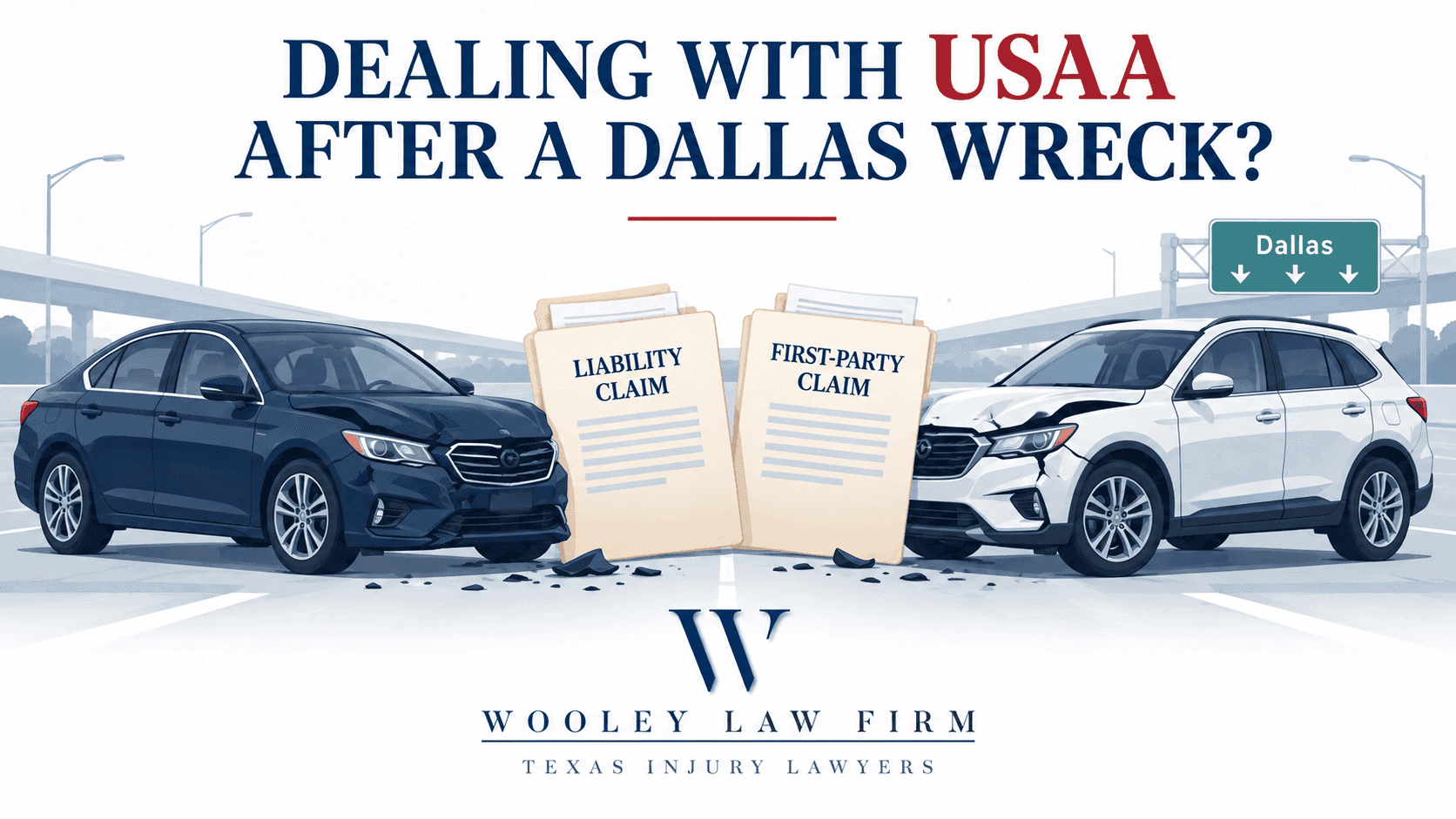
If you were injured in a Dallas car wreck and the driver who hit you has USAA insurance, you may soon find yourself dealing with a USAA claims representative.
You may also have USAA insurance yourself, which can make the claims process more complicated. You could have a liability claim against another driver's USAA policy while also having potential claims under your own USAA policy for collision, Personal Injury Protection, Medical Payments, or uninsured/underinsured motorist coverage.
Before giving a detailed statement about how the wreck happened, discussing your medical history, signing an authorization, or accepting a settlement, consider speaking with a Dallas car accident lawyer.
The first few days after a serious collision can be important.
You may still be hurting. You may not know the full extent of your injuries. You may not have undergone an MRI, seen a specialist, or learned whether you will need physical therapy, injections, surgery, or additional treatment.
USAA, meanwhile, may already be investigating the collision.
A claims representative may want information about:
How the collision occurred;
Where each vehicle was traveling;
What you saw before the impact;
Whether you could have avoided the crash;
Whether police investigated the wreck;
Whether witnesses were present;
Your injuries;
Your medical treatment;
Prior medical conditions;
Lost wages; and
Vehicle damage.
Those may sound like routine questions, but the information you provide can become part of the insurer's evaluation of your claim.
How Does a USAA Car Accident Claim Work?
USAA describes its auto claims process as generally involving several stages: reporting the claim, investigating what happened, estimating vehicle damage, determining payment, and completing repairs.
USAA states that during the investigation it may gather information such as photographs, police reports, information from the people involved, and other evidence relating to the accident.
You can review USAA's official auto claims process for more information.
If you are not a USAA member but were injured by a USAA-insured driver, USAA also has a separate third-party claims process.
Opening a USAA claim does not necessarily mean USAA has accepted responsibility for the wreck.
The insurer may investigate:
Whether its insured caused the collision;
Whether another driver contributed to the accident;
Whether the policy provides coverage;
The severity of the vehicle damage;
Whether your injuries resulted from the collision;
Whether your treatment is related to the wreck;
Your lost income; and
The other damages being claimed.
Should I Call USAA After a Dallas Car Accident?
If the person who caused your Dallas wreck has USAA insurance, the accident generally needs to be reported so a claim can be opened and investigated.
But there is a difference between reporting a claim and giving a detailed recorded statement about every aspect of the crash and your medical history.
If you suffered serious injuries, consider speaking with an attorney before providing a lengthy or recorded statement to the other driver's insurance carrier.
Our guide on what to say when an insurance company calls after a Dallas car or truck wreck explains why early insurance conversations can become important later.
A Dallas car accident attorney can help determine:
What information USAA reasonably needs;
Whether a recorded statement should be provided;
What evidence needs to be preserved;
Whether another person or company may share responsibility;
Whether multiple insurance policies apply;
How medical treatment should be documented;
Whether your own insurance coverage may apply; and
Whether a settlement offer fully accounts for your damages.
What Information Does USAA Investigate?
USAA's claims materials state that its investigation can include gathering information from the parties involved as well as photographs and police reports.
After a serious Dallas wreck, important evidence can include:
The Texas crash report;
Driver statements;
Witness statements;
Photographs of both vehicles;
Crash-scene photographs;
Dash-camera video;
Nearby surveillance video;
Traffic-camera recordings;
911 calls;
Police body-camera footage;
Vehicle event-data information;
Vehicle damage; and
Electronic evidence when appropriate.
An insurance company's investigation does not necessarily end with the police report.
USAA may independently evaluate responsibility based on the evidence available to it.
That is one reason an injured person should preserve independent evidence rather than assuming the insurer will locate everything that may support the claim.
What If USAA Wants a Recorded Statement?
A USAA claims representative may ask you to explain how the collision occurred.
If USAA insures the other driver, do not assume you must immediately provide a recorded statement merely because one is requested.
The situation can be different when USAA is your own insurance company.
When you make a first-party claim under your own policy, your insurance contract may contain duties requiring you to cooperate with the insurer's investigation. The exact obligations depend on the policy and the type of coverage involved.
That distinction matters.
If you are dealing with USAA, first determine:
Is this a claim against someone else's USAA policy?
or
Is this a claim under my own USAA policy?
Those are not necessarily the same type of insurance claim.
Why Recorded Statements Can Matter
A recorded statement preserves what you say early in the claim.
You may be answering detailed questions before:
You have obtained the crash report;
Video evidence has been collected;
Witnesses have been interviewed;
Your doctors understand the full extent of your injuries;
You have undergone an MRI or CT scan;
You have seen an orthopedic, neurological, or spine specialist; or
You know whether future treatment will be necessary.
You may also be asked:
How fast were you going?
When did you first see the other car?
Could you have stopped sooner?
Were you distracted?
How are you feeling today?
Have you ever had neck or back pain before?
Do not guess about speed, distance, timing, or another fact you genuinely do not know.
What If USAA Says My Injuries Were Pre-Existing?
Insurance companies frequently review an injured person's prior medical history.
Having prior back pain, neck pain, arthritis, a previous accident, an earlier surgery, or another medical condition does not automatically establish that a new collision caused no injury.
Depending on the medical evidence, a crash may:
Cause a new injury;
Aggravate a prior condition;
Make a previously asymptomatic condition symptomatic; or
Increase existing symptoms or physical limitations.
Medical records can therefore become an important part of a USAA bodily injury claim.
The issue may be less about whether you ever had a prior condition and more about how your condition before the collision compares with your condition afterward.
Can USAA Request My Medical Records?
If you make a bodily injury claim, USAA may request documentation supporting your injuries.
That can include:
Emergency room records;
Ambulance records;
Physician records;
MRI and CT reports;
Physical therapy records;
Pain-management records;
Surgical records;
Medical bills; and
Records concerning prior similar conditions.
Before signing a broad medical authorization, understand what it permits the insurance company to obtain.
You may want to determine:
What medical providers are covered;
How far back the authorization reaches;
What categories of records are included; and
Whether unrelated medical information could be obtained.
Our guide to medical treatment and medical bills after a Dallas car accident explains additional issues involving medical bills, liens, and treatment after a serious collision.
Injured in an Accident?
Free consultation. Tell us what happened and learn what options may be available.
What Is a USAA Car Accident Claim Worth?
There is no fixed settlement amount for a USAA car accident claim.
The potential value depends on the evidence in the individual case.
Important factors may include:
Who caused the wreck;
Whether liability is disputed;
Whether more than one driver is responsible;
The severity of your injuries;
Emergency medical treatment;
MRI or CT findings;
Physical therapy;
Specialist treatment;
Injections;
Surgery;
Future medical expenses;
Past medical expenses;
Lost wages;
Loss of earning capacity;
Physical impairment;
Pain and other legally recoverable damages;
Available liability insurance; and
Other applicable insurance coverage.
The fact that USAA is the insurance carrier does not determine the value of an injury claim.
The evidence does.
What If USAA Makes a Settlement Offer?
Before accepting a bodily injury settlement, make sure you understand both your medical condition and what rights you are releasing.
Consider whether you know:
Your diagnosis;
Whether further diagnostic testing is needed;
Whether a specialist has evaluated you;
Whether additional therapy is necessary;
Whether injections have been recommended;
Whether surgery is possible;
Whether you will continue losing income;
Whether symptoms may be permanent;
Your total medical expenses;
Whether liens or reimbursement claims exist; and
Whether sufficient insurance coverage is available.
The Texas Office of Public Insurance Counsel warns injured people pursuing third-party claims to read settlement documents carefully because a release can end the injury claim. Read OPIC's third-party auto claim guidance.
Once a bodily injury claim has been finally settled and released, you generally cannot simply reopen it later because your condition worsened.
What If USAA Blames Me for the Accident?
USAA may determine that its driver was not entirely responsible for the collision.
That does not necessarily end the claim.
An insurance company's liability determination is based on the evidence available to it.
Additional evidence may support a different analysis, including:
Dash-camera video;
Surveillance recordings;
Witness statements;
Traffic-camera footage;
Police recordings;
Scene photographs;
Vehicle photographs;
Event-data-recorder information;
Cell-phone evidence when relevant; and
Accident reconstruction evidence in serious cases.
Texas proportionate-responsibility rules can become important when the insurance company argues that more than one person contributed to a collision.
Preserving evidence early can therefore be particularly important when fault is disputed.
What If the USAA Driver Does Not Have Enough Insurance?
A serious injury claim may exceed the other driver's available liability limits.
That can happen when a collision results in:
Hospitalization;
Surgery;
Significant future treatment;
Long periods away from work;
Permanent limitations; or
Injuries to several people.
When the at-fault driver's insurance is insufficient, your own uninsured or underinsured motorist coverage may become important.
Read our detailed guide to Texas uninsured and underinsured motorist coverage.
You can also learn about how our firm handles these claims on our Dallas uninsured and underinsured motorist attorney page.
What If I Have USAA Insurance Too?
This is an especially important issue in USAA claims.
Suppose the person who hit you has USAA.
You also have USAA.
You could potentially have several separate claims arising from the same collision:
A liability claim against the other driver's USAA policy;
A collision claim under your own USAA policy;
A Personal Injury Protection claim;
A Medical Payments claim;
An uninsured motorist claim;
An underinsured motorist claim; or
Another first-party coverage claim.
Do not assume every USAA adjuster or claims representative is handling the same interest.
Ask which claim and which coverage the representative is handling.
The Texas Office of Public Insurance Counsel explains that a claim under your own policy is a first-party claim. A claim made against another person's policy is a third-party claim.
Your contractual obligations to your own insurance company can be different from your obligations to the other driver's insurer.
USAA Uninsured and Underinsured Motorist Claims
USAA is particularly relevant in another situation: when USAA is your own insurance company and the person who caused the wreck has no insurance or inadequate insurance.
Your UM/UIM coverage may potentially become another source of recovery.
For example, assume another driver causes a serious Dallas wreck and has liability insurance, but the available policy limits are insufficient to cover your damages.
If your USAA policy includes underinsured motorist coverage, you may potentially pursue a UIM claim after addressing the other driver's coverage, depending on the circumstances and your policy.
Texas requires insurers to offer UM/UIM coverage, although a policyholder may reject that coverage in writing.
Read more in our Texas UM/UIM coverage guide.
Can My Own USAA Insurance Company Dispute My UM/UIM Claim?
Potentially, yes.
The fact that you pay premiums to USAA does not mean every element of a UM/UIM claim will automatically be accepted.
Issues may arise concerning:
Whether the other driver was responsible;
Whether you share responsibility;
Whether the other driver was actually uninsured or underinsured;
Whether your injuries resulted from the wreck;
The extent of your damages;
Whether treatment was related and necessary;
Whether your policy contains applicable coverage; and
How much is owed under that coverage.
That is why a first-party USAA UM/UIM claim should not necessarily be treated as simply an extension of the claim against the at-fault driver.
Property Damage After a USAA Accident
USAA's claims materials explain that its auto-claim process can include vehicle inspection, repair estimates, payment, and repair.
USAA also states that customers may choose their repair facility.
You can review USAA's official auto claims information.
Vehicle-damage issues may include:
Repair costs;
Supplemental damage;
Whether the vehicle is a total loss;
Towing;
Storage charges;
Rental expenses;
Deductibles;
Diminished value; and
Personal property damaged in the collision.
Be careful when signing paperwork.
Confirm whether a document resolves only property damage or also releases bodily injury claims.
How Long Does USAA Have to Handle a Texas Claim?
This depends in part on whether the claim is under your own policy or against another driver's policy.
The Texas Department of Insurance explains that Texas prompt-payment deadlines apply to certain first-party insurance claims but do not apply the same way when another driver's insurer is paying the claim.
You can review the Texas Department of Insurance auto insurance guide for additional information.
This is another reason the distinction between a first-party USAA claim and a third-party claim against a USAA-insured driver matters.
When Should I Contact a Dallas Car Accident Lawyer About a USAA Claim?
Consider talking with an attorney if:
You were transported to a hospital;
You suffered substantial injuries;
An MRI or CT scan showed an injury;
You were referred to a specialist;
Injections have been recommended;
Surgery may be necessary;
You have significant medical expenses;
You are missing work;
USAA disputes liability;
USAA says you contributed to the collision;
You are being asked for a recorded statement;
You are asked to sign a broad medical authorization;
Your injuries are being blamed on a prior condition;
USAA has denied all or part of the claim;
You received a settlement offer;
The other driver's policy limits may be inadequate;
You may have a USAA UM/UIM claim; or
You are being asked to sign a release.
You do not necessarily need to wait for a claim denial before contacting an attorney.
Video can be overwritten. Vehicles can be repaired or sold. Witnesses can become difficult to locate.
Early investigation may help preserve evidence.
How The Wooley Law Firm Can Help With a USAA Car Accident Claim
If you hire The Wooley Law Firm after a serious Dallas car accident, we can handle insurance communications while you focus on your medical treatment.
Depending on the facts of the case, we may:
Investigate how the collision happened;
Obtain the police crash report;
Search for video evidence;
Preserve photographs and electronic evidence;
Locate witnesses;
Communicate with USAA;
Determine whether other insurers are involved;
Identify available liability coverage;
Evaluate PIP and MedPay coverage;
Evaluate potential UM/UIM coverage;
Gather medical records and bills;
Document lost income;
Review liens and reimbursement issues;
Document future medical needs;
Prepare a settlement demand;
Negotiate the injury claim;
Review proposed releases; and
File a lawsuit when appropriate.
USAA is one of several significant insurers Texas drivers may encounter. Our guide to the most popular auto insurance companies in Dallas-Fort Worth discusses USAA along with Progressive, State Farm, Allstate, GEICO, Farmers, Texas Farm Bureau, and other insurers.
Frequently Asked Questions About USAA Car Accident Claims in Dallas
Can I file a claim with USAA if I am not a USAA member?
Yes. USAA provides a process for third-party claimants who were involved in accidents with USAA-insured drivers. You do not need to be a USAA member to make a liability claim against a USAA-insured driver.
Does the USAA adjuster represent me?
If you are making a third-party claim against another driver's USAA policy, the claims representative is handling a claim involving USAA and its insured. The adjuster is not your attorney.
Do I have to give USAA a recorded statement?
That depends on the type of claim. Your obligations when pursuing a third-party claim against another driver's policy may differ from your contractual duties when making a claim under your own USAA policy.
What if I have USAA and the driver who hit me also has USAA?
You may have separate claims under separate policies or coverages. Ask which policy and which coverage each claims representative is handling.
Can I make a UM/UIM claim against my own USAA policy?
Potentially. If your policy includes applicable UM/UIM coverage and the at-fault driver has no insurance or insufficient insurance, your own coverage may become relevant. The specific rights and requirements depend on the policy and facts.
What if USAA says my injuries existed before the wreck?
Prior medical conditions may be relevant, but they do not automatically establish that a new collision caused no injury. Medical evidence may help determine whether the wreck caused a new injury or aggravated an existing condition.
Should I accept a USAA settlement offer?
Before accepting an injury settlement, consider the severity of your injuries, future treatment, medical bills, lost income, available insurance coverage, and what rights the proposed release would end.
Injured in a Dallas Wreck Involving USAA? Talk to a Dallas Car Accident Lawyer
Whether USAA insures the driver who hit you or USAA is your own insurance company, it is important to identify exactly what claim is being handled and what coverage may apply.
Before giving a detailed recorded statement, signing a broad medical authorization, accepting an injury settlement, or signing a release, consider speaking with an attorney.
The Wooley Law Firm represents people injured in serious car accidents throughout Dallas and North Texas.
We can investigate the wreck, preserve evidence, communicate with USAA and other insurance carriers, identify available insurance coverage, document medical treatment and lost income, evaluate potential UM/UIM benefits, negotiate the claim, and file a lawsuit when necessary.
Learn more about how we represent injured motorists on our Dallas car accident lawyer page.
Call The Wooley Law Firm at (214) 699-6524 for a free consultation. You don't pay unless we win.
You can also contact The Wooley Law Firm online.
Tell us what happened. We can review the insurance issues involved and explain the options that may be available.
Disclaimer
This article is for general informational purposes only and is not legal advice. Reading it does not create an attorney-client relationship. Insurance coverage depends on the policy language and facts of each claim. Every case is different, and past results do not guarantee a similar outcome.
Topics
Share This Article
Andrew J. Wooley
Personal Injury Attorney
Andrew J. Wooley is a dedicated personal injury attorney based in Dallas, Texas. He focuses on helping accident victims recover fair compensation for their injuries. With a commitment to personalized service, Andrew works directly with each client to understand their unique situation and fight for their rights.
Related Local News
Recent related coverage