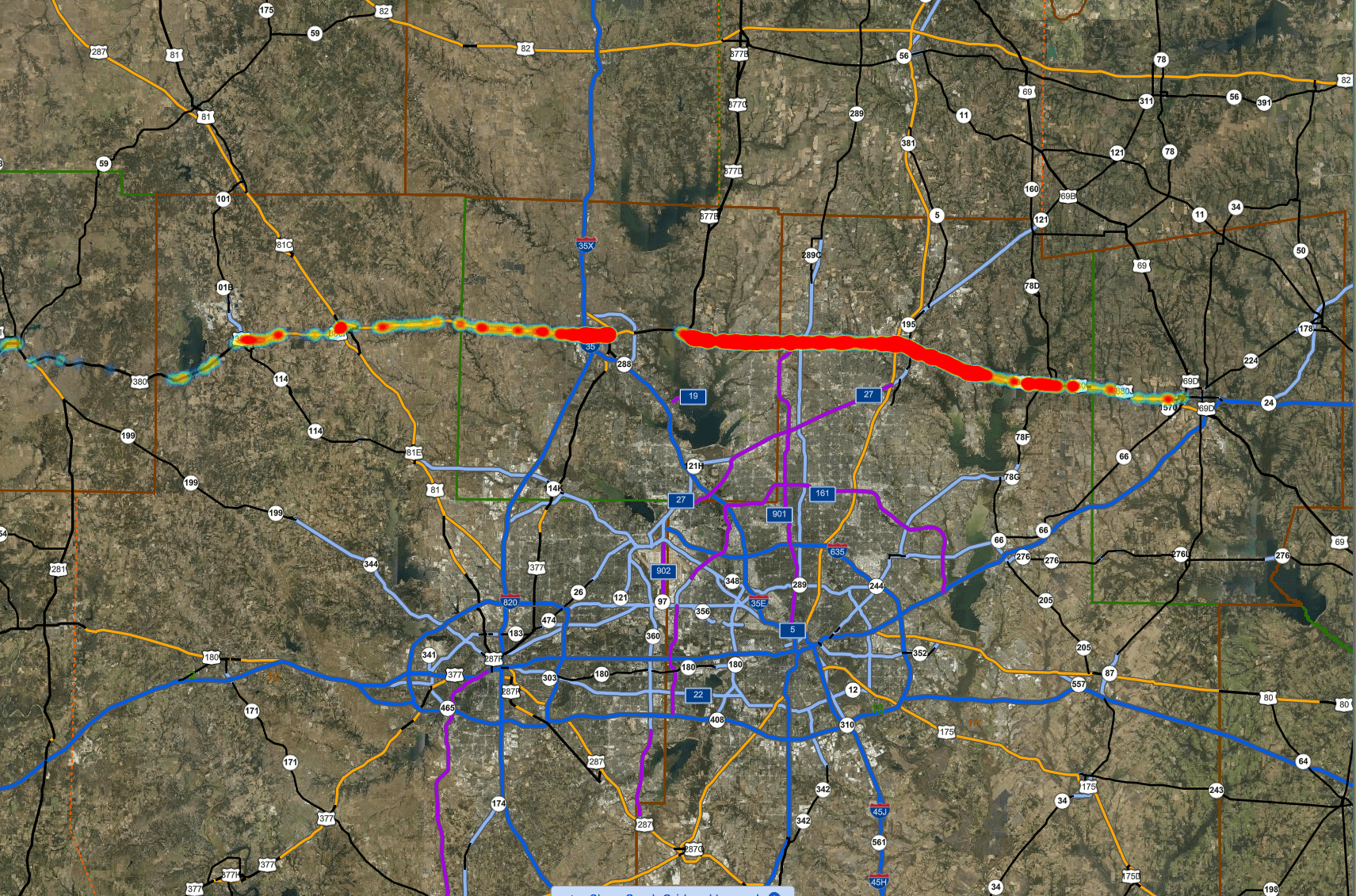
U.S. Highway 380 has become one of the most dangerous and frustrating roadways in the Dallas-Fort Worth metroplex. What was once a route connecting smaller North Texas communities is now a heavily traveled corridor cutting through explosive population growth, constant construction, crowded intersections, and heavy commercial vehicle traffic.
According to a TxDOT CRIS query for 2025, there were 1,710 crashes on U.S. 380 in the DFW area, including 12 fatalities. That data includes crashes in Collin, Denton, Hunt, and Wise Counties.
For drivers in McKinney, Denton, Frisco, Princeton, Little Elm, Prosper, Cross Roads, Decatur, Bridgeport, Greenville, and surrounding areas, these numbers confirm what many already know: U.S. 380 is dangerous.
At The Wooley Law Firm, we represent people injured in serious car wrecks and truck accidents across North Texas. If you or a loved one was hurt on U.S. 380, the location of the crash, construction activity, commercial vehicle involvement, and roadway conditions may all be important parts of your injury claim.
1,710 Crashes on U.S. 380 in 2025
The 2025 TxDOT CRIS data shows the danger on U.S. 380 is not limited to one city or one intersection. Crashes occurred across multiple counties and communities throughout the DFW metroplex.
By county, the U.S. 380 crash totals were:
Collin County: 855
Denton County: 673
Wise County: 148
Hunt County: 34
Collin County had the highest number of reported U.S. 380 crashes, followed closely by Denton County. Together, those two counties accounted for 1,528 crashes, or nearly 90% of all reported U.S. 380 crashes in the DFW-area counties included in the query.
That is not surprising. Collin and Denton Counties sit directly in the path of some of the fastest growth in North Texas. The North Central Texas Council of Governments reported that the DFW region added 234,125 residents in one year, with Collin County adding almost 76,000 residents and Denton County adding more than 31,000. The region’s population was estimated at 8,718,500, an increase of more than 886,000 since the 2020 Census.
McKinney, Denton, Frisco, Princeton, and Little Elm Saw the Most Crashes
The 2025 CRIS query also shows how concentrated the problem is in fast-growing cities along the U.S. 380 corridor:
McKinney: 312 crashes
Denton: 243 crashes
Frisco: 223 crashes
Princeton: 187 crashes
Little Elm: 183 crashes
Cross Roads: 88 crashes
Farmerville: 82 crashes
Decatur: 54 crashes
Bridgeport: 32 crashes
Prosper: 25 crashes
Runaway Bay: 8 crashes
Greenville: 5 crashes
Lowry Crossing: 1 crash
Outside city limits: 267 crashes
McKinney had the highest number of reported U.S. 380 crashes, with 312 wrecks in 2025. Denton followed with 243, Frisco with 223, Princeton with 187, and Little Elm with 183.
These are not random numbers. They reflect the reality of a highway corridor surrounded by new subdivisions, school traffic, retail centers, construction projects, and commuters trying to move across a rapidly expanding region.
Construction Zones Are a Major Problem on U.S. 380
One of the most alarming findings from the 2025 CRIS data is the number of U.S. 380 crashes connected to construction zones.
In 2025, there were 349 crashes on U.S. 380 in construction zones across the DFW-area counties included in the query. Workers were present in 70 of those construction-zone crashes.
That means more than 1 out of every 5 U.S. 380 crashes in the data occurred in a construction zone.
Construction zones are dangerous because they often combine heavy traffic with sudden changes in the roadway. Drivers may encounter narrow lanes, concrete barriers, lane shifts, uneven pavement, reduced shoulders, construction vehicles, changing signs, and unexpected backups.
TxDOT has multiple U.S. 380 projects in Collin and Denton Counties. TxDOT’s Keep It Moving Dallas page states that the Collin County corridor has been separated into five independent project segments, with project timing dependent on factors such as traffic needs and funding. TxDOT’s U.S. 380 Denton County fact sheet describes a major widening project from four to six lanes, grade separations at five major intersections, a curbed median, and pedestrian improvements, with an estimated cost of about $140 million.
Construction may be necessary to keep up with growth, but it also creates real risks for drivers, passengers, construction workers, pedestrians, and nearby residents.
Injured in an Accident?
Free consultation. Tell us what happened and learn what options may be available.
Commercial Vehicles and Truck Traffic Add to the Danger
U.S. 380 is not just a commuter road. It is also heavily used by commercial vehicles, including 18-wheelers, dump trucks, delivery trucks, concrete trucks, and construction vehicles.
According to the 2025 CRIS data, 164 U.S. 380 crashes involved commercial motor vehicles. Of those, 27 commercial vehicle crashes occurred in construction zones.
Truck wrecks are often more serious than ordinary passenger vehicle crashes because commercial vehicles are larger, heavier, and harder to stop. A fully loaded 18-wheeler, dump truck, or construction vehicle can cause catastrophic injuries in a collision with a smaller car, SUV, or pickup.
Truck accident cases may also involve more evidence than a typical car wreck, including:
Driver qualification files
Hours-of-service records
Inspection and maintenance records
Dash camera footage
Event data recorder information
Cell phone records
Dispatch records
Load documents
Construction traffic-control plans
When a commercial vehicle crash happens on U.S. 380, it is important to investigate quickly before evidence disappears.
Why U.S. 380 Has Become So Dangerous
The danger on U.S. 380 is the result of several overlapping problems.
First, the population is growing faster than the roadway can comfortably handle. Cities along and near U.S. 380, including McKinney, Frisco, Prosper, Princeton, Little Elm, Denton, and Cross Roads, have seen rapid development. More people means more vehicles, more school traffic, more delivery traffic, more construction traffic, and more pressure on intersections.
Second, construction is everywhere. Drivers are often forced to navigate shifting lanes, reduced shoulders, traffic barrels, concrete barriers, and confusing work-zone layouts. Statewide, TxDOT reported more than 28,000 work-zone crashes in Texas in 2025, resulting in 203 deaths, including seven roadway workers.
Third, U.S. 380 includes many high-risk driving conditions in one corridor: high speeds, stop-and-go congestion, major intersections, driveway access points, construction entrances, commercial trucks, and impatient drivers.
Fourth, many drivers simply do not adjust to the conditions. Speeding, distracted driving, tailgating, unsafe lane changes, red-light running, and impaired driving are especially dangerous on a road like U.S. 380.
Common Causes of U.S. 380 Car and Truck Wrecks
Many serious U.S. 380 crashes involve one or more of the following:
Distracted driving
A driver looking at a phone may fail to notice stopped traffic, a red light, a lane shift, or a construction worker.
Speeding
Speeding is especially dangerous on U.S. 380 because traffic conditions can change quickly. A driver may go from highway speed to stopped traffic in seconds.
Following too closely
Rear-end crashes are common in congested areas and construction zones. Tailgating can lead to chain-reaction collisions when traffic suddenly slows.
Unsafe lane changes
Lane shifts, merging traffic, and construction barriers increase the risk of sideswipe crashes and multi-vehicle wrecks.
Failure to yield or running red lights
U.S. 380 has many busy intersections where a single mistake can cause a severe T-bone collision.
Commercial vehicle negligence
Truck drivers and trucking companies must follow safety rules. When they fail to properly inspect vehicles, manage driver fatigue, train drivers, or operate safely in construction zones, innocent people can be seriously injured.
Dangerous construction-zone conditions
Sometimes a wreck is caused or worsened by poor signage, confusing lane markings, unsafe barriers, inadequate lighting, or improper traffic control.
What to Do After a Crash on U.S. 380
If you are involved in a crash on U.S. 380, your health and safety come first. Call 911, get medical treatment, and report the crash.
If you are able, try to document:
Vehicle positions
Damage to all vehicles
Skid marks or debris
Construction signs and barriers
Lane closures or lane shifts
Traffic signals
Road conditions
Nearby businesses or homes with cameras
Names and contact information for witnesses
Company names or DOT numbers on commercial vehicles
You should also avoid giving a recorded statement to the other driver’s insurance company before speaking with an attorney. Insurance adjusters may try to use your words against you, even when the crash was not your fault.
Injured on U.S. 380? Call The Wooley Law Firm.
The 2025 crash numbers are clear: U.S. 380 is one of the most dangerous corridors in the DFW metroplex. With 1,710 crashes, 12 fatalities, 349 construction-zone crashes, and 164 commercial motor vehicle crashes, drivers and passengers face serious risks on this roadway every day.
If you or a loved one was injured in a car wreck or truck accident on U.S. 380, The Wooley Law Firm can help investigate what happened, identify all responsible parties, and fight for the compensation you deserve.
Contact Us! Call (214) 699-6524 for a free consultation. You don’t pay unless we win.
Frequently Asked Questions About U.S. 380 Crashes
Why is U.S. 380 so dangerous?
U.S. 380 is dangerous because it combines rapid population growth, heavy traffic, construction zones, busy intersections, and commercial vehicles.
How many crashes happened on U.S. 380 in 2025?
According to the 2025 TxDOT CRIS data discussed above, there were 1,710 crashes on U.S. 380, including 12 fatalities.
Are construction-zone crashes common on U.S. 380?
Yes. The 2025 data showed 349 U.S. 380 crashes in construction zones, which means more than one out of every five reported crashes occurred in a work zone.
What should I do after a crash on U.S. 380?
Call 911, get medical care, report the crash, and document the scene if you can safely do so. Take photos of vehicle damage, road conditions, construction signs, lane closures, and any commercial vehicles involved.
Topics
Share This Article

Andrew J. Wooley
Personal Injury Attorney
Andrew J. Wooley is a dedicated personal injury attorney based in Dallas, Texas. He focuses on helping accident victims recover fair compensation for their injuries. With a commitment to personalized service, Andrew works directly with each client to understand their unique situation and fight for their rights.
Related Local News
Recent related coverage