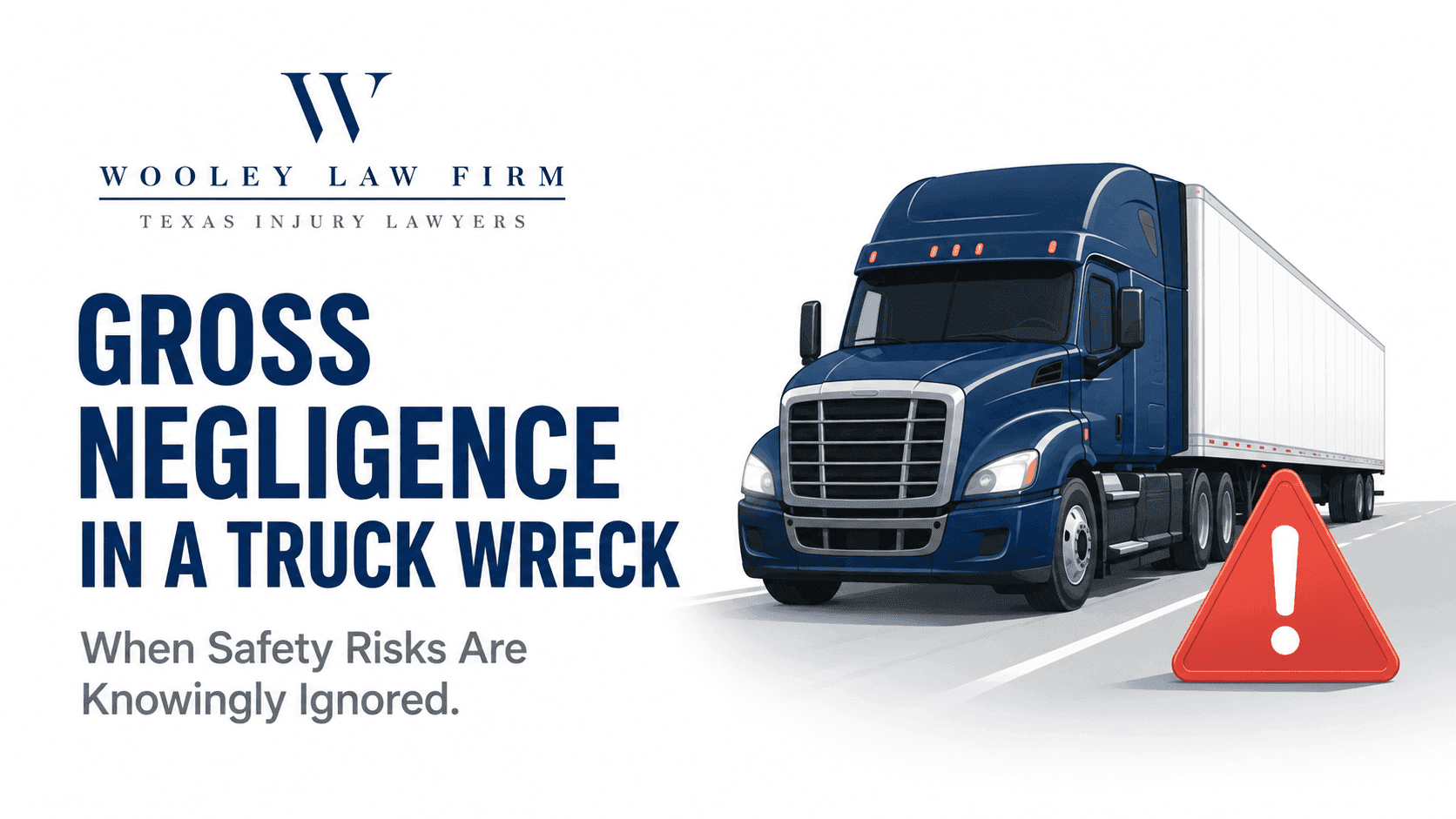
A truck driver who causes a wreck may be negligent. But when the driver or trucking company knows that its conduct creates an extreme danger and chooses to ignore that danger, the conduct may rise to gross negligence.
In common terms, gross negligence means more than carelessness. It can mean:
Extreme carelessness
Reckless conduct
Knowingly ignoring a serious safety risk
Acting with conscious disregard for the safety of others
Putting schedules or profits ahead of public safety
When gross negligence causes a serious Dallas 18-wheeler accident, the injured person may be able to seek punitive damages, also called exemplary damages. These damages are different from compensation for medical bills, lost wages, pain, or disability. Their purpose is to punish particularly dangerous conduct and discourage similar behavior.
However, punitive damages are not available in every truck wreck. Texas law requires clear and convincing evidence of gross negligence.
What Is Gross Negligence in a Texas Truck Wreck Case?
Under Chapter 41 of the Texas Civil Practice and Remedies Code, gross negligence has two basic parts.
The conduct created an extreme risk
First, the truck driver’s or trucking company’s conduct must have involved an extreme degree of risk when considering the probability and seriousness of the potential harm.
This is more than proof that a crash could happen. The conduct must create a serious and unusually dangerous risk to other people.
An 80,000-pound tractor-trailer driven at highway speed can cause catastrophic injuries. Conduct such as knowingly operating the truck with defective brakes, driving while dangerously fatigued, or repeatedly ignoring serious safety violations may create an extreme risk.
The driver or company knew about the risk and ignored it
Second, the evidence must show that the truck driver or trucking company actually knew about the danger but proceeded with conscious indifference to the rights, safety, or welfare of others.
In plain English: the defendant recognized a serious danger and chose not to care enough to stop it.
This knowledge requirement is often the most contested part of a gross-negligence claim. It is not enough to show what the driver or company should have known. The evidence must support a finding that the defendant was actually aware of the risk.
What Is the Difference Between Negligence and Gross Negligence?
Ordinary negligence generally involves failing to use reasonable care. Examples might include:
Following another vehicle too closely
Failing to check a blind spot
Misjudging the distance needed to stop
Making an unsafe lane change
Failing to yield
Gross negligence requires substantially more. It focuses on extreme danger and the defendant’s actual awareness of that danger.
For example, a truck driver might negligently miss a required inspection. But the circumstances could support a gross-negligence claim if the driver knew the brakes were failing, had already experienced serious braking problems, ignored repeated warnings, and continued driving a fully loaded tractor-trailer through Dallas traffic.
The distinction depends on the complete evidence—not merely the severity of the injuries.
Truck Driver Conduct That May Support Gross Negligence
Depending on the facts, a Dallas truck wreck lawyer may investigate whether the driver:
Continued driving after exceeding legal hours-of-service limits
Falsified an electronic driving log to hide fatigue
Drove after admitting that they were too tired to continue safely
Used drugs or alcohol before driving
Drove at an extreme speed despite traffic, weather, or construction
Continued operating after discovering defective brakes or tires
Read or sent messages while driving
Ignored repeated collision or lane-departure warnings
Drove an overloaded or dangerously loaded truck despite knowing the risk
Continued driving after being ordered to place the truck out of service
A single traffic violation does not automatically prove gross negligence. The surrounding facts must show both an extreme risk and conscious disregard of that risk.
How a Trucking Company May Be Grossly Negligent
The investigation should not stop with the person behind the wheel. A motor carrier may have created, encouraged, or knowingly tolerated the unsafe conditions that led to the crash.
Possible examples include:
Hiring a driver with a known history of serious safety violations
Keeping an unsafe or medically unqualified driver on the road
Ignoring repeated speeding, fatigue, or distracted-driving alerts
Pressuring drivers to violate hours-of-service rules
Creating delivery schedules that cannot be completed safely
Allowing drivers to falsify electronic logs
Failing to act after previous crashes or safety complaints
Knowingly operating trucks with dangerous maintenance problems
Refusing to repair defective brakes, tires, lights, or steering components
Rewarding drivers for carrying overweight loads or breaking safety rules
Failing to train drivers despite known safety problems
Texas law imposes additional requirements before an employer can be made to pay punitive damages based on an employee’s conduct. Depending on the circumstances, the evidence may need to show that the company authorized or ratified the conduct, employed an unfit driver recklessly, or that a qualifying manager committed the grossly negligent act.
This is why a claim against a trucking company should be developed from its own records and decisions—not merely from the driver’s mistake.
Injured in an Accident?
Free consultation. Tell us what happened and learn what options may be available.
How Do You Prove Gross Negligence After an 18-Wheeler Wreck?
Gross negligence is rarely established through the crash report alone. The most important evidence is often found in electronic systems and company files controlled by the trucking company.
Electronic logging device records
Electronic logging device data may reveal that the driver exceeded driving limits, skipped required breaks, edited logs, or continued operating after receiving hours-of-service warnings.
Our guide to truck driver hours-of-service violations in Texas explains how driver fatigue and illegal schedules may contribute to serious wrecks.
Black-box and telematics data
An 18-wheeler’s electronic systems may record speed, braking, throttle use, engine warnings, GPS locations, hard-braking events, and collision alerts. This information may show the dangerous conduct and whether similar warnings occurred before the wreck.
Learn more about 18-wheeler black-box data after a Dallas–Fort Worth truck wreck.
Dispatch messages and company communications
Emails, text messages, dispatch communications, and driver-management applications may show that:
The driver reported being tired
The driver warned the company about unsafe equipment
A dispatcher pressured the driver to continue
Management knew the delivery schedule required unsafe driving
The company received repeated safety alerts but did nothing
These records can be particularly important in proving that company decision-makers actually knew about the danger.
Driver qualification and safety records
A driver qualification file may contain the driver’s application, driving history, medical certification, prior-employer information, license records, and annual driving reviews.
Prior crashes, failed drug tests, safety complaints, license suspensions, or repeated moving violations may become relevant if they gave the company notice that the driver presented a serious risk.
Inspection and maintenance records
Work orders, driver inspection reports, repair invoices, roadside inspections, and out-of-service notices may establish that the company knew a truck was unsafe.
For example, repeated brake complaints followed by a decision to keep the truck in service may tell a very different story than an unexpected mechanical failure.
Policies, training, and disciplinary records
Written policies may show that the trucking company understood the danger. Training records and disciplinary files may then reveal whether the company enforced those policies or merely kept them on paper.
A company’s safety manual may also be compared with its actual dispatch, hiring, maintenance, and supervision practices.
Prior similar incidents
Prior similar violations, complaints, crashes, or warnings may help establish notice. The evidence must be sufficiently connected to the dangerous practice involved in the current collision.
For a broader checklist, see our guide to evidence that can help prove an 18-wheeler wreck case.
Texas Case Example: Martinez and Lone Star Disposal v. Kwas
A Texas truck case illustrates the type of company evidence that may support a gross-negligence finding.
In Martinez, Lone Star Disposal (Texas), LLC, and Lone Star Disposal, L.P. v. Kwas, a dump truck carrying broken concrete collided with an ambulance and overturned onto it. The dump truck was found to exceed applicable axle and total-weight limits.
According to the Texas First Court of Appeals’ opinion, the evidence included:
The truck was overweight
Truck weight affects stopping distance
The company knew weight restrictions were an important safety issue
The company left weight decisions largely to its drivers
The truck had onboard scales capable of functioning
The driver testified that he had not received training about load weight
The driver had received a prior overweight citation
The company did not provide additional training or supervision after that citation
Other company drivers had received pre-collision overweight citations
Drivers who refused an overweight load could lose half of the pay for that load
The jury found the trucking company grossly negligent and awarded $250,000 in punitive damages in addition to compensatory damages. In 2020, the court of appeals affirmed the judgment.
The case is important because the gross-negligence evidence went beyond a single driver error. It addressed the company’s prior knowledge, its training and supervision, its response to previous warnings, and financial practices that could encourage drivers to accept dangerous loads.
Every case is different, but Kwas shows how internal company practices and prior warnings may help prove conscious disregard for public safety.
What Are Punitive Damages?
Punitive damages—called exemplary damages under Texas law—are designed to punish and deter wrongful conduct. They are separate from compensatory damages intended to repay or compensate an injured person.
Compensatory damages may include:
Past and future medical expenses
Lost wages
Loss of earning capacity
Physical pain
Mental anguish
Physical impairment
Disfigurement
Property damage
Punitive damages may be available only after the claimant proves the required legal grounds, such as gross negligence, by clear and convincing evidence. Texas law also generally requires a unanimous jury finding concerning liability for exemplary damages and the amount awarded.
Texas ordinarily limits punitive damages under a statutory formula. The applicable limit can depend on the compensatory damages awarded and whether a statutory exception applies. A lawyer should evaluate the cap based on the specific facts rather than assume that every punitive-damages award will be unlimited.
Does Breaking a Federal Trucking Rule Prove Gross Negligence?
Not by itself.
A violation of an FMCSA safety regulation may be important evidence, but a regulatory violation does not automatically establish gross negligence. The injured person still generally needs evidence of:
An extreme degree of risk; and
The driver’s or company’s actual awareness of that risk and conscious decision to disregard it.
Repeated violations, prior warnings, falsified records, internal safety alerts, and management communications may transform what appears to be one violation into evidence of a known and tolerated safety problem.
Why Evidence Must Be Preserved Quickly
Trucking companies and their insurers may begin investigating within hours of a major crash. Meanwhile:
Electronic data may be overwritten
Camera footage may be deleted
The tractor or trailer may be repaired
Electronic logs may reach the end of a retention period
Employees may leave the company
Physical evidence may be altered or lost
A Dallas truck wreck attorney can send preservation demands identifying the particular trucks, systems, documents, and communications that must be protected. If available, dash-camera footage can also provide powerful evidence of how the collision occurred.
Speak With a Dallas Truck Wreck Lawyer
Proving truck driver or trucking company gross negligence requires much more than showing that a terrible wreck occurred. It requires evidence of an extreme danger, actual knowledge, and a conscious decision to ignore the safety of others.
The Wooley Law Firm investigates serious Dallas 18-wheeler and commercial truck wrecks. We work to preserve electronic data, uncover company safety practices, identify prior warnings, and determine whether the facts support claims for compensatory and punitive damages.
If you or a loved one was seriously injured in a truck wreck in Dallas–Fort Worth or elsewhere in Texas, call The Wooley Law Firm at (214) 699-6524 for a free consultation. You don’t pay unless we win.
Frequently Asked Questions
Is reckless driving the same as gross negligence?
Not necessarily. “Reckless” is often used informally to describe extremely dangerous conduct, but a Texas gross-negligence claim must satisfy the specific legal requirements of extreme risk and conscious indifference.
Can I recover punitive damages from both the driver and trucking company?
Possibly, but gross negligence must be evaluated separately for each defendant. Proof that the driver acted dangerously does not automatically establish that the trucking company was grossly negligent.
Does a serious injury automatically establish gross negligence?
No. Serious injuries establish the consequences of the crash, but gross negligence focuses on the defendant’s conduct and state of awareness before the collision.
Can punitive damages be recovered in a fatal truck wreck?
Depending on the evidence, qualifying family members or estate representatives may pursue exemplary damages in connection with a Texas wrongful-death or survival claim. The facts, available claims, and statutory requirements must be evaluated individually.
Disclaimer: This article is for general informational purposes only and is not legal advice. Reading it does not create an attorney-client relationship. Every case is different, and past results do not guarantee a similar outcome. The Wooley Law Firm did not represent the parties in the Kwas case discussed above.
Topics
Share This Article

Andrew J. Wooley
Personal Injury Attorney
Andrew J. Wooley is a dedicated personal injury attorney based in Dallas, Texas. He focuses on helping accident victims recover fair compensation for their injuries. With a commitment to personalized service, Andrew works directly with each client to understand their unique situation and fight for their rights.