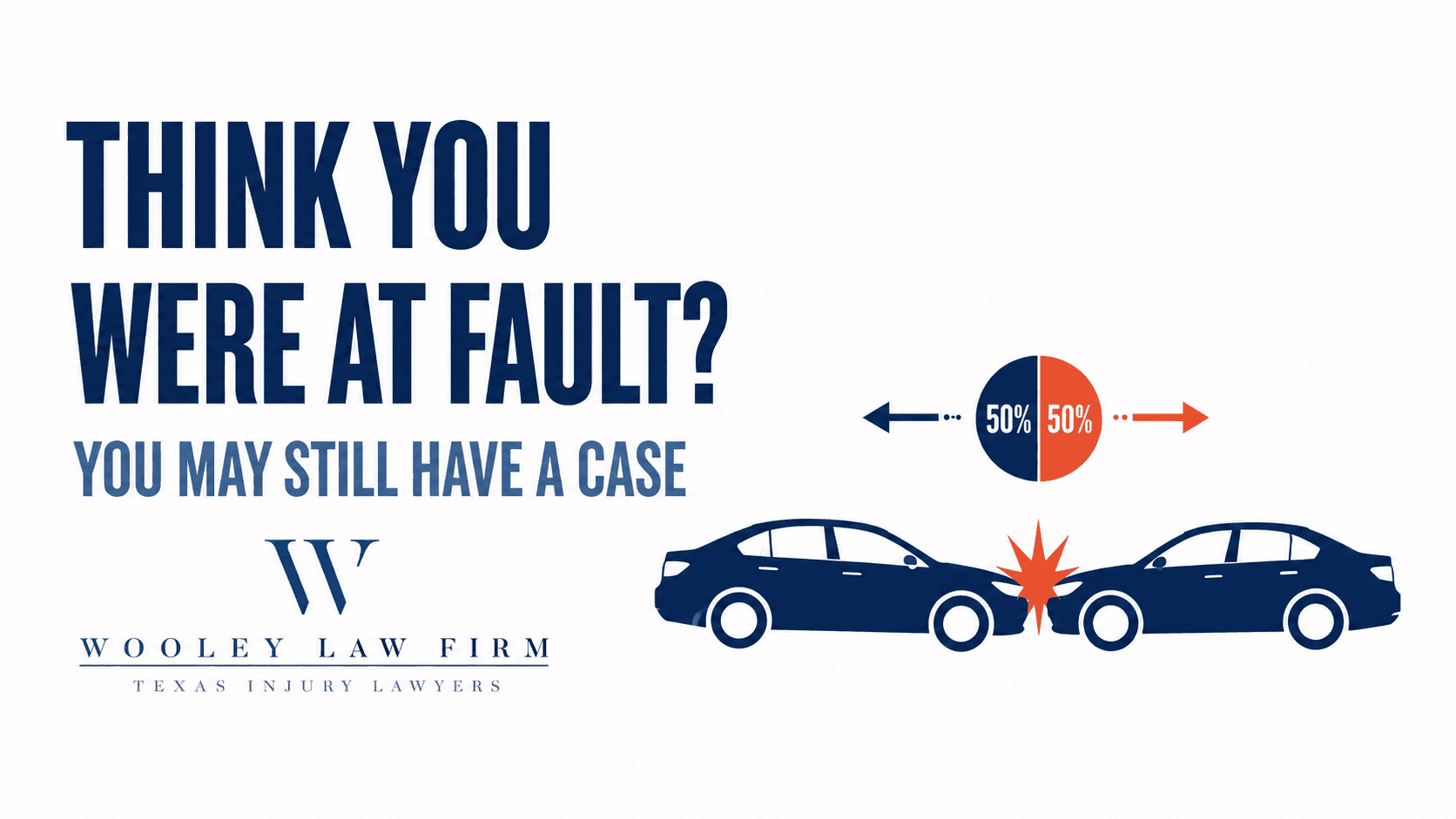
After a car accident in Dallas, it is common to replay the wreck in your head and wonder whether you did something wrong.
Maybe you were changing lanes when another vehicle hit you.
Maybe you were going slightly over the speed limit.
Maybe you were making a left turn.
Maybe you looked away for a moment before the collision.
Maybe the police officer gave you a ticket.
Or maybe an insurance adjuster has already told you that you were “partly at fault.”
Do not automatically assume that means you cannot recover compensation for your injuries.
Texas allows responsibility for a car accident to be divided between multiple people. Depending on the evidence, you may still have a claim even if you contributed to causing the collision.
If you were seriously injured and liability is disputed, our Dallas car accident lawyer page explains more about how The Wooley Law Firm investigates crashes, deals with insurance companies, and helps injured people pursue compensation.
Can I Recover Compensation If I Was Partly at Fault for a Car Accident in Texas?
Yes, potentially.
Texas follows a system called proportionate responsibility, which is also commonly described as modified comparative negligence.
Under Texas law, you are generally barred from recovering damages if your percentage of responsibility is greater than 50%.
That means:
10% at fault: you may still recover
25% at fault: you may still recover
40% at fault: you may still recover
50% at fault: you may still recover
51% or more at fault: you generally cannot recover under Texas's proportionate responsibility rules
If you are allowed to recover, your damages are generally reduced by your percentage of responsibility.
This is sometimes called the Texas 51% rule.
How Does the Texas 51% Rule Work?
Assume you suffered $100,000 in recoverable damages after a Dallas car wreck.
If You Are 10% at Fault
Your damages would generally be reduced by 10%.
$100,000 becomes $90,000.
If You Are 25% at Fault
Your damages would generally be reduced by 25%.
$100,000 becomes $75,000.
If You Are 50% at Fault
You may still recover because the statutory bar applies when your responsibility is greater than 50%.
Your $100,000 in damages would generally be reduced to $50,000.
If You Are 51% at Fault
You may be barred from recovering.
That is why disagreements about fault percentages can become extremely important in a serious Texas car accident case.
Do Not Decide for Yourself That the Accident Was Your Fault
One of the biggest mistakes an injured driver can make is deciding at the scene that the wreck was entirely their fault before all the evidence is known.
Car crashes happen in seconds.
You know what you were doing. You usually do not know everything the other driver was doing.
For example, you might believe you caused the collision because you were changing lanes.
But later evidence could show that the other driver:
Was speeding
Was looking at a cellphone
Accelerated while you were entering the lane
Drifted out of another lane
Failed to maintain a proper lookout
Ran a traffic light
Was impaired
Had time to avoid the collision but failed to react
Fault is not necessarily all-or-nothing.
That is why The Wooley Law Firm focuses on investigating what actually happened rather than accepting an insurance adjuster's initial opinion.
For more information about the evidence needed to establish liability, see our article on proving a car accident claim in Texas.
What If I Told Someone the Accident Was My Fault?
Maybe you got out of your car and immediately said:
“I’m sorry.”
“I didn't see you.”
“I think that was my fault.”
Do not assume one statement automatically destroys your case.
People say things immediately after collisions when they are frightened, embarrassed, injured, or still processing what happened.
An admission can become evidence, but it does not necessarily answer every liability question.
Video, witnesses, vehicle damage, roadway evidence, traffic signals, and the conduct of the other driver may tell a more complete story.
This is also why you should be careful about what you say afterward. Our guide on things not to say to an insurance adjuster explains why statements such as “it was my fault” can later be used against you.
What If the Police Report Says I Caused the Accident?
A police report can be important, but it does not necessarily determine the final outcome of a personal injury claim.
The investigating officer normally arrives after the crash has already occurred.
The officer may rely on:
Driver statements
Witness statements
Vehicle positions
Damage
Roadway evidence
Traffic citations
Available photographs
But the officer may not have surveillance video, dashcam footage, electronic vehicle data, phone records, or witnesses who are discovered later.
If you need to obtain or review your report, our guide explains how to get a Texas Peace Officer's Crash Report after a Dallas-Fort Worth accident.
Even if the report lists you as a contributing driver, the investigation should not necessarily end there.
What If I Got a Ticket After the Crash?
Receiving a traffic citation does not automatically mean you are 100% responsible for a civil injury case.
Suppose you received a ticket for an unsafe lane change.
That may be relevant.
But what if the other driver was traveling 20 miles per hour over the speed limit?
What if that driver was texting?
What if that driver changed lanes at almost the same time?
The actions of both drivers can matter.
A citation is evidence. It is not necessarily the entire case.
Rear-End Accident? You May Not Automatically Be at Fault
One common situation involves a driver who rear-ends another vehicle and assumes there is no possible claim.
That is not always true.
The facts surrounding the collision still matter.
For example, the front vehicle may have:
Suddenly entered your lane
Cut you off without enough stopping distance
Had defective or nonfunctioning brake lights
Stopped unexpectedly because of another collision
Been part of a chain-reaction wreck
Our article on rear-end crashes in Texas and why fault is not always automatic explains these situations in more detail.
Injured in an Accident?
Free consultation. Tell us what happened and learn what options may be available.
Why Insurance Companies Want to Put Part of the Blame on You
Comparative fault gives an insurance company a strong financial incentive to shift responsibility.
Every percentage point assigned to you can potentially reduce what it has to pay.
Consider a serious injury case involving $500,000 in damages.
If you are found:
10% responsible, the potential reduction is $50,000
20% responsible, the potential reduction is $100,000
40% responsible, the potential reduction is $200,000
And if the insurer can establish that you were more than 50% responsible, it may argue that it owes you nothing for the injury claim.
That is why you should view an insurance company's percentage determination as the insurance company's position, not necessarily a final determination of fault.
Common Arguments Insurance Companies Use to Blame Injured Drivers
Some of the most common comparative-fault allegations include:
Speeding
The insurance company may claim you were traveling too fast to avoid the crash.
Distracted Driving
An adjuster may ask whether you were using your phone, changing music, speaking with someone in the vehicle, or looking at navigation.
Unsafe Lane Change
Lane-change accidents commonly become contested because both drivers claim they had possession of the lane.
Following Too Closely
This commonly arises in rear-end collisions and chain-reaction wrecks.
Failure to Keep a Proper Lookout
The insurer may claim you should have seen the danger earlier.
Failure to Take Evasive Action
Even when another driver created the dangerous situation, the insurer may argue that you should have braked or swerved.
The key issue is whether those allegations are supported by evidence.
Multi-Vehicle Wrecks Can Have Several At-Fault Drivers
Comparative responsibility becomes even more important when three, four, or more vehicles are involved.
For example:
Driver A may initiate the crash.
Driver B may be following too closely.
Driver C may be speeding.
Driver D may make an unsafe evasive maneuver.
Responsibility may potentially be divided among multiple people.
This often happens in chain-reaction wrecks on highways such as I-35E, I-30, I-635, I-20, US-75, and the Dallas North Tollway.
Our guide to multi-vehicle car wrecks in Dallas explains how multiple drivers, insurance companies, and coverage limits can complicate these claims.
What Evidence Can Prove Who Was Actually at Fault?
When liability is disputed, objective evidence becomes extremely important.
Crash Scene Photographs
Photographs may show:
Vehicle resting positions
Lane markings
Skid marks
Debris
Traffic lights
Traffic signs
Vehicle damage
Road conditions
Sight obstructions
Take both close-up and wide-angle photographs when it is safe to do so.
Surveillance Video
Video can sometimes resolve a disputed-liability case almost immediately.
Potential sources include:
Gas stations
Restaurants
Shopping centers
Apartment complexes
Homes
Doorbell cameras
Parking garages
Dashcams
Nearby businesses
The challenge is that recordings may be overwritten.
That is one reason evidence preservation should begin quickly.
Independent Witnesses
A witness may be able to explain:
Which driver changed lanes
Who entered an intersection first
Which direction a vehicle was traveling
Whether someone ran a red light
Whether a vehicle appeared to be speeding
Whether the driver was using a phone
What happened immediately before the collision
Vehicle Damage
The location and angle of the damage can sometimes help reconstruct how the collision occurred.
Take photographs before the vehicles are repaired or disposed of.
Electronic Vehicle Data
Depending on the vehicle and circumstances, electronic information may provide evidence regarding:
Speed
Braking
Acceleration
Steering
Seatbelt use
Other vehicle activity immediately before impact
Cellphone Evidence
In significant injury cases where distracted driving is suspected, phone evidence may become important.
What Should I Say If the Insurance Adjuster Asks Whether I Was at Fault?
Do not guess.
An adjuster may ask:
“Is there anything you could have done differently?”
“Were you speeding?”
“Why didn't you brake?”
“Did you see the other car?”
“Were you distracted?”
“Would you agree that you were partly responsible?”
These questions may sound casual, but your answers could later be used to support a comparative-fault argument.
If you are uncertain about what happened, say you do not know rather than speculating.
You should be particularly careful before agreeing to a recorded statement.
Our article on what not to say to an insurance adjuster provides additional guidance about statements that can harm an injury claim.
What If the Insurance Company Denies My Claim Because It Says I Caused the Accident?
A liability denial does not necessarily mean the insurance company is correct.
Ask how it reached its decision.
What evidence did the adjuster rely on?
Did the company obtain surveillance footage?
Did it speak with independent witnesses?
Did it inspect the vehicles?
Did it simply accept its insured driver's version of events?
Insurance denials can also involve coverage issues separate from fault. If you are dealing with an insurance dispute, see our article on denied insurance coverage after a Texas accident.
What If the Other Driver Does Not Have Enough Insurance?
Fault is only one part of a serious car accident case.
You also have to determine what insurance coverage is available.
If another driver caused most of the collision but does not have enough liability insurance to cover your injuries, your own uninsured or underinsured motorist coverage may become important.
Learn more in our guide to Texas uninsured and underinsured motorist coverage.
Can I Recover If Both Drivers Were 50% at Fault?
Potentially, yes.
This is one of the most misunderstood parts of Texas's proportionate responsibility law.
The statutory bar generally applies when your percentage of responsibility is greater than 50%.
If you are exactly 50% responsible, you are not automatically barred by the 51% rule, although your recoverable damages would generally be reduced by your 50% share of responsibility.
What Damages Can I Recover If I Share Some Fault?
If you are permitted to recover, the types of damages available depend on the facts of the case.
They may include compensation for:
Medical expenses
Future medical care
Lost wages
Loss of earning capacity
Physical pain
Mental anguish
Physical impairment
Disfigurement
Property damage
Other legally recoverable losses
Your percentage of responsibility may then reduce the amount you are entitled to recover.
What Should I Do If I Think I Was Partly at Fault?
Get Medical Treatment
Do not avoid medical treatment because you think you may have contributed to the wreck.
Your health comes first.
Preserve Photos and Video
Save everything related to the collision, including dashcam footage.
Write Down What Happened
Record your memory while it is fresh.
Include:
Where each vehicle was located
Traffic signals
Lane positions
Approximate speeds
Weather
Visibility
What you saw before impact
Conversations at the scene
Get the Police Report
You can use our Texas crash report guide to understand how to obtain the report.
Do Not Guess During a Recorded Statement
If you do not know an answer, do not speculate.
Do Not Sign a Release Too Quickly
A settlement release can end your injury claim.
Before signing anything, understand exactly what rights you are giving up.
Have the Fault Decision Investigated
If you suffered significant injuries, do not automatically accept the insurance company's allocation of fault.
How The Wooley Law Firm Helps When Fault Is Disputed
When an insurance company claims our client caused or contributed to a Dallas car wreck, we look at the evidence.
Depending on the circumstances, The Wooley Law Firm can investigate:
Police reports
Crash-scene photographs
Surveillance footage
Dashcam video
Vehicle damage
Witness statements
Traffic signals
Electronic vehicle information
Cellphone evidence
Roadway evidence
Statements from the drivers
Other potentially responsible parties
We can also communicate with the insurance companies so you do not have to argue about fault with an adjuster while trying to recover from your injuries.
Learn more about how we handle these cases on our Dallas car accident lawyer page.
Frequently Asked Questions About Being Partly at Fault for a Texas Car Accident
Can I sue if I think the accident was partly my fault?
Possibly. Texas law allows an injured claimant to recover in some cases even when that person shares responsibility. Your recovery may be reduced by your percentage of fault.
What is the 51% rule in Texas?
Generally, if you are more than 50% responsible for the occurrence, Texas's proportionate responsibility statute bars your recovery.
Can I recover if I am exactly 50% at fault?
Potentially, yes. The statutory bar applies when your responsibility is greater than 50%. A recovery would generally be reduced according to your assigned percentage.
What if the police officer says the accident was my fault?
The crash report can be important evidence, but it does not necessarily resolve every disputed liability issue. Additional evidence may change the analysis.
What if I received a ticket?
A citation may be relevant, but it does not automatically establish that you were 100% responsible for a civil injury claim.
What if I rear-ended another vehicle?
Do not automatically assume you have no case. Read our guide explaining why a rear-end crash does not always mean automatic fault in Texas.
What if I already told the insurance company I was at fault?
Do not assume the claim is over. Your statement may be evidence, but it should be evaluated together with the physical evidence, witnesses, video, and actions of the other driver.
What if the insurance company says I am 60% responsible?
That is the insurance company's liability position. Depending on the circumstances and evidence, it may be challenged.
Injured in a Dallas Car Accident and Being Blamed for the Wreck?
If you were injured in a Dallas car accident, highway collision, rear-end wreck, intersection accident, lane-change crash, or multi-vehicle collision, do not assume you have no case simply because you believe you made a mistake.
The other driver may also have contributed to the collision.
Important evidence may not yet have been discovered.
And an insurance company's initial fault decision does not necessarily determine the final outcome of your case.
The Wooley Law Firm can investigate the collision, preserve evidence, analyze disputed liability, deal with the insurance companies, and determine what options may be available.
If you were injured in a Dallas car accident, North Central Expressway crash, or a multiple-vehicle wreck, you may have the right to seek justice and pursue compensation for medical expenses, pain and suffering, lost wages, mental anguish, impairment, and other damages.
Call (214) 699-6524 for a free consultation. You don’t pay unless we win.
Disclaimer
This article is for general informational purposes only and is not legal advice. Reading it does not create an attorney-client relationship. Every case is different.
Topics
Share This Article

Andrew J. Wooley
Personal Injury Attorney
Andrew J. Wooley is a dedicated personal injury attorney based in Dallas, Texas. He focuses on helping accident victims recover fair compensation for their injuries. With a commitment to personalized service, Andrew works directly with each client to understand their unique situation and fight for their rights.
Related Local News
Recent related coverage