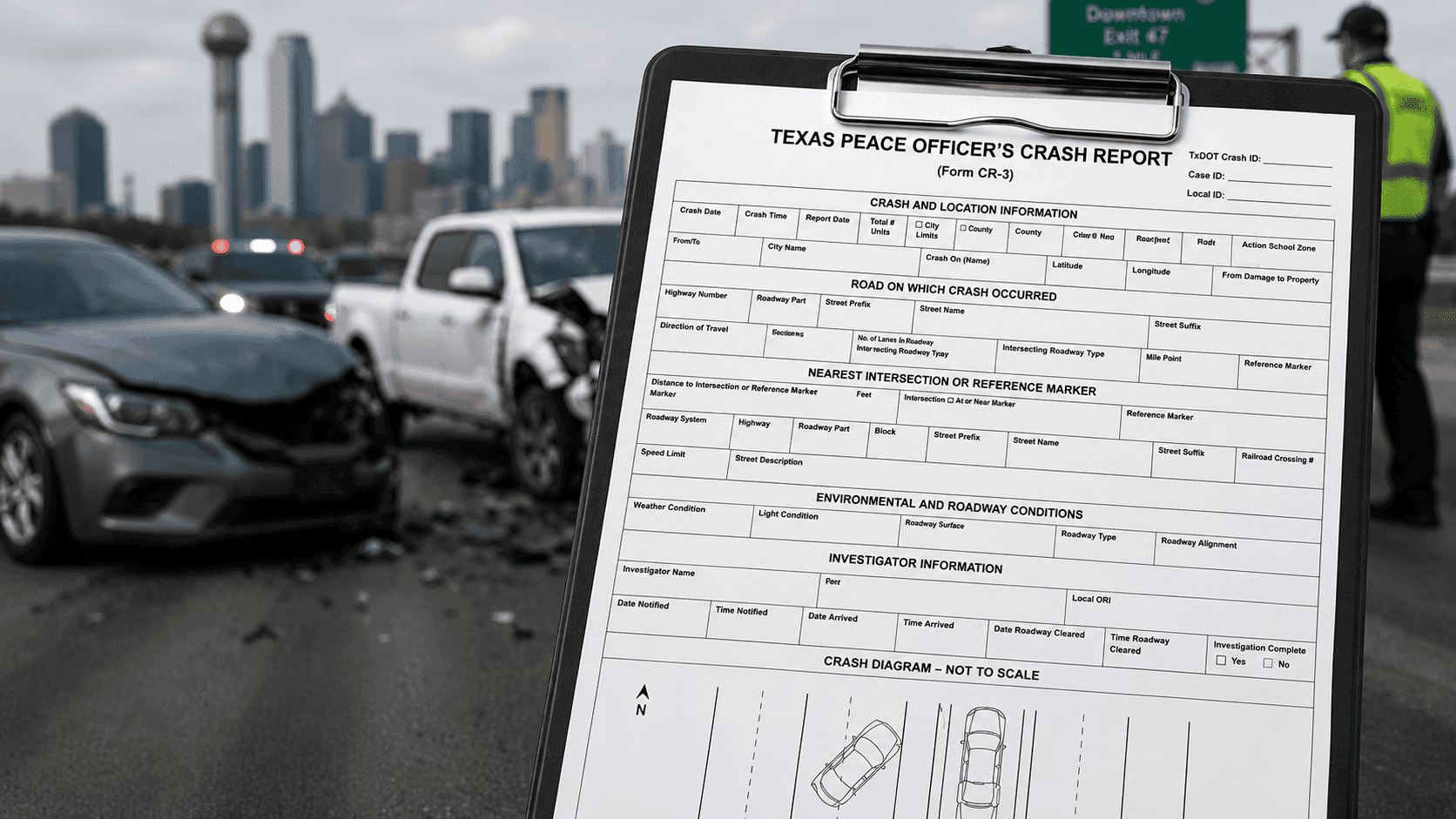
If you were injured in a car accident, 18-wheeler crash, truck wreck, motorcycle collision, rideshare accident, or multi-vehicle crash in Dallas-Fort Worth, one of the first documents you may need is the Texas Peace Officer’s Crash Report. This report is often called a Texas crash report, CR-3 report, police accident report, or car accident report.
For injured people and families, the crash report can be an important first step in an insurance claim or personal injury case. It may identify the drivers, vehicles, insurance companies, crash location, contributing factors, citations, witnesses, injuries, and the investigating officer’s description of what happened.
At The Wooley Law Firm, we help people injured in car wrecks and truck accidents across Dallas, Fort Worth, Arlington, Plano, Irving, Garland, Mesquite, Frisco, McKinney, Denton, Grand Prairie, Carrollton, Richardson, Lewisville, Grapevine, and throughout the DFW metroplex. We can help you obtain your crash report, investigate the wreck, deal with the insurance companies, and pursue the compensation you may be entitled to recover.
What Is a Texas Peace Officer’s Crash Report?
A Texas Peace Officer’s Crash Report is the official crash report prepared by law enforcement after investigating a motor vehicle accident. In Texas, this report is commonly known as the CR-3 crash report.
After a serious collision, the report may be prepared by:
Dallas Police Department
Fort Worth Police Department
Arlington Police Department
Plano Police Department
Irving Police Department
Garland Police Department
Mesquite Police Department
Frisco Police Department
McKinney Police Department
Denton Police Department
Texas Department of Public Safety
Dallas County Sheriff’s Office
Tarrant County Sheriff’s Office
Collin County Sheriff’s Office
Denton County Sheriff’s Office
Another local police department in the Dallas-Fort Worth area
The report can be especially important after a serious injury crash, commercial truck accident, 18-wheeler wreck, fatal collision, hit-and-run crash, drunk driving accident, distracted driving crash, rear-end collision, intersection crash, highway wreck, or chain-reaction accident.
Why the Crash Report Matters After a Dallas-Fort Worth Car or Truck Wreck
Insurance companies often look at the crash report early in the claim process. The report may affect how the insurance adjuster evaluates fault, liability, damages, and settlement value.
A Texas crash report may include:
Names of the drivers involved
Vehicle and insurance information
Crash date, time, and location
Roadway, weather, and lighting conditions
Diagrams of the collision
Officer narrative
Contributing factors
Citations issued
Witness information
Injury information
Whether alcohol, drugs, speeding, distracted driving, unsafe lane changes, failure to yield, or following too closely may have contributed to the wreck
But the crash report is not the entire case. Police officers usually arrive after the wreck has already happened. They may not have access to all video footage, witness statements, black box data, phone records, trucking company documents, medical records, or expert accident reconstruction evidence.
That is why an injured person should not rely only on the police report. A lawyer can review the crash report, identify problems, and investigate what really happened.
How to Get a Texas Crash Report After a Car Accident in Dallas-Fort Worth
If you were involved in a wreck in Dallas-Fort Worth, you may be able to request the crash report online, by mail, or through the investigating law enforcement agency.
1. Request the Crash Report Through TxDOT
The Texas Department of Transportation maintains crash reports for accidents investigated by Texas peace officers. Many reports can be purchased through TxDOT’s online crash report system.
You can request a Texas crash report through the TxDOT Crash Report Online Purchase System.
To search for your report, you may need information such as:
Date of the crash
Location of the wreck
Name of a driver or person involved
City or county where the crash happened
Vehicle identification number
Crash report number
Police service number or incident number
Crash reports are not always available immediately. It may take up to fourteen days for the crash report to be available.
Injured in an Accident?
Free consultation. Tell us what happened and learn what options may be available.
2. Request the Report From the Police Department or Sheriff’s Office
You may also be able to request the accident report from the law enforcement agency that investigated the crash.
For example:
If the wreck happened in Dallas, the Dallas Police Department may have the report.
If the crash happened in Fort Worth, the Fort Worth Police Department may have the report.
If the wreck happened in Dallas County but outside a city’s jurisdiction, or in an area handled by county law enforcement, the Dallas County Sheriff’s Office may have investigated the crash.
If the collision happened outside city limits in Tarrant County, or in an area handled by county law enforcement, the Tarrant County Sheriff’s Office may have the report.
If the wreck happened on a highway, interstate, service road, or rural roadway, a Texas DPS trooper may have investigated.
If the crash happened in or near a surrounding city, such as Garland, Mesquite, Irving, Richardson, Grand Prairie, Carrollton, or another Dallas-Fort Worth city, that city’s police department may have investigated the wreck.
If you do not know which agency investigated the crash, an attorney can help determine where the report is located.
3. Request the Report by Mail or In Person
Some law enforcement agencies allow crash reports to be requested by mail or in person. You may need to provide:
Your name
Date of the accident
Crash location
Name of another driver involved
Police report number, if available
Proof that you are entitled to receive the report
An attorney can also request the report on behalf of an injured client.
Who Can Get a Texas CR-3 Crash Report?
Texas crash reports are not available to everyone without restriction. Generally, a person requesting the report must have a proper connection to the accident.
People who may be able to obtain a Texas crash report include:
A driver involved in the wreck
A passenger injured in the crash
The owner of a damaged vehicle
A person injured in the collision
A parent or legal guardian of an involved person
An employer of an involved driver
An insurance company connected to the crash
A person who may bring a wrongful death claim
An attorney representing someone involved in the accident
If you were injured in a car or truck wreck, The Wooley Law Firm can help request and review your crash report.
What If the Police Report Blames You for the Accident?
Sometimes crash reports are incomplete or wrong. This can be a serious problem when an insurance company tries to use the report against you.
A crash report may contain mistakes about:
How the wreck happened
Which driver had the right of way
Whether a driver was speeding
Whether a driver was distracted
Whether a commercial truck driver violated safety rules
Whether a driver ran a red light or stop sign
Whether unsafe lane changes caused the crash
Whether a rear-end crash involved sudden stopping or multiple impacts
Whether a witness was interviewed
Whether injuries were properly documented
If the police report is wrong, you should speak with a personal injury lawyer as soon as possible. An attorney may be able to gather additional evidence, speak with witnesses, request video footage, consult experts, and challenge the insurance company’s version of events.
Why You Need More Than a Crash Report After a Truck Accident
Truck accident cases are often more complex than ordinary car accident claims. A crash involving an 18-wheeler, semi-truck, tractor-trailer, delivery truck, commercial van, dump truck, box truck, or company vehicle may involve multiple responsible parties.
Potentially responsible parties may include:
The truck driver
The trucking company
The truck owner
A trailer owner
A freight broker
A maintenance company
A loading company
A parts manufacturer
Another negligent driver
Important evidence in a Texas truck accident case may include:
Driver qualification files
Hours-of-service records
Electronic logging device data
Black box or event data recorder information
Dispatch records
Maintenance and inspection records
Drug and alcohol testing records
Dash camera footage
Cargo loading records
Safety policies and training materials
Cell phone records
Prior crash or violation history
This evidence can disappear quickly. Trucking companies and insurance carriers may begin defending the case immediately. If you were injured in a truck wreck in Dallas-Fort Worth, it is important to act quickly to preserve evidence.
How a Dallas-Fort Worth Car Accident Lawyer Can Help
After a serious car or truck accident, an attorney can protect your claim and fight for the compensation you deserve.
A Lawyer Can Obtain and Analyze the Crash Report
A personal injury attorney can request the Texas Peace Officer’s Crash Report, review the officer’s findings, explain the codes and contributing factors, and determine whether the report supports or hurts your claim.
A Lawyer Can Investigate the Cause of the Wreck
The police report may only tell part of the story. An attorney can investigate whether the wreck was caused by:
Speeding
Distracted driving
Drunk driving
Drug impairment
Driver fatigue
Tailgating
Unsafe lane changes
Failure to yield
Running a red light
Running a stop sign
Reckless driving
Aggressive driving
Unsafe turns
Defective vehicle parts
Poor truck maintenance
Negligent hiring or training
Overloaded cargo
Dangerous road conditions
A Lawyer Can Preserve Critical Evidence
Evidence can be lost, deleted, repaired, destroyed, or overwritten. A car accident lawyer can send preservation letters, request video footage, inspect the vehicles, locate witnesses, and work to protect the evidence needed to prove your case.
A Lawyer Can Deal With the Insurance Companies
Insurance companies are not on your side. Adjusters may try to get you to give a recorded statement, sign broad medical authorizations, accept blame, downplay your injuries, or settle before you know the full value of your case.
An attorney can handle communications with the insurance companies, protect you from unfair tactics, and fight for a full and fair recovery.
A Lawyer Can Help Prove Your Damages
After a serious wreck, compensation may include more than emergency room bills or vehicle damage. Depending on the facts, an injured person may be able to pursue compensation for:
Past medical expenses
Future medical care
Surgery
Physical therapy
Lost wages
Loss of earning capacity
Pain and suffering
Mental anguish
Physical impairment
Disfigurement
Loss of enjoyment of life
Property damage
Out-of-pocket expenses
In fatal car and truck crash cases, surviving family members may be able to pursue wrongful death and survival claims.
A Lawyer Can File a Lawsuit If the Insurance Company Refuses to Be Fair
Many injury claims settle, but not every insurance company makes a fair offer. When necessary, an attorney can file a lawsuit, conduct discovery, take depositions, hire experts, and prepare the case for trial.
Injured in a Dallas-Fort Worth Car or Truck Wreck? Call The Wooley Law Firm.
If you were injured in a Dallas car accident, Fort Worth truck wreck, 18-wheeler crash, highway collision, rideshare accident, motorcycle wreck, or multi-vehicle crash anywhere in the DFW metroplex, a Texas Peace Officer’s Crash Report may be an important first step.
But the crash report is only the beginning.
The Wooley Law Firm can help you obtain the report, investigate the wreck, preserve evidence, deal with the insurance companies, and pursue compensation for medical expenses, pain and suffering, lost wages, mental anguish, impairment, and other damages.
Call (214) 699-6524 for a free consultation. You don’t pay unless we win. Contact Us Today!
Topics
Share This Article

Andrew J. Wooley
Personal Injury Attorney
Andrew J. Wooley is a dedicated personal injury attorney based in Dallas, Texas. He focuses on helping accident victims recover fair compensation for their injuries. With a commitment to personalized service, Andrew works directly with each client to understand their unique situation and fight for their rights.
Related Local News
Recent related coverage