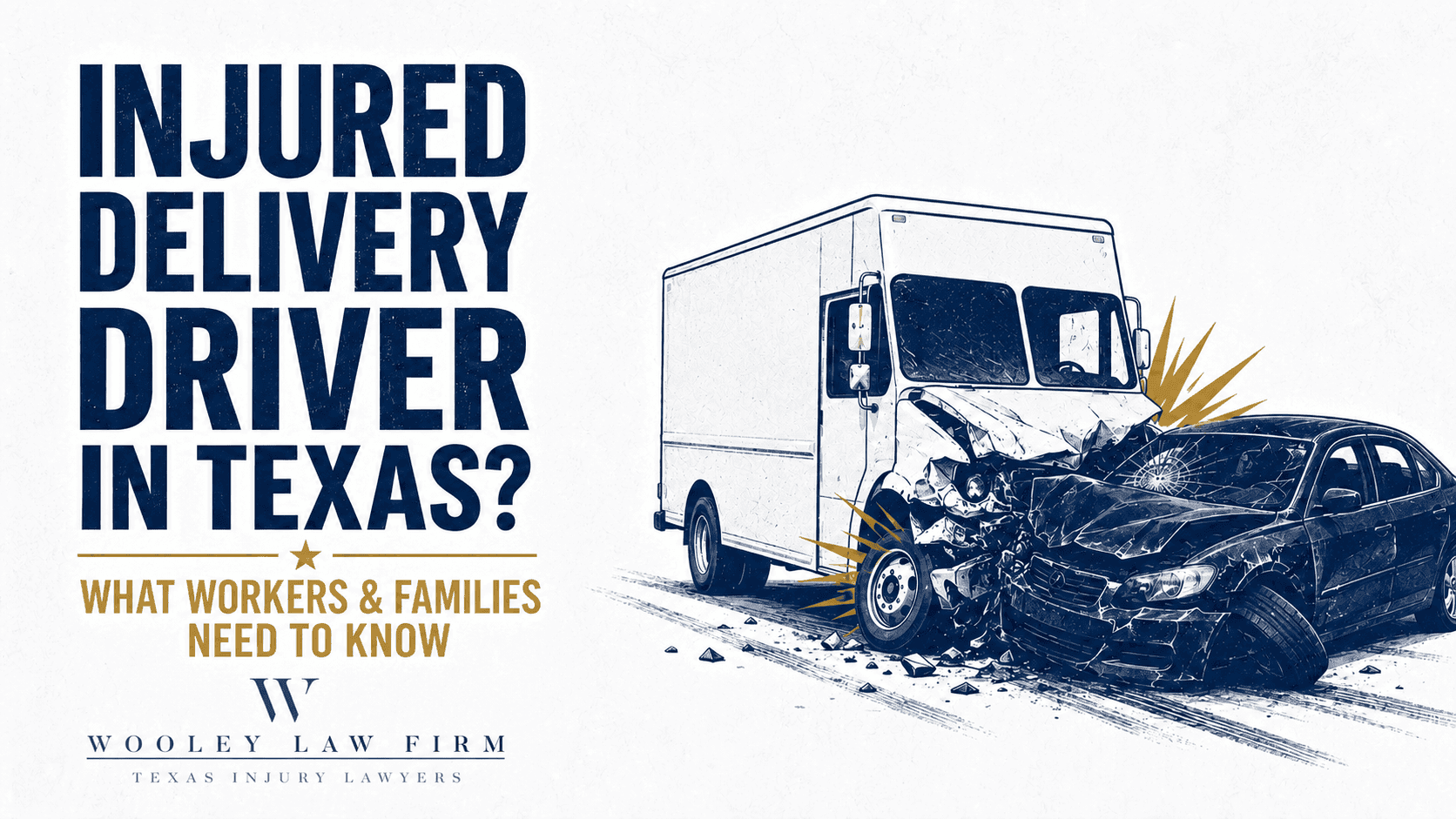
FedEx drivers spend long hours on Texas roads, often working around heavy traffic, tight delivery schedules, dangerous shoulders, loading areas, warehouses, rail crossings, and unfamiliar neighborhoods. When a FedEx driver is seriously injured or killed in a wreck, the case may involve much more than an ordinary workers’ compensation claim.
The injured driver or surviving family may have claims against another motorist, a trucking company, a property owner, a vehicle manufacturer, a maintenance contractor, or another business that contributed to the crash.
The first question should not simply be whether employment benefits are available.
The more important question is:
Did someone outside the FedEx driver’s employer cause or contribute to the wreck?
If so, the driver or family may have a separate third-party personal injury or wrongful death claim under Texas law.
What Should a FedEx Driver Do After a Serious Wreck?
A FedEx driver injured while making deliveries, driving between facilities, transporting packages, or performing another work-related task should report the accident to the employer as soon as possible.
The driver should also:
Call 911;
Request a police investigation;
Seek immediate medical care;
Photograph the vehicles and crash scene;
Obtain the other driver’s insurance information;
Identify all witnesses;
Preserve dash-camera or cellphone video;
Photograph company names, DOT numbers, license plates, and vehicle numbers;
Keep copies of work restrictions and medical records; and
Avoid giving detailed recorded statements before speaking with an attorney.
A serious crash may create two different legal tracks.
The first may involve workers’ compensation, an occupational accident policy, disability benefits, or another employment-related benefit program.
The second may involve a claim against the person or company that caused the crash.
These claims are not always handled the same way, and accepting one type of benefit does not necessarily eliminate the other.
Can a FedEx Driver Sue After a Work-Related Wreck?
A FedEx driver generally cannot sue a subscribing employer for ordinary negligence when the employer carries Texas workers’ compensation coverage. However, that does not prevent the driver from pursuing a negligent third party.
A third-party claim may exist when the crash was caused by:
A careless passenger-vehicle driver;
An 18-wheeler driver;
Another delivery company;
A construction contractor;
A vehicle or parts manufacturer;
A repair or maintenance company;
A property owner;
A loading company;
A governmental entity; or
Another business involved in the transportation operation.
For example, a FedEx driver rear-ended by an 18-wheeler may have employment benefits through the driver’s employer and a separate personal injury claim against the truck driver and trucking company.
The third-party claim may allow the injured worker to recover damages that are not fully covered through an employment-benefit program.
What If the FedEx Driver Is Classified as a Contractor?
Not every person driving a FedEx-branded vehicle is directly employed by FedEx.
A driver may work for:
A FedEx operating company;
A local service provider;
A route contractor;
A fleet owner;
A staffing company;
An independent delivery business; or
Another company operating within the FedEx network.
The company name on the driver’s paycheck may be different from the company name displayed on the truck.
This distinction matters because the driver’s employer may determine:
Whether traditional workers’ compensation applies;
Whether an occupational accident policy applies;
Whether the employer is a Texas nonsubscriber;
Which insurance company handles the claim;
Whether wage-loss benefits are available;
Whether medical treatment must be approved; and
Whether the driver may have claims against additional companies.
Drivers should not assume they have no case merely because they were called an independent contractor.
Texas courts look beyond labels in some situations. The actual working relationship, level of control, contracts, payment arrangement, route requirements, and other facts may matter.
What If the Employer Does Not Have Workers’ Compensation?
Texas does not require most private employers to carry traditional workers’ compensation insurance.
An employer that does not participate in the Texas workers’ compensation system is commonly called a nonsubscriber.
If a FedEx contractor or delivery company is a nonsubscriber, an injured driver may have different legal rights. Depending on the facts, the driver may be able to bring a negligence claim against the employer.
A nonsubscriber case may involve allegations such as:
Requiring the driver to operate an unsafe vehicle;
Failing to maintain brakes or tires;
Assigning an unsafe delivery schedule;
Failing to train the driver;
Ignoring complaints about dangerous equipment;
Requiring work despite fatigue or illness;
Failing to provide safe loading procedures; or
Exposing the driver to an unreasonable workplace danger.
Some nonsubscribing employers provide occupational injury plans instead of traditional workers’ compensation. These plans may have deadlines, limitations, required providers, and appeal procedures.
A Texas attorney can review the policy, plan documents, employment agreement, and coverage information to determine which claims may be available.
Who Can Be Liable for a FedEx Driver’s Injuries?
A serious FedEx driver accident should be investigated from every angle.
A Negligent Motorist
Many FedEx driver injuries are caused by other drivers who:
Run red lights;
Fail to yield;
Rear-end delivery vehicles;
Speed through work zones;
Cross into oncoming traffic;
Drive while intoxicated;
Use a cellphone;
Make unsafe lane changes; or
Ignore stopped or slowing delivery vehicles.
The negligent driver and that driver’s insurance company may be responsible for the FedEx worker’s injuries.
A Trucking Company
If an 18-wheeler or commercial truck caused the wreck, the driver and trucking company may both be liable.
A trucking company may be responsible for:
Driver fatigue;
Hours-of-service violations;
Unsafe hiring;
Poor training;
Negligent supervision;
Defective brakes;
Worn tires;
Overloaded cargo;
Improper maintenance; or
Pressuring drivers to meet unsafe schedules.
Truck accident cases often involve electronic logs, engine data, onboard cameras, GPS information, inspection records, and company safety files.
Injured in an Accident?
Free consultation. Tell us what happened and learn what options may be available.
A Vehicle or Parts Manufacturer
A defective vehicle or component may contribute to a crash or make the driver’s injuries worse.
Potential defects may involve:
Brakes;
Tires;
Steering systems;
Airbags;
Seatbelts;
Doors;
Fuel systems;
Vehicle stability systems; or
Collision-avoidance technology.
The delivery vehicle should be preserved when a mechanical defect may have caused the crash.
A Maintenance or Repair Company
FedEx vehicles and contractor-owned delivery vehicles may be serviced by outside repair facilities.
A maintenance company may share responsibility when it:
Performed defective brake work;
Failed to replace worn tires;
Improperly installed a wheel;
Missed a steering defect;
Approved an unsafe vehicle for service; or
Failed to complete required repairs.
Maintenance records and repair invoices should be obtained before they disappear.
A Property Owner or Business
FedEx drivers frequently enter loading docks, warehouses, apartment complexes, shopping centers, private roads, and commercial properties.
A property owner or business may be responsible for injuries caused by:
Dangerous loading areas;
Poor lighting;
Hidden drop-offs;
Broken pavement;
Unsafe traffic patterns;
Defective gates;
Missing warning signs;
Dangerous railroad crossings;
Unsecured cargo; or
Negligent forklift operation.
Not every FedEx driver injury happens on a public highway. A driver injured on private property may still have a third-party claim.
A Governmental Entity
Dangerous roadway design, missing signs, defective traffic signals, or the negligent operation of a governmental vehicle may contribute to a wreck.
Claims against cities, counties, transportation authorities, or other governmental entities may have short notice deadlines. A driver should not wait to investigate a possible governmental claim.
What Compensation Can an Injured FedEx Driver Recover?
The available compensation depends on the type of claim.
A third-party personal injury claim may include compensation for:
Past and future medical expenses;
Lost wages;
Reduced earning capacity;
Physical pain;
Mental anguish;
Physical impairment;
Disfigurement;
Future medical treatment;
Rehabilitation;
Surgery;
Home assistance; and
Property damage.
FedEx drivers may suffer injuries that prevent them from returning to commercial driving or delivery work.
A driver may be unable to:
Lift packages;
Enter and exit a vehicle repeatedly;
Sit for long periods;
Pass a commercial medical examination;
Operate a large vehicle;
Work overtime;
Complete routes; or
Return to the same occupation.
The value of the case should reflect the effect of the injuries on the driver’s long-term earning ability—not just the amount of the initial medical bills.
Common Injuries in FedEx Driver Accidents
FedEx delivery and commercial-vehicle wrecks can cause severe injuries, including:
Traumatic brain injuries;
Concussions;
Spinal cord injuries;
Paralysis;
Neck and back injuries;
Herniated discs;
Shoulder injuries;
Rotator cuff tears;
Wrist and hand injuries;
Broken arms and legs;
Crush injuries;
Internal organ injuries;
Burns;
Amputations;
Nerve damage;
Facial injuries;
Post-traumatic stress; and
Permanent chronic pain.
A driver may initially believe the injuries are minor because of adrenaline after the crash. Symptoms from head, back, neck, nerve, and internal injuries may become more noticeable over time.
Prompt medical evaluation protects the driver’s health and documents the connection between the wreck and the injuries.
What Happens If a FedEx Driver Is Killed in a Wreck?
When a FedEx driver dies because of another person’s negligence, the surviving family may have a Texas wrongful death claim.
The deceased driver’s estate may also have a survival claim.
Wrongful Death Claims
A Texas wrongful death claim may generally be brought for the benefit of the deceased driver’s:
Spouse;
Children; and
Parents.
Potential wrongful death damages may include:
Lost income;
Lost financial support;
Lost care and services;
Lost companionship;
Mental anguish; and
Lost inheritance.
The value of a wrongful death case depends on the driver’s age, income, family relationships, life expectancy, health, and the circumstances of the death.
Survival Claims
A survival claim belongs to the deceased driver’s estate.
It may include compensation for:
Medical expenses before death;
Pain experienced before death;
Mental anguish before death;
Lost earnings before death;
Property damage; and
Funeral expenses paid by the estate.
If the driver survived for any period after the collision, medical and witness evidence may be important in establishing conscious pain and suffering.
What Benefits May Be Available to the Family?
The family of a deceased FedEx driver may have access to several possible sources of compensation.
These may include:
Workers’ compensation death benefits;
Occupational accident benefits;
Employer-provided life insurance;
Accidental death coverage;
Disability benefits;
Retirement benefits;
Third-party insurance claims;
Uninsured or underinsured motorist coverage; and
Wrongful death and survival claims.
These benefits may overlap, and one insurer may claim a right to reimbursement from another recovery.
Families should not assume that an employment death benefit is the only compensation available.
A lawyer should identify every potential policy and responsible party.
What Evidence Should Be Preserved?
Evidence can disappear quickly after a serious commercial-vehicle crash.
Important evidence may include:
Dash-camera video;
In-cab camera footage;
GPS and route data;
Package-scan records;
Dispatch messages;
Vehicle telematics;
Engine-control-module data;
Cellphone records;
Driver schedules;
Timecards;
Surveillance video;
Police photographs;
Witness statements;
Maintenance records;
Inspection reports;
Employment agreements;
Insurance policies;
Occupational accident plans; and
Contracts between FedEx and service providers.
The damaged vehicle may also contain critical evidence.
It should not be repaired, destroyed, sold, or returned to service before an appropriate inspection when mechanical failure or crash reconstruction may be an issue.
Why a Preservation Letter Is Important
A preservation letter instructs the people and companies involved to retain evidence related to the crash.
Depending on the facts, preservation notices may need to be sent to:
The at-fault driver;
The at-fault driver’s employer;
The trucking company;
The FedEx driver’s employer;
A FedEx operating company;
The vehicle owner;
A maintenance provider;
A warehouse;
A property owner;
An insurance company; and
Any business with surveillance footage.
The letter may request preservation of video, electronic data, employment records, vehicle records, communications, and insurance documents.
The sooner these letters are sent, the better the chance of preventing important evidence from being routinely overwritten or destroyed.
Should a FedEx Driver Give a Recorded Statement?
An insurance adjuster may request a recorded statement shortly after the collision.
The adjuster may represent:
The other driver;
The driver’s employer;
The FedEx contractor;
A workers’ compensation carrier;
An occupational accident insurer; or
Another involved company.
The driver should determine who the adjuster represents and why the statement is being requested.
Statements made early in the claim may later be used to dispute:
How the crash occurred;
Whether the driver was working;
When symptoms began;
The severity of the injuries;
Prior medical conditions;
Ability to return to work; or
The amount of lost income.
A seriously injured FedEx driver should consider speaking with a Texas attorney before giving a detailed recorded statement or signing a broad medical authorization.
What If the Other Driver Has Little or No Insurance?
Some serious FedEx driver accidents are caused by uninsured or underinsured motorists.
Other possible sources of recovery may include:
Uninsured motorist coverage;
Underinsured motorist coverage;
Commercial vehicle policies;
Employer-owned vehicle policies;
Umbrella coverage;
Excess insurance;
Policies covering additional responsible companies; or
Claims against a trucking or delivery company.
Insurance issues can become complicated when the FedEx driver was operating a company vehicle rather than a personal vehicle.
An attorney can review the commercial auto policy, employer policy, contractor policy, and any personal insurance policies that may apply.
How Long Does a FedEx Driver Have to File a Claim in Texas?
Texas generally has a two-year statute of limitations for personal injury and wrongful death claims.
However, some deadlines may be much shorter.
For example:
Workers’ compensation claims have separate notice requirements;
Occupational injury plans may have contractual deadlines;
Governmental claims may require early written notice;
Insurance policies may require prompt reporting;
Employment-benefit appeals may have short deadlines; and
Evidence may disappear within days or weeks.
A driver or family should not wait until the two-year deadline approaches.
The legal case may be damaged long before the statute of limitations expires if video, vehicle data, witness information, or other evidence is lost.
How a Texas FedEx Driver Accident Lawyer Can Help
A lawyer representing an injured FedEx driver or grieving family can investigate both the employment-benefit claim and the third-party case.
The investigation may include:
Identifying the driver’s actual employer;
Determining whether the employer has workers’ compensation;
Reviewing occupational accident plan documents;
Identifying all negligent third parties;
Obtaining insurance policies;
Sending evidence-preservation notices;
Securing dash-camera and surveillance video;
Inspecting the vehicles;
Obtaining electronic vehicle data;
Reviewing delivery and route records;
Calculating lost income and earning capacity;
Coordinating medical evidence;
Investigating wrongful death damages; and
Protecting the family from insurance-company pressure.
The driver’s employer, the other driver’s insurer, and the companies involved may each have different interests.
The injured worker needs an attorney focused on protecting the worker—not the delivery company or insurance carrier.
The Wooley Law Firm Represents Injured FedEx Drivers and Their Families
The Wooley Law Firm represents commercial drivers, delivery workers, truck drivers, and families affected by serious and fatal wrecks throughout Texas.
We investigate crashes involving:
FedEx delivery vans;
FedEx box trucks;
FedEx tractor-trailers;
FedEx Ground contractors;
Commercial trucks;
18-wheelers;
Delivery vehicles;
Warehouse and loading operations; and
Dangerous commercial properties.
Our firm works to identify every source of compensation available to the driver or family.
That may include a claim against a negligent motorist, trucking company, contractor, maintenance provider, property owner, manufacturer, or other responsible business.
Speak With a Texas FedEx Driver Accident Lawyer
A FedEx driver injured on the job may be entitled to more than medical or wage benefits through an employer program.
When another driver or company caused the wreck, the FedEx worker may also have a third-party personal injury claim.
When a FedEx driver is killed, the surviving spouse, children, parents, and estate may have claims for wrongful death and survival damages.
Contact The Wooley Law Firm for a free consultation if you were injured while working as a FedEx driver or if your family lost a FedEx driver in a serious Texas wreck.
This article provides general legal information and is not legal advice. Every case is different. Reading this article does not create an attorney-client relationship.
Topics
Share This Article

Andrew J. Wooley
Personal Injury Attorney
Andrew J. Wooley is a dedicated personal injury attorney based in Dallas, Texas. He focuses on helping accident victims recover fair compensation for their injuries. With a commitment to personalized service, Andrew works directly with each client to understand their unique situation and fight for their rights.