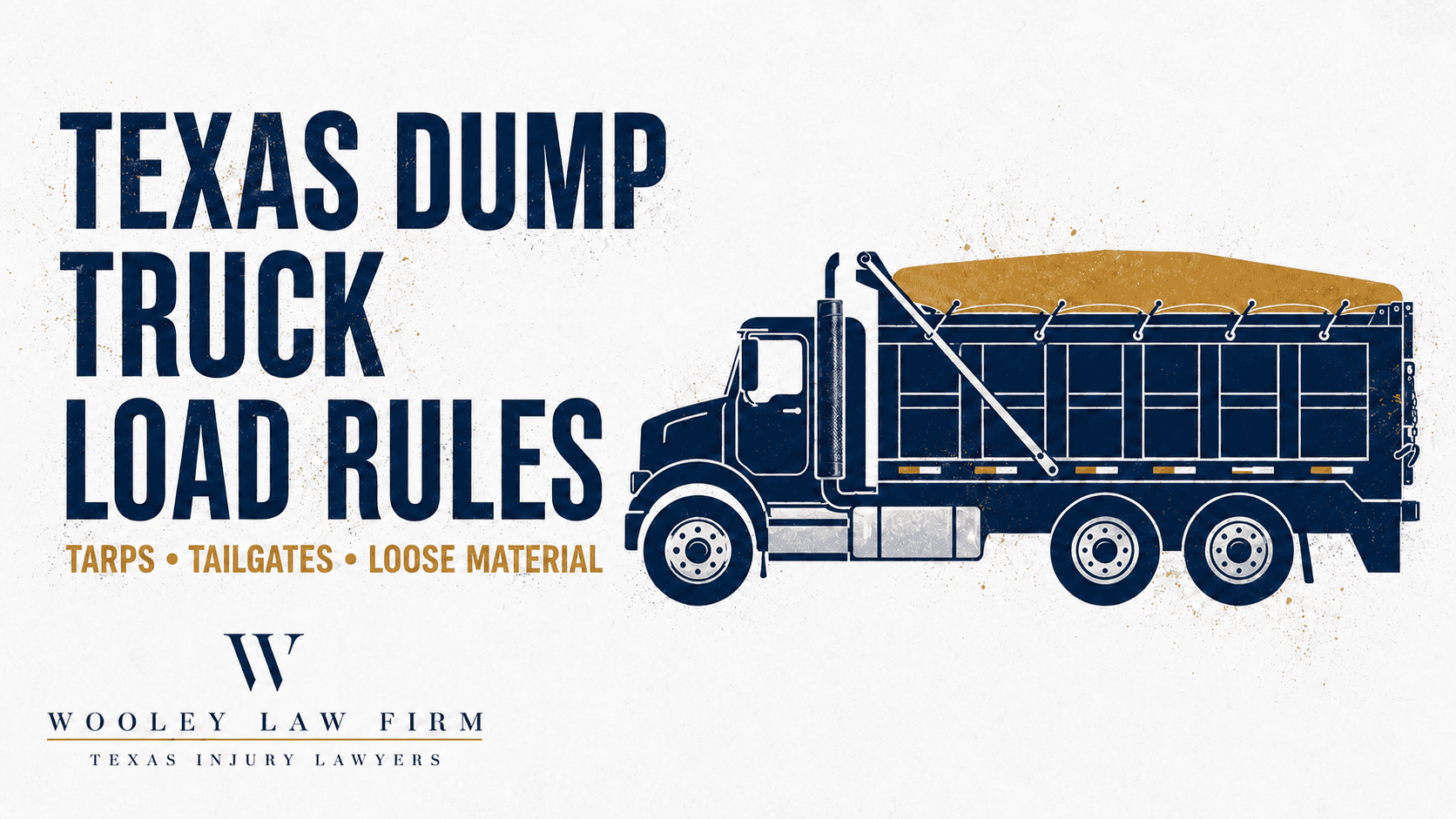
Dump trucks are different from ordinary tractor-trailers. Instead of carrying sealed pallets or freight inside an enclosed trailer, dump trucks frequently transport gravel, dirt, sand, crushed stone, construction debris, refuse, and other loose material in an open bed.
If that material escapes, it can strike a windshield, cover the roadway, cause a driver to lose control, or create a chain-reaction collision. Texas therefore imposes specific requirements addressing loose material, tailgates, and load coverings. Federal cargo-securement rules may also apply to commercial dump-truck operations.
After a serious Texas dump truck accident, the investigation should go beyond whether the truck driver was speeding or following too closely. It should determine:
What the dump truck was carrying;
Who loaded the material;
Whether the bed was overloaded;
Whether the load was properly covered;
Whether the covering was firmly secured;
Whether the tailgate was completely closed;
Whether the tarp or tailgate was damaged;
Whether the driver inspected the load before leaving; and
Whether the trucking company had adequate loading and inspection procedures.
These questions can help establish why the material escaped and who may be responsible.
What Is “Loose Material” Under Texas Law?
Chapter 725 of the Texas Transportation Code governs the transportation of certain loose materials. The statute defines loose material as material that can be blown or spilled from a vehicle because of movement or exposure to air, wind currents, or weather.
Examples identified in the statute include:
Dirt;
Sand;
Gravel;
Refuse; and
Wood chips.
Agricultural products in their natural state are excluded from that particular definition. Whether Chapter 725 applies to a specific truck and load depends on the vehicle, cargo, and circumstances.
This definition matters because a trucking company cannot necessarily dismiss escaped gravel as an unavoidable road hazard. When a commercial vehicle is transporting material that can blow or spill from an open bed, Texas law provides specific safety standards for containing it.
Texas Transportation Code § 725.021: Preventing Loose Material From Escaping
Texas Transportation Code § 725.021 requires vehicles covered by the chapter to be constructed and maintained so that loose material cannot escape through cracks, holes, or other openings in the cargo compartment.
The statute addresses several parts of a dump truck’s load-containment system.
The Truck Bed Must Prevent Material From Escaping
A dump bed should not have holes, gaps, or damaged areas that allow gravel, sand, or debris to fall onto the road. The legal inquiry is not limited to whether the driver placed a tarp over the load. The condition of the bed itself may matter.
Relevant evidence may include:
Photographs of the dump bed;
Holes, cracks, or separated seams;
Corrosion or structural damage;
Prior repair records;
Driver inspection reports; and
Complaints about earlier material loss.
A tarp cannot correct a hole in the bottom or side of a deteriorated dump bed.
The Tailgate Must Be Securely Closed
Section 725.021 also requires the vehicle’s tailgate to be securely closed to prevent spillage during transportation.
A dump-truck tailgate may fail because it was not latched, its locking mechanism was worn or damaged, material prevented it from closing, or the bed was loaded beyond a safe level. Even a small opening can allow gravel or dirt to pour onto the roadway as the truck accelerates, turns, climbs a grade, or travels over uneven pavement.
After a crash, an investigation should determine:
Whether both tailgate latches engaged;
Whether the hinges and locking mechanisms worked;
Whether the driver visually checked the tailgate;
Whether the truck had previous tailgate problems;
Whether repairs had been recommended but delayed; and
Whether material was found around the tailgate or rear frame.
The driver, trucking company, loader, truck owner, or maintenance contractor may possess evidence addressing these issues.
Commercial Loads Must Be Covered or Completely Enclosed
When a commercial motor vehicle transports loose material, Texas law generally requires the load to be covered and the covering firmly secured at the front and back, unless the material is completely enclosed by the load-carrying compartment.
The practical rule is straightforward: loose material should not be able to blow or bounce out of an open commercial truck bed.
The existence of a tarp alone does not necessarily establish compliance. Important questions include:
Did the tarp cover the entire load?
Was it secured at both ends?
Did it have tears or holes?
Did the load extend above the sides of the bed?
Was the tarp pulled tightly enough to prevent wind from getting underneath it?
Did the tarp system malfunction?
Did the driver know it was damaged?
Was the truck allowed to leave the loading facility without being properly covered?
A loosely attached, partially retracted, or badly damaged tarp may not provide meaningful protection.
Federal Cargo-Securement Rules May Also Apply
Federal regulations create additional duties for drivers and motor carriers operating covered commercial motor vehicles. Determining whether a particular federal regulation applies requires examining the vehicle, carrier, cargo, route, and nature of the operation.
Cargo Must Not Leak, Spill, Blow, or Fall From the Truck
Under 49 C.F.R. § 393.100, covered commercial motor vehicles transporting cargo on public roads must be loaded, equipped, and secured to prevent cargo from leaking, spilling, blowing, or falling from the vehicle.
The rule also requires cargo to be contained, immobilized, or secured so that shifting does not adversely affect the vehicle’s stability or maneuverability.
That second requirement can become important even when no gravel leaves the truck. An uneven or shifting load can change a dump truck’s center of gravity and contribute to:
Rollovers;
Loss of control;
Longer stopping distances;
Unsafe turns;
Tire or suspension overload;
Brake-performance problems; and
Trailer instability.
For more information about unstable commercial vehicles, see our guide to truck rollover accidents in Dallas.
Injured in an Accident?
Free consultation. Tell us what happened and learn what options may be available.
Tailgates and Tarpaulins Must Be Secured
49 C.F.R. § 392.9 prohibits a driver from operating—and a motor carrier from requiring or permitting the driver to operate—a covered commercial motor vehicle unless its cargo is properly distributed and adequately secured.
The rule also specifically addresses equipment used to contain cargo, including:
Tailgates;
Tailboards;
Doors;
Tarpaulins; and
Cargo-fastening equipment.
Those components must be secured before the truck operates.
This means responsibility may extend beyond the person behind the wheel. A motor carrier may face scrutiny if it knowingly used a truck with a defective tarp system, failed to maintain the tailgate, ignored driver complaints, or pressured a driver to transport an unsafe load.
The Driver Must Check the Cargo Before Driving
Section 392.9 generally requires a truck driver to assure that the cargo and related equipment comply with the rule before driving the commercial vehicle.
The regulation also includes cargo-reinspection requirements in certain circumstances. However, there are exceptions, including situations in which the cargo is loaded in a way that makes inspection impracticable. The precise inspection duties must therefore be evaluated under the facts of the trip.
In a dump-truck case, the pre-trip inspection is often particularly important. Before entering traffic, the driver should be able to identify visible problems such as:
An uncovered load;
A torn or improperly positioned tarp;
An unlatched tailgate;
Material piled above the bed;
Gravel resting on exterior ledges;
Loose material on the bumper or chassis; and
An obviously uneven or overloaded bed.
Inspection reports, dash-camera footage, loading-site video, dispatch messages, and electronic timestamps may help establish whether a meaningful inspection occurred.
Does a Tarp Violation Automatically Prove Negligence?
Not necessarily. A statutory or regulatory violation can be important evidence, but civil liability remains dependent on the facts and applicable Texas law.
The injured person generally must connect the unsafe conduct to the incident. For example, the evidence may need to establish that:
The law or safety rule applied to the truck and load;
The driver or company failed to comply;
Loose material escaped or the load shifted;
The violation caused or contributed to the collision; and
The collision caused the claimed injuries and damages.
Texas courts evaluate negligence-per-se questions under specific legal standards. Accordingly, it is safer to say that a violation may provide powerful evidence of negligence, not that every citation or technical violation automatically proves the entire injury claim.
Even when a particular statute does not apply, allowing gravel or debris to escape may still support an ordinary-negligence claim based on unsafe loading, inspection, maintenance, or operation.
How Loose Material From a Dump Truck Causes Crashes
Escaped cargo can cause several different types of accidents.
Gravel or Debris Strikes a Vehicle
A rock can crack or penetrate a windshield, causing a driver to brake suddenly, swerve, or lose visibility. Larger pieces of concrete, asphalt, or construction debris can cause direct physical damage and serious injuries.
Material Covers the Roadway
Gravel or sand can reduce traction, particularly during braking or turning. A motorcycle rider may be especially vulnerable to losing control on loose material.
Drivers Swerve to Avoid Falling Cargo
A driver may leave the roadway, enter another lane, strike a barrier, or collide with another vehicle while attempting to avoid debris.
The Load Shifts and the Truck Overturns
Improperly distributed material can destabilize a dump truck during a turn or evasive maneuver. A rollover may crush adjacent vehicles and spread additional material across multiple lanes.
Who May Be Responsible for an Unsecured Dump-Truck Load?
Depending on the evidence, potentially responsible parties may include:
The Dump-Truck Driver
The driver may be responsible for leaving with an uncovered load, failing to inspect the tailgate, ignoring a damaged tarp, driving too fast for the load, or continuing after material began escaping.
The Trucking Company
The carrier or employer may be responsible for inadequate training, unsafe loading policies, negligent maintenance, or permitting an unsafe truck to remain in service.
The Loading Company or Worksite Operator
A quarry, construction company, demolition contractor, or other loader may have placed too much material in the bed, distributed it unevenly, or allowed the truck to leave without proper containment.
The Truck Owner or Leasing Company
When the truck is leased or owned by another business, the owner’s maintenance obligations and knowledge of defective equipment should be investigated.
A Maintenance or Tarp-System Contractor
A third-party company may bear responsibility if negligent inspection or repair caused a tailgate, hydraulic tarp, latch, hinge, or other component to fail.
Anyone injured in a serious commercial-vehicle collision can learn more about potential claims from our Dallas truck accident lawyer page.
Evidence to Preserve After a Dump-Truck Spill
Evidence can disappear quickly after a commercial truck collision. The truck may be cleaned, unloaded, repaired, or returned to service. Electronic data may be overwritten, and loading-site video may be deleted under an ordinary retention schedule.
Important evidence may include:
The dump truck and its cargo bed;
The tarp, motor, rails, switches, and fastening points;
Tailgate hinges, latches, and locks;
Photographs of the load and roadway;
Material recovered from the scene;
Dash-camera and surveillance video;
Driver inspection reports;
Maintenance and repair history;
Loading tickets and weight records;
Quarry or jobsite video;
Dispatch and driver communications;
GPS and telematics data;
Driver qualification and training records;
Company tarp and loading policies;
Prior reports of escaping cargo; and
Witness statements.
A preservation letter should identify the particular truck, load, trip, loading location, equipment, and electronic records. A generic request may overlook the evidence unique to a dump-truck claim.
Our broader guide explains why evidence can disappear quickly after a Dallas-Fort Worth truck accident.
What Should You Do After Gravel or Debris Falls From a Dump Truck?
If you are involved in this type of crash:
Move to a safe location if you can do so.
Call 911 and report both the collision and material on the roadway.
Obtain medical care for any injuries.
Photograph the truck, load, tarp, tailgate, debris, roadway, and vehicle damage.
Record the truck’s license plate, company name, unit number, and identifying markings.
Obtain contact information from witnesses.
Preserve dash-camera footage before it is overwritten.
Avoid signing a release or giving a detailed recorded statement before understanding your options.
Speak with an attorney experienced in commercial-truck evidence.
Do not place yourself in danger by approaching the truck or standing in traffic to gather evidence.
Talk to a Dallas Dump Truck Accident Lawyer
A dump-truck debris case can involve overlapping Texas statutes, federal regulations, company safety policies, equipment-maintenance duties, and loading practices. The critical question is not simply whether gravel was on the road. The investigation must determine how it escaped, who had the ability to prevent it, and what evidence proves the connection between the unsafe load and the collision.
The Wooley Law Firm represents people injured in serious dump-truck and commercial-vehicle wrecks in Dallas–Fort Worth and throughout Texas. To discuss a potential case, call (214) 699-6524 for a free consultation. You do not pay attorney’s fees unless we win.
Frequently Asked Questions
Are dump trucks required to use tarps in Texas?
A commercial motor vehicle transporting loose material covered by Chapter 725 generally must have the load covered with the covering firmly secured at the front and back, unless the load is completely enclosed by the cargo compartment. Whether the statute applies depends on the vehicle, material, and circumstances.
Does the tarp have to cover the entire load?
The load must be covered in a manner that prevents loose material from escaping. A partial, torn, retracted, or poorly secured tarp may raise questions about whether the truck complied with Texas law and reasonable safety practices.
What if gravel came through the tailgate?
Texas law requires the tailgate of a covered vehicle to be securely closed to prevent spillage. The investigation should examine the latches, hinges, locking system, maintenance records, loading level, and pre-trip inspection.
Can the loading company be liable?
Potentially. A separate business may be responsible if it overloaded the truck, distributed the material unsafely, failed to follow containment procedures, or allowed the truck to leave in an obviously unsafe condition.
What if I swerved to avoid the debris but the dump truck never hit me?
Physical contact with the truck is not always required for a claim. You would still need evidence connecting the dump truck and escaped cargo to the collision, injuries, and damages.
Can I recover for windshield damage alone?
A property-damage claim may be possible, but proving which truck released a particular rock can be difficult without dash-camera footage, witness information, identifying details, or other supporting evidence.
Disclaimer
This article is for general informational purposes only and is not legal advice. Reading it does not create an attorney-client relationship. The application of Texas and federal transportation laws depends on the truck, cargo, route, carrier, and specific facts of the incident. Every case is different, and past results do not guarantee a similar outcome.
Topics
Share This Article

Andrew J. Wooley
Personal Injury Attorney
Andrew J. Wooley is a dedicated personal injury attorney based in Dallas, Texas. He focuses on helping accident victims recover fair compensation for their injuries. With a commitment to personalized service, Andrew works directly with each client to understand their unique situation and fight for their rights.