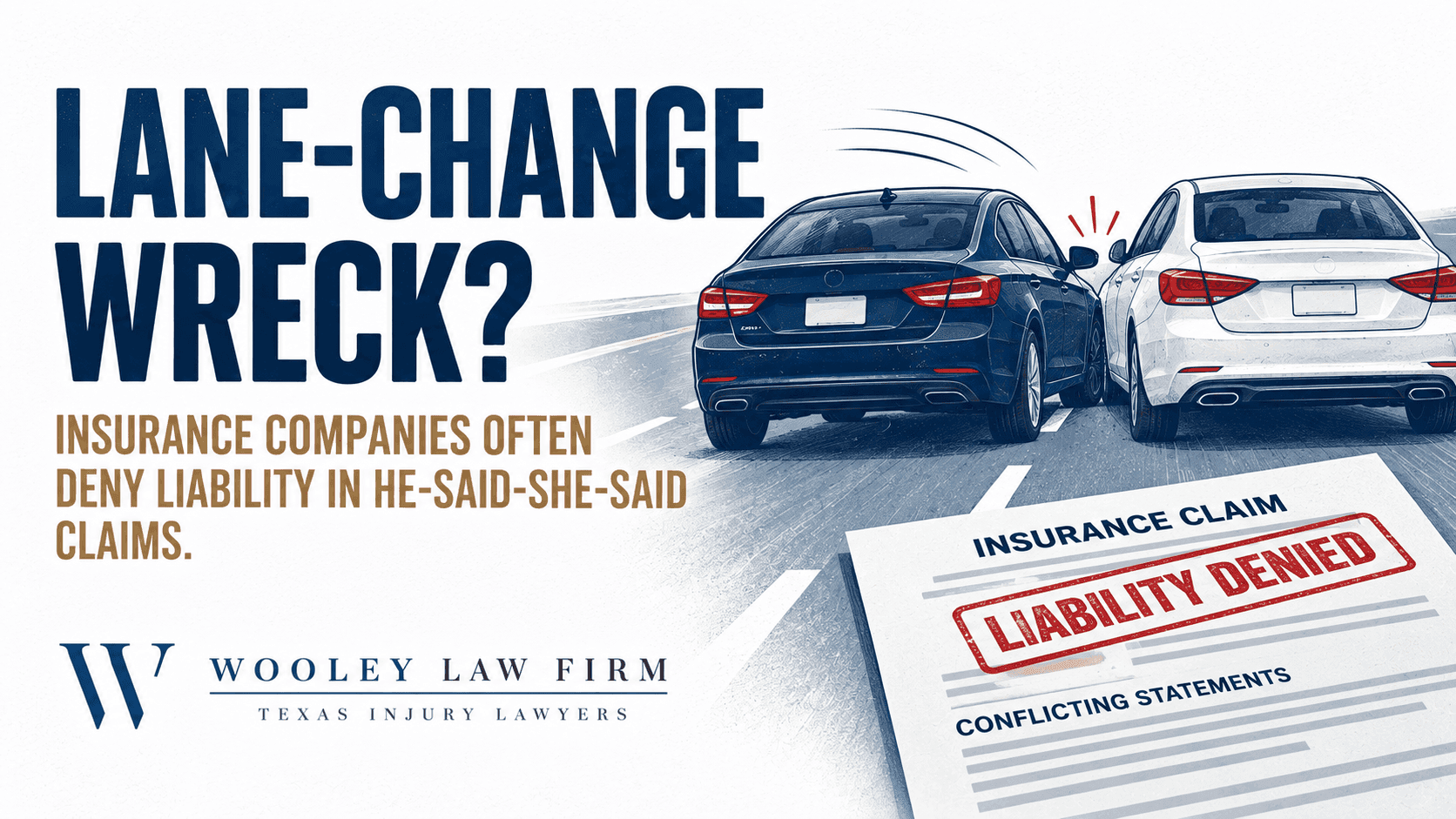
You were driving in your lane when another vehicle suddenly moved over and hit you.
Maybe the other driver’s front passenger side struck your driver’s side.
Maybe their vehicle crossed the lane divider and sideswiped you.
Maybe you saw the vehicle coming over, hit your brakes or horn, and tried to avoid the collision—but there was nowhere to go.
At the scene, the other driver may have apologized or admitted they did not see you.
But once the insurance company became involved, the story changed.
Now the other driver claims you changed lanes into them.
The insurance adjuster tells you there are no independent witnesses and no video. Because each driver blames the other, the insurance company calls it a “he said, she said” lane-change accident and denies liability.
That does not necessarily mean your case is over.
Lane-change collisions can often be investigated using evidence beyond the drivers’ statements. Vehicle damage, the point of impact, photographs, dashcam footage, nearby surveillance cameras, witnesses, roadway markings, electronic vehicle information, and other evidence may help establish which vehicle actually left its lane.
If you were injured in a disputed lane-change wreck in Dallas, The Wooley Law Firm can investigate the collision and look for objective evidence that may prove what happened.
Texas Law Requires Drivers to Make Lane Changes Safely
Texas law requires drivers to remain within a marked lane as nearly as practical and not move from that lane unless the movement can be made safely.
A turn signal does not give a driver the right to move into a lane that is already occupied.
Before changing lanes, a driver should determine whether another vehicle is traveling beside them or occupying the space they intend to enter.
An unsafe lane change can cause:
Sideswipe collisions;
Highway wrecks;
Multi-vehicle crashes;
Collisions involving vehicles in blind spots;
Loss-of-control wrecks; and
Secondary collisions when another driver swerves to avoid impact.
The fact that an insurance company cannot immediately determine which driver changed lanes does not change the central question:
Which vehicle moved from its lane before the collision?
Why Lane-Change Accidents Often Become “He Said, She Said” Claims
Lane-change crashes are particularly easy for the at-fault driver to dispute.
Consider a common scenario.
You are driving northbound on US 75 in Dallas in the middle lane.
Another vehicle is traveling beside you in the right lane.
Without enough clearance, that driver begins moving left and strikes the passenger side of your vehicle.
You know you never left your lane.
But after the crash, the other driver tells the police:
“They came into my lane.”
Unless a camera or independent witness immediately confirms what happened, the responding officer may be left with two drivers giving opposite accounts.
The same problem can arise on I-35E, I-635, I-30, I-20, the Dallas North Tollway, US 75, or almost any multilane road in Dallas.
The insurance adjuster may then say:
“We have conflicting statements.”
“There is no independent evidence.”
“We cannot prove our driver changed lanes.”
“Each driver says the other entered their lane.”
“We are denying liability.”
But the insurance company’s investigation may not uncover all of the available evidence.
The Insurance Company Denied Liability. Does That Mean I Cannot Recover?
No.
An insurance company’s liability decision is not the same thing as a court judgment.
An adjuster evaluates a claim based on the information available to the insurance company at that time.
If the insurer has only two conflicting driver statements, it may conclude that there is not enough evidence to prove its insured caused the wreck.
But additional evidence can change that analysis.
What happens if surveillance video is later located showing the insured vehicle crossing the lane divider?
What if damage patterns contradict the insured driver’s version?
What if an independent witness is found?
What if a dashcam recorded the entire collision?
What if photographs taken immediately after the wreck show one vehicle sitting across the lane divider?
A liability denial should be tested against the evidence—not simply accepted because an adjuster says the claim is denied.
Vehicle Damage May Help Show Who Changed Lanes
One of the first things to examine in a disputed lane-change collision is where each vehicle was damaged.
Vehicle damage does not automatically establish fault, but it can provide important clues.
Suppose the other driver claims you suddenly moved into their lane.
But the front driver-side corner of their vehicle struck the rear passenger-side portion of yours.
The locations and directions of the damage may help determine whether that version of the collision makes sense.
Other physical evidence may include:
Scrape patterns;
Paint transfer;
Wheel damage;
Tire marks;
Broken mirrors;
Gouges;
Crush direction;
The beginning and ending points of contact; and
Damage extending along the side of one or both vehicles.
The complete damage pattern should be evaluated—not merely one photograph of one damaged panel.
That is one reason detailed photographs of both vehicles can be so important after a sideswipe or lane-change wreck.
Dashcam Footage Can Turn a “He Said, She Said” Claim Into an Evidence Case
Dashcam footage can be extremely valuable in a disputed lane-change accident.
A camera may show:
Both vehicles traveling in separate lanes;
The lane divider;
Which vehicle begins crossing the line;
Whether a turn signal was used;
How suddenly the lane change occurred;
Whether the adjacent lane was occupied;
Whether either driver accelerated or braked;
The point of impact; and
The movement of the vehicles immediately after the collision.
The camera does not necessarily have to be mounted inside your vehicle.
A vehicle traveling behind you may have captured the wreck.
A rideshare driver may have a dash camera.
A delivery truck, commercial vehicle, or other motorist may have recorded the collision.
When two drivers give completely different stories, objective video evidence can sometimes become one of the most important pieces of the case.
Injured in an Accident?
Free consultation. Tell us what happened and learn what options may be available.
Nearby Surveillance Video May Also Matter
A lane-change collision may happen near:
Gas stations;
Restaurants;
Apartment complexes;
Shopping centers;
Parking garages;
Office buildings;
Dealerships;
Hotels; or
Homes equipped with security cameras.
A nearby camera may capture the roadway itself or the vehicles immediately before or after impact.
The video does not always have to show the exact moment of collision to be useful.
For example, footage may show both vehicles approaching in separate lanes and then show one vehicle immediately after impact occupying part of the adjacent lane.
The problem is that surveillance video may be overwritten or deleted.
That is why identifying cameras and seeking preservation of potentially useful footage can be important early in the case.
An Independent Witness Can Change a Denied Claim
An insurance company may call a collision “he said, she said” because no witness is listed on the police report.
That does not necessarily mean nobody saw what happened.
Another driver may have stopped briefly and left.
Someone may have called 911 without staying until police arrived.
A motorist traveling behind you may have seen the other vehicle move into your lane.
A pedestrian or nearby employee may have witnessed the collision.
A genuinely independent witness can be important because that person usually has no financial interest in whether one driver or the other is blamed.
Photographs of the Roadway Can Help Reconstruct the Collision
After a wreck, people understandably focus on photographing the damaged vehicles.
Those pictures are important.
But wide photographs of the roadway can also provide valuable evidence.
They may show:
The number of lanes;
Lane width;
Lane markings;
Construction;
Concrete barriers;
Merge areas;
Entrance and exit ramps;
Road curvature;
Shoulder width;
Debris locations;
Where the vehicles stopped; and
Whether another driver had room to make the maneuver they claim occurred.
These details can help determine whether the drivers’ statements fit the physical layout of the road.
Electronic Vehicle Data May Matter in Serious Lane-Change Cases
Modern vehicles may contain electronic information relating to the moments before a crash.
Depending on the vehicle and the circumstances, available data may provide information concerning:
Vehicle speed;
Braking;
Accelerator use;
Steering inputs;
Changes in velocity; or
Other recorded events.
Electronic data does not always prove which vehicle occupied which lane.
But in an appropriate case, it may be considered together with vehicle damage, photographs, video, witness statements, and roadway evidence.
What If the Police Report Does Not Blame the Other Driver?
That can make an insurance claim more difficult, but it does not necessarily end the case.
The investigating officer usually arrives after the collision.
Unless the officer witnessed the wreck, the officer may be attempting to reconstruct what happened using:
Driver statements;
Witness statements;
Vehicle positions;
Visible damage;
Roadway evidence; and
Information available at the scene.
The officer may not have surveillance footage discovered later.
The officer may not have electronic vehicle information.
The officer may not know about a witness who left before police arrived.
And the officer may face the same fundamental problem as the adjuster: both drivers claim they stayed in their own lane.
A crash report can be important evidence, but it is not always the complete investigation.
What If the Other Driver Says You Were the One Who Changed Lanes?
Do not assume the insurance company’s accusation makes it true.
Texas follows a proportionate-responsibility system. Depending on the evidence, responsibility can be divided among people whose actions contributed to a collision.
That means proving exactly how a disputed lane-change wreck happened can have a direct effect on the claim.
An insurance carrier may argue that:
You changed lanes;
You drifted across the lane divider;
Both vehicles changed lanes at the same time;
You were traveling in the other vehicle’s blind spot;
You failed to maintain a proper lookout;
You should have avoided the collision; or
There is insufficient evidence to determine who moved first.
Those allegations should be compared against the actual evidence.
If you were hurt in a crash but are being blamed for part or all of it, a Dallas car wreck lawyer can investigate whether the physical evidence supports the insurance company’s position.
Be Careful About Giving the Other Driver’s Insurance Company a Recorded Statement
When liability is disputed, an adjuster may ask you to provide a recorded statement.
The questions may sound routine:
“Which lane were you in?”
“How long had you been in that lane?”
“Did you see the other vehicle before impact?”
“Were you attempting to merge?”
“Did you move at all before the collision?”
“Could you have braked?”
“Did you honk your horn?”
“Were you using your phone or navigation?”
Your answers can become important when the insurer is deciding whether to place some or all of the blame on you.
You should always be truthful when discussing a collision, but you may want to speak with a Dallas car wreck lawyer before giving a recorded statement to the other driver’s insurance company—particularly when the carrier has already indicated that liability is disputed.
Why Hiring a Dallas Car Wreck Lawyer Early Can Matter
A denied lane-change claim is often an evidence problem.
If the insurance company says the collision is simply one driver’s word against another’s, repeating your story over and over may not solve the problem.
The better question is:
What independent evidence can show what actually happened?
A Dallas car accident lawyer can investigate evidence an injured person may not know exists or may have difficulty obtaining alone.
Depending on the circumstances, The Wooley Law Firm can:
Obtain and analyze the crash report;
Review photographs of both vehicles;
Examine the location and direction of vehicle damage;
Review available police body-camera or dash-camera footage;
Identify nearby surveillance cameras;
Send preservation requests for video;
Search for independent witnesses;
Preserve available dashcam footage;
Investigate 911 calls and related records;
Evaluate roadway geometry and lane markings;
Investigate electronic vehicle evidence when appropriate;
Compare the other driver’s statements for inconsistencies;
Deal directly with the insurance carrier;
Challenge an unsupported liability denial; and
File a lawsuit when appropriate to pursue evidence and the injury claim.
The Wooley Law Firm has recovered millions of dollars for clients injured in lane-change car wrecks and other serious motor vehicle collisions.
We understand that disputed lane-change claims often turn on details the insurance company did not investigate—or did not investigate thoroughly.
Our goal is to locate the objective evidence that can show which driver’s version fits the physical facts.
Past results do not guarantee a similar outcome. Every case is different.
Evidence Can Disappear While the Insurance Company Is “Investigating”
This is one reason a disputed lane-change claim should not simply sit for months while an insurance carrier repeats that liability is unclear.
Potential evidence can disappear.
Surveillance footage may be overwritten.
Dashcam footage can be deleted.
Vehicles may be repaired, totaled, or sold.
Debris may disappear from the roadway.
Witnesses may become harder to locate.
Memories may fade.
If another driver changed lanes into you and now denies it, preserving available evidence can be just as important as arguing with the adjuster.
Frequently Asked Questions About Dallas Lane-Change Accidents
What if the other driver lies and says I changed lanes?
The drivers’ statements are only one part of the evidence. Photographs, vehicle damage, dashcam footage, surveillance video, independent witnesses, electronic information, roadway evidence, and other facts may help determine which vehicle actually left its lane.
Can the insurance company deny my claim because there were no witnesses?
An insurer may deny liability if it concludes there is insufficient evidence showing its insured caused the collision. But the absence of an identified eyewitness does not mean no other evidence exists.
Does the vehicle with side damage automatically have the right of way?
No. Damage location may be important, but it should be analyzed in context. Investigators may consider the direction and pattern of damage together with photographs, lane positions, video, statements, and other evidence.
Is the driver changing lanes always at fault?
Not automatically. Liability depends on the circumstances and the evidence. Texas law requires a driver not to move from a marked lane unless the movement can be made safely, but the first question in a disputed claim may be determining which driver actually moved.
Can I still have a case if the police report does not identify who changed lanes?
Potentially. Additional evidence discovered after the collision may establish facts that were not available to the responding officer.
What if both drivers changed lanes at the same time?
That situation may involve shared responsibility. Video, damage patterns, roadway evidence, speed, timing, and other facts may help determine whether one or both drivers contributed to the wreck.
What if the insurance company already denied my lane-change claim?
A denial does not necessarily prevent an attorney from investigating the claim. New evidence may support a challenge to the carrier’s liability decision.
Insurance Says It Is “He Said, She Said”? Call The Wooley Law Firm
If you were hurt because another driver changed lanes into your vehicle in Dallas, you should not necessarily accept an insurance denial simply because the other driver refuses to admit what happened.
A disputed lane-change accident may require much more investigation than an ordinary insurance claim.
The Wooley Law Firm represents people injured in Dallas car wrecks involving unsafe lane changes, sideswipes, disputed liability, and insurance companies that try to blame the injured driver.
The Wooley Law Firm has recovered millions of dollars for clients injured in lane-change car wrecks and other serious motor vehicle collisions.
We can investigate physical evidence, search for video, locate witnesses, evaluate vehicle damage, examine roadway evidence, and determine whether additional information may establish how the collision actually occurred.
If you were injured in a lane-change collision and the insurance company says it is simply your word against the other driver’s, talk with a Dallas car accident lawyer before assuming the denial is the final answer.
Call The Wooley Law Firm at (214) 699-6524 for a free consultation. You don’t pay unless we win.
Disclaimer
This article is for general informational purposes only and is not legal advice. Reading it does not create an attorney-client relationship. Every case is different. Past results do not guarantee a similar outcome.
Topics
Share This Article

Andrew J. Wooley
Personal Injury Attorney
Andrew J. Wooley is a dedicated personal injury attorney based in Dallas, Texas. He focuses on helping accident victims recover fair compensation for their injuries. With a commitment to personalized service, Andrew works directly with each client to understand their unique situation and fight for their rights.
Related Local News
Recent related coverage