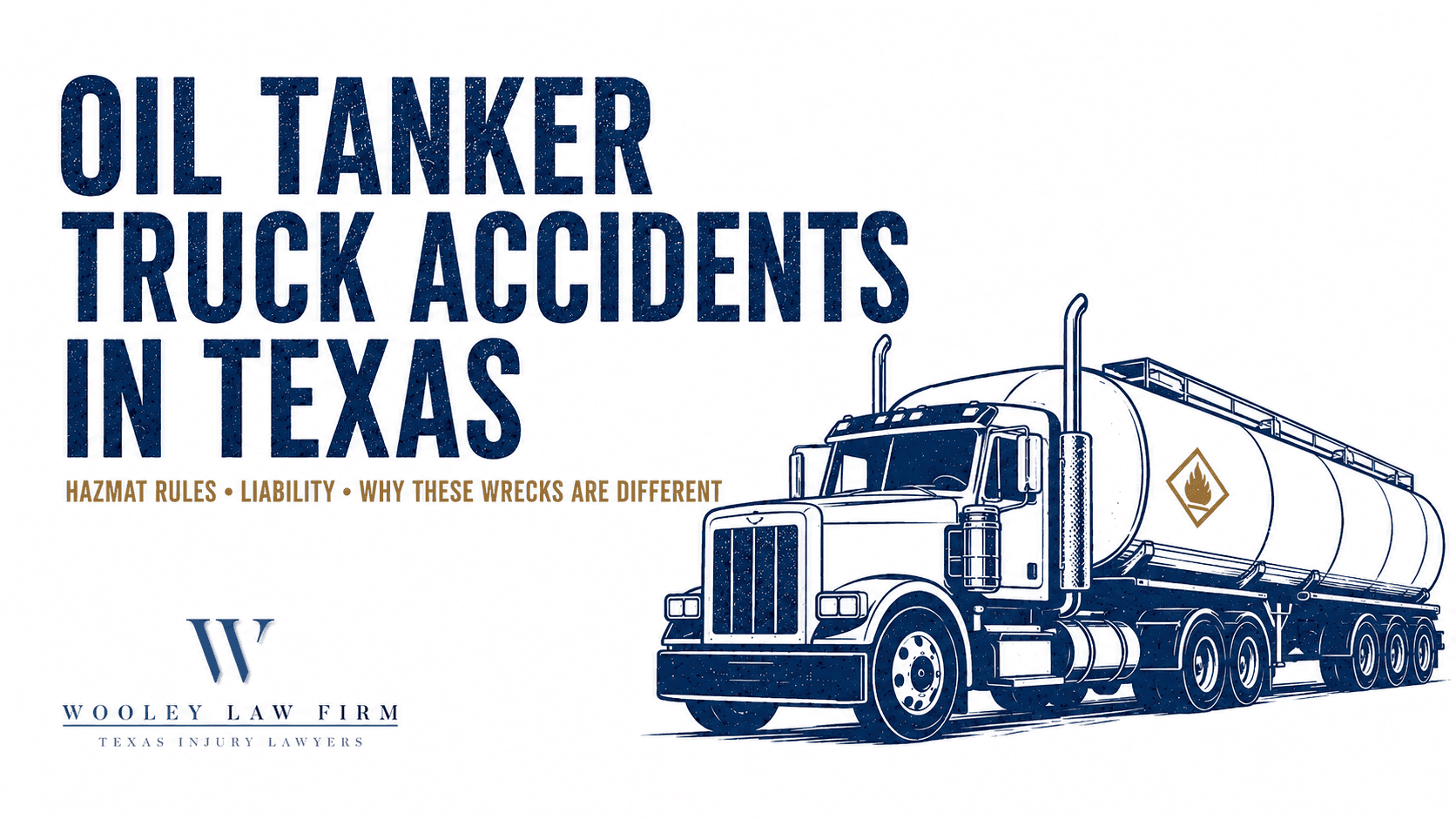
Oil tanker trucks are not “just another semi.” When a tanker is hauling gasoline, diesel fuel, crude oil, condensate, or another petroleum product, a crash can create dangers that are not present in an ordinary commercial truck accident.
In addition to the massive force created by a fully loaded tractor-trailer, an oil tanker wreck may involve:
A fuel leak or hazardous-material spill
Fire or explosion
Toxic smoke, fumes, or chemical exposure
Severe burns and inhalation injuries
Liquid surge that contributes to a rollover or loss of control
Emergency evacuations
Extended highway shutdowns
Environmental cleanup operations that disturb physical evidence
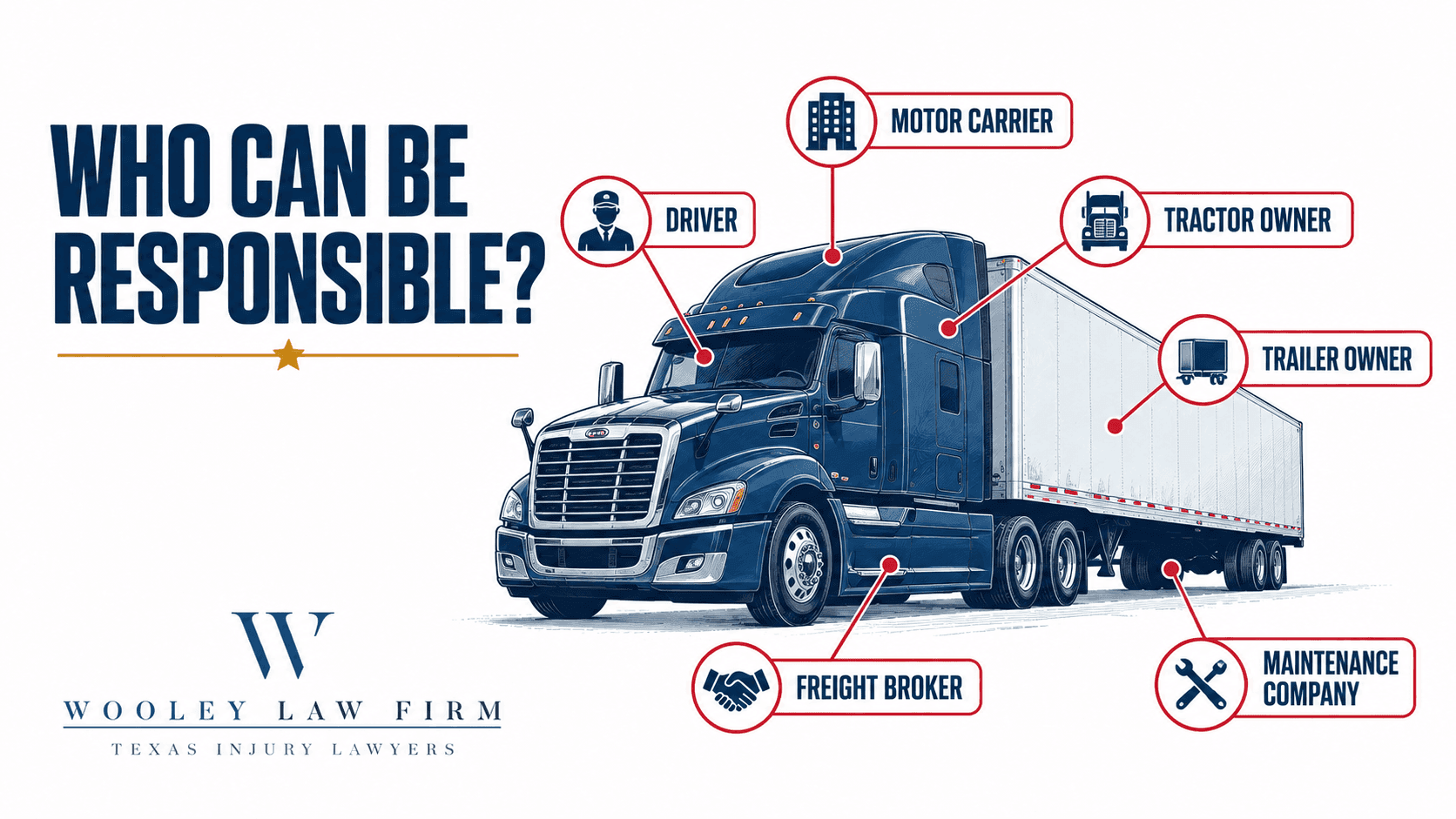
If you were hit by an oil tanker truck in Texas, your claim may involve far more than the driver. The trucking company, tanker owner, fuel supplier, shipper, loading facility, maintenance contractor, cargo-tank inspection company, broker, or equipment manufacturer may also share responsibility.
These cases require an immediate investigation. Tanker companies and their insurance carriers may begin collecting evidence within hours. Meanwhile, electronic records, onboard video, vehicle data, and physical evidence can be overwritten, altered, repaired, or lost.
The Wooley Law Firm represents people injured in serious commercial truck crashes throughout Texas. Learn more about our experience handling complex trucking claims on our 18-wheeler accident lawyer page.
Texas Oil Tanker Truck Accident Lawyers
The Wooley Law Firm investigates serious accidents involving:
Gasoline tanker trucks
Diesel fuel tankers
Crude oil tankers
Condensate tankers
Oilfield water-hauling trucks
Petroleum transport trucks
Vacuum trucks
Frac tanks and oilfield service vehicles
Hazardous-material tankers
Tanker trucks serving refineries, terminals, pipelines, and drilling operations
Whether the collision happened in Dallas-Fort Worth, Houston, San Antonio, Austin, West Texas, the Permian Basin, the Eagle Ford Shale, or another part of Texas, a complete investigation should identify every company that controlled the driver, tractor, tanker, cargo, route, maintenance, inspection, or delivery schedule.
People injured in North Texas can also learn more about working with a Dallas truck accident lawyer.
Why Oil Tanker Trucks Are More Dangerous Than Other 18-Wheelers
Tanker trucks may carry thousands of gallons of petroleum products
A fully loaded tractor-trailer can weigh tens of thousands of pounds. Its size and weight already create the potential for catastrophic injuries.
When the trailer is carrying gasoline, diesel, crude oil, or another combustible material, a collision can also create an immediate risk of fire, explosion, toxic exposure, or environmental contamination.
Even when the cargo tank does not completely rupture, leaking petroleum can:
Spread across the roadway
Flow underneath nearby vehicles
Enter storm drains or waterways
Produce flammable vapors
Ignite when exposed to sparks or hot components
Expose motorists and emergency responders to harmful substances
These additional dangers make oil tanker crashes more complicated to investigate and more likely to cause severe or fatal injuries.
Liquid surge can push a tanker out of control
Unlike a dry van trailer carrying boxes or pallets, a tanker carries liquid that moves inside the trailer.
When the driver brakes, accelerates, turns, changes lanes, or travels over uneven pavement, the liquid shifts. This movement is commonly called liquid surge or sloshing.
Liquid surge can:
Push the tractor forward during braking
Increase the distance needed to stop
Shift the tanker’s center of gravity
Make sudden steering corrections more dangerous
Contribute to a jackknife
Cause the trailer to roll during a turn
Make a partially loaded tanker more difficult to control
A properly trained tanker driver must understand how the volume, weight, compartment configuration, and movement of the liquid affect the truck.
A driver who fails to account for liquid surge may enter a curve too quickly, follow another vehicle too closely, brake too aggressively, or lose control while attempting an emergency maneuver.
Tankers have an increased rollover risk
Oil tanker trucks can roll over because of:
Excessive speed
Unsafe turns
Abrupt steering
Driver overcorrection
Improper loading
Uneven weight distribution
Shifting liquid
Driver fatigue
Distracted driving
Tire failure
Brake failure
Poor road conditions
Inadequate tanker-driver training
A tanker does not have to be traveling at highway speed to overturn. A rollover can occur while the driver is turning at an intersection, negotiating a curved exit ramp, entering a terminal, driving through a construction zone, or turning into a fuel station.
For more information about how commercial trucks overturn and who may be responsible, read our guide to truck rollover accidents in Dallas.
Petroleum cargo may ignite after impact
Gasoline and many other petroleum products produce flammable vapors. A collision may damage the tank, valves, piping, hoses, fittings, manhole covers, or emergency shutoff systems.
Leaking fuel may then encounter:
Sparks
Hot engine components
Electrical systems
Damaged batteries
Roadway friction
Open flames
Other ignition sources
Victims may suffer severe burns even when their vehicle was not initially struck by the tanker. A fire may spread to surrounding vehicles, nearby property, vegetation, or structures.
Common Oil Tanker Accident Scenarios in Texas
Oil tanker wrecks can happen in many different ways.
Rear-end collisions
A tanker driver who follows too closely may be unable to stop when traffic slows. The truck’s weight and liquid surge can make the stopping problem even worse.
A tanker may crush the rear of a passenger vehicle or push it into another vehicle, concrete barrier, guardrail, or intersection.
Read more about the special evidence and liability issues involved when someone is rear-ended by an 18-wheeler in Dallas.
Rollover accidents
A tanker may overturn while entering a curve, making a turn, changing lanes, or trying to avoid another vehicle. A rollover may block several traffic lanes and release fuel onto the roadway.
Jackknife accidents
Liquid surge, sudden braking, excessive speed, or poor road conditions may cause the trailer to swing sideways toward the tractor. A jackknifed tanker can sweep across several lanes and strike multiple vehicles.
Intersection and wide-turn crashes
Tankers require additional space to complete turns. A driver who turns from the wrong position, fails to check mirrors, or misjudges trailer off-tracking may crush a vehicle beside the tanker.
Learn more about wide-turn 18-wheeler accidents in Dallas-Fort Worth.
Tank rupture and fuel-spill accidents
A valve, closure, hose, fitting, or portion of the cargo tank may fail during or after the collision. The product may spill onto the roadway even if the trailer remains upright.
Multi-vehicle highway crashes
An overturned or leaking tanker can create a chain-reaction accident. Motorists may strike the tanker, collide with stopped traffic, lose control while avoiding the spill, or become trapped by fire.
Where Oil Tanker Truck Accidents Happen in Texas
Texas has an enormous network of oilfields, refineries, pipelines, terminals, ports, distribution centers, drilling operations, and fuel stations. Oil and fuel tankers travel through major cities and rural communities every day.
Serious tanker accidents may occur on:
Interstate 10
Interstate 20
Interstate 30
Interstate 35
Interstate 37
Interstate 45
Interstate 610
Interstate 635
U.S. Highway 59 and Interstate 69
U.S. Highway 75
U.S. Highway 80
U.S. Highway 90
U.S. Highway 281
U.S. Highway 287
State Highway 114
State Highway 121
State Highway 130
State Highway 161
State Highway 183
State Highway 360
Farm-to-market roads serving drilling and production sites
Roads near refineries, fuel terminals, pipelines, and storage facilities
Oilfield-related tanker wrecks are a particular concern in Midland, Odessa, Pecos, Monahans, Big Spring, and other communities throughout the Permian Basin.
Rural tanker accidents may be especially dangerous because emergency medical treatment, firefighting resources, and specialized hazardous-material response teams may be farther away.
Common Causes of Texas Oil Tanker Truck Accidents
Speeding or driving too fast for conditions
Speed affects stopping distance, turning stability, and the driver’s ability to react.
A speed that might already be dangerous for an ordinary tractor-trailer can be even more dangerous when thousands of gallons of liquid are moving inside the tanker.
Tanker drivers should adjust their speed for:
Curves
Exit ramps
Wet or icy pavement
Construction zones
High winds
Heavy traffic
Limited visibility
Uneven road surfaces
The weight and volume of the load
A tanker company should not pressure a driver to sacrifice safety to meet a delivery deadline.
Following too closely
Tankers require substantial stopping distance. Liquid surge may continue pushing the vehicle forward after the brakes are applied.
A normal traffic slowdown can become a catastrophic rear-end collision when the driver fails to leave enough distance.
Driver fatigue
Oil and fuel transportation may involve:
Overnight driving
Early departures
Long waits at terminals
Irregular schedules
Remote routes
Multiple deliveries
Pressure to complete a load quickly
A fatigued driver may drift from the lane, miss a traffic signal, overlook stopped traffic, misjudge a curve, react too slowly, or fall asleep behind the wheel.
Electronic logging-device records should be compared with:
Dispatch records
GPS information
Fuel receipts
Toll records
Terminal-entry records
Bills of lading
Payroll records
Inspection reports
Cellphone activity
A log may appear compliant until it is compared with independent evidence.
Distracted driving
A tanker driver may become distracted by:
A cellphone
Text messages
Dispatch communications
Navigation equipment
An electronic logging device
Delivery instructions
Paperwork
Food or drinks
In-cab controls
Because of the tanker’s weight, stopping distance, and rollover risk, a few seconds of inattention can cause a devastating collision.
Improper tanker-driver training
Operating a tanker requires specialized knowledge.
The driver must understand:
Liquid surge
Safe braking
Load movement
Rollover prevention
Proper turning
Emergency procedures
Loading and unloading safety
The characteristics of the material being transported
Evidence of inadequate training may include:
No tanker-specific road training
Missing hazardous-material instruction
No rollover-prevention training
Inadequate supervised driving
Missing or falsified training records
Assignment to unfamiliar equipment
Failure to verify required endorsements
A carrier may have safety policies on paper while failing to train its drivers or enforce those policies in practice.
Improper loading or unsafe weight distribution
The amount and placement of liquid inside the tanker affect how the vehicle handles.
A partially filled compartment may permit greater movement of the liquid. Improper distribution among compartments can also affect stability.
Loading failures may include:
Overfilling the tanker
Unevenly distributing the cargo
Filling the wrong compartment
Loading an incompatible product
Failing to secure a valve or closure
Failing to inspect hoses and connections
Miscalculating the cargo weight
Allowing a leaking or defective tanker to leave the facility
Loading-rack records and surveillance footage can help establish what occurred before the tanker entered the highway.
Brake failure or poor maintenance
A fully loaded tanker places enormous demands on its braking system.
Potential brake problems include:
Worn brake components
Improper brake adjustment
Air-system failures
Contaminated components
Delayed repairs
Ignored inspection findings
Inadequate preventive maintenance
Depending on the facts, responsibility may extend to the carrier, vehicle owner, maintenance contractor, brake-repair facility, or component manufacturer.
For more information about maintenance-related claims, read our article on truck maintenance and brake failures.
Tire blowouts and tire defects
A tire failure may cause the driver to lose control, leave the roadway, cross a median, strike another vehicle, or roll the tanker.
Investigators should examine:
Tire age
Tread depth
Air pressure
Load rating
Retread history
Prior repairs
Inspection records
Underinflation
Visible damage
Mismatched tires
Injured in an Accident?
Free consultation. Tell us what happened and learn what options may be available.
Defective valves, hoses, fittings, and closures
Not every petroleum release is caused solely by the force of the collision.
A valve, hose, coupling, pressure-relief device, manhole cover, or other component may have been:
Defective
Worn
Corroded
Improperly installed
Poorly repaired
Inadequately inspected
A failed component may support claims against the tanker owner, maintenance company, repair facility, inspection provider, or manufacturer.
Special Rules That May Apply to Oil Tanker Operations
Oil tanker claims may involve federal motor-carrier regulations and federal hazardous-materials regulations that do not apply in the same way to ordinary freight shipments.
The applicable rules depend on the vehicle, cargo, quantity, tank configuration, and circumstances of the transportation.
Tank vehicle and hazardous-material endorsements
Depending on the vehicle and product, a tanker driver may be required to possess:
A tank vehicle endorsement
A hazardous-materials endorsement
A combined tank and hazardous-materials endorsement
The investigation should confirm that the driver possessed every required license and endorsement on the date of the collision.
It is not enough for the trucking company to show that the driver later obtained the proper qualification.
Hazmat shipping papers
Shipping papers may identify:
The petroleum product
The quantity being transported
The hazard classification
The shipper
The motor carrier
The point of origin
The destination
Emergency-response information
These records may identify companies that do not appear on the crash report.
Placards and vehicle markings
Hazardous-material placards warn emergency personnel and motorists about the type of material being transported.
Missing, incorrect, damaged, or obscured placards may indicate a serious compliance failure.
Investigators should preserve photographs of:
Placards
Product identification numbers
Company markings
U.S. Department of Transportation numbers
License plates
Tank specification plates
Warning labels
Hazmat training
Employees who prepare, load, handle, document, or transport hazardous materials may be subject to training requirements.
Relevant training may include:
General-awareness training
Function-specific training
Safety training
Security-awareness training
Driver training
Emergency-response instruction
Training records should be compared with what the employee actually knew and did.
Cargo-tank inspection and testing requirements
Cargo tanks used to transport petroleum products may be subject to periodic inspection, testing, repair, and qualification requirements.
Depending on the tanker and service, relevant records may include:
Visual inspections
Leakage tests
Pressure tests
Thickness tests
Internal inspections
Repair records
Tank qualification documents
After a leak, rupture, or component failure, an investigation should determine:
When the tanker was last inspected
Who performed the inspection
Whether the facility was qualified
What defects were documented
Whether recommended repairs were completed
Whether earlier leaks had occurred
Whether the tanker was improperly returned to service
Loading and unloading requirements
The investigation should examine what happened at the terminal or loading facility before the tanker departed.
Important evidence may include:
Terminal surveillance video
Loading-rack records
Entry and exit timestamps
Scale tickets
Meter readings
Compartment records
Seal records
Employee identities
Inspection checklists
Communications between the driver and loading personnel
Driving, parking, and routing rules
Certain hazardous-material loads may be subject to additional requirements involving:
Routing
Parking
Attendance
Disabled vehicles
Leaking cargo
Railroad crossings
Emergency procedures
A complete investigation should identify the product before determining which rules applied.
Who Can Be Liable After a Texas Oil Tanker Accident?
The tanker driver
A tanker driver may be responsible for:
Speeding
Following too closely
Unsafe lane changes
Distracted driving
Fatigued driving
Running a traffic signal
Making an unsafe turn
Failing to account for liquid surge
Driving with defective equipment
Failing to perform required inspections
Operating without proper endorsements
Failing to respond appropriately to a leak
The driver’s conduct is important, but the investigation should not stop with the driver.
The trucking company or motor carrier
A carrier may be legally responsible for the driver’s negligence and for its own corporate conduct.
Potential claims may involve:
Negligent hiring
Negligent retention
Negligent supervision
Inadequate tanker training
Inadequate hazmat training
Unsafe dispatch practices
Failure to monitor driving behavior
Failure to maintain the tractor or tanker
Hours-of-service violations
Failure to investigate prior crashes
Failure to act on safety complaints
Allowing an unqualified driver to transport hazardous materials
The company’s records may show whether the wreck was an isolated mistake or the result of a broader safety failure.
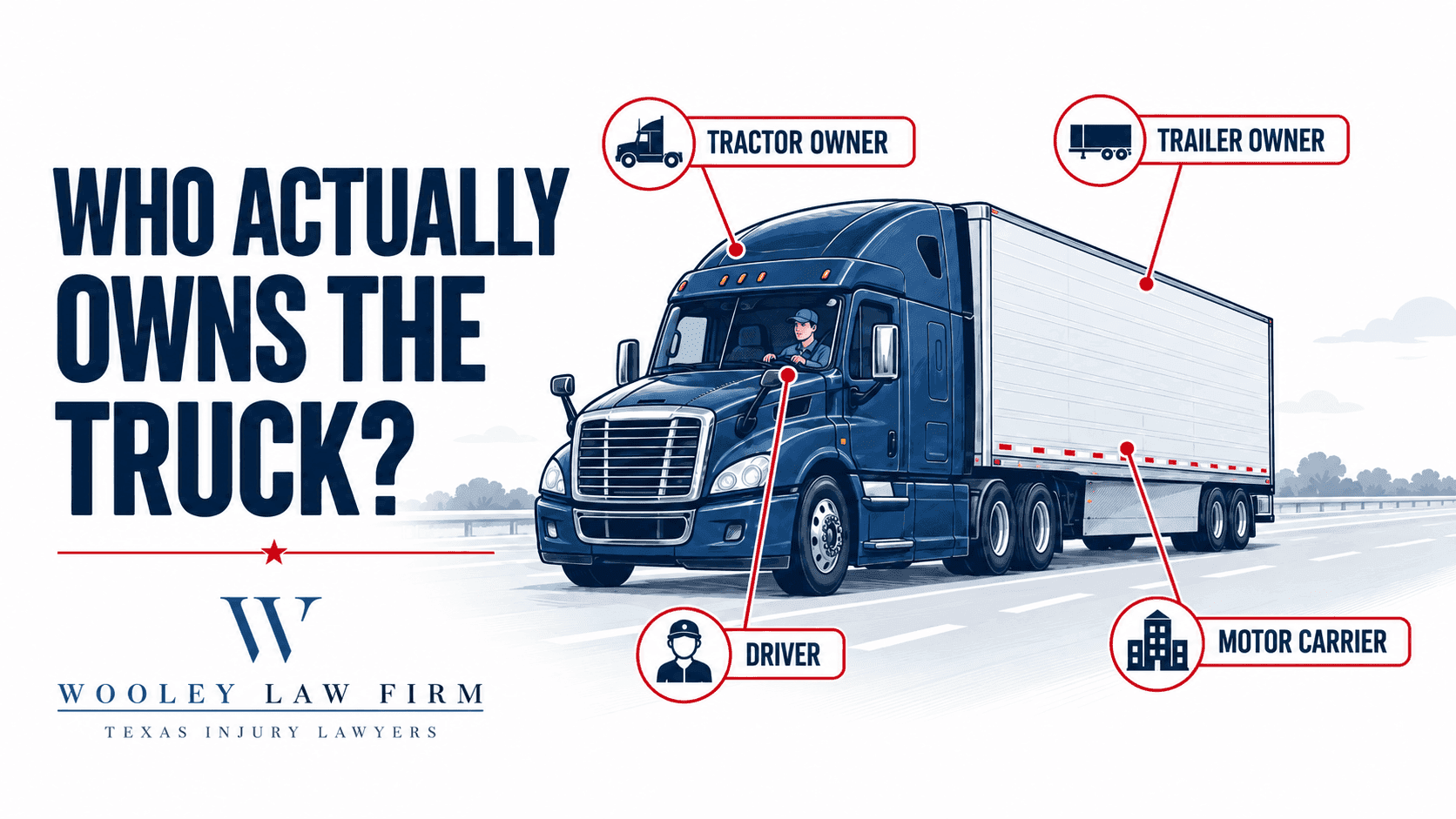
The owner of the tractor or tanker trailer
The motor carrier may not own every piece of equipment involved in the shipment. The tractor and cargo tank may be leased from separate companies.
An equipment owner may be responsible if it:
Supplied unsafe equipment
Failed to complete repairs
Ignored inspection findings
Concealed known defects
Used an unqualified repair facility
Failed to remove dangerous equipment from service
The fuel supplier or shipper
A shipper or fuel supplier may become relevant when it:
Misidentified the petroleum product
Provided incorrect shipping documents
Failed to provide required hazard information
Selected an unsafe carrier
Controlled important parts of the transportation
Imposed an unsafe delivery schedule
Participated in improper loading
Failed to warn about product-specific hazards
The company name on the side of the tanker may not be the company that owned, supplied, or arranged the load.
The terminal or loading facility
A terminal operator or loading contractor may be responsible for:
Overloading
Uneven loading
Filling the wrong compartment
Failing to secure valves or caps
Failing to detect a leak
Allowing a visibly defective tanker to leave
Failing to follow loading procedures
Providing inaccurate documents
Permitting an unqualified employee to handle the load
A freight broker or logistics company
A freight broker is not automatically liable merely because it arranged the shipment. However, its conduct should be investigated when it:
Selected the carrier
Controlled important parts of the work
Ignored known safety problems
Participated in unsafe scheduling
Required a route or deadline that could not be completed safely
Contracts, emails, load tenders, payment records, and carrier-selection documents may show the broker’s actual role.
A maintenance or cargo-tank inspection company
A third-party contractor may share responsibility if it negligently:
Inspected the tanker
Tested the tank
Repaired the tank
Serviced the brakes
Installed a valve or closure
Replaced a hose
Certified defective equipment
Failed to detect corrosion, cracking, thinning, or leakage
The company’s qualifications, technician training, procedures, and previous work should be examined.
A tanker or component manufacturer
A product-liability claim may exist when a defective product contributed to the crash, spill, fire, or severity of the injuries.
Potentially defective products may include:
The cargo tank
Valves
Emergency shutoff systems
Pressure-relief devices
Hoses
Couplings
Manhole assemblies
Rollover-protection systems
Braking components
Tires
Steering components
Lighting systems
The tanker and failed components should be preserved before repair, destructive testing, alteration, or disposal.
Another motorist or road contractor
Some tanker accidents begin when another motorist cuts off the tanker, enters its lane, or creates an emergency.
Road contractors or governmental entities may also become relevant when dangerous road design, construction, signage, or maintenance contributed to the wreck.
A complete investigation should evaluate every potential cause rather than simply accepting the tanker company’s explanation.
Evidence That Must Be Preserved After an Oil Tanker Wreck
Oil tanker cases are evidence-heavy. Some of the most important records may be controlled by the defendants.
For a more detailed discussion, read our article about what evidence matters after a Texas fuel tanker accident.
Truck black-box and engine data
The tractor’s electronic systems may contain information about:
Speed
Braking
Throttle position
Engine RPM
Cruise-control use
Sudden deceleration
Fault codes
Vehicle movement before impact
The information available depends on the truck, engine, and electronic systems.
Read our guide to 18-wheeler black-box data after a Dallas-Fort Worth truck wreck.
Telematics and GPS records
Fleet-management systems may record:
The tanker’s route
Speed history
Stops
Hard-braking events
Sudden acceleration
Cornering events
Driver login information
Terminal arrival and departure times
Dispatch communications
These records may provide more detail than the tractor’s event data.
Dash-camera and cab-camera footage
Video may show:
What the driver could see
Traffic conditions
Lane position
Following distance
Cellphone use
Signs of fatigue
The driver’s reaction
Statements made after the crash
Some systems continuously overwrite footage. A preservation demand should identify the date, time, driver, tractor, tanker, route, and every potentially relevant camera system.
Electronic logging-device records
ELD information may help determine whether the driver was fatigued, exceeded working limits, or maintained inaccurate records.
ELD records should be compared with supporting documents rather than reviewed in isolation.
Shipping papers and bills of lading
Shipping records may identify:
The product
The quantity
The shipper
The carrier
The loading facility
The origin
The destination
Other companies involved in the transportation chain
Loading records
Important loading evidence may include:
Compartment diagrams
Meter tickets
Scale tickets
Loading-rack records
Product codes
Seal numbers
Loading timestamps
Employee identities
Surveillance footage
Pre-departure inspections
Cargo-tank inspection and testing records
These records may establish whether the tanker was properly inspected, tested, repaired, and qualified for continued service.
Maintenance and repair records
Maintenance evidence should include records for the tractor and tank trailer, including:
Brake inspections
Tire service
Steering repairs
Suspension work
Tank repairs
Valve and hose replacement
Leak complaints
Driver-reported defects
Out-of-service orders
Annual inspections
Driver qualification and training records
The driver’s file may contain:
Employment applications
CDL information
Tanker and hazmat endorsements
Driving history
Prior-employer inquiries
Road-test records
Medical qualification documents
Drug and alcohol testing records
Training records
Disciplinary history
Previous crash information
Cellphone and communication records
Relevant evidence may include calls, texts, dispatch applications, navigation activity, and communications with the trucking company or terminal.
These records must be obtained through lawful preservation and discovery procedures.
Physical evidence
The tractor, tanker, tires, brakes, valves, hoses, and failed components should be preserved.
Investigators may also need access to:
The collision scene
Tire and skid marks
Pavement gouges
Guardrails
Roadway geometry
Traffic signals
Nearby surveillance cameras
Witness vehicles
Debris
Spill patterns
Hazmat cleanup can quickly alter the scene. Early photographs, measurements, mapping, drone documentation, and expert inspections may be critical.
Our broader guide to evidence in Texas 18-wheeler cases explains why immediate preservation matters.
Why You Should Contact an Attorney Quickly
Truck accident evidence can disappear quickly.
The tractor and tanker may be removed, repaired, inspected, cleaned, sold, or returned to service. Electronic data may be overwritten. Surveillance video may be deleted. Witnesses may become difficult to locate.
A tanker company may also send investigators, insurance adjusters, lawyers, and experts to the scene immediately.
An attorney can send preservation notices demanding that potentially relevant evidence not be destroyed or altered.
Learn more about why evidence can disappear quickly after a Dallas-Fort Worth truck accident.
What Should You Do After Being Hit by an Oil Tanker Truck?
Move away from the tanker if there is a leak or fire risk
Your first priority is safety.
Do not approach leaking cargo or attempt to identify the petroleum product yourself. Follow instructions from firefighters, police officers, and hazmat personnel.
Call 911
Report:
The location
Known injuries
Smoke or fire
Visible leaks
Strong odors
Any placard information you can safely observe
Seek medical treatment
Some injuries are immediately apparent. Others—including traumatic brain injuries, internal injuries, inhalation injuries, and toxic exposure—may take time to produce noticeable symptoms.
Tell medical personnel about:
Smoke exposure
Fume exposure
Skin contact with liquid
Eye irritation
Breathing problems
Dizziness
Headaches
Nausea
Loss of consciousness
Burns
Pain caused by the collision
Document the scene only when it is safe
Photograph or record:
The tractor and tanker
Company names
DOT numbers
License plates
Placards
Product identification numbers
Vehicle damage
Road conditions
Debris
Skid marks
Traffic signs
Responding agencies
Witness vehicles
Visible smoke or leaks from a safe distance
Never place yourself in danger to obtain evidence.
Identify witnesses
Witnesses may leave before law enforcement completes its investigation. Obtain names and contact information when possible.
Do not give the tanker company’s insurer a recorded statement
The insurance company may contact you quickly. Its representative may sound helpful while attempting to obtain statements that reduce the company’s financial exposure.
You generally should not provide the other company’s insurer with an immediate recorded statement without first understanding your rights.
Do not accept a quick settlement
Severe injuries may require future treatment, surgery, rehabilitation, or time away from work.
A settlement release usually ends the claim, even if your condition later becomes worse or you discover that additional companies were responsible.
Contact a Texas tanker truck accident lawyer
An attorney can preserve evidence, identify the responsible companies, inspect the equipment, obtain records, and work with qualified experts.
Injuries Caused by Oil Tanker Accidents
Oil tanker wrecks may cause life-changing or fatal injuries, including:
Severe burns
Smoke-inhalation injuries
Toxic-exposure injuries
Traumatic brain injuries
Spinal cord injuries
Paralysis
Crush injuries
Internal organ damage
Multiple fractures
Amputations
Facial injuries
Scarring and disfigurement
Vision or hearing loss
Serious neck and back injuries
Post-traumatic stress
Wrongful death
Victims may require emergency transportation, intensive care, surgeries, skin grafts, respiratory treatment, rehabilitation, prosthetics, counseling, and lifelong medical support.
Read more about life-changing injuries after a Dallas-Fort Worth truck wreck.
Compensation Available After a Texas Tanker Truck Accident
Depending on the evidence and circumstances, an injured person may seek compensation for:
Past medical expenses
Future medical expenses
Lost wages
Loss of future earning capacity
Physical pain
Mental anguish
Physical impairment
Disfigurement
Property damage
Other legally recoverable losses
When a tanker crash causes a death, eligible family members or estate representatives may have wrongful-death or survival claims.
The value of a tanker accident claim depends on:
The severity of the injuries
Whether the injuries are permanent
The cost of medical treatment
Future care needs
Time missed from work
Loss of earning capacity
Physical impairment
Scarring or disfigurement
The strength of the liability evidence
The number of responsible defendants
Available insurance coverage
How the injuries changed the victim’s daily life
Why Oil Tanker Accident Claims May Involve Multiple Insurance Policies
Tanker transportation may involve separate companies that own or control:
The tractor
The cargo tank
The petroleum product
The driver’s employment
The shipment
The loading facility
Maintenance
Tank inspection
Delivery operations
There may also be:
Primary commercial liability coverage
Excess coverage
Umbrella policies
Trailer coverage
Contractor policies
Product-liability coverage
Identifying all available insurance requires more than obtaining the driver’s insurance card at the scene.
How The Wooley Law Firm Helps After a Texas Oil Tanker Accident
At The Wooley Law Firm, we understand that serious tanker accidents require immediate action.
Our investigation may include:
Sending evidence-preservation demands
Identifying the tractor, tanker, driver, carrier, shipper, and loader
Obtaining ELD, GPS, telematics, and camera data
Preserving the tractor and cargo tank
Inspecting failed valves, hoses, brakes, tires, and components
Obtaining cargo-tank inspection and testing records
Reviewing hazardous-materials documentation
Investigating the driver’s qualifications and training
Examining dispatch practices and delivery pressure
Locating witnesses
Obtaining surveillance video
Reviewing fire department and hazmat records
Identifying all potentially responsible companies
Identifying all potentially applicable insurance policies
Working with reconstruction, trucking, engineering, fire, hazmat, medical, and economic experts when appropriate
The Wooley Law Firm has handled truck wreck cases across Texas and obtained millions of dollars for injured clients. We prepare serious cases with the expectation that the trucking company and its insurance carriers will aggressively defend them.
Learn more about our approach on our Dallas 18-wheeler accident lawyer page.
Frequently Asked Questions About Texas Oil Tanker Accidents
What makes an oil tanker accident different from a regular 18-wheeler wreck?
Oil tanker accidents may involve flammable cargo, hazardous materials, liquid surge, rollover danger, specialized driver qualifications, cargo-tank inspection requirements, hazmat documents, emergency-response issues, and multiple responsible companies.
Can I sue the tanker company if its driver caused the collision?
Potentially. A trucking company may be responsible for the driver’s conduct and for its own negligent hiring, training, supervision, dispatch, maintenance, or safety practices.
The available claims depend on the evidence and the relationship between the driver and company.
Who is responsible if the tanker leaked after the crash?
Responsibility may extend to the driver, motor carrier, tanker owner, loading facility, maintenance contractor, inspection company, shipper, or equipment manufacturer.
The cause of the leak must be investigated before responsibility can be determined.
What if the tanker rolled over while avoiding another vehicle?
The other motorist may share responsibility. However, the tanker driver or trucking company may also be responsible if excessive speed, inadequate following distance, poor training, improper loading, or an unsafe steering response contributed to the rollover.
What if the oil tanker driver was called an independent contractor?
Calling a driver an independent contractor does not automatically eliminate claims against the carrier or other companies.
The investigation should examine the contracts, operating authority, equipment ownership, company control, payment arrangements, dispatch practices, and actual working relationship.
What if I inhaled smoke or fumes but was not burned?
You may still have a serious injury.
Smoke and chemical exposure can affect the lungs, eyes, nervous system, and other organs. Seek medical treatment and tell the medical provider what you may have inhaled or contacted.
How long does the trucking company keep dash-camera footage?
Retention periods vary. Some systems automatically save footage associated with a detected event, while other recordings may be overwritten.
The safest approach is to demand preservation immediately.
Can tanker inspection records prove negligence?
They may.
Inspection, testing, maintenance, and repair records can reveal prior leaks, corrosion, defective components, overdue inspections, inadequate repairs, or a decision to keep unsafe equipment in service.
What if the police report blames me?
A police report does not necessarily determine civil responsibility.
The investigating officer may not have access to electronic data, company records, dash-camera footage, loading documents, maintenance files, witness testimony, or expert analysis when preparing the report.
What happens when several companies are involved?
Each company’s role should be investigated.
Different businesses may be responsible for the driver, tractor, tanker, petroleum product, loading, maintenance, inspection, dispatch, or delivery schedule.
How long do I have to file a tanker accident lawsuit in Texas?
Texas injury claims are subject to legal deadlines. The applicable deadline can depend on the parties and circumstances.
Claims involving governmental entities may also have much shorter notice requirements. Contact an attorney promptly rather than relying on a general deadline.
How much is my Texas oil tanker accident case worth?
There is no automatic or fixed value.
Important factors include the severity and permanence of the injuries, medical treatment, future care, lost income, impairment, disfigurement, liability evidence, responsible defendants, available insurance, and how the injuries affected the victim’s life.
How much does it cost to hire The Wooley Law Firm?
Call (214) 699-6524 for a free consultation.
You don’t pay unless we win.
Speak With a Texas Oil Tanker Truck Accident Lawyer
If you were injured in a Texas oil tanker accident, gasoline tanker collision, diesel tanker wreck, crude oil truck crash, or another hazardous-material trucking accident, you may have the right to seek justice and pursue compensation for medical expenses, pain and suffering, lost wages, mental anguish, impairment, disfigurement, and other damages.
The companies involved may already be investigating the collision and protecting their interests. You deserve a legal team that will move quickly to preserve evidence, identify every responsible party, and demand accountability.
Call The Wooley Law Firm at (214) 699-6524 for a free consultation.
You don’t pay unless we win.
Disclaimer
This article is provided for general informational purposes only and is not legal advice. Reading this article or contacting The Wooley Law Firm does not create an attorney-client relationship. Every case is different, and past results do not guarantee a similar outcome. Legal deadlines may apply, so you should consult with a qualified attorney regarding your specific circumstances.
Topics
Share This Article

Andrew J. Wooley
Personal Injury Attorney
Andrew J. Wooley is a dedicated personal injury attorney based in Dallas, Texas. He focuses on helping accident victims recover fair compensation for their injuries. With a commitment to personalized service, Andrew works directly with each client to understand their unique situation and fight for their rights.