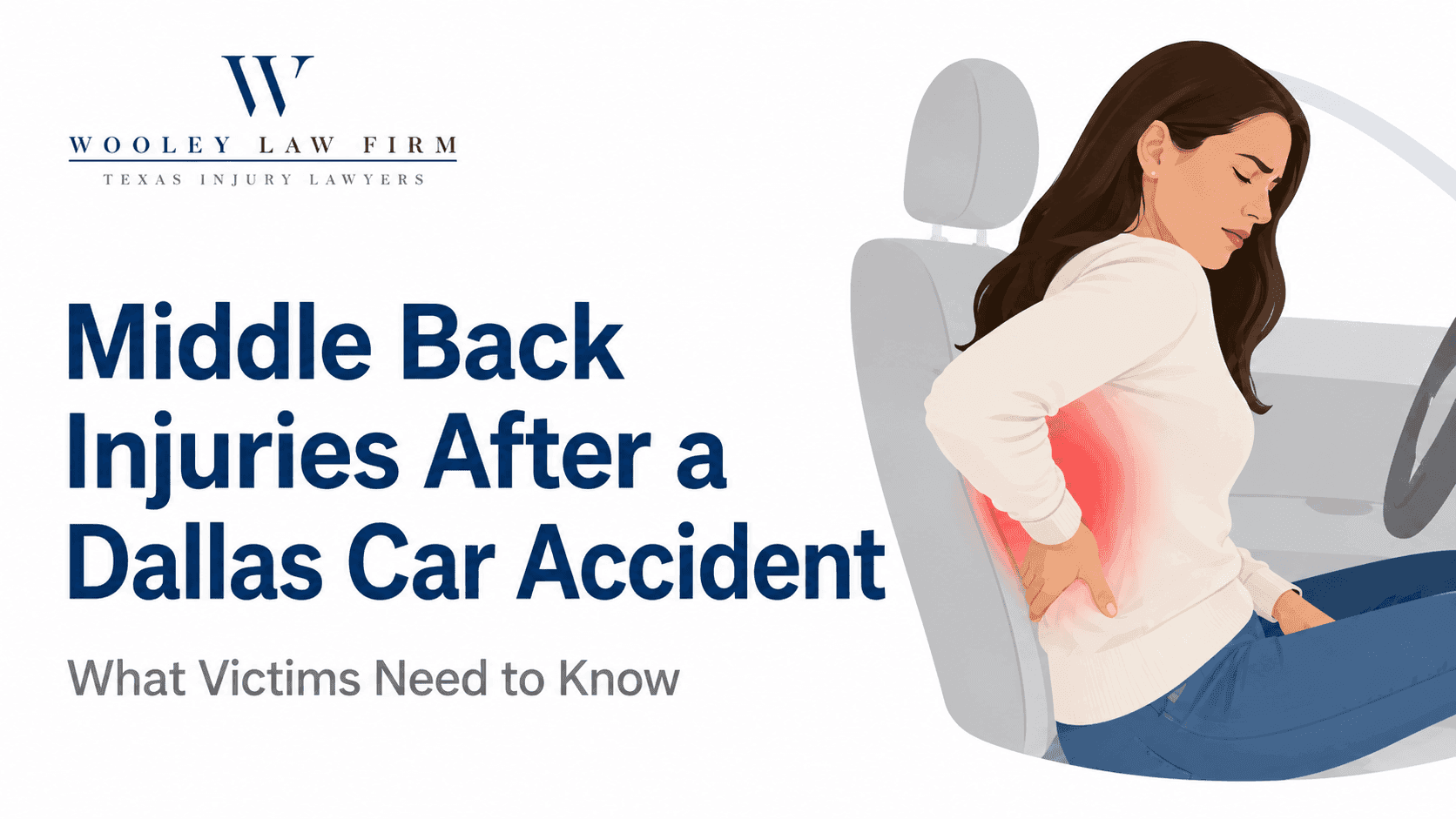
A middle back injury after a car accident can be painful, limiting, and more serious than it first appears. Many people leave a crash thinking they only suffered soreness, stiffness, bruising, or a muscle strain, only to later discover that they have a thoracic spine injury, herniated disc, compression fracture, rib-related injury, nerve irritation, or another condition that may require months of treatment.
Middle back injuries are common after Dallas car accidents because the spine can absorb significant force during a collision. In a rear-end crash, side-impact collision, head-on wreck, rollover, truck accident, rideshare crash, or high-speed collision, the body may be thrown forward, backward, or sideways. The seatbelt may restrain the torso while the spine twists or compresses. The middle back, also called the thoracic spine, can be strained, stretched, compressed, or injured by the force of the wreck.
Even a “minor” middle back injury can cause major problems. The middle back helps support posture, protect the spinal cord, stabilize the ribs, and assist with movement. Pain in this area can make it difficult to sit, stand, drive, sleep, lift, breathe deeply, work, exercise, and care for your family.
At The Wooley Law Firm, Dallas car accident lawyer Andrew J. Wooley represents injured crash victims with middle back injuries ranging from soft tissue injuries to serious spine injuries. These claims may involve emergency room treatment, x-rays, MRIs, CT scans, orthopedic care, pain management, injections, physical therapy, future medical expenses, lost wages, pain, impairment, and loss of enjoyment of life.
Before accepting a settlement from an insurance company, it is important to fully understand the nature of your middle back injury, your future medical needs, and how the injury may affect your work and daily life.
If you suffered a middle back injury in a Dallas car accident, call The Wooley Law Firm at 214-699-6524 or contact us through our website for a free case evaluation.
Why Middle Back Injuries After a Car Accident Should Be Taken Seriously
Insurance companies often try to minimize back injury claims. They may argue that the injury is only soreness, a strain, or a minor soft tissue injury. They may also claim that back pain is related to age, posture, prior injuries, degenerative changes, or everyday activity.
However, middle back injuries can be complicated. A normal x-ray does not always rule out a serious injury. X-rays may help show fractures or alignment problems, but they may not show disc injuries, ligament injuries, nerve irritation, soft tissue trauma, or certain spinal conditions. In many cases, an MRI, CT scan, orthopedic evaluation, pain management referral, or specialist care may be needed.
Pain, stiffness, spasms, radiating symptoms, numbness, tingling, weakness, pain with breathing, or difficulty sitting and standing should not be ignored. A crash victim may need additional medical care to understand the full injury.
Car accident victims should be cautious before settling too quickly. Once a settlement is signed, the insurance company will usually not pay more money if the middle back injury later requires injections, surgery, therapy, or additional treatment.
Common Causes of Middle Back Injuries in Dallas Car Accidents
Middle back injuries can happen in many types of motor vehicle collisions. Common causes include:
Rear-end collisions that force the body forward and backward
Side-impact crashes that twist the torso and spine
Head-on collisions
Rollover accidents
Seatbelt force across the chest and torso
Airbag deployment
The body striking the seat, door, console, or interior of the vehicle
Sudden twisting during impact
Compression forces through the spine
Truck accidents and commercial vehicle crashes
Pedestrian, bicycle, and motorcycle accidents
Rideshare and delivery vehicle collisions
A middle back injury does not have to involve a broken bone to be serious. Disc injuries, muscle spasms, ligament injuries, nerve irritation, and thoracic joint injuries can cause lasting pain and functional problems.
Symptoms of a Middle Back Injury After a Car Accident
Middle back injury symptoms may appear immediately after the crash or worsen over the next several days. Common symptoms include:
Pain between the shoulder blades
Pain in the middle of the back
Stiffness
Muscle spasms
Tenderness
Bruising
Pain with twisting
Pain with bending
Pain when sitting or standing
Pain while driving
Pain with deep breathing
Pain radiating around the ribs or chest wall
Numbness or tingling
Burning pain
Weakness
Reduced range of motion
Difficulty sleeping
Difficulty lifting or carrying objects
Pain that worsens with activity
Any of these symptoms should be taken seriously. A crash victim may need medical evaluation, diagnostic imaging, physical therapy, pain management, injections, or specialist care.
What Is the Thoracic Spine?
The middle back is often referred to as the thoracic spine. This part of the spine is located between the neck and lower back. It connects with the ribs and helps protect important structures in the chest.
The thoracic spine is generally less mobile than the neck or lower back, but it can still be injured in a car accident. When the torso is twisted, compressed, or forcefully restrained during a crash, the thoracic spine may suffer injury.
Thoracic spine injuries can be painful because this area is involved in posture, breathing mechanics, shoulder movement, trunk rotation, and upper-body stability.
Thoracic Sprains and Strains After a Car Accident
A thoracic sprain occurs when ligaments in the middle back are stretched or torn. A strain involves injury to muscles or tendons. These injuries can occur when the back is twisted, stretched, or forced into an abnormal position during a crash.
Symptoms may include:
Middle back pain
Tightness
Muscle spasms
Stiffness
Tenderness
Pain with movement
Pain with sitting or standing
Difficulty sleeping
Reduced range of motion
Mild sprains and strains may improve with rest, medication, stretching, and physical therapy. More serious injuries can last for months and may require additional medical care.
Insurance companies may try to dismiss these injuries as minor, but persistent middle back pain can interfere with work, sleep, driving, household tasks, and daily life.
Thoracic Disc Injuries After a Dallas Car Accident
The discs between the bones of the spine act as cushions. A car accident can injure these discs, causing bulging, protrusion, herniation, or irritation of nearby nerves.
Thoracic disc injuries are less common than neck or lower back disc injuries, but they can be very painful. A disc injury in the middle back may cause localized pain or pain that radiates around the ribs, chest, abdomen, or shoulder blade area.
Symptoms of a thoracic disc injury may include:
Middle back pain
Pain between the shoulder blades
Burning pain
Pain wrapping around the chest or ribs
Numbness or tingling
Muscle weakness
Pain with twisting or bending
Pain with coughing, sneezing, or deep breathing
Difficulty sitting or standing for long periods
Disc injuries are often diagnosed with MRI. Treatment may include physical therapy, medication, injections, pain management, and in some cases surgical evaluation.
Injured in an Accident?
Free consultation. Tell us what happened and learn what options may be available.
Herniated Disc in the Middle Back After a Car Accident
A herniated disc occurs when disc material pushes out and irritates nearby nerves or the spinal cord. In the thoracic spine, this can cause significant pain and unusual symptoms because nerves in this area can travel around the chest wall.
Symptoms may include:
Sharp or burning middle back pain
Pain radiating around the ribs
Chest wall pain
Numbness or tingling
Weakness
Pain that worsens with movement
Pain with prolonged sitting or standing
Muscle spasms
Insurance companies may argue that a herniated disc is degenerative or unrelated to the crash. However, a car accident can cause a new disc injury or aggravate a pre-existing condition. The medical records, imaging, symptoms, and timing of the pain can be important in evaluating the claim.
Compression Fractures After a Car Accident
A compression fracture occurs when a vertebra in the spine collapses or is compressed. Although compression fractures are often associated with older adults or weakened bones, they can also occur after significant trauma, including a car accident.
Symptoms of a thoracic compression fracture may include:
Sudden middle back pain
Pain that worsens with standing or walking
Pain that improves when lying down
Tenderness over the spine
Reduced mobility
Muscle spasms
Stooped posture
Pain with movement
Compression fractures may be diagnosed with x-rays, CT scan, or MRI. Treatment depends on the severity of the injury and may include bracing, medication, activity restrictions, therapy, pain management, or surgical procedures in certain cases.
Thoracic Vertebra Fractures After a Crash
A serious car accident can cause fractures in the bones of the thoracic spine. These injuries may occur in high-impact crashes, rollover wrecks, truck accidents, motorcycle accidents, pedestrian accidents, or severe side-impact collisions.
Symptoms may include:
Severe middle back pain
Tenderness over the spine
Difficulty moving
Muscle spasms
Pain with breathing or movement
Numbness or tingling
Weakness
Difficulty walking in severe cases
Spinal fractures should be taken seriously. Some fractures can be stable and treated with bracing and conservative care. Others may require surgical evaluation, especially if there is instability or nerve involvement.
Rib and Chest Wall Pain Related to Middle Back Injuries
Because the thoracic spine connects with the ribs, a middle back injury after a car accident may also cause rib pain, chest wall pain, or pain with breathing. Seatbelt force, airbag deployment, twisting, or impact against the interior of the vehicle can injure muscles, joints, ribs, and nerves around the thoracic spine.
Symptoms may include:
Pain around the ribs
Pain between the shoulder blades
Pain with deep breathing
Pain with coughing or sneezing
Chest wall tenderness
Pain wrapping from the back to the front of the body
Muscle spasms
These symptoms should be evaluated, especially after a significant crash. A doctor may need to rule out rib fractures, chest injuries, spinal injuries, or nerve-related pain.
Facet Joint Injuries in the Middle Back
Facet joints are small joints in the spine that help control movement. A car accident can irritate or injure these joints, causing localized pain and stiffness.
Symptoms of thoracic facet joint injury may include:
Middle back pain
Pain with twisting
Pain with extension
Stiffness
Muscle spasms
Tenderness near the spine
Pain that worsens with activity
Treatment may include physical therapy, medication, chiropractic care if appropriate, pain management, injections, or other procedures depending on the injury.
Nerve Pain After a Middle Back Injury
Thoracic spine trauma can irritate nerves and cause pain that travels around the torso. Some crash victims describe burning, stabbing, shooting, or electric pain.
Nerve-related symptoms may include:
Burning pain
Shooting pain
Numbness
Tingling
Pain wrapping around the ribs
Pain into the chest wall
Sensitivity to touch
Weakness in more serious cases
Nerve symptoms should not be ignored. They may be related to a disc injury, spinal inflammation, fracture, or nerve compression. A doctor may recommend imaging, nerve testing, medication, therapy, injections, or specialist evaluation.
Aggravation of a Prior Middle Back Condition
Insurance companies often try to blame back pain on pre-existing conditions. They may point to prior back pain, arthritis, degenerative disc disease, scoliosis, old injuries, or age-related changes.
However, a prior back condition does not automatically prevent an injured person from bringing a claim. A car accident can aggravate or worsen a pre-existing condition. A person who was functioning normally before the wreck may suddenly need medical treatment, injections, therapy, work restrictions, or future care after the collision.
The key issue is whether the crash caused new pain, worsened symptoms, increased limitations, or created a need for additional treatment.
How Middle Back Injuries Are Diagnosed After a Car Accident
A middle back injury may require several forms of medical evaluation. Depending on the symptoms, a doctor may recommend:
Physical examination
X-rays
MRI
CT scan
Orthopedic referral
Spine specialist referral
Pain management evaluation
Range-of-motion testing
Strength testing
Neurological examination
Nerve testing
Diagnostic injections
Follow-up imaging
Surgical consultation
It is important for car accident victims to explain how the injury happened, when the pain started, whether symptoms have worsened, and how the middle back injury affects work, driving, sleep, lifting, and daily life.
Treatment for Middle Back Injuries After a Dallas Car Accident
Treatment depends on the type and severity of the injury. Common treatment may include:
Rest
Ice or heat
Anti-inflammatory medication
Pain medication
Muscle relaxers
Activity restrictions
Physical therapy
Chiropractic treatment where appropriate
Pain management
Trigger point injections
Epidural steroid injections
Facet injections
Medial branch blocks
Radiofrequency ablation
Bracing
Orthopedic care
Spine specialist care
Surgical evaluation in serious cases
Long-term rehabilitation
Some middle back injuries improve with conservative treatment. Others require injections, long-term pain management, or surgical evaluation. Either way, the cost of treatment and the impact on the victim’s life should be considered before settling with the insurance company.
How a Middle Back Injury Can Affect Work and Daily Life
A middle back injury can interfere with nearly every part of daily life. Pain, stiffness, and spasms can make basic tasks difficult.
Middle back injuries may affect your ability to:
Sit
Stand
Walk
Drive
Work
Lift objects
Carry groceries
Bend
Twist
Sleep comfortably
Exercise
Cook
Clean
Care for children
Perform household tasks
Travel
Participate in hobbies
For workers who lift, bend, drive, stand, or use their upper body throughout the day, a middle back injury can create serious wage loss and job limitations. This may include construction workers, nurses, delivery drivers, warehouse workers, mechanics, restaurant workers, retail employees, teachers, police officers, firefighters, and many others.
Even office workers may struggle if prolonged sitting increases pain or if driving to work becomes difficult.
Compensation for a Middle Back Injury After a Dallas Car Accident
A middle back injury claim may include compensation for both economic and non-economic damages. Depending on the case, damages may include:
Emergency room bills
Urgent care bills
Doctor visits
Orthopedic treatment
Spine specialist treatment
Pain management treatment
X-rays, MRIs, and CT scans
Physical therapy
Injections
Future medical expenses
Lost wages
Loss of earning capacity
Pain and suffering
Physical impairment
Mental anguish
Disfigurement if surgery is required
Loss of enjoyment of life
Out-of-pocket expenses
A serious middle back injury can affect more than medical bills. It can limit independence, mobility, sleep, work, household responsibilities, hobbies, exercise, and the ability to live normally.
Why You Should Not Settle Too Early After a Middle Back Injury
Insurance companies may contact you quickly after a Dallas car accident and offer a settlement before you know the full extent of your middle back injury. This can be risky.
Before resolving your claim, you should know the answers to important questions:
Do you need an MRI or CT scan?
Have you seen an orthopedic doctor, spine specialist, or pain management doctor?
Is there a herniated disc?
Is there a compression fracture?
Are there rib or chest wall symptoms?
Are you having numbness, tingling, burning, or radiating pain?
Are injections recommended?
Will you need future treatment?
Are you still having pain, spasms, stiffness, or limited motion?
Can you return to work?
Can you sit, stand, drive, lift, and sleep normally?
Do you have permanent impairment?
Have all medical bills been obtained?
Have future medical expenses been evaluated?
Once you accept a settlement, you generally cannot reopen the claim later because your middle back injury became worse or required more treatment. A Dallas car accident lawyer can help evaluate the claim before the insurance company pushes you into a low settlement.
How The Wooley Law Firm Helps Dallas Car Accident Victims
The Wooley Law Firm helps injured car accident victims pursue compensation after serious middle back injuries. Depending on the facts of the case, we may help by:
Investigating the crash
Reviewing the police report
Identifying all insurance coverage
Communicating with the insurance company
Gathering medical records and bills
Documenting lost wages
Evaluating future medical expenses
Reviewing orthopedic, spine, and pain management recommendations
Calculating pain, impairment, and loss of enjoyment damages
Negotiating with the insurance company
Filing a lawsuit when necessary
Insurance companies are not on your side after a wreck. Their goal is to pay as little as possible. Before giving a recorded statement, signing paperwork, or accepting a settlement, speak with a Dallas car accident lawyer who can protect your rights.
Dallas Car Accident Middle Back Injury Lawyer
If you suffered a middle back injury in a car accident in Dallas, Fort Worth, or anywhere in North Texas, The Wooley Law Firm may be able to help. Andrew J. Wooley represents car accident victims with minor and severe middle back injuries and helps them pursue full compensation, including future medical expenses, lost wages, pain and suffering, impairment, and loss of enjoyment of life.
Call 214-699-6524 or contact us through our website for a free case evaluation.
You don’t pay unless we win.
Frequently Asked Questions About Middle Back Injuries After a Car Accident
Can a car accident cause middle back pain?
Yes. A car accident can cause middle back pain when the thoracic spine is twisted, compressed, strained, or injured during impact. Middle back pain may involve muscles, ligaments, discs, nerves, ribs, or vertebrae.
What is a thoracic spine injury?
A thoracic spine injury involves the middle portion of the spine between the neck and lower back. These injuries may include sprains, strains, disc injuries, fractures, nerve irritation, and joint injuries.
Can a car accident cause a herniated disc in the middle back?
Yes. Although thoracic herniated discs are less common than neck or lower back disc injuries, a car accident can cause or aggravate a disc injury in the middle back.
What if my x-ray was normal but I still have middle back pain?
A normal x-ray does not always rule out a serious injury. Disc injuries, ligament injuries, nerve irritation, soft tissue injuries, and some fractures may require MRI, CT scan, or specialist evaluation.
Can middle back pain radiate around the ribs?
Yes. Thoracic spine injuries can irritate nerves that travel around the ribs and chest wall. This may cause burning, wrapping, or radiating pain from the back toward the front of the body.
What if I had back problems before the accident?
A prior back problem does not automatically prevent you from bringing a personal injury claim. A car accident can aggravate or worsen a pre-existing condition. The key issue is whether the crash caused new pain, worsened symptoms, or increased the need for treatment.
Should I settle my car accident claim before my middle back treatment is finished?
It is usually risky to settle before you understand the full extent of your middle back injury. If you later need injections, specialist care, future treatment, or additional medical evaluation, the insurance company may not have to pay more after a settlement is signed.
What compensation can I recover for a middle back injury after a Dallas car accident?
Compensation may include medical bills, future medical expenses, lost wages, loss of earning capacity, pain and suffering, physical impairment, mental anguish, and loss of enjoyment of life.
Important Note
Andrew J. Wooley is not a healthcare provider. He is an attorney who primarily practices personal injury law. If you have questions about a middle back injury, medical treatment, symptoms, or your overall health, you should contact a qualified healthcare provider.
For more information about your rights after a wreck, visit our Dallas Car Accident Attorney page.
Topics
Share This Article

Andrew J. Wooley
Personal Injury Attorney
Andrew J. Wooley is a dedicated personal injury attorney based in Dallas, Texas. He focuses on helping accident victims recover fair compensation for their injuries. With a commitment to personalized service, Andrew works directly with each client to understand their unique situation and fight for their rights.
Related Local News
Recent related coverage