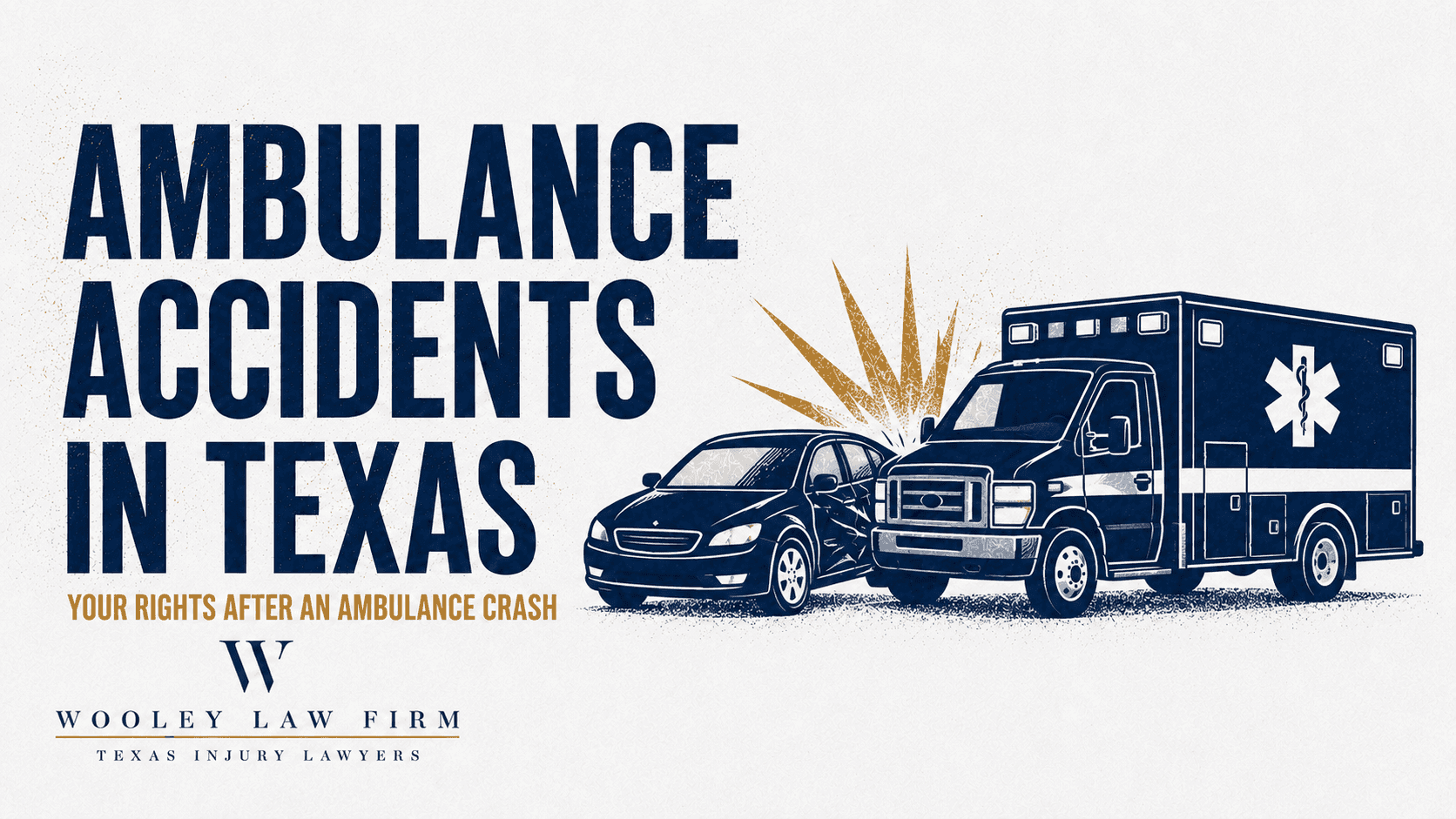
If you were hit by an ambulance in Texas, you may be wondering who is responsible, whether emergency vehicles are allowed to run red lights, and whether you can sue an ambulance driver, EMS provider, city, county, or private ambulance company.
Ambulance accident cases are not ordinary car accident claims. They often involve emergency vehicle laws, government immunity rules, short notice deadlines, insurance issues, and sometimes medical malpractice questions. The ambulance driver may have been responding to an emergency, but that does not automatically excuse unsafe driving.
According to TxDOT CRIS Query data, there were 1,113 crashes in Texas involving an ambulance, resulting in 420 injuries and 5 deaths. These ambulance-involved crashes happened across Texas, including Houston, Fort Worth, San Antonio, Austin, Dallas, and many crashes outside city limits.
If you or a loved one was injured in a crash with an ambulance, you should speak with a Texas ambulance accident lawyer quickly. Your deadline may be much shorter than in a typical car accident case, especially if the ambulance was operated by a city, county, fire department, hospital district, or other government entity.
Call The Wooley Law Firm at (214) 699-6524 for a free consultation. You don’t pay unless we win. Contact Us Today!
Can You Sue After an Ambulance Accident in Texas?
Yes, you may be able to bring a claim after an ambulance accident in Texas, but the type of claim depends on who caused the crash and who owned or operated the ambulance.
A claim may involve:
A private ambulance company
A city or county EMS department
A fire department ambulance
A hospital district or governmental EMS provider
The ambulance driver
Another driver who failed to yield
A vehicle maintenance company
A manufacturer, if defective equipment contributed to the crash
The first question is usually whether the ambulance was public or private. That distinction matters because claims against government-operated ambulances may be subject to the Texas Tort Claims Act.
Texas Ambulance Crash Statistics
Ambulance crashes happen more often than many people realize. According to TxDOT CRIS Query data, there were:
1,113 ambulance-involved crashes in Texas
420 injuries
5 deaths
The cities with the highest number of ambulance crashes included:
Houston: 135 crashes
Fort Worth: 82 crashes
San Antonio: 73 crashes
Austin: 48 crashes
Dallas: 44 crashes
Laredo: 22 crashes
Corpus Christi: 21 crashes
El Paso: 21 crashes
Brownsville: 13 crashes
Beaumont: 12 crashes
Another 230 ambulance crashes occurred outside city limits.
By county, the highest numbers of ambulance-involved crashes included:
Harris County: 251 crashes
Tarrant County: 102 crashes
Bexar County: 91 crashes
Dallas County: 69 crashes
Travis County: 50 crashes
Hidalgo County: 43 crashes
Fort Bend County: 40 crashes
El Paso County: 25 crashes
Cameron County: 24 crashes
Webb County: 22 crashes
Montgomery County: 21 crashes
Nueces County: 21 crashes
These numbers show that ambulance crashes are a serious issue throughout Texas, especially in high-traffic areas like Houston, Dallas-Fort Worth, San Antonio, Austin, and the Rio Grande Valley.
Why Ambulance Crashes at Intersections Are So Dangerous
Intersections are one of the most dangerous places for an ambulance accident.
According to TxDOT CRIS Query data, 344 ambulance-involved crashes happened at intersections. In 91 of those intersection crashes, “failed to yield the right of way to an emergency vehicle” was listed as a contributing factor.
Texas drivers generally must yield to ambulances and other emergency vehicles using lights and sirens. But that does not mean every ambulance crash is automatically the fault of the other driver.
Many ambulance wrecks happen because intersections are unpredictable. Drivers may not hear a siren in time. Buildings, traffic, music, road noise, weather, or other vehicles may block visibility or sound. Some drivers panic or move the wrong way. Others may not know where the ambulance is coming from.
Because of these risks, ambulance drivers must still use caution before entering an intersection.
Are Ambulances Allowed to Run Red Lights in Texas?
Texas law gives emergency vehicle drivers certain privileges during an emergency response, but those privileges are limited.
Under Texas Transportation Code § 546.001, the operator of an authorized emergency vehicle may proceed past a red light or stop signal during an emergency response, but only after slowing as necessary for safe operation.
That means an ambulance driver cannot simply blow through a red light without considering whether it is safe.
Texas law also limits emergency vehicle speed. An ambulance driver cannot exceed the maximum speed limit if doing so endangers life or property.
Ambulance Drivers Must Use Due Regard for Safety
Even during an emergency, ambulance drivers must use due regard for the safety of others.
Texas Transportation Code § 546.005 states that emergency vehicle laws do not relieve the operator of an authorized emergency vehicle from:
The duty to operate the vehicle with appropriate regard for the safety of all persons; or
The consequences of reckless disregard for the safety of others.
Texas Transportation Code § 545.156(b) also makes clear that emergency vehicle rules do not exempt the operator from the duty to drive with due regard for the safety of everyone using the highway.
In plain English: ambulance drivers may have special privileges during an emergency, but they do not have permission to drive recklessly.
Injured in an Accident?
Free consultation. Tell us what happened and learn what options may be available.
Do Lights and Sirens Automatically Give an Ambulance the Right of Way?
No. Lights and sirens do not automatically give an ambulance unlimited right of way.
Lights and sirens are warning devices. They tell other drivers to yield, but they do not allow an ambulance driver to ignore obvious danger, enter an intersection blindly, speed through heavy traffic without caution, or assume every driver has seen and heard the ambulance.
Safe ambulance operation may require the driver to:
Slow down before entering an intersection
Confirm that cross-traffic has yielded
Use both visual and audible warning devices
Proceed cautiously, often one lane at a time
Treat each lane as a separate danger zone
Watch for drivers who may not see or hear the ambulance
Avoid excessive speed when it would endanger life or property
Local EMS policies, fire department rules, ambulance company procedures, dispatch records, GPS data, and video footage can all become important evidence in an ambulance accident case.
Public vs. Private Ambulance Accident Claims in Texas
Ambulance accident claims often depend on whether the ambulance was operated by a government entity or a private company.
Public or Government Ambulance Accidents
If the ambulance was operated by a city, county, fire department, EMS district, hospital district, or other governmental unit, the claim may be governed by the Texas Tort Claims Act.
The Texas Tort Claims Act can limit lawsuits against government entities. A governmental unit may be liable for personal injury or property damage caused by an employee’s negligent operation or use of a motor-driven vehicle, but special rules apply.
Claims involving public ambulances may involve:
Sovereign immunity issues
Damage caps
Short notice deadlines
Special defenses
Emergency response exceptions
Strict procedural requirements
This is one reason it is important to contact an attorney quickly after a crash with a city, county, or fire department ambulance.
Private Ambulance Company Accidents
If the ambulance was owned or operated by a private ambulance company, the Texas Tort Claims Act typically does not apply.
Instead, the case is usually handled under ordinary negligence, auto liability, and personal injury law. A private ambulance company may be liable if its driver caused a crash by acting negligently or recklessly.
Depending on the facts, a private ambulance company may also be responsible for:
Negligent hiring
Poor training
Inadequate supervision
Unsafe emergency response policies
Failure to maintain the ambulance
Failure to follow company safety procedures
Ambulance Accident Cases May Involve Medical Malpractice
Ambulance cases can be more complex than a typical car accident because the ambulance crew may be responsible for more than safely operating the vehicle. In many situations, the ambulance crew is also providing medical care during transport.
That means an ambulance-related injury claim may involve both general car wreck law and medical malpractice law, depending on what went wrong.
A case may involve negligent driving if the ambulance driver:
Ran a red light unsafely
Failed to slow down at an intersection
Drove too fast for the conditions
Failed to use lights or sirens properly
Caused a collision with another vehicle
But a case may also involve medical negligence if the ambulance crew:
Failed to properly monitor the patient
Failed to secure the patient during transport
Failed to provide appropriate emergency care
Failed to respond to a medical complication
Dropped or mishandled a patient
Failed to safely transfer the patient into or out of the ambulance
The ambulance crew is not just driving a vehicle. They may also be responsible for patient care during a medical emergency. If they fail to do that safely and someone is harmed, the injured person may have the right to seek compensation.
Texas Tort Claims Act Notice Deadlines for Government Ambulance Crashes
If a government-operated ambulance caused the crash, your deadline may be much shorter than you think.
Under Section 101.101 of the Texas Tort Claims Act, a governmental unit must receive notice of a claim within a short period of time. The general TTCA deadline may be six months, but some cities and municipalities have local charter provisions requiring notice much sooner, sometimes within 90 days.
Missing the applicable notice deadline can permanently bar your claim.
This is one of the most important reasons to speak with an attorney immediately after a crash involving a city ambulance, county ambulance, fire department ambulance, EMS district, or other public emergency vehicle.
What Evidence Matters in an Ambulance Accident Case?
Ambulance crash cases are evidence-heavy. Important evidence may include:
Police crash reports
TxDOT crash data
Ambulance driver statements
Witness statements
Dash camera footage
Body camera footage
Nearby surveillance video
Traffic light timing data
911 dispatch records
EMS run reports
GPS and vehicle tracking data
Ambulance speed data
Maintenance records
Company safety policies
Fire department or EMS standard operating guidelines
Medical records
Photos of vehicle damage and injuries
This evidence should be requested and preserved quickly. Video footage, dispatch records, and government documents can be lost or overwritten if action is not taken early.
What To Do If You Were Hit by an Ambulance in Texas
If you were injured in a crash with an ambulance, take these steps as soon as possible:
Call 911 and get medical help.
Report every injury and symptom.
Take photos and videos of the vehicles, intersection, traffic lights, road conditions, skid marks, debris, and visible injuries.
Get names and contact information for witnesses.
Find out whether the ambulance was public or private.
Do not assume the ambulance driver is automatically protected from liability.
Do not give a recorded statement without legal advice.
Contact an attorney quickly, especially if a government entity may be involved.
Ambulance crash claims can involve short deadlines and complex liability issues. The sooner you act, the better chance you have of preserving evidence and protecting your rights.
Who Pays After an Ambulance Accident in Texas?
Who pays after an ambulance accident depends on who caused the crash and what type of ambulance was involved.
Potential sources of compensation may include:
A private ambulance company’s insurance
A government entity, subject to TTCA limits and rules
Another driver’s insurance
A commercial auto policy
An uninsured or underinsured motorist policy
A medical malpractice insurance policy, if patient care was involved
Because multiple insurance policies and legal rules may apply, ambulance accident cases should be investigated carefully from the beginning.
Injured in a Texas Ambulance Accident? Call The Wooley Law Firm
If you were injured in a crash with an ambulance in Texas, you may have questions about your rights, your medical bills, your lost wages, and whether you can sue the ambulance driver, EMS provider, city, county, or private ambulance company.
The answer depends on the facts. Was the ambulance public or private? Was it using lights and sirens? Did the driver slow down before entering the intersection? Did another driver fail to yield? Was the crew providing medical care? Did a government notice deadline apply?
At The Wooley Law Firm, we help injured Texans understand their rights after serious vehicle crashes, including crashes involving ambulances, EMS providers, fire department vehicles, and other emergency vehicles.
Call (214) 699-6524 for a free consultation. You don’t pay unless we win. Contact Us Today!
Frequently Asked Questions About Texas Ambulance Accidents
Can I sue if I was hit by an ambulance in Texas?
Yes, you may be able to sue after an ambulance crash in Texas, but the rules depend on whether the ambulance was operated by a private company or a government entity.
Are ambulances allowed to run red lights in Texas?
Ambulance drivers may proceed through red lights in certain emergency situations, but they must slow as necessary for safe operation and use due regard for the safety of others.
What if the ambulance had its lights and siren on?
Lights and sirens do not automatically excuse unsafe driving. They warn other drivers to yield, but ambulance drivers still must avoid reckless disregard for public safety.
How long do I have to file a claim after a crash with an ambulance?
Deadlines depend on the facts. If a government ambulance was involved, special notice deadlines may apply and can be much shorter than a typical personal injury deadline.
Is an ambulance crash a personal injury case or a medical malpractice case?
It can be either or both. If the crash involved unsafe driving, it may be a personal injury claim; if the ambulance crew failed to provide safe medical care, it may also involve medical malpractice issues.
This blog is for general informational purposes only and is not legal advice. Reading this article does not create an attorney-client relationship with The Wooley Law Firm.
Topics
Share This Article

Andrew J. Wooley
Personal Injury Attorney
Andrew J. Wooley is a dedicated personal injury attorney based in Dallas, Texas. He focuses on helping accident victims recover fair compensation for their injuries. With a commitment to personalized service, Andrew works directly with each client to understand their unique situation and fight for their rights.
Related Local News
Recent related coverage