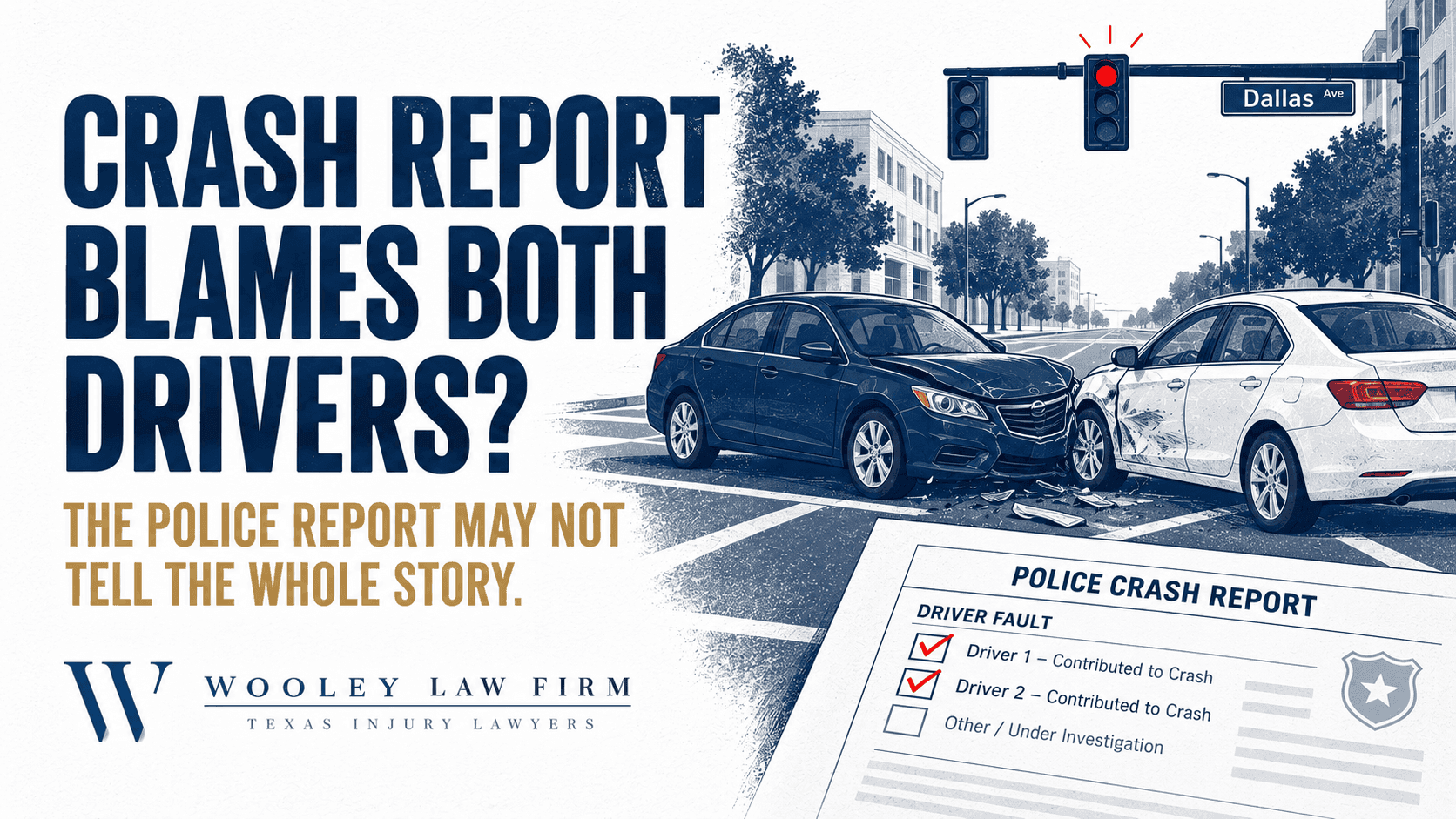
You entered a Dallas intersection on a green light.
Another vehicle came through the intersection against a red light and hit you.
But when the police arrived, there were no independent witnesses standing around, no obvious video available, and both drivers told completely different stories.
You told the officer, “My light was green.”
The other driver said exactly the same thing.
Then the Texas Peace Officer’s Crash Report came out—and instead of blaming the driver who ran the red light, the report lists contributing factors for both drivers or otherwise leaves fault unclear.
Now the other driver’s insurance company may be using that report to deny your claim, reduce what it is willing to pay, or argue that you were at least partially responsible for the collision.
That does not necessarily mean your case is over.
A police officer usually arrives after a collision. When there is no independent witness and both drivers claim they had the green light, the officer may have limited information available at the scene.
A serious Dallas red-light accident claim may require an investigation that goes well beyond the crash report.
The Wooley Law Firm represents people injured in disputed Dallas car accidents. When the other driver says you caused the wreck and the crash report does not tell the entire story, we can investigate the collision, search for objective evidence, deal with the insurance companies, and work to establish what actually happened.
What Happens When Both Drivers Say They Had the Green Light?
Red-light crashes can become some of the most difficult car accident claims because the central issue may come down to one question:
Who actually had the green light?
Imagine a T-bone collision at a Dallas intersection.
You are traveling northbound. Your light turns green, and you proceed through the intersection.
A vehicle traveling eastbound enters the intersection and crashes into the side of your vehicle.
You tell the investigating officer that the eastbound driver ran a red light.
The other driver insists the opposite: that their light was green and you ran the red light.
If nobody else saw the collision—or nobody stayed at the scene—the officer may be faced with conflicting statements and limited physical evidence.
That is the classic “he said, she said” red-light crash.
But a personal injury case does not have to remain a he-said-she-said case.
The purpose of a thorough investigation is to find evidence that can independently confirm which version of the collision is correct.
A Dallas Crash Report Is Important—but It Is Not the Entire Investigation
A Texas Peace Officer’s Crash Report can contain important information about a collision, including:
The drivers and vehicles involved
Insurance information
The location of the crash
Vehicle damage
A collision diagram
Driver statements
Witness information
Citations
Contributing factors
The investigating officer’s narrative
But the investigating officer ordinarily did not personally see the collision happen.
The officer may be reconstructing the wreck based on what the drivers said, where the vehicles ended up, visible vehicle damage, roadway evidence, and whatever witnesses or video were available at that moment.
The officer may not have had access to surveillance footage that existed at a nearby business.
The officer may not know that another vehicle had a dash camera.
The officer may not have obtained traffic-signal timing records.
The officer may not have downloaded electronic data from the vehicles.
The officer may not have located witnesses who left before police arrived.
That is why the police report can be an important starting point without necessarily being the final word on liability.
If you have not obtained your report yet, The Wooley Law Firm also has a guide explaining how to obtain a Texas Peace Officer’s Crash Report after a Dallas-Fort Worth car accident.
The Police Report Says We Were Both at Fault. Can I Still Have a Case?
Potentially, yes.
Texas uses a system of proportionate responsibility.
Under Texas Civil Practice and Remedies Code Chapter 33, responsibility can be divided among the people whose conduct caused or contributed to an injury. A claimant generally cannot recover if the claimant is found more than 50% responsible. If the claimant is 50% or less responsible, any recovery can generally be reduced according to the percentage of responsibility assigned to that claimant.
That means an insurance company's allegation that you share some responsibility does not automatically eliminate your claim.
More importantly, the percentage written or implied in an insurance adjuster's evaluation is not necessarily what the evidence will ultimately establish.
If the other driver actually entered the intersection against a red light, evidence discovered after the crash may substantially change the liability analysis.
What Evidence Can Prove the Other Driver Ran the Red Light?
This is where hiring a Dallas car wreck lawyer can become particularly important.
Instead of simply accepting competing driver statements, an attorney can investigate whether objective evidence exists.
Surveillance Video From Nearby Businesses
One of the first places to look is around the intersection itself.
A nearby:
Gas station
Restaurant
Convenience store
Office building
Apartment complex
Shopping center
Bank
Parking garage
Hotel
Residence
may have a camera pointed toward the roadway.
The camera does not necessarily need to show the traffic signal itself.
Video may show the timing and movement of vehicles entering the intersection, surrounding traffic stopping, or one vehicle entering substantially later than the others.
The problem is that surveillance footage may be overwritten.
That is why identifying and preserving video quickly can be critical. Our article on preserving dashcam and surveillance footage after a Texas wreck explains why waiting can result in valuable evidence disappearing.
Injured in an Accident?
Free consultation. Tell us what happened and learn what options may be available.
Dashcam Video
Dashcam footage can transform a disputed red-light case.
Your vehicle may have a dash camera.
The vehicle behind you may have one.
A rideshare driver, delivery driver, commercial truck, bus, or other passing vehicle may also have recorded the intersection.
Depending on the camera angle, footage may establish:
The color of the traffic light
When the light changed
Which vehicle entered first
Whether traffic in one direction had stopped
The other vehicle’s speed
Whether the other driver attempted to brake
The point of impact
This is why dash-camera evidence can be particularly valuable when both drivers claim they had the right of way.
Independent Witnesses
The most important witness may be someone whose name never appeared on the police report.
A driver who stopped briefly after the wreck may have seen the other vehicle run the light.
A pedestrian may have been waiting at the corner.
Someone working inside a nearby business may have heard the impact and seen what happened immediately beforehand.
Passengers in surrounding vehicles may also have useful information.
A Dallas car accident lawyer can investigate whether witnesses exist beyond those identified by the responding officer.
Traffic-Signal Timing Information
Some disputed intersection cases require a closer examination of how the traffic signal operates.
Relevant information may include:
Signal phase sequences
Green-light intervals
Yellow-light intervals
Protected turn phases
Red-clearance intervals
Traffic-actuated signal information
Maintenance or malfunction records
Texas law generally requires a driver facing a steady red signal to stop and remain stopped until permitted to proceed, subject to permitted turns after stopping and yielding.
Understanding the actual sequence of the intersection's signals can sometimes help determine whether one driver's version of events is physically possible.
Vehicle Damage and Point of Impact
The location of damage can also matter.
Suppose the other driver claims that you entered the intersection late.
But the front of their vehicle struck the rear passenger side of yours.
That evidence may suggest your vehicle had already traveled much farther through the intersection before the collision.
Damage alone may not answer every liability question, but it can help test whether the drivers' stories match the physical evidence.
Event Data and Other Electronic Evidence
Modern vehicles can contain electronic information relating to the seconds before a crash.
Depending on the vehicle and circumstances, data may help investigators evaluate:
Vehicle speed
Braking
Accelerator position
Seat-belt status
Changes in velocity
Other pre-impact information
Electronic data can become especially important when the other driver claims they stopped, slowed down, or attempted to avoid the collision.
Why Insurance Companies May Take Advantage of a “He Said, She Said” Crash
When liability is uncertain, an insurance carrier may see an opportunity to minimize what it pays.
The adjuster may say:
“The police report puts fault on both drivers.”
Or:
“We cannot determine who had the green light.”
Or:
“Our insured says you ran the red light.”
The insurer may then deny the claim entirely or try to assign part of the responsibility to you.
That matters because under Texas's proportionate-responsibility system, the percentage of fault assigned to an injured person can directly affect the amount that person may recover.
If you are being blamed for a wreck that you believe the other driver caused, our article Think You Were at Fault for a Dallas Car Accident? You May Still Have a Case explains the Texas 51% rule and why an initial allegation of fault does not necessarily determine the outcome.
Why Hiring a Dallas Car Wreck Lawyer Early Can Matter
In a straightforward accident where the other driver immediately admits fault and clear video exists, liability may not require extensive investigation.
A disputed red-light crash is different.
When both drivers claim the light was green, the evidence that breaks the tie may disappear quickly.
Surveillance footage can be overwritten.
Witnesses can become difficult to locate.
Vehicles can be repaired or totaled.
Electronic information may become harder to obtain.
Businesses may discard recordings.
That is why it can be important to have an attorney investigating the collision while evidence is still available.
How The Wooley Law Firm Investigates Disputed Red-Light Accidents
At The Wooley Law Firm, we do not have to accept an insurance company's conclusion simply because the crash report lists contributing factors for both drivers.
Depending on the facts of the case, our investigation may include:
Reviewing the complete crash report
Reviewing body-camera or dash-camera footage from responding officers
Inspecting photographs of the vehicles and intersection
Locating businesses and residences with surveillance cameras
Sending evidence-preservation requests
Searching for dashcam footage
Interviewing witnesses
Investigating the traffic-signal sequence
Examining vehicle damage and point of impact
Evaluating electronic vehicle information when available
Reviewing the other driver's statements for inconsistencies
Investigating whether distraction, speeding, or impairment contributed to the collision
Working with accident-reconstruction professionals when appropriate
Presenting the evidence to the insurance company
Filing a lawsuit when necessary to obtain evidence or pursue the claim
The goal is simple:
Find the evidence that tells the story the crash report could not.
Do Not Assume You Lost Your Case Because of the Police Report
This is one of the most important things for an injured driver to understand.
If you know you had the green light, do not assume your case is hopeless because the responding officer could not determine exactly what happened.
The officer may have had only two conflicting stories.
A Dallas car accident attorney may have the ability to conduct a much broader investigation.
Your case could ultimately depend on a surveillance camera across the street, an unidentified witness, traffic-signal information, a dashcam recording, electronic vehicle data, or physical evidence that was never available to the officer at the scene.
Our broader Dallas car accident lawyer resource explains how The Wooley Law Firm handles serious injury claims and disputed-liability crashes throughout Dallas.
Frequently Asked Questions About Disputed Red-Light Crashes in Dallas
What if both drivers say they had the green light?
The case may require additional evidence. Surveillance footage, dashcams, witnesses, traffic-signal timing, vehicle damage, electronic data, and the location of the impact can all potentially help determine which driver had the right of way.
Can the police report be wrong about who caused a Dallas car accident?
A crash report is based on the information available to the investigating officer. The officer may not have witnessed the collision and may not have access to evidence discovered later. Additional investigation can sometimes provide information that was unavailable when the report was prepared.
What if the other driver's insurance company denies my claim because of the crash report?
A denial does not necessarily determine whether you have a valid personal injury claim. A lawyer can review the carrier's liability position and investigate whether additional evidence supports your version of the collision.
Can I recover if the insurance company says I was partly at fault?
Possibly. Texas's proportionate-responsibility law generally permits recovery when a claimant's responsibility is 50% or less, although any recovery can be reduced based on the claimant's percentage of responsibility. A claimant who is found more than 50% responsible generally cannot recover damages.
What if there were no witnesses?
You may still have a case. Witness testimony is only one form of evidence. Video, vehicle damage, traffic-signal information, electronic vehicle data, photographs, debris, roadway evidence, and accident reconstruction may also help establish what happened.
How quickly should I hire a lawyer after a disputed red-light accident?
The sooner an investigation begins, the better the opportunity may be to identify and preserve evidence before it disappears. Video footage in particular may be overwritten or deleted.
Injured by a Driver Who Ran a Red Light in Dallas? Call The Wooley Law Firm
If another driver ran a red light and injured you in Dallas, but the crash report blames both drivers because each person claims to have had the green light, do not assume the police report ends your case.
The Wooley Law Firm can investigate beyond the report.
We can look for surveillance video, dashcam footage, witnesses, traffic-signal evidence, vehicle data, photographs, and other evidence that may show what actually happened.
We represent injured people in serious car wrecks throughout Dallas and North Texas, including cases where liability is disputed and the insurance company is trying to blame the injured driver.
Call The Wooley Law Firm at (214) 699-6524 for a free consultation. You don't pay unless we win.
Disclaimer
This article is for general informational purposes only and is not legal advice. Reading it does not create an attorney-client relationship. Every case is different.
Topics
Share This Article
Andrew J. Wooley
Personal Injury Attorney
Andrew J. Wooley is a dedicated personal injury attorney based in Dallas, Texas. He focuses on helping accident victims recover fair compensation for their injuries. With a commitment to personalized service, Andrew works directly with each client to understand their unique situation and fight for their rights.
Related Local News
Recent related coverage