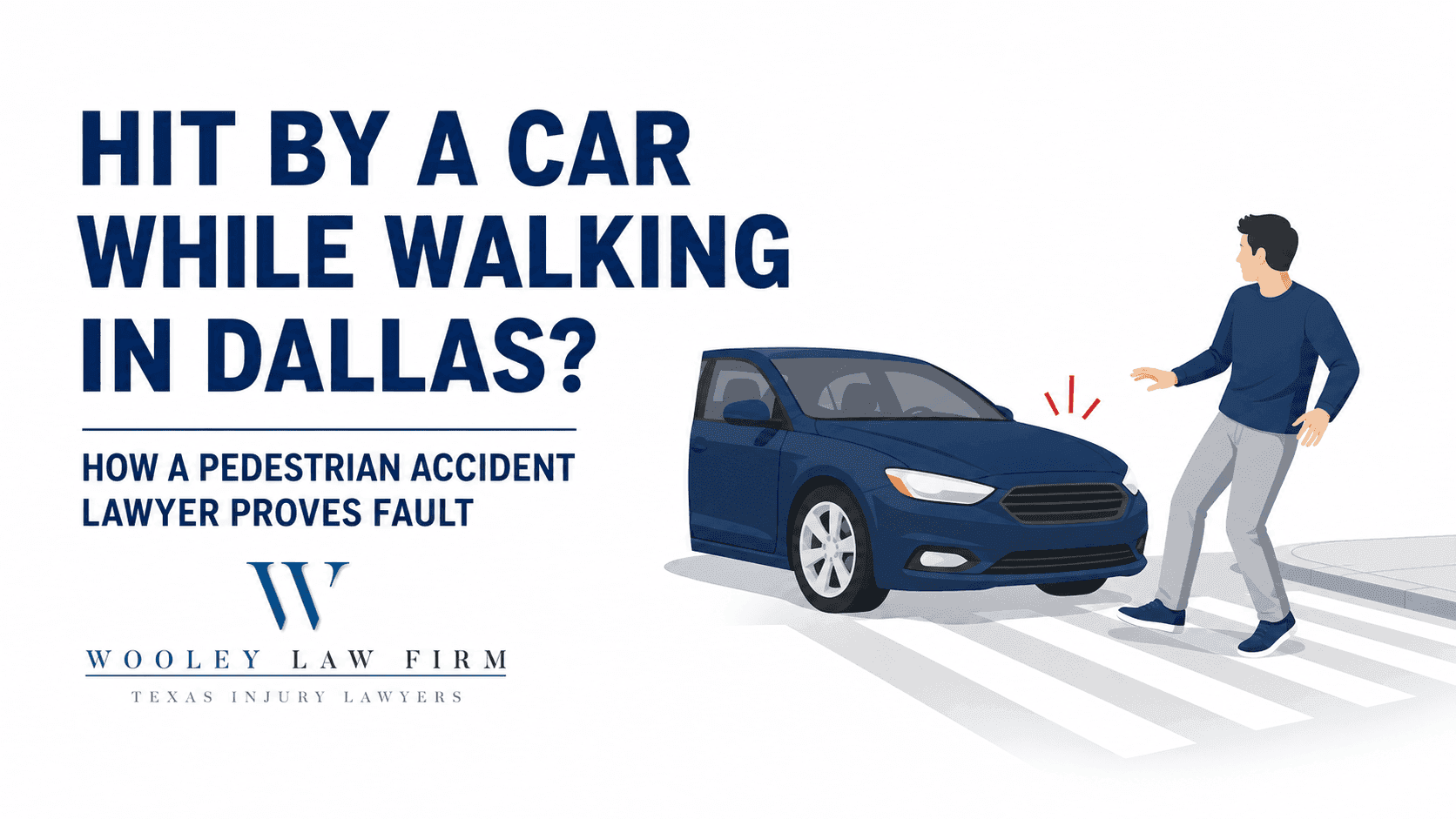
Being hit by a car while walking can cause devastating injuries in a matter of seconds. Unlike someone inside a vehicle, a pedestrian has no seat belt, airbag, steel frame, or other meaningful protection from the force of a collision.
For injured pedestrians and their families, one of the first questions after a crash is often: Who had the right-of-way?
The answer is important, but a successful pedestrian accident case usually involves much more than determining whether someone was inside a painted crosswalk. An investigation may need to establish where the pedestrian was walking, what the traffic signals showed, whether the driver was turning, how fast the vehicle was traveling, whether the driver was distracted, what the lighting conditions were, and how long the pedestrian should have been visible before impact.
At The Wooley Law Firm, we have represented pedestrians seriously injured by vehicles as well as families who have lost loved ones in pedestrian crashes. Our firm has recovered millions of dollars for injured clients in personal injury cases.
When we investigate a serious pedestrian accident, we focus on obtaining the evidence necessary to answer one critical question:
What should the driver have seen, and what should the driver have done to avoid the collision?
Texas Pedestrian Right-of-Way Laws
Texas pedestrian cases are governed in part by Chapter 552 of the Texas Transportation Code.
The law does not simply say that pedestrians always have the right-of-way or that drivers always have the right-of-way. The rules depend on where the pedestrian was crossing, what traffic signals were present, and what was happening immediately before the collision.
Pedestrians With a Walk Signal
When a pedestrian control signal displays “Walk,” a pedestrian may proceed across the roadway in the direction of that signal.
Texas Transportation Code § 552.002 provides that the operator of a vehicle must stop and yield the right-of-way to a pedestrian proceeding with the Walk signal.
This becomes especially important in crashes involving drivers making turns.
A pedestrian may have a Walk signal while a driver is:
turning right through the crosswalk;
turning left across the pedestrian’s path;
watching for approaching vehicles instead of pedestrians; or
attempting to beat a traffic light.
A driver can look toward traffic coming from one direction while failing to check the crosswalk in the direction the vehicle is actually traveling.
That is why simply knowing that the driver had a green light does not necessarily resolve a pedestrian accident claim.
Pedestrians in Crosswalks Without a Traffic Signal
Texas law also protects pedestrians using crosswalks when no traffic control signal is present or operating.
Under Texas Transportation Code § 552.003, a driver generally must stop and yield when a pedestrian is crossing in a crosswalk and is either on the driver's half of the roadway or approaching closely enough from the opposite half to be in danger.
The law also states that a pedestrian cannot suddenly step from a curb or other place of safety into the path of a vehicle so close that the driver cannot reasonably stop.
This is why the precise sequence of events matters.
In a disputed pedestrian accident, we may need to determine:
How long was the pedestrian in the roadway before impact?
How far away was the approaching vehicle?
How fast was the vehicle traveling?
When should the pedestrian have become visible to an attentive driver?
Those questions often require much more investigation than simply looking at where the pedestrian landed after impact.
Drivers Still Have a Duty to Exercise Due Care
One of the most important Texas pedestrian laws is sometimes overlooked.
Texas Transportation Code § 552.008 separately requires drivers to exercise due care to avoid colliding with a pedestrian on a roadway.
That means a pedestrian case does not always end simply because an insurance adjuster claims the pedestrian was not in a marked crosswalk.
The circumstances still matter.
Was the pedestrian plainly visible?
Was the driver speeding?
Was the driver looking at a phone?
Was there enough time to brake?
Did the driver ever attempt to avoid the collision?
Did the driver see the pedestrian but react too late?
Was the driver making an unsafe turn?
These are factual questions that can become central to proving negligence.
You can review the current pedestrian statutes in Texas Transportation Code Chapter 552.
What If the Pedestrian Was Not in a Crosswalk?
Insurance companies frequently use some version of the same argument:
“The pedestrian was jaywalking, so our driver isn't responsible.”
The law is more complicated than that.
Texas Transportation Code § 552.005 generally requires a pedestrian crossing somewhere other than a marked crosswalk or an unmarked crosswalk at an intersection to yield the right-of-way to vehicles on the roadway.
But that does not automatically mean the driver bears no responsibility for a collision.
The investigation may still examine whether the driver:
was speeding;
was distracted;
was impaired;
failed to keep a proper lookout;
had sufficient time and distance to avoid the pedestrian;
failed to brake;
drove with inadequate headlights;
made an unsafe lane movement; or
otherwise failed to exercise reasonable care.
Texas also uses a proportionate-responsibility system. Depending on the facts, responsibility can potentially be divided between the people involved. Texas Civil Practice and Remedies Code § 33.001 generally prevents a claimant from recovering when the claimant's percentage of responsibility is greater than 50 percent.
That makes evidence especially important when an insurance company tries to place all or most of the blame on the pedestrian.
“The Pedestrian Came Out of Nowhere”
This is one of the most common defenses after a pedestrian accident.
Drivers frequently say:
“I never saw them.”
“They came out of nowhere.”
“It was too dark.”
“I didn't have enough time to stop.”
Those statements do not necessarily establish what actually happened.
A major part of our investigation can involve determining how long the pedestrian should have been visible to an attentive driver.
Visibility Can Be Reconstructed
Pedestrian visibility can depend on factors such as:
street lighting;
nearby businesses and parking-lot lighting;
headlights;
weather conditions;
the driver's direction of travel;
the pedestrian's direction of travel;
vehicle speed;
curves or hills;
parked vehicles;
landscaping;
roadway signs;
construction barriers;
other vehicles; and
the driver's line of sight.
A pedestrian accident lawyer may return to the scene at approximately the same time of day as the collision to document lighting and sight distances.
In serious cases, accident-reconstruction or human-factors experts may also analyze how far away a pedestrian could reasonably have been detected and how much time the driver had to react.
Crosswalk Video Can Be Some of the Best Evidence
Pedestrian accidents frequently occur in places surrounded by cameras.
That can include:
traffic cameras;
apartment cameras;
gas station surveillance;
restaurant cameras;
retail-store cameras;
doorbell cameras;
parking-garage cameras;
school cameras;
bus cameras;
dashcams; and
commercial vehicle cameras.
Video can establish facts that witnesses may remember differently after the crash.
For example, surveillance footage may show that the pedestrian had already crossed an entire traffic lane before impact. That could directly contradict a driver's claim that the pedestrian suddenly stepped into traffic.
The problem is that surveillance footage may not remain available indefinitely.
Businesses routinely overwrite video as part of their normal recording systems. An attorney can identify nearby businesses and property owners and send preservation requests before important evidence disappears.
Injured in an Accident?
Free consultation. Tell us what happened and learn what options may be available.
Traffic-Signal Records Can Help Prove Who Had the Right-of-Way
In a disputed intersection crash, investigators may also examine traffic-signal information.
The issue may not simply be whether the traffic light was green or red.
We may need to determine:
when the pedestrian signal changed to Walk;
how long the Walk phase lasted;
whether a countdown was displayed;
which vehicle movements were permitted at the same time;
whether the driver had a protected or unprotected turn;
whether the signal was functioning properly; and
where the pedestrian was when the signal changed.
When video is available, signal timing can sometimes be compared with the footage to reconstruct the seconds leading up to impact.
Vehicle Data Can Show What the Driver Did Before Impact
Modern vehicles can contain valuable electronic evidence.
Depending on the vehicle and severity of the collision, an event data recorder may contain information about vehicle speed, braking, accelerator use, and other data surrounding a crash event.
Other useful evidence may come from:
onboard navigation;
telematics;
commercial fleet tracking;
rideshare applications;
delivery applications;
vehicle cameras; and
electronic driver-assistance systems.
When a pedestrian is struck by a commercial vehicle, delivery van, rideshare driver, company truck, or other business vehicle, additional corporate records may exist.
Those cases can involve more than just the individual driver.
Cell Phone Evidence May Reveal Driver Distraction
A driver looking at a phone for even a short period can travel a substantial distance without watching the road.
In a pedestrian accident lawsuit, cell phone evidence may become important when distraction is suspected.
Depending on the circumstances and what can legally be obtained through discovery, evidence could address whether the driver was:
texting;
making a call;
using social media;
looking at navigation;
interacting with a delivery application; or
otherwise using the phone around the time of the collision.
Witness statements and video may also show a driver looking downward before impact.
Witnesses and 911 Calls Can Help Reconstruct a Pedestrian Crash
Independent witnesses can be extremely valuable.
A witness may have seen:
the pedestrian enter the crosswalk;
the Walk signal;
the driver's speed;
a vehicle run a red light;
a driver make an aggressive turn;
the pedestrian attempt to avoid the vehicle; or
the driver never brake before impact.
911 recordings can also preserve statements made immediately after a crash before witnesses have had time to forget details.
This is another reason a pedestrian accident investigation should begin quickly.
What If the Driver Was Turning Right or Left?
Turning vehicles are a major issue in crosswalk cases because drivers often focus on other vehicles instead of pedestrians.
A driver waiting to turn right may be watching traffic approaching from the left.
When an opening appears, the driver accelerates into the turn—without looking back toward the crosswalk.
Similarly, a driver making a left turn may focus on finding a gap in oncoming traffic and fail to see someone walking through the crosswalk.
These cases can involve important evidence concerning:
the driver's head position;
signal phases;
turning speed;
crosswalk markings;
sightlines;
nearby surveillance footage; and
how long the pedestrian was visible.
The fact that a vehicle was turning rather than traveling straight can therefore be extremely important.
Pedestrian Accidents Often Cause Severe Injuries
A pedestrian can suffer catastrophic injuries even when the striking vehicle is traveling at a speed that might produce relatively minor damage in a collision between two cars.
There is nothing to absorb the impact before the vehicle hits the person's body.
The initial impact may throw a pedestrian onto the hood or windshield. A second impact can occur when the person hits the pavement.
Serious pedestrian injuries can include traumatic brain injuries, spinal cord injuries, broken legs, pelvic fractures, arm and shoulder fractures, internal injuries, organ damage, facial injuries, scarring, crush injuries, amputations, and permanent disability.
Some victims require surgery, hospitalization, rehabilitation, mobility equipment, future medical treatment, or assistance with activities they handled independently before the crash.
These damages should be evaluated based on the individual person's injuries and future needs—not simply the amount of the first hospital bill.
For broader information about serious motor-vehicle injury claims, see our Dallas car accident lawyer page.
What Compensation May Be Available After a Pedestrian Accident?
Depending on the facts and available insurance coverage, an injured pedestrian may be able to pursue compensation for losses such as medical expenses, lost wages, reduced future earning capacity, physical pain, mental anguish, physical impairment, disfigurement, and other legally recoverable damages.
Catastrophic injuries may also involve substantial future needs.
For example, a person with a serious brain injury, spinal injury, or orthopedic injury may require future surgeries, therapy, medication, home modifications, attendant care, or other long-term support.
Identifying those damages may require medical experts, vocational experts, economists, life-care planners, or other professionals depending on the case.
What Happens If the Driver Has No Insurance?
A pedestrian accident can become even more complicated when the driver is uninsured, underinsured, or leaves the scene.
Do not automatically assume there is no recovery available.
Depending on the circumstances and the insurance policies involved, other coverage may potentially apply.
Our firm examines available insurance carefully in serious accident cases. Learn more about uninsured and underinsured motorist claims in Texas and how UM/UIM coverage works after a Texas accident.
Hit-and-Run Pedestrian Accidents Require Immediate Investigation
When a driver strikes someone and leaves the scene, quickly identifying the vehicle can make an enormous difference.
Potential evidence can include:
surveillance footage;
traffic cameras;
witness cellphone video;
vehicle debris;
license-plate information;
automatic license-plate-reader information;
nearby business cameras; and
police investigative records.
Even when police are investigating, a civil attorney can conduct a separate investigation focused on identifying insurance coverage and preserving evidence for the injury or wrongful death claim.
Fatal Pedestrian Accidents in Dallas
Few cases are more devastating than losing a family member who was simply walking when a driver struck them.
When a pedestrian collision results in death, the family may have potential claims under Texas wrongful death and survival laws depending on the circumstances.
Those cases deserve a careful investigation—not assumptions about why the pedestrian was in the roadway.
Our firm looks for objective evidence, including video, vehicle data, witnesses, scene evidence, phone evidence, and crash reconstruction.
Families can learn more on our Dallas wrongful death attorney page.
Do Not Assume the Police Report Decides Your Case
A police crash report is important evidence, but it does not automatically determine civil liability.
Officers generally arrive after the collision. They did not personally see what happened.
Their conclusions may be based on statements from the driver, witnesses, physical evidence, or information available during the initial investigation.
In a severe pedestrian accident, an attorney can independently investigate the crash and locate evidence that may not have been available when the initial report was prepared.
That can be particularly important when the injured pedestrian was unconscious or transported by ambulance and therefore never had an opportunity to tell police what happened.
What Should You Do After Being Hit by a Car in Dallas?
Your health comes first. Obtain appropriate medical attention and follow your medical providers' recommendations.
When possible, preserve photographs of the scene, your injuries, clothing, shoes, damaged personal property, and anything else connected with the collision.
Avoid giving a recorded statement to the driver's insurance company before understanding your rights. Insurance adjusters may ask questions designed to obtain statements about where you crossed, what you saw, what you were wearing, whether you were distracted, and when you first noticed the vehicle.
Most importantly, do not delay investigating the evidence.
Texas generally has a two-year limitations period for personal injury lawsuits, although exceptions and different deadlines can apply depending on the circumstances. Evidence such as surveillance video, however, can disappear far sooner than the lawsuit deadline.
How The Wooley Law Firm Investigates Pedestrian Accident Cases
Pedestrian cases can be won or lost on what happened during a few seconds before impact.
We work to reconstruct those seconds.
Depending on the case, our investigation may include obtaining the police investigation, locating surveillance cameras, interviewing witnesses, preserving vehicles, securing event-data-recorder information, examining cell phone evidence, documenting the scene, analyzing lighting and sightlines, obtaining signal information, evaluating insurance coverage, and working with appropriate experts.
The Wooley Law Firm has represented many pedestrians who were struck by vehicles and families who lost loved ones in pedestrian crashes.
Our firm has also recovered millions of dollars for injured clients. Past results do not guarantee a similar outcome because every case depends on its own facts, evidence, injuries, insurance coverage, and applicable law. The firm's website likewise identifies its pedestrian representation and “Millions Recovered” experience.
If you were hit while walking in Dallas, Fort Worth, Plano, Frisco, Arlington, Irving, Garland, Richardson, or elsewhere in North Texas, we can investigate what happened and determine what evidence may be available.
Dallas Pedestrian Accident Lawyer
If you were injured after being struck by a car, SUV, pickup truck, rideshare vehicle, delivery van, commercial vehicle, or other motor vehicle, you may have the right to pursue compensation.
The central issue is often not simply whether the driver claims they did not see you.
The real questions may be:
Why didn't the driver see you?
How long should you have been visible?
Did you have the right-of-way?
Was the driver speeding, distracted, or making an unsafe turn?
Could the collision have been avoided if the driver had been paying attention?
Those questions can be answered with evidence.
The Wooley Law Firm represents pedestrians and families in serious injury and wrongful death cases throughout Dallas–Fort Worth and across Texas.
Call (214) 699-6524 for a free consultation. You don't pay unless we win.
You can also contact The Wooley Law Firm online.
Frequently Asked Questions About Texas Pedestrian Accidents
Do pedestrians always have the right-of-way in Texas?
No. Right-of-way depends on factors including where the pedestrian was crossing and what traffic or pedestrian signals were present. Texas law contains separate rules for signal-controlled crossings, crosswalks without signals, and crossings outside crosswalks.
What if I had a Walk signal when the car hit me?
Texas Transportation Code § 552.002 provides that a pedestrian facing a Walk signal may proceed in the direction of the signal and that vehicle operators must stop and yield the right-of-way.
Can I still have a case if I was not in a crosswalk?
Possibly. Texas law generally requires pedestrians crossing outside a marked crosswalk or an unmarked crosswalk at an intersection to yield to vehicles, but the driver's actions still matter. Drivers also have a statutory duty to exercise due care to avoid colliding with pedestrians. Liability depends on the entire set of facts.
What if the insurance company says I “came out of nowhere”?
That is a factual claim, not necessarily the end of the case. Video, vehicle speed, sight distances, street lighting, crash reconstruction, witnesses, and other evidence may show how long you were visible before impact.
Can I recover if I was partly at fault?
Potentially. Texas follows proportionate-responsibility rules. Depending on the facts, compensation can be affected by the percentage of responsibility assigned to each party. A claimant generally cannot recover if the claimant's responsibility is greater than 50 percent.
What if the driver who hit me was uninsured?
Other potential insurance may exist depending on the circumstances and applicable policies. A lawyer can investigate all potentially available insurance coverage rather than assuming the driver's policy is the only possible source.
How long do I have to file a pedestrian accident lawsuit in Texas?
Texas generally provides a two-year limitations period for personal injury claims, but exceptions and shorter notice requirements can apply in certain cases. Because video and other evidence can disappear much sooner, it is usually important to investigate promptly.
What evidence is most important after a pedestrian crash?
Surveillance video, traffic-signal information, witness statements, 911 recordings, photographs, vehicle data, driver cell phone evidence, crash-scene measurements, roadway lighting, and medical documentation can all be important depending on the collision.
Disclaimer
This article is for general informational purposes only and is not legal advice. Reading it does not create an attorney-client relationship. Every case is different, and past results do not guarantee a similar outcome.
Topics
Share This Article

Andrew J. Wooley
Personal Injury Attorney
Andrew J. Wooley is a dedicated personal injury attorney based in Dallas, Texas. He focuses on helping accident victims recover fair compensation for their injuries. With a commitment to personalized service, Andrew works directly with each client to understand their unique situation and fight for their rights.
Related Local News
Recent related coverage