
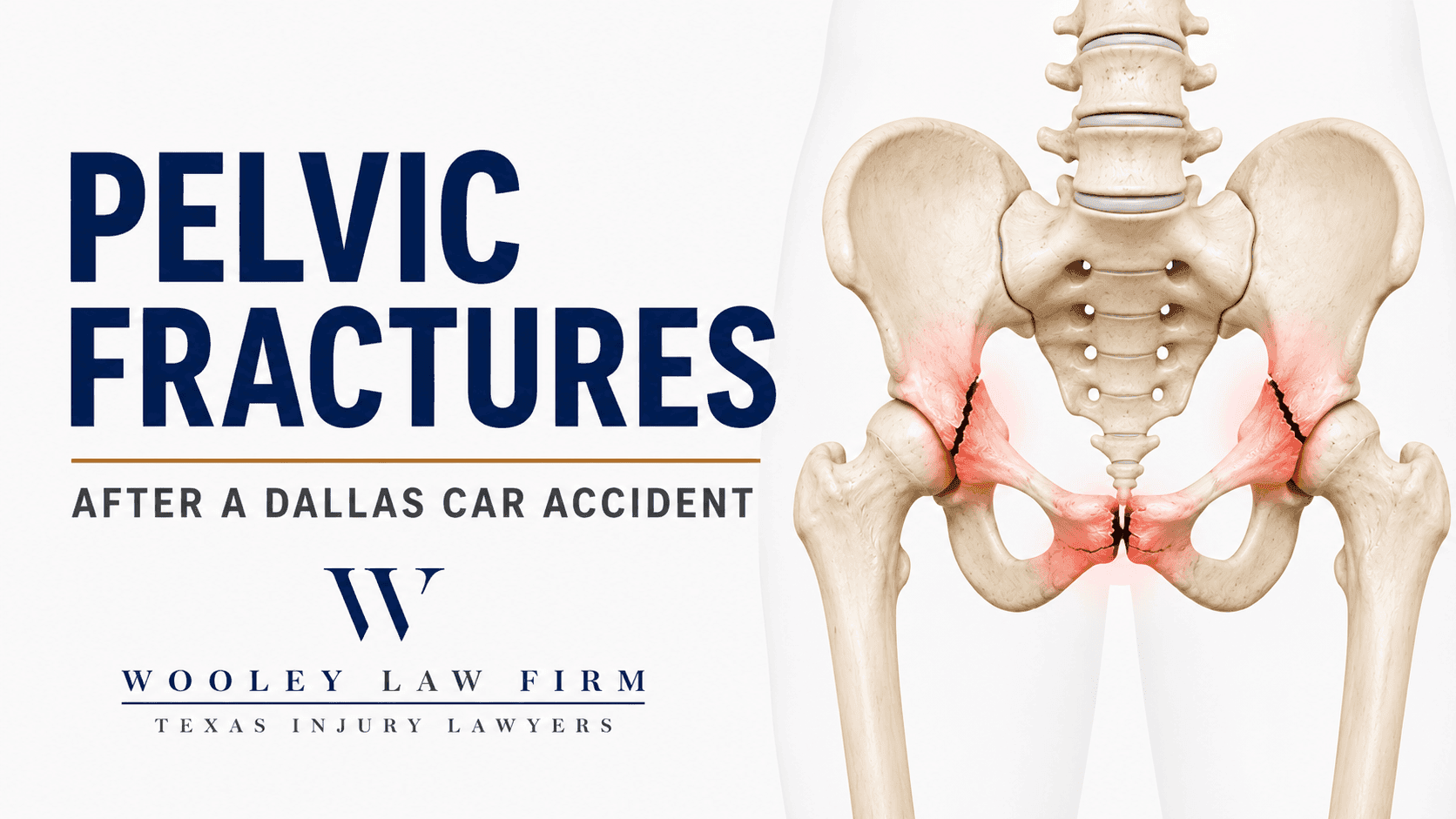
A pelvic fracture after a Dallas car accident can be a life-changing injury. Unlike a minor broken bone that may heal with a cast and several weeks of rest, a serious pelvic fracture can involve multiple broken bones, internal bleeding, damage to the hip joint, surgery, hospitalization, months of rehabilitation, and lasting problems with walking, working, or performing everyday activities.
The pelvis is a ring of bones that supports the upper body and connects the spine to the legs. Because of its strength, traumatic pelvic fractures are often associated with significant force, including serious motor vehicle collisions.
If another driver caused the collision that fractured your pelvis, you may have a Texas personal injury claim for your medical expenses, lost income, physical pain, impairment, mental anguish, and other accident-related damages.
The Wooley Law Firm represents people injured in serious motor vehicle crashes throughout Dallas and North Texas. Our Dallas car accident lawyer page explains more about how we investigate collisions and pursue claims against negligent drivers.
Why Pelvic Fractures From Car Accidents Can Be So Serious
The pelvis surrounds and protects important blood vessels, nerves, and organs. A severe fracture can therefore involve much more than a broken bone.
High-energy pelvic injuries can be associated with significant blood loss and other traumatic injuries. That is one reason people with serious pelvic fractures may require emergency trauma care and extensive diagnostic testing after a crash.
Depending on the location and severity of the fracture, a car accident victim may experience:
Severe pelvic, groin, hip, or lower-back pain
Difficulty standing or walking
Inability to put weight on one or both legs
Internal bleeding
Injury to blood vessels or nerves
Bladder or urinary tract injuries
Abdominal injuries
Hip-joint damage
Surgery involving plates, screws, or other fixation
Extended hospitalization
Rehabilitation or physical therapy
Use of a walker, crutches, or wheelchair
Chronic pain
Reduced range of motion
Difficulty returning to work
Permanent physical impairment
A pelvic fracture can also occur together with other serious injuries, including leg fractures, spinal injuries, abdominal trauma, and head injuries.
How Car Accidents Cause Pelvic Fractures
The pelvis is strong, so a traumatic fracture may indicate that substantial force was transferred into the occupant's body.
Several types of Dallas car accidents can cause pelvic injuries.
Side-Impact or T-Bone Accidents
Side-impact crashes can be especially dangerous because there is less vehicle structure between an occupant and the striking vehicle.
During a severe T-bone collision, the door or side of the vehicle may be pushed inward toward the driver or passenger. The force can be transferred directly into the hip, acetabulum, or pelvic ring.
These crashes commonly occur at Dallas intersections when a driver:
Runs a red light
Ignores a stop sign
Fails to yield
Turns across oncoming traffic
Drives while distracted
Speeds through an intersection
A person seated on the side of the initial impact may be particularly vulnerable to pelvic and hip injuries.
Head-On Collisions
A head-on collision can place tremendous force on the lower body.
An occupant may be thrown forward while the seat belt restrains the torso. The knees may strike the dashboard, sending force through the femur and into the hip socket and pelvis.
Head-on wrecks can produce pelvic fractures together with femur fractures, knee injuries, foot injuries, and spinal trauma.
High-Speed Dallas Highway Accidents
Pelvic fractures may also occur in high-speed collisions on Dallas-area roadways such as:
I-35E
I-30
I-20
I-635
US 75
I-45
Dallas North Tollway
These wrecks may involve multiple impacts, spinning vehicles, rollovers, vehicle intrusion, concrete barriers, commercial trucks, and secondary collisions.
The severity of an injury cannot be determined simply by looking at photographs of the vehicles. What matters is the force transmitted to the person inside and the medical evidence showing what happened to the body.
Rollover Accidents
A rollover can subject an occupant to forces from several directions.
A person may strike the interior of the vehicle repeatedly, become partially ejected, or suffer injuries as the roof and passenger compartment deform.
Pelvic fractures can occur alongside spinal injuries, head injuries, and fractures of the arms and legs.
Pedestrian Accidents
Pelvic fractures are also common concerns when a pedestrian is struck by a vehicle.
The initial impact may occur near the pedestrian's legs, hip, or pelvis. The person may then be thrown onto the hood, windshield, pavement, or another object.
Because pedestrians have almost no protection from the force of a vehicle, these crashes can cause catastrophic injuries.
Types of Pelvic Fractures After a Car Accident
“Pelvic fracture” is not one single diagnosis. The location and stability of the fracture can dramatically affect treatment, recovery, and the value of a personal injury claim.
Stable Pelvic Fractures
A stable pelvic fracture generally means the pelvic ring remains structurally stable despite the break.
Some stable fractures can be treated without surgery. But that does not mean the injury is minor.
A person may still experience:
Significant pain
Difficulty walking
Inability to work
Weeks or months of activity restrictions
Physical therapy
Loss of independence
Sleep problems
Difficulty driving
Long-term discomfort
Insurance companies sometimes focus too heavily on whether surgery was required. A fracture can still produce substantial damages even when doctors determine that surgery is unnecessary.
Unstable Pelvic Fractures
An unstable pelvic fracture involves greater disruption of the pelvic ring and can be a much more serious injury.
These fractures may require surgical stabilization and can be associated with significant bleeding or injuries to surrounding structures.
An unstable pelvic fracture can result in prolonged hospitalization, months of rehabilitation, and potentially permanent limitations.
Acetabular Fractures
The acetabulum is the socket portion of the hip joint. An acetabular fracture occurs when part of that socket breaks.
These injuries can happen when the knee or leg is driven backward during a collision, transmitting force into the hip joint.
Because an acetabular fracture involves the joint itself, it can create concerns about:
Long-term hip pain
Reduced range of motion
Arthritis
Difficulty walking
Future orthopedic treatment
Possible hip replacement in severe cases
For more information about related injuries, read our guide to hip injuries after a Dallas car accident.
Sacral Fractures
The sacrum sits at the lower end of the spine and forms part of the back of the pelvis.
A serious crash can injure the sacrum together with surrounding pelvic structures. These injuries may cause symptoms involving the lower back, buttocks, hips, or legs.
Our guide to lower-back injuries after a Dallas car accident discusses additional conditions that can occur after a collision.
Symptoms of a Pelvic Fracture After a Car Accident
Symptoms vary depending on the location of the fracture and whether other injuries occurred.
Possible symptoms include:
Severe pain in the pelvis
Groin pain
Hip pain
Lower abdominal pain
Pain when moving the legs
Pain when standing
Inability to walk normally
Difficulty putting weight on a leg
Bruising around the pelvis or hip
Swelling
Numbness or tingling
Weakness in the legs
Abdominal tenderness
Urinary problems
Pain that becomes worse over time
Some people know immediately that something is seriously wrong. Others may initially attribute their symptoms to soreness from the collision.
Anyone experiencing significant pelvic, abdominal, hip, or groin symptoms after a serious wreck should seek appropriate medical evaluation.
How Doctors Diagnose Pelvic Fractures
Doctors may use several tools to diagnose a pelvic fracture and determine its severity.
Depending on the circumstances, testing may include:
Physical examination
X-rays
CT scans
Blood tests
Neurological testing
Additional imaging
Evaluation for internal injuries
CT imaging can be particularly important in complicated pelvic injuries because it allows doctors to see the fracture pattern in greater detail.
These diagnostic images can also become important evidence in a personal injury claim because they objectively document the injury.
Injured in an Accident?
Free consultation. Tell us what happened and learn what options may be available.
Treatment for a Pelvic Fracture After a Dallas Car Accident
Treatment depends on the location and severity of the fracture, whether the pelvic ring is stable, whether bones are displaced, and whether other structures were damaged.
Non-Surgical Treatment
Some stable pelvic fractures can heal without surgery.
Treatment may include:
Restricted activity
Limited weight-bearing
Crutches
Walker use
Medication
Follow-up imaging
Physical therapy
Home exercises
Gradual return to normal activity
Even without surgery, the recovery can significantly affect a person's life.
Someone who cannot walk normally may be unable to:
Work
Drive
Care for children
Exercise
Shop independently
Perform household chores
Sleep comfortably
Participate in recreational activities
Surgery
More serious fractures may require surgery.
Depending on the injury, surgeons may use:
Plates
Screws
Internal fixation
External fixation
Other orthopedic procedures
A surgical pelvic-fracture case may involve far more than the surgeon's bill.
Medical expenses can include:
Ambulance transportation
Emergency room treatment
Trauma care
Hospitalization
Imaging
Surgeon fees
Anesthesia
Medication
Physical therapy
Rehabilitation
Medical equipment
Follow-up visits
Future medical care
Our guide to medical bills after a Dallas car accident explains why accident victims may receive bills from numerous providers following a hospital stay.
Recovery After a Pelvic Fracture
Every pelvic fracture is different.
Recovery may depend on:
The number of fractures
The location of the breaks
Whether the pelvic ring is stable
Whether surgery was necessary
Whether the hip socket was damaged
Associated nerve injuries
Associated vascular injuries
Internal injuries
Age
Overall health
Rehabilitation
Complications
The physical demands of the person's job
Some people recover well and eventually return to most of their prior activities.
Others may continue to suffer:
Chronic pain
Hip stiffness
Difficulty walking
Weakness
Limited endurance
Reduced range of motion
Problems sitting for long periods
Difficulty standing for long periods
Changes in gait
Reduced ability to exercise
Permanent impairment
These long-term consequences are extremely important when evaluating a serious Dallas car accident claim.
Pelvic Fracture vs. Hip Fracture After a Car Accident
People sometimes use “pelvic fracture” and “hip fracture” interchangeably, but they can describe different injuries. A hip fracture commonly refers to a fracture of the upper femur near the hip joint. A pelvic fracture involves one or more bones forming the pelvis. An acetabular fracture involves the socket portion of the hip joint, which is part of the pelvis. A serious crash may cause several injuries at the same time.
For example, a person might suffer:
Pelvic fracture
Acetabular fracture
Femur fracture
Knee injury
Nerve injury
Lower-back injury
Our guide to leg injuries after a Dallas car accident discusses other lower-extremity injuries that can occur in a serious collision.
What Is a Pelvic Fracture Car Accident Case Worth in Texas?
There is no legitimate average settlement value for a pelvic fracture.
Every case is different.
The value of a Dallas pelvic-fracture claim can depend on:
How the crash occurred
Who caused the collision
Severity of the fracture
Number of broken bones
Whether the fracture was stable or unstable
Whether surgery was required
Length of hospitalization
Rehabilitation needs
Future medical care
Permanent physical limitations
Lost wages
Reduced earning capacity
Physical pain
Mental anguish
Physical impairment
Scarring or disfigurement
Available insurance coverage
Whether a business or employer is responsible
Whether UM/UIM coverage applies
A person who suffers an unstable pelvic fracture requiring surgery and is left with permanent difficulty walking may have dramatically different damages from someone whose stable fracture heals fully. A serious injury claim should be evaluated based on the actual consequences of the injury, not simply the name of the diagnosis.
Damages After a Pelvic Fracture in a Dallas Car Accident
If another driver or company caused the wreck, an injured person may be entitled to pursue several categories of damages under Texas law depending on the evidence.
Medical Expenses
Medical expenses can include past and future costs associated with:
Emergency treatment
Hospitalization
Diagnostic imaging
Orthopedic treatment
Surgery
Medication
Physical therapy
Rehabilitation
Medical equipment
Follow-up appointments
Future procedures
Future medical costs can become particularly important when doctors expect additional treatment or long-term orthopedic care.
Lost Wages
A serious pelvic fracture can keep someone away from work for weeks or months.
A person whose job requires:
Walking
Standing
Climbing
Lifting
Driving
Construction work
Warehouse work
Manual labor
may be unable to return until substantial healing occurs.
Loss of Earning Capacity
Some pelvic injuries result in permanent restrictions. If a person can no longer perform the same work or earn the same income because of the injury, loss of future earning capacity may become part of the claim.
Physical Pain
Pelvic fractures can produce substantial pain during:
The initial collision
Emergency treatment
Surgery
Hospitalization
Rehabilitation
Physical therapy
Daily activities
Chronic pain can make the impact of the injury continue long after the bones have technically healed.
Physical Impairment
Physical impairment addresses how an injury affects a person's ability to live and function.
For example, a pelvic fracture could interfere with:
Walking
Running
Exercising
Driving
Traveling
Caring for children
Household chores
Hobbies
Sports
Social activities
A person does not have to be completely disabled for physical impairment to matter.
Mental Anguish
A serious pelvic injury can also affect emotional well-being. Someone who suddenly loses independence or cannot perform ordinary activities may experience significant emotional distress, anxiety, frustration, and uncertainty about the future.
Why Insurance Coverage Matters in a Severe Pelvic-Fracture Case
A serious pelvic-fracture claim can involve substantial damages. That makes identifying every available source of insurance coverage extremely important.
Potential coverage may include:
The negligent driver's liability insurance
A vehicle owner's policy
Employer liability or commercial auto coverage
Insurance covering another responsible driver
Uninsured motorist coverage
Underinsured motorist coverage
Personal injury protection
Other applicable commercial policies
If the person who caused the crash does not have enough insurance to compensate the victim fully, Texas uninsured and underinsured motorist coverage may become especially important. In serious cases, identifying all applicable insurance policies should be part of the investigation from the beginning.
Evidence That Can Strengthen a Pelvic-Fracture Claim
A serious injury alone does not automatically establish liability. Evidence is still necessary to prove who caused the collision and how the crash produced the injury.
Important evidence may include:
Police crash report
Scene photographs
Vehicle photographs
Dashcam footage
Surveillance video
Traffic-camera footage
Witness statements
Event data recorder information
Cellphone evidence
Vehicle inspection evidence
Medical records
CT scans
X-rays
Operative reports
Orthopedic records
Physical therapy records
Medical bills
Employment records
Wage documentation
Photographs showing mobility limitations
Testimony from family and friends
Evidence showing what a person could do before the crash compared with what they can do afterward can be especially important in proving physical impairment.
Do Not Rush to Settle a Pelvic-Fracture Claim
Insurance companies sometimes approach injured people early in the claims process.
That can happen before doctors know:
Whether the fracture will heal properly
Whether more surgery will be necessary
Whether the person will develop chronic pain
Whether arthritis will develop
Whether permanent walking limitations will remain
Whether the person can return to work
Whether future treatment will be necessary
Accepting a settlement too early can be dangerous because a signed release can prevent the injured person from seeking additional compensation later.
Before settling a serious pelvic-fracture claim, it is important to understand both the current damages and the expected long-term consequences.
The Wooley Law Firm Has Represented Many Clients With Serious Pelvic Injuries
At The Wooley Law Firm, we have represented many clients who suffered serious pelvic injuries in car accidents and other traumatic incidents, including pelvic fractures, acetabular fractures, hip injuries, and other injuries affecting a person's ability to walk, work, and live independently.
These are not injuries we only know from medical records or textbooks. We have seen firsthand how a fractured pelvis can affect nearly every part of a client's life.
Some of our clients have required:
Surgery
Hospitalization
Extensive physical therapy
Rehabilitation
Assistive devices
Time away from work
Months of recovery
Others have been left with ongoing pain, mobility problems, physical impairment, or the possibility of future medical treatment.
The Wooley Law Firm has recovered millions of dollars for clients suffering pelvic injuries and other serious injuries.
Every case is different, and past results do not guarantee a particular outcome. But our experience handling serious injury cases helps us understand the evidence that can be critical to proving the full value of a pelvic-fracture claim. That includes documenting not only the initial emergency-room treatment and medical bills, but also:
Surgical procedures and orthopedic treatment
CT scans and X-rays
Physical therapy and rehabilitation
Future medical needs
Lost wages
Reduced earning capacity
Physical pain
Mental anguish
Physical impairment
Loss of mobility
Loss of independence
How the injury has changed everyday life
A serious pelvic-fracture case should not be reduced to the amount of the hospital bills. The real question is what the injury has taken from the person and what consequences that person may continue to face in the future.
How a Dallas Car Accident Lawyer Can Help After a Pelvic Fracture
A serious pelvic-fracture case often requires far more investigation than a routine insurance claim.
The Wooley Law Firm can investigate issues including:
How the collision happened
Which driver was responsible
Whether a company or employer may also be liable
Available insurance policies
Accident-scene evidence
Witness testimony
Video evidence
Electronic vehicle evidence
Medical records and imaging
Past medical expenses
Future medical care
Lost wages
Future earning limitations
Physical impairment
Long-term medical prognosis
The goal is not merely to prove that a fracture happened. The goal is to show the full extent of what that injury has done to the person's life.
How Long Do I Have to File a Car Accident Lawsuit in Texas?
Texas generally has a two-year statute of limitations for personal injury lawsuits, although exceptions can apply depending on the facts.
Waiting too long can also create problems even before the legal deadline expires.
Important evidence may disappear, including:
Surveillance video
Dashcam footage
Traffic-camera footage
Vehicle data
Witness memories
Vehicle evidence
That is one reason serious car accident cases should be investigated promptly.
Frequently Asked Questions About Pelvic Fractures After Dallas Car Accidents
Can a car accident fracture your pelvis?
Yes. A serious motor vehicle collision can produce enough force to fracture one or more bones in the pelvis. The injury may range from a stable fracture to a complex unstable pelvic-ring injury requiring surgery.
Does a pelvic fracture always require surgery?
No. Some stable fractures can be treated without surgery. More severe or unstable fractures may require surgical stabilization. Treatment depends on the fracture pattern and other injuries.
How long does a pelvic fracture take to heal?
Recovery varies significantly. Some people recover in a matter of months, while others require prolonged rehabilitation or continue experiencing symptoms long after the fracture has healed. The person's orthopedic surgeon is in the best position to provide an individualized prognosis.
Can a pelvic fracture cause permanent problems?
Yes. Depending on the severity of the injury, a person may experience:
Chronic pain
Difficulty walking
Reduced range of motion
Weakness
Arthritis
Physical impairment
Problems returning to work
Not every person experiences permanent complications.
Can I recover lost wages if a pelvic fracture keeps me from working?
Potentially. If another person is legally responsible for the collision, accident-related lost income may be part of the damages claim. If the injury permanently reduces the person's ability to earn income, future loss of earning capacity may also be an issue.
What if the driver who hit me does not have enough insurance?
Additional coverage may exist. Potential sources include uninsured or underinsured motorist coverage, commercial insurance, employer coverage, or policies covering other responsible parties.
Is a pelvic fracture considered a serious injury?
It can be. Some pelvic fractures involve major trauma, hospitalization, surgery, mobility restrictions, significant pain, and long-term impairment. The seriousness of the injury depends on the specific fracture and the patient's condition.
Should I give the other driver's insurance company a recorded statement?
Be cautious. An insurance adjuster may ask questions about how the collision happened, your medical condition, your prior health history, and whether you are improving. Statements made early in the case can later be used to dispute liability or minimize the severity of an injury.
Talk to a Dallas Car Accident Lawyer After a Pelvic Fracture
A pelvic fracture can change a person's life in seconds. The collision may be over quickly, but the consequences can continue for months or years through surgery, hospital bills, missed work, rehabilitation, pain, mobility problems, and uncertainty about the future. If you suffered a pelvic fracture, acetabular fracture, hip injury, or other serious injury in a Dallas car accident, The Wooley Law Firm can investigate what happened, identify available insurance coverage, preserve important evidence, and pursue compensation for the full impact of your injuries.
Call (214) 699-6524 for a free consultation. You don’t pay unless we win.
You can also contact The Wooley Law Firm online.
This article is for general informational purposes only and is not legal advice. Reading it does not create an attorney-client relationship. Every case is different, and past results do not guarantee a similar outcome.
Topics
Share This Article

Andrew J. Wooley
Personal Injury Attorney
Andrew J. Wooley is a dedicated personal injury attorney based in Dallas, Texas. He focuses on helping accident victims recover fair compensation for their injuries. With a commitment to personalized service, Andrew works directly with each client to understand their unique situation and fight for their rights.
Related Local News
Recent related coverage