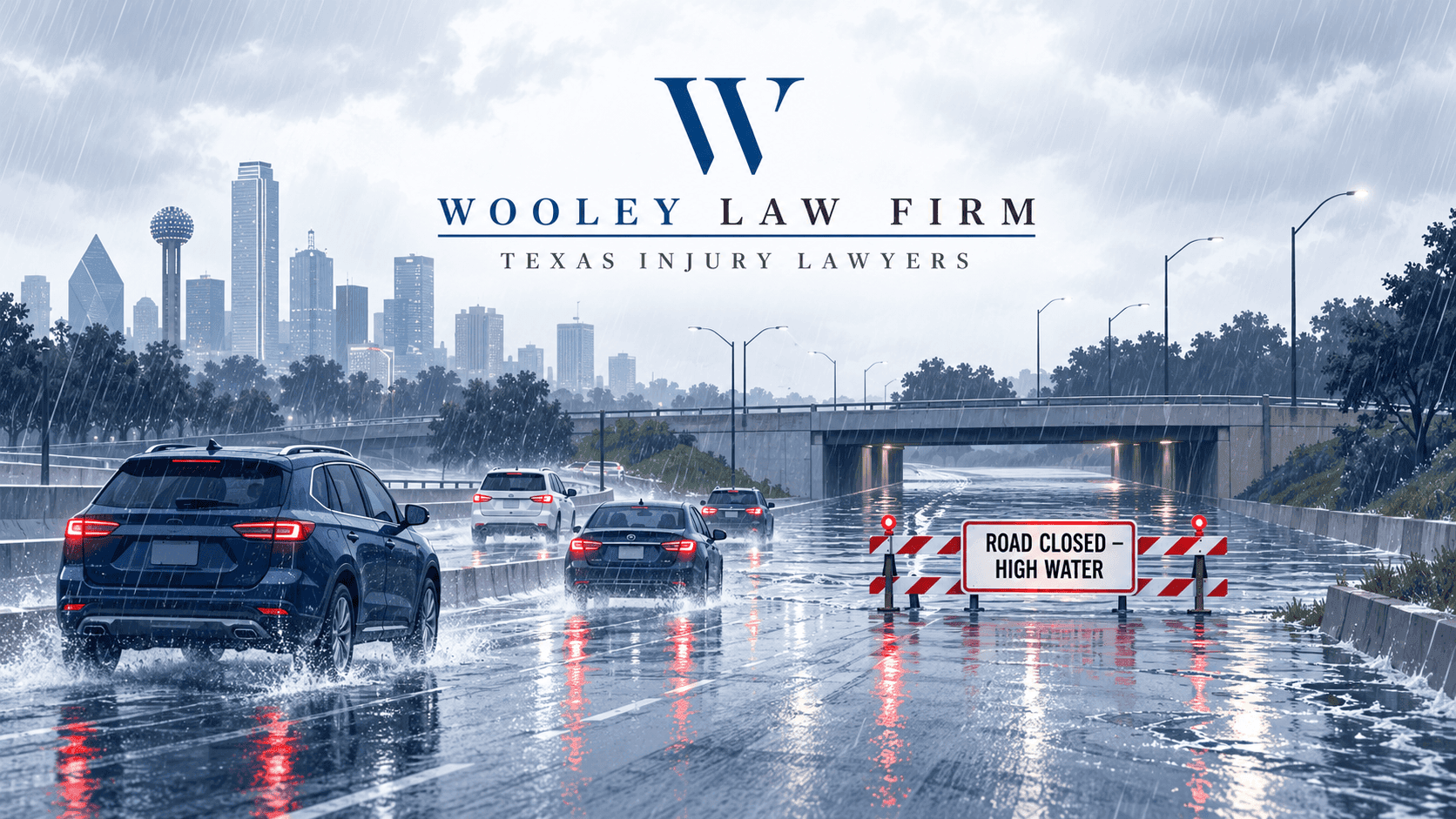
Heavy rain can turn an ordinary drive across Dallas into a dangerous situation within minutes.
Water can collect on I-35E, I-30, I-20, I-635, U.S. 75, Dallas North Tollway, frontage roads, intersections, and low-lying streets throughout North Texas. Visibility can suddenly disappear. Vehicles can hydroplane. Traffic may stop unexpectedly. And during intense storms, a roadway that looked passable minutes earlier may become flooded.
Dallas drivers should know how to adjust when rain begins and when the safest decision is simply not to continue.
If another driver loses control, drives too fast for the conditions, follows too closely, or enters a flooded roadway and causes a collision, the fact that it was raining does not necessarily eliminate responsibility for the wreck.
Why Driving in Heavy Rain Can Be Dangerous in Dallas
Dallas drivers regularly deal with high-speed highways and dense traffic. Heavy rain can make those conditions significantly more difficult.
Rain can create several hazards at the same time:
Reduced visibility;
Standing water;
Hydroplaning;
Longer stopping distances;
Spray from 18-wheelers and other large vehicles;
Sudden traffic backups;
Flooded underpasses and low-water areas;
Disabled vehicles in travel lanes;
Drivers making abrupt lane changes to avoid water; and
Traffic signals that may be difficult to see during intense rainfall.
These risks become especially serious when someone continues driving at the same speed and following distance they would use on a dry roadway.
Texas law does not simply allow a driver to rely on the posted speed limit regardless of the conditions.
Under Texas Transportation Code § 545.351, a driver may not operate at a speed greater than is reasonable and prudent under the existing circumstances. The statute specifically requires an appropriate reduction in speed when a special hazard exists because of weather or highway conditions.
That means 65 or 70 mph may be the posted speed limit, but that does not necessarily mean it is a safe speed during a severe Dallas thunderstorm.
Slow Down Before You Lose Traction
One of the most important things a driver can do during heavy rain is reduce speed before encountering standing water.
A vehicle does not have to be speeding above the posted limit to be traveling too fast for wet conditions.
A driver may need to slow significantly when:
Water is accumulating on the roadway;
Visibility is poor;
Windshield wipers cannot keep up with the rain;
Traffic ahead is braking;
Large trucks are producing heavy spray;
Water is collecting near the shoulder or median; or
The vehicle begins to feel unstable.
Sudden acceleration, braking, or steering can make it harder to maintain control on a wet roadway.
Drivers should also give themselves substantially more room behind the vehicle ahead. If traffic suddenly slows on I-635 or U.S. 75, the extra following distance may be what prevents a rear-end collision.
If you are injured in a rain-related wreck, our Dallas car accident lawyer page explains how we investigate serious collisions and insurance claims.
What Is Hydroplaning?
Hydroplaning occurs when a vehicle's tires lose effective contact with the road because of water between the tires and pavement.
When that happens, steering and braking can become much less effective.
Hydroplaning can occur quickly, particularly when a driver enters standing water at highway speed.
If your vehicle begins to hydroplane, avoid panicking or making a sudden steering movement. Generally, ease off the accelerator and keep the vehicle pointed in the direction you want to travel while traction returns.
The better strategy, however, is prevention: slow down when you see water collecting on the roadway and avoid driving through standing water when possible.
Never Assume Floodwater Is Shallow Enough to Drive Through
Rain and flooding are not the same hazard.
Standing water on a roadway can become life-threatening when it is deep or moving.
The National Weather Service warns that only about 12 inches of rushing water can carry away most cars, while approximately two feet of rushing water can carry away SUVs and trucks. Floodwater can also conceal washed-out pavement, holes, debris, electrical hazards, or an unexpectedly deep drainage channel.
That is why the National Weather Service uses the warning:
Turn Around, Don't Drown.
If you cannot determine how deep the water is, do not drive into it.
A flooded roadway is not the place to test whether your pickup, SUV, Jeep, or four-wheel-drive vehicle can make it across.
Injured in an Accident?
Free consultation. Tell us what happened and learn what options may be available.
Do Not Drive Around a Flood Barricade
If police, firefighters, TxDOT crews, or another public agency has barricaded a flooded roadway, do not drive around the barricade.
Texas Transportation Code § 472.022 makes it an offense to disobey certain warning signs or drive around a barricade.
The barricade may be there because:
Water is deeper than it appears;
The current is moving rapidly;
The pavement has washed away;
A bridge or culvert is unsafe;
Emergency crews are working ahead; or
The roadway is otherwise impassable.
What looks like a few inches of water from your vehicle may actually conceal a serious drop-off or damaged roadway.
Check Road Conditions Before Leaving
When severe storms are moving through Dallas-Fort Worth, check conditions before starting your trip.
TxDOT recommends checking weather forecasts and using DriveTexas for highway conditions and notices involving closures caused by hazards such as flooding.
This can be particularly useful before traveling on major corridors such as:
I-35E;
I-30;
I-20;
I-45;
I-635;
U.S. 75;
SH 114;
SH 121; and
highways connecting Dallas, Fort Worth, Arlington, Irving, Plano, Richardson, Garland, Mesquite, and surrounding communities.
A 15-minute delay is far better than becoming trapped on a flooded roadway.
What If Another Driver Causes a Wreck During the Rain?
Rain does not automatically excuse a driver who causes a collision.
The important question is usually whether the driver acted reasonably considering the conditions.
For example, another driver may potentially be responsible if the evidence shows that the driver:
Was traveling too fast for the rain;
Followed another vehicle too closely;
Failed to slow for standing water;
Hydroplaned after entering water at an unsafe speed;
Made an unsafe lane change;
Failed to maintain a single lane;
Rear-ended traffic that had slowed for weather conditions;
Drove with poor or defective tires;
Continued driving despite severely limited visibility; or
Ignored a warning sign or barricade.
The insurance company may say, “It was just the weather.”
But weather does not operate the steering wheel, accelerator, or brakes.
The investigation should determine whether the driver adjusted appropriately for conditions before the collision occurred.
Texas law's requirement that motorists use a reasonable and prudent speed under existing conditions can become particularly important in these cases.
What Evidence Can Help Prove a Rain-Related Car Accident?
Rain-related crashes can become difficult to investigate because conditions change quickly.
Water drains away. Rain stops. Vehicles are towed. Traffic resumes.
That makes early documentation important.
Potential evidence may include:
Dash-camera video;
Photographs or video showing rainfall and standing water;
Police body-camera and dash-camera footage;
Traffic-camera video;
Nearby business surveillance footage;
Witness statements;
Weather records;
911 calls and dispatch records;
Tire condition and tread depth;
Vehicle event data;
Cellphone video from the crash scene;
Road-closure information; and
Photographs showing flooded lanes or warning barricades.
Dash-camera footage can be particularly useful because it may show exactly how hard it was raining, how much water was on the pavement, how traffic was moving, and what the other driver did immediately before impact.
What Should You Do After a Crash in Heavy Rain?
Your first priority should be getting out of danger.
If you are involved in a crash during severe weather:
Call 911. Tell the dispatcher about injuries, traffic hazards, standing water, or flooding.
Do not stand in an active traffic lane. Other motorists may have difficulty seeing the collision.
Move somewhere safe if you can do so safely. Follow instructions from police, firefighters, or emergency personnel.
Photograph the conditions if it is safe. Capture the vehicles, roadway, standing water, rainfall, traffic signals, signs, skid marks, and surrounding area.
Get witness information.
Seek medical attention when appropriate.
Preserve dash-camera video immediately. Some cameras automatically overwrite older recordings.
Do not assume the weather means nobody was at fault.
Our article on Dallas County car wrecks and what to do after a collision discusses additional evidence that may be important after a serious crash.
If you initially feel fine but symptoms begin later, you can also read our guide about why injuries may appear after a Texas car accident.
What If My Car Is Swept Away or Damaged by Floodwater Without Another Driver?
That may be primarily a property-insurance issue rather than a personal-injury claim against another motorist.
Coverage can depend on the type of automobile insurance you purchased. For example, comprehensive coverage may become relevant when a vehicle suffers flood damage without another driver causing the loss.
The answer is different when another person's negligence contributes to the event—for example, another driver crashes into your vehicle during heavy rain and pushes it into a flooded area.
The facts and applicable insurance coverage need to be reviewed separately.
What If the Other Driver Does Not Have Enough Insurance?
Serious rain-related crashes can cause significant injuries, particularly when vehicles collide at highway speeds or multiple vehicles become involved.
If the driver who caused the wreck has no insurance or insufficient liability coverage, your own uninsured or underinsured motorist coverage may become important.
Read more about Texas uninsured and underinsured motorist coverage.
Frequently Asked Questions About Driving in Heavy Rain in Texas
Can I be at fault for hydroplaning?
Potentially. Hydroplaning itself does not automatically establish negligence, but investigators may consider the driver's speed, tire condition, standing water, visibility, following distance, and other circumstances leading up to the loss of control.
Is the posted speed limit always safe when it is raining?
No. Texas law requires drivers to operate at a reasonable and prudent speed considering existing hazards and requires an appropriate reduction in speed when weather or highway conditions create a special hazard.
Should I drive through a flooded street if other cars are making it through?
No. Another vehicle successfully crossing does not tell you the depth, current, pavement condition, or whether your vehicle can safely cross. The National Weather Service recommends turning around rather than driving into floodwater.
Can I drive around a barricade if I think the road is safe?
Texas law generally prohibits driving around a roadway barricade unless an applicable exception applies.
Does rain automatically prevent me from bringing a car accident claim?
No. A crash investigation can still examine whether another driver was speeding for the conditions, following too closely, making an unsafe maneuver, failing to maintain control, or otherwise driving negligently.
Injured in a Rain-Related Car Accident in Dallas?
Heavy rain may contribute to a collision, but that does not mean the crash was unavoidable.
If another driver failed to slow down, followed too closely, lost control, made an unsafe lane change, or otherwise failed to drive appropriately for the conditions, the evidence should be investigated.
The Wooley Law Firm represents people injured in serious car and truck wrecks throughout Dallas and North Texas.
Call (214) 699-6524 for a free consultation. You don't pay unless we win.
This article is for general informational purposes only and is not legal advice. Reading it does not create an attorney-client relationship. Every case is different.
Topics
Share This Article

Andrew J. Wooley
Personal Injury Attorney
Andrew J. Wooley is a dedicated personal injury attorney based in Dallas, Texas. He focuses on helping accident victims recover fair compensation for their injuries. With a commitment to personalized service, Andrew works directly with each client to understand their unique situation and fight for their rights.
Related Local News
Recent related coverage