The Dallas-Fort Worth metroplex has some of the busiest, fastest-growing, and most dangerous roadways in Texas. Every day, drivers across North Texas share the road with commuters, 18-wheelers, delivery trucks, construction vehicles, rideshare drivers, and out-of-town traffic moving through one of the largest metropolitan areas in the country.
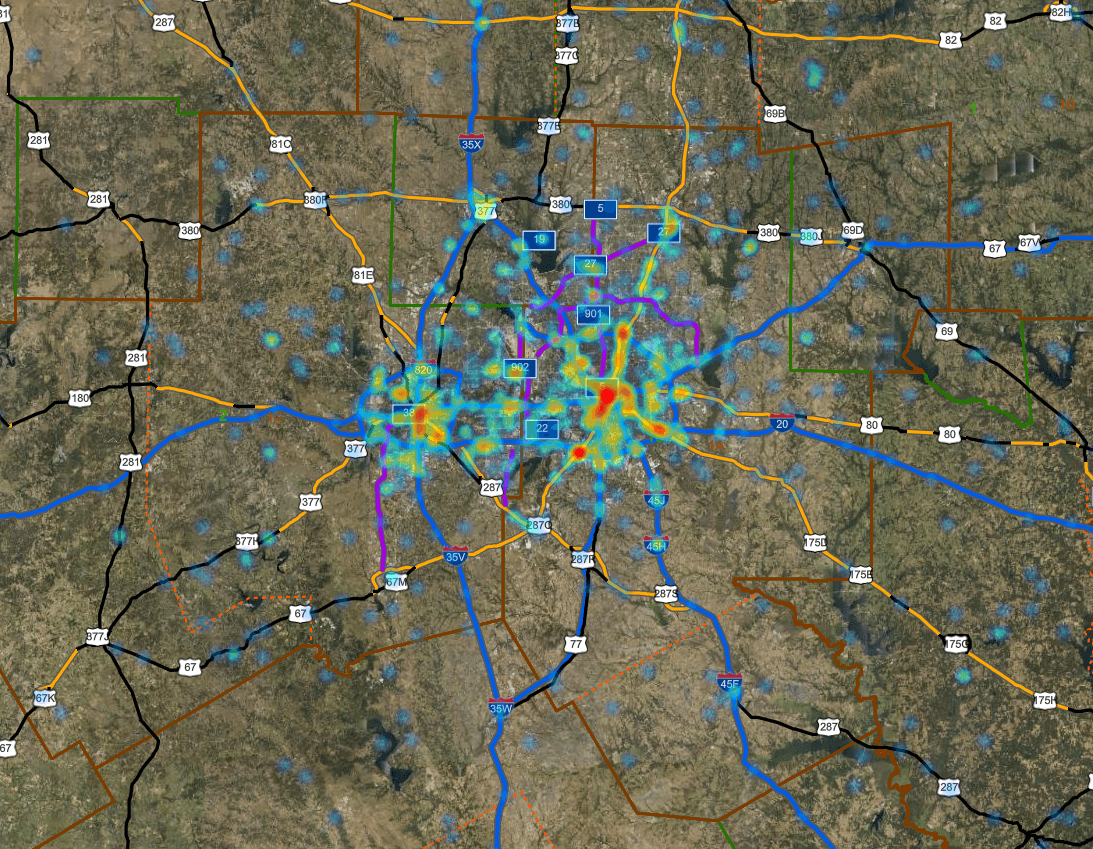
According to a 2025 TxDOT CRIS query covering Collin, Dallas, Denton, Ellis, Hood, Hunt, Johnson, Kaufman, Navarro, Parker, Rockwall, Tarrant, Van Zandt, and Wise Counties, there were 720 fatal wrecks in the DFW-area counties reviewed. Those crashes resulted in 765 fatalities.
The data also shows that 81 fatal wrecks involved a commercial motor vehicle. That means 18-wheelers, tractor-trailers, dump trucks, delivery trucks, work trucks, and other commercial vehicles were involved in a significant number of deadly crashes across North Texas.
At The Wooley Law Firm, we represent people and families affected by serious car wrecks, 18-wheeler wrecks, and fatal crashes throughout the Dallas-Fort Worth area. This data is a serious reminder that some roads in DFW are especially dangerous and that many fatal crashes are preventable.
The Deadliest Roads in DFW Based on 2025 Fatal-Wreck Data
Based on the 2025 TxDOT CRIS roadway breakdown, the roads with the highest number of fatal wrecks in the DFW-area counties reviewed were:
I-30: 39 fatal wrecks
I-20: 35 fatal wrecks
I-35E: 32 fatal wrecks
U.S. 75: 23 fatal wrecks
I-35W: 19 fatal wrecks
U.S. 175: 14 fatal wrecks
I-45: 13 fatal wrecks
I-635: 13 fatal wrecks
State Highway 183: 13 fatal wrecks
I-820: 11 fatal wrecks
State Highway 121: 11 fatal wrecks
Loop 12: 11 fatal wrecks
U.S. 380: 11 fatal wrecks
These roadways are some of the most heavily traveled corridors in North Texas. They connect Dallas, Fort Worth, Arlington, Denton, McKinney, Plano, Garland, Mesquite, Irving, Rockwall, Weatherford, Waxahachie, and many other communities across the metroplex.
They also carry a dangerous mix of commuter traffic, commercial trucks, construction vehicles, high speeds, sudden slowdowns, and aggressive drivers.
Dallas, Fort Worth, and Arlington Had the Most Fatal Wrecks
The 2025 TxDOT CRIS data also shows which DFW cities had the highest number of fatal wrecks. Not surprisingly, the largest cities in the metroplex had the highest totals:
Dallas: 168 fatal wrecks
Fort Worth: 110 fatal wrecks
Arlington: 31 fatal wrecks
Grand Prairie: 21 fatal wrecks
Denton: 16 fatal wrecks
Garland: 16 fatal wrecks
Irving: 15 fatal wrecks
Dallas had the highest number of fatal wrecks in the DFW-area data, with 168 fatal crashes in 2025. Fort Worth followed with 110 fatal crashes, and Arlington had 31 fatal crashes.
These city totals help explain why roads like I-30, I-20, I-35E, U.S. 75, I-35W, I-635, I-820, Loop 12, and State Highway 183 appear among the deadliest roadways. Many of these routes run through or near the cities with the highest fatal-wreck totals.
The data also shows that deadly crashes are not limited to one part of the metroplex. Fatal wrecks occurred across Dallas County, Tarrant County, Denton County, Collin County, Kaufman County, and surrounding North Texas counties. Larger cities may see higher crash totals because they have more traffic, more intersections, more commercial vehicles, more pedestrians, and more high-speed corridors.
I-30, I-20, and I-35E Had the Highest Fatal-Wreck Totals
The 2025 TxDOT CRIS data showed I-30 with 39 fatal wrecks, the highest roadway total in the DFW-area counties reviewed. I-20 followed with 35 fatal wrecks, and I-35E had 32 fatal wrecks.
These three highways are among the most important transportation corridors in North Texas.
I-30 runs east and west through the metroplex, connecting areas such as Fort Worth, Arlington, Grand Prairie, Dallas, Mesquite, Rockwall, and beyond. It carries commuters, commercial vehicles, and long-distance traffic. Congestion, high speeds, lane changes, and construction can make I-30 especially dangerous.
I-20 is another major east-west route across the southern part of the metroplex. It serves drivers in Tarrant County, Dallas County, Parker County, Kaufman County, and surrounding areas. Like I-30, it carries heavy truck traffic and fast-moving passenger vehicles.
I-35E is a critical north-south corridor through Denton County and Dallas County. Drivers on I-35E often deal with congestion, merging traffic, construction, commercial vehicles, and sudden slowdowns.
When crashes happen on these highways, the consequences are often severe. At highway speeds, a distracted driver, an impaired driver, a speeding driver, or a negligent truck driver can cause a fatal chain-reaction crash in seconds.
The Deadliest DFW Crash in 2025 Happened on I-20 in Kaufman County
The deadliest DFW-area wreck in the 2025 data occurred on June 28, 2025, on I-20 in Kaufman County east of Terrell near Wills Point. According to news reports, five people were killed after an 18-wheeler driver allegedly fell asleep behind the wheel and caused a multi-vehicle crash.
Reports stated that the 18-wheeler crashed into a pickup truck carrying five people. The crash then pushed the rig into two other semi-trucks, one of which jackknifed and struck three nearby passenger vehicles.
Four occupants of the pickup truck died at the scene. One pickup occupant was airlifted to a hospital with life-threatening injuries. The occupant of one of the other struck vehicles was also killed.
This crash shows why commercial vehicle wrecks can be so devastating. One fatigued or inattentive truck driver can trigger a chain-reaction crash involving multiple vehicles, multiple families, and life-changing consequences.
It also shows why fatal truck wrecks require a fast and thorough investigation into driver fatigue, hours-of-service compliance, company safety practices, dispatch records, vehicle data, and the trucking company’s role in putting that driver on the road.
Because this crash happened on I-20, the roadway with the second-highest fatal-wreck total in the DFW-area data, it reinforces one of the main findings of the 2025 TxDOT CRIS review: major interstate corridors carrying heavy commercial traffic are among the most dangerous roads in North Texas.
The Second-Deadliest DFW Crash Happened on East Clarendon Drive in Dallas
The second-deadliest DFW-area crash in the 2025 data happened on East Clarendon Drive at North Street in Dallas. According to news reports, a heavy-duty work truck struck an SUV carrying two adults and four children.
An adult woman and two children later died from their injuries.
This crash is another example of how deadly commercial and work-truck crashes can be. Even though many people think of fatal crashes as highway or interstate wrecks, a city street can become the scene of a catastrophic collision when a large work truck and a family vehicle are involved.
Crashes like this may require an investigation into more than just the drivers. Depending on the facts, attorneys may need to examine:
Who owned the work truck
Whether the driver was working at the time
Whether the driver was properly trained
Whether the truck was properly maintained
Whether the truck had any mechanical problems
Whether speed, distraction, or impairment played a role
Whether roadway design, visibility, signage, or lighting contributed to the crash
Whether nearby video footage captured the collision
Whether prior crashes or complaints involved the same location
This crash also highlights an important point from the 2025 fatal-wreck data: the danger is not limited to the biggest interstates. Serious and fatal crashes can happen on local streets, intersections, and neighborhood corridors when large vehicles, vulnerable passenger vehicles, and dangerous conditions come together.
Injured in an Accident?
Free consultation. Tell us what happened and learn what options may be available.
U.S. 75, I-35W, and Other Major DFW Roads Also Had High Fatal-Wreck Numbers
The data also showed high fatal-wreck totals on other major DFW roadways, including U.S. 75 with 23 fatal wrecks and I-35W with 19 fatal wrecks.
U.S. 75 is one of the busiest north-south routes in the Dallas area. It runs through Dallas, Richardson, Plano, Allen, McKinney, and other communities. Drivers on U.S. 75 often encounter heavy commuter traffic, short merging distances, aggressive lane changes, and sudden stops.
I-35W is a major Fort Worth-area corridor that carries commuters, commercial vehicles, and regional traffic. Like other interstate highways in DFW, it combines high speeds with congestion, construction, and truck traffic.
Several other roadways also appeared among the highest fatal-wreck totals:
U.S. 175: 14 fatal wrecks
I-45: 13 fatal wrecks
I-635: 13 fatal wrecks
State Highway 183: 13 fatal wrecks
I-820: 11 fatal wrecks
State Highway 121: 11 fatal wrecks
Loop 12: 11 fatal wrecks
U.S. 380: 11 fatal wrecks
These roads serve different parts of the metroplex, but they share many of the same risk factors: congestion, high speeds, merging traffic, construction, distracted driving, impaired driving, and commercial vehicle traffic.
Other Deadly Roads in the DFW-Area Data
The fatal-wreck data was not limited to major interstates. Several state highways, U.S. highways, farm-to-market roads, tollways, and local roads also had multiple fatal crashes in 2025.
Other deadly roads in the DFW-area counties reviewed included:
State Highway 78: 9 fatal wrecks
State Highway 114: 9 fatal wrecks
U.S. 67: 9 fatal wrecks
U.S. 80: 9 fatal wrecks
U.S. 287: 9 fatal wrecks
State Highway 180: 7 fatal wrecks
U.S. 377: 7 fatal wrecks
Farm-to-Market Road 157: 6 fatal wrecks
State Highway 199: 6 fatal wrecks
Farm-to-Market Road 730: 5 fatal wrecks
State Highway 5: 5 fatal wrecks
State Highway 360: 5 fatal wrecks
Business U.S. 287-P: 4 fatal wrecks
Farm-to-Market Road 51: 4 fatal wrecks
Farm-to-Market Road 455: 4 fatal wrecks
Miller Avenue: 4 fatal wrecks
State Highway 34: 4 fatal wrecks
State Highway 276: 4 fatal wrecks
State Highway 342: 4 fatal wrecks
Chisholm Trail Parkway: 3 fatal wrecks
Dallas North Tollway: 3 fatal wrecks
Farm-to-Market Road 4: 3 fatal wrecks
Forest Lane: 3 fatal wrecks
I-345: 3 fatal wrecks
South Belt Line Road: 3 fatal wrecks
State Highway 171: 3 fatal wrecks
State Highway 174: 3 fatal wrecks
State Highway 352: 3 fatal wrecks
Tollway 161: 3 fatal wrecks
This portion of the data is important because it shows that deadly crashes are not confined to the most obvious highways. Fatal wrecks also happen on suburban arterials, rural highways, toll roads, frontage roads, and farm-to-market roads where drivers may encounter high speeds, limited lighting, cross traffic, construction, commercial vehicles, and dangerous intersections.
For families, the roadway where the crash occurred can matter. A fatal wreck on a major interstate may involve different evidence than a fatal crash on a farm-to-market road, local street, or tollway. Depending on the facts, an investigation may need to examine traffic signal timing, roadway design, lighting, signage, construction activity, commercial vehicle routes, nearby surveillance cameras, and prior crash history.
81 Fatal Wrecks Involved Commercial Motor Vehicles
One of the most concerning parts of the 2025 TxDOT CRIS data is the number of fatal crashes involving commercial motor vehicles. Across the DFW-area counties reviewed, 81 fatal wrecks involved a commercial motor vehicle. Commercial motor vehicles may include:
18-wheelers
Tractor-trailers
Dump trucks
Box trucks
Delivery trucks
Concrete trucks
Construction vehicles
Company-owned work trucks
Utility vehicles
Heavy-duty work trucks
Fatal crashes involving commercial vehicles are often more complex than ordinary car wrecks. A commercial vehicle crash may involve not only the driver, but also the trucking company, vehicle owner, maintenance company, cargo loader, broker, contractor, employer, or another negligent party.
Important evidence in a commercial vehicle fatal crash may include:
Driver logs
Hours-of-service records
Driver qualification files
Inspection reports
Maintenance records
Dash camera footage
Event data recorder information
Cell phone records
Dispatch records
Load documents
Company safety policies
Post-crash drug and alcohol testing
GPS and route data
Employment records
Vehicle ownership records
Because 81 fatal wrecks involved a commercial motor vehicle, families should treat these cases differently from ordinary car accident claims. Trucking and work-truck cases can involve driver logs, company safety policies, maintenance records, black box data, dash camera footage, employment records, and multiple insurance policies.
If your family was affected by a fatal crash involving a semi-truck, tractor-trailer, dump truck, delivery truck, work truck, or other commercial vehicle, our 18-wheeler wreck attorneys can help investigate what happened and preserve critical evidence.
Why Are DFW Roads So Dangerous?
The danger on DFW roads is not caused by one single problem. Fatal crashes usually happen because multiple risk factors come together at the wrong time.
Rapid Population Growth
North Texas continues to grow quickly. More people means more vehicles, more commuters, more delivery drivers, more construction traffic, and more congestion.
Roads that were once easier to navigate are now carrying far more traffic than they were designed to handle. This is especially true in fast-growing areas of Collin County, Denton County, Kaufman County, Ellis County, Rockwall County, Parker County, and Wise County.
As more neighborhoods, schools, warehouses, shopping centers, and business developments are built, traffic patterns change. Drivers may face more intersections, more driveway entrances, more stop-and-go traffic, and more commercial vehicles.
Heavy Truck and Commercial Vehicle Traffic
DFW is a major transportation, shipping, logistics, and construction hub. Large trucks are common on I-30, I-20, I-35E, I-35W, U.S. 75, I-635, I-820, U.S. 80, U.S. 380, and other major corridors.
Commercial vehicles are much larger and heavier than passenger vehicles. They need more space to stop, have larger blind spots, and can cause catastrophic injuries when they collide with smaller cars, SUVs, motorcycles, or pickups.
When truck drivers speed, follow too closely, drive distracted, drive fatigued, or fail to inspect their vehicles, the results can be deadly.
Construction Zones
Construction is constant across the DFW metroplex. Drivers regularly encounter lane closures, narrow lanes, concrete barriers, uneven pavement, confusing signs, detours, reduced shoulders, and sudden traffic slowdowns.
Construction zones are especially dangerous when drivers fail to slow down or pay attention. They can also create additional risks when construction companies, contractors, or traffic-control companies fail to properly design, mark, or maintain a safe work zone.
Speeding
Speeding is one of the most dangerous behaviors on DFW roads. On highways and interstates, speeding reduces reaction time and increases the force of impact.
A speeding driver may not be able to stop in time for traffic, avoid a lane shift, react to a disabled vehicle, or safely navigate a construction zone. When a crash occurs at high speed, the chance of serious injury or death increases.
Distracted Driving
Distracted driving remains one of the most common causes of serious and fatal crashes. Looking at a phone, texting, using GPS, adjusting music, eating, or reaching for something inside the vehicle can take a driver’s attention off the road.
On busy DFW highways, traffic can change in seconds. A distracted driver may not notice stopped traffic, a slowing 18-wheeler, a lane closure, a pedestrian, or another vehicle entering the roadway.
Impaired Driving
Alcohol and drug impairment continue to cause devastating crashes throughout North Texas. Impaired drivers may speed, drift out of their lane, run red lights, fail to yield, or drive the wrong way.
In fatal crash cases, impairment is often one of the first issues that should be investigated.
Aggressive Driving and Unsafe Lane Changes
Many DFW drivers are familiar with aggressive driving: speeding, tailgating, weaving through traffic, cutting off other vehicles, and making unsafe lane changes.
On highways like I-30, I-20, I-35E, U.S. 75, I-635, and I-820, aggressive driving can lead to sideswipe crashes, rollovers, rear-end collisions, and multi-vehicle pileups.
Driver Fatigue
The I-20 crash in Kaufman County shows how dangerous driver fatigue can be, especially when an 18-wheeler or commercial vehicle is involved.
A tired driver may have slower reaction time, poor judgment, and difficulty staying alert. In the trucking industry, fatigue can be especially dangerous because commercial drivers may spend long hours behind the wheel, travel overnight, and face pressure to meet delivery schedules.
What Families Should Do After a Fatal Crash in DFW
After a fatal wreck, families are often overwhelmed. A wrongful death claim may help surviving family members seek accountability and compensation when a loved one is killed because of another person’s negligence.
Families may be dealing with grief, funeral arrangements, medical bills, insurance calls, lost income, and unanswered questions. A wrongful death investigation can help determine:
Who caused the crash
Whether a commercial motor vehicle was involved
Whether the driver was distracted, impaired, fatigued, or speeding
Whether a trucking company violated safety rules
Whether road construction contributed to the wreck
Whether a vehicle defect or maintenance problem played a role
Whether additional insurance coverage is available
Whether another company, employer, or contractor may be legally responsible
Whether roadway design, lighting, signage, or prior crash history contributed to the collision
It is important to act quickly after a fatal crash. Physical evidence can disappear. Vehicles may be repaired or destroyed. Witnesses may become harder to locate. Surveillance video may be overwritten. Commercial vehicle data may be lost if it is not preserved.
An attorney can send preservation letters, investigate the scene, obtain crash reports, identify potential defendants, locate insurance coverage, and work with experts when needed.
What Compensation May Be Available After a Fatal Wreck?
Every case is different, but families may be able to pursue compensation through a wrongful death or survival claim.
Potential damages may include:
Funeral and burial expenses
Loss of financial support
Loss of companionship
Loss of care, maintenance, support, services, advice, and counsel
Mental anguish
Medical expenses before death
Pain and suffering before death
Loss of inheritance
Other damages available under Texas law
When a fatal crash involves a commercial vehicle, there may be multiple layers of insurance coverage. This is one reason it is important to investigate the case thoroughly and quickly.
Injured or Lost a Loved One in a DFW Crash? Call The Wooley Law Firm.
The 2025 TxDOT CRIS data shows how dangerous DFW roads can be. Across the counties reviewed, there were 720 fatal wrecks, 765 fatalities, and 81 fatal wrecks involving commercial motor vehicles. The roads with the highest fatal-wreck totals included I-30, I-20, I-35E, U.S. 75, I-35W, U.S. 175, I-45, I-635, State Highway 183, I-820, State Highway 121, Loop 12, U.S. 380, State Highway 78, State Highway 114, U.S. 67, U.S. 80, and U.S. 287.
The cities with the highest fatal-wreck totals included Dallas, Fort Worth, Arlington, Grand Prairie, Denton, Garland, and Irving. The deadliest crash in the 2025 DFW-area data happened on I-20 in Kaufman County, where five people were killed in a commercial vehicle wreck. The second-deadliest happened on East Clarendon Drive at North Street in Dallas, where a heavy-duty work truck struck an SUV carrying a family, and an adult woman and two children later died.
These are not just statistics. Each fatality represents a person, a family, and a life changed forever.
If you or a loved one was injured in a serious car wreck, truck accident, work-truck crash, or fatal collision in the Dallas-Fort Worth area, The Wooley Law Firm can help investigate what happened, identify all responsible parties, and fight for the compensation your family deserves.
Contact Us today or call (214) 699-6524 for a free consultation. You don’t pay unless we win.
Topics
Share This Article

Andrew J. Wooley
Personal Injury Attorney
Andrew J. Wooley is a dedicated personal injury attorney based in Dallas, Texas. He focuses on helping accident victims recover fair compensation for their injuries. With a commitment to personalized service, Andrew works directly with each client to understand their unique situation and fight for their rights.