Insurance policy limits are the maximum amounts available under a particular coverage, subject to the policy’s terms. They do not necessarily determine what your injuries are worth—or identify every possible source of compensation after a Dallas wreck.
If an adjuster tells you the driver who hit you “only has $30,000,” that information matters. But before accepting a settlement, you need to know whether the limits are accurate, whether other injured people are competing for the same coverage, and whether additional insurance applies.
Those questions become especially important when a car accident or 18-wheeler wreck causes surgery, a head injury, lasting back pain, missed work, or permanent limitations.
The Wooley Law Firm helps injured people investigate available insurance, document their damages, and evaluate settlement offers after car and truck wrecks in Dallas and throughout North Texas.
What Are the Minimum Car Insurance Limits in Texas?
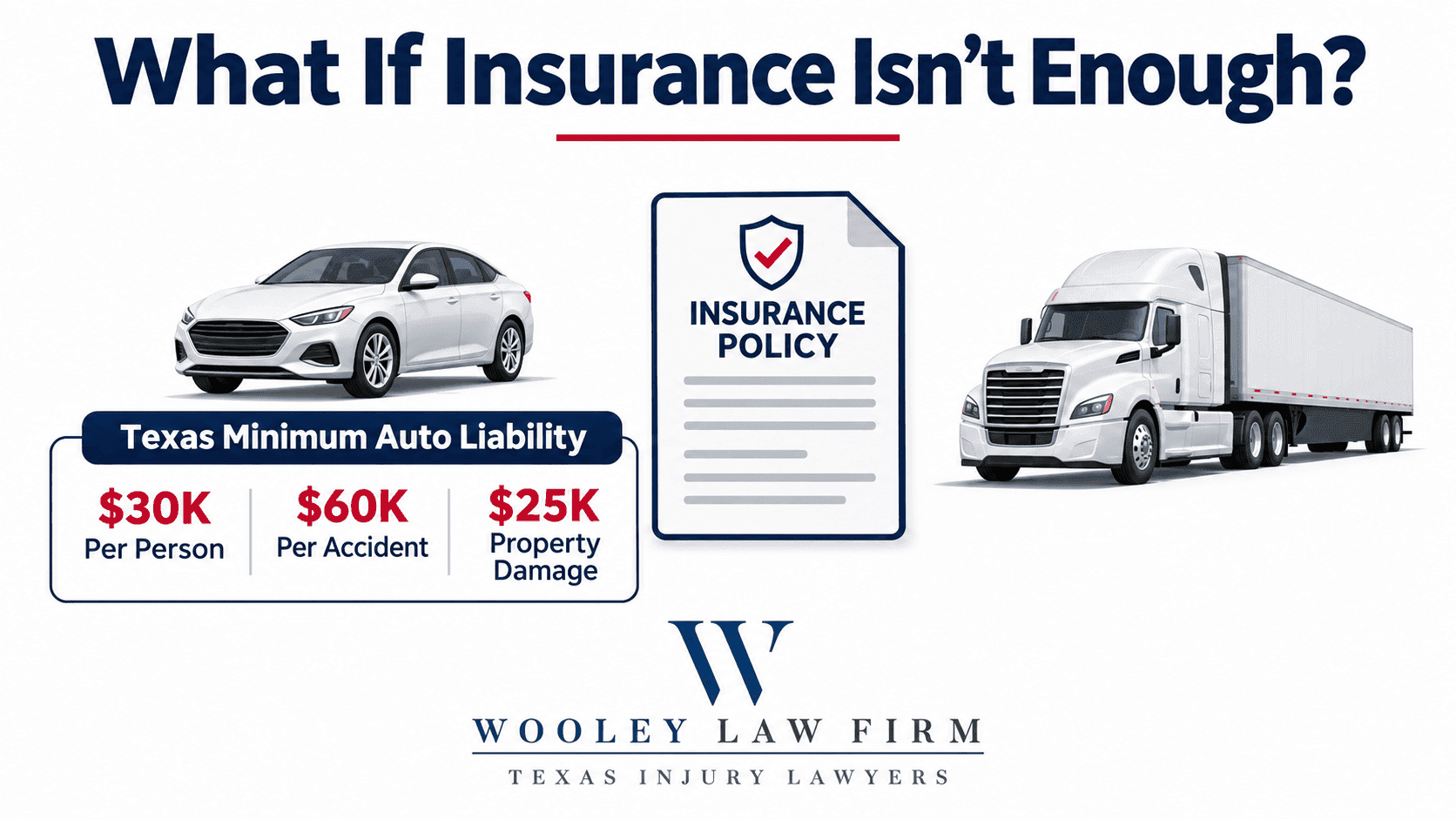
Texas generally requires drivers who satisfy the state’s financial responsibility requirements through auto liability insurance to carry at least 30/60/25 coverage. That means:
$30,000 per person for bodily injury.
$60,000 per accident for bodily injury to everyone involved.
$25,000 per accident for damage to other people’s property.
The Texas Department of Insurance’s explanation of liability limits describes these minimum amounts. Drivers can purchase higher limits.
These are separate limits. The $25,000 property damage limit generally is not an additional fund available to pay your bodily injury claim.
Also, “full coverage” does not identify a specific liability limit. You need the actual policy information to determine what coverage exists.
What Do “Per Person” and “Per Accident” Mean?
A split-limit policy places two different restrictions on bodily injury payments.
The per-person limit caps coverage for one injured person
Suppose one person suffers $100,000 in damages, but the at-fault driver has a $30,000-per-person bodily injury limit.
Under that policy’s ordinary liability limits, the most available for that person’s bodily injury claim is generally $30,000—even though the injuries and losses may be worth substantially more.
The $60,000 accident limit does not automatically become available to one person.
The per-accident limit is shared by injured claimants
Now suppose four people are injured in the same collision and the driver has 30/60/25 coverage.
Each person’s bodily injury claim remains subject to the $30,000 individual limit. However, the policy generally provides no more than $60,000 total for all bodily injury claims from that accident.
Four injured people do not each have access to a separate $30,000 fund.
The shared limit can create a serious problem when several people need emergency treatment, surgery, or extended rehabilitation.
These examples illustrate how split limits work; they do not predict any particular settlement.
What Happens When Several People Are Injured in the Same Dallas Wreck?
Multiple claimants can make an insurance claim more complicated, even when the insurer accepts that its driver caused the collision.
The available bodily injury coverage may need to address claims from:
Drivers and passengers in several vehicles.
Passengers in the at-fault driver’s vehicle who qualify for coverage.
Pedestrians, bicyclists, or motorcyclists injured in the collision.
There is no automatic rule that everyone receives an equal share. The injuries, evidence, settlement negotiations, applicable law, and remaining coverage all matter.
An attorney should investigate both the policy’s original limits and whether payments to other claimants have reduced the amount still available.
If an adjuster says there are “other injured people,” ask what that means for your claim. The existence of other potential claimants does not, by itself, explain how the insurer calculated your offer.
Does a Policy Limit Determine What My Car Accident Case Is Worth?
No. The value of your damages and the insurance available to pay them are different questions.
Depending on the evidence and Texas law, a bodily injury claim may include:
Past and future medical expenses.
Lost income and reduced earning capacity.
Physical pain.
Mental anguish.
Physical impairment.
Disfigurement.
A person who needs surgery and cannot return to the same job may have damages far exceeding a minimum-limits policy.
However, proving substantial damages does not automatically create additional insurance. A Dallas car accident lawyer must evaluate both the harm caused by the collision and the practical sources from which compensation may be recovered.
Likewise, a large policy does not establish that a claim is worth its full limit. Liability, causation, and damages still require proof.
Injured in an Accident?
Free consultation. Tell us what happened and learn what options may be available.
Are Truck Accident Insurance Limits Different From Car Insurance Limits?
They can be. Do not assume an 18-wheeler or commercial vehicle is subject only to the same minimum insurance requirements as a personal passenger car.
For example, federal requirements generally call for at least $750,000 in public liability coverage for covered for-hire interstate property carriers transporting nonhazardous freight in vehicles with a gross vehicle weight rating of 10,001 pounds or more. Different requirements apply to certain operations and cargo. The FMCSA’s insurance requirements explain these categories.
The actual insurance investigation must consider the truck’s operation, cargo, policies, and potentially responsible businesses. Some commercial policies use a combined single limit rather than separate bodily injury and property damage limits.
A Dallas truck wreck lawyer can investigate whether primary commercial auto coverage, excess insurance, or other policies may apply.
Our article about finding insurance after a Dallas 18-wheeler wreck explains why the insurer listed on the crash report may be only the starting point.
How Do You Find Out the At-Fault Driver’s Policy Limits?
Start by requesting written confirmation of the applicable limits and the documents needed to evaluate coverage.
Depending on the circumstances, an attorney may seek:
The declarations page identifying coverage and stated limits.
Policy forms and endorsements.
Confirmation of which people, vehicles, and businesses are insured.
Information about excess or umbrella coverage.
An explanation of any coverage denial or reservation of rights.
Information about payments affecting the remaining limits.
An insurance card identifies an insurer, but it generally does not answer all these questions.
Pre-suit disclosure is not always straightforward. If a lawsuit becomes necessary, Texas discovery rules provide a means to obtain relevant insurance and indemnity agreements, subject to applicable rules and limitations.
Also, a settlement offer is not proof of the policy limit. An insurer offering $15,000 may have substantially more coverage available.
For an example of the distinctions between opening a claim, investigating coverage, and evaluating an offer, read our guide to Progressive car accident claims after a Dallas wreck.
What If the At-Fault Driver Does Not Have Enough Insurance?
Insufficient liability coverage should prompt a broader investigation before the claim is closed.
Underinsured motorist coverage
Your own underinsured motorist coverage, commonly called UIM, may provide compensation when the responsible driver’s available insurance does not adequately compensate you for covered damages.
Texas law generally requires UM/UIM coverage unless a named insured rejects it in writing. If the insurer says you do not have this coverage, reviewing the policy and any applicable rejection can be important.
A UIM claim is not an automatic payment of your own policy limit. Coverage, liability, damages, applicable credits, and policy conditions still matter.
The Wooley Law Firm’s page on uninsured and underinsured motorist claims in Dallas explains when your own insurance may become relevant.
Other responsible parties and policies
Depending on the evidence, additional recovery may involve an employer, another negligent driver, or another legally responsible business.
For example, a driver making deliveries for work may present different liability and coverage questions from someone driving solely for personal reasons.
Another party’s involvement does not automatically establish liability or make its insurance available. The facts must support the claim, and the relevant policy must apply.
PIP, medical payments, and health insurance
Personal injury protection, medical payments coverage, and health insurance may help address certain expenses while the liability claim is pending. Each operates differently and may involve separate limits, conditions, or reimbursement issues.
These benefits should be coordinated as part of the overall claim strategy.
Should I Accept a Policy-Limits Settlement?
A verified policy-limits offer can be an important development. But “we are offering the limits” does not answer every question needed to evaluate a settlement.
Before accepting, consider:
Have the limits been verified?
Have other applicable policies and responsible parties been investigated?
Does the release affect claims you intend to preserve?
Have any UIM notice or consent-to-settle requirements been addressed?
What medical bills, liens, or reimbursement claims remain?
What amount would you actually receive after applicable deductions?
Accepting a liability settlement without addressing your own policy’s requirements can create disputes over UIM coverage. The release and insurance policies should be reviewed together.
Our article about whether to accept a Progressive settlement offer after a Dallas car accident discusses why the paperwork matters as much as the amount offered.
Will I Receive the Entire Policy-Limits Settlement?
Not necessarily.
The gross settlement is the amount paid to resolve the claim. Your net recovery is what remains after applicable attorney fees, case expenses, medical payments, liens, or reimbursement obligations.
For example, a $30,000 settlement does not necessarily mean $30,000 goes into your pocket.
An attorney should explain the anticipated deductions and investigate whether medical balances or reimbursement claims can be reduced. Reductions may improve the client’s net recovery, but they are not guaranteed.
Can I Recover More Than the Insurance Policy Limits?
Potentially, but recovery beyond one policy’s limits requires a separate factual and legal basis.
Possible sources include additional applicable insurance, another responsible party, or collectible assets belonging to a liable defendant.
A judgment exceeding the insurance limit does not guarantee that the excess can be collected. Likewise, filing suit does not automatically increase the policy limits.
The practical question is: What legally supported and collectible sources of compensation exist for this collision?
How The Wooley Law Firm Helps With Policy-Limits Claims
When available insurance may be insufficient, the coverage investigation should begin early.
The Wooley Law Firm can help:
Investigate how the Dallas car or truck wreck occurred.
Identify potentially responsible drivers and businesses.
Request and evaluate applicable insurance information.
Document injuries, treatment, lost income, and other damages.
Assess how competing claims affect available coverage.
Review settlement releases and protect remaining claims.
Evaluate applicable UM/UIM benefits.
Explain the proposed settlement and anticipated net recovery.
If an adjuster says the insurance is not enough—or asks you to sign a policy-limits release—get a clear understanding of your options before closing the claim.
Call The Wooley Law Firm at (214) 699-6524 for a free consultation. You do not pay unless we win.
Frequently Asked Questions About Texas Accident Policy Limits
Does $60,000 per accident mean I can receive $60,000?
Not under a 30/60/25 policy if you are the only injured claimant. The $30,000 per-person bodily injury limit generally still applies. The $60,000 limit is the total available for bodily injury claims from everyone injured in the accident.
Does the insurance company have to offer its limits because my bills exceed them?
Medical bills exceeding the limit do not automatically require a limits offer. The insurer may dispute fault, whether the collision caused the treatment, the recoverable expenses, or coverage. A supported demand should address those issues.
Can passengers make separate injury claims?
Potentially. Each injured passenger may have a claim, depending on liability and coverage. However, several claims against the same policy may share its per-accident limit.
Can I reopen my injury claim if I need surgery after settling?
A valid settlement release generally ends the claims it covers. You should not assume you can seek additional payment later because your condition worsens or treatment becomes more expensive.
Does a trucking company’s insurance limit guarantee my settlement amount?
No. A commercial policy’s limit identifies potential coverage, subject to its terms. It does not establish liability, prove your damages, or guarantee a particular recovery.
This article is for general informational purposes only and is not legal advice. Reading it does not create an attorney-client relationship. Every case is different, and past results do not guarantee a similar outcome.
Topics
Share This Article

Andrew J. Wooley
Personal Injury Attorney
Andrew J. Wooley is a dedicated personal injury attorney based in Dallas, Texas. He focuses on helping accident victims recover fair compensation for their injuries. With a commitment to personalized service, Andrew works directly with each client to understand their unique situation and fight for their rights.
Related Local News
Recent related coverage